
Many lenders will qualify you using bank deposits as income evidence when your deposits are documented, consistent and traceable to real business activity. Guidance from the CFPB, Fannie Mae and FHFA all recognize bank statements as verification. Gather statements, a signed year-to-date profit-and-loss statement, and proof of your down payment and reserves.
TL;DR:
- Lenders count business deposits only when they represent your income and are likely to continue; transfers, refunds, and loan proceeds do not qualify.
- For asset checks on a purchase, lenders typically request the two most recent consecutive statements, while income reviews often require more months when deposits fluctuate.
- Digital verification flags every transaction, so document large or irregular deposits and reconcile your profit and loss statement with bank activity before applying.
- Strong tax return income may qualify you for cheaper conventional financing, while rental income can qualify investment properties through a debt service coverage ratio loan.
Table of Contents
- What does deposits only mortgage qualification mean in practice?
- Who qualifies, and what do lenders check first?
- Which documents do lenders request, and how should you organize them?
- How do lenders turn deposits into qualifying income?
- What is the step-by-step checklist for preparing your application?
- What do Texas lenders typically require for deposits-only qualification?
- How does deposits-only qualification compare with traditional and other non-QM options?
- How long does it take to get approved using deposits-only qualification?
- What are the total costs and fees of deposits-only mortgage loans?
- How can you improve your approval chances with deposits-only qualification?
- Why do we believe in this approach for self-employed borrowers?
- How can Texas Bank Statement Home Loans help you qualify?
- FAQ
- Sources
What does deposits only mortgage qualification mean in practice?
“Deposits only” means a lender treats the money landing in your accounts as the main evidence of your income, instead of leaning on the net profit shown on your tax returns. It has nothing to do with interest-only loans, which are a different product with a different payment structure.
This matters most when write-offs shrink your taxable income far below what your business actually brings in. The CFPB explains that bank statements can serve as primary verification for assets and as an alternative method for verifying income. FHFA has also allowed a bank statement showing a recent payroll deposit as an alternative to verbal employment verification, provided the lender uses sound underwriting judgment.
The underwriting principle is simple. Deposits a lender relies on must be your own personal or business income, and they must be reasonably likely to continue. The ability-to-repay rule requires creditors to use reasonably reliable third-party records and to confirm that inflows are the consumer’s income if they are counted. A deposit is therefore not income just because it arrived. A transfer from your own savings or a loan advance does not count.
Who qualifies, and what do lenders check first?
Bank-deposit qualification is built for borrowers whose paperwork does not tell the full story:
- Self-employed business owners and sole proprietors
- 1099 contractors and freelancers
- Gig workers with several income streams
- Small-business owners paying themselves through distributions
- Realtors and commission earners with uneven months
Underwriters then run a familiar set of gates. They look at deposit consistency from month to month, your credit score, your debt-to-income ratio, your cash reserves, and how long the business has operated. Fannie Mae’s self-employed guidance frames this as an assessment of income stability and continuance. Freddie Mac likewise requires a written analysis of self-employed income.
The lookback window varies by purpose. For verifying assets on a purchase, lenders typically want the two most recent consecutive statements, per the CFPB. Income analysis for self-employed applicants often reaches further back, and Freddie Mac says to obtain additional months of statements when revenue on the P&L is not supported by deposits. Expect a longer review the more irregular your income looks.
Which documents do lenders request, and how should you organize them?
Missing or messy paperwork delays more files than weak income does. Fannie Mae lists bank account statements, 1099s, tax returns and profit-and-loss statements among the common application documents. For a deposits-based file, build your packet in this order:
- Personal and business bank statements for the full lookback period, every page included
- A signed year-to-date profit-and-loss statement
- Tax transcripts, if you have them
- Proof of your down payment and reserves
- Invoices or contracts that back your main deposit streams
Freshness and clarity matter. Fannie Mae’s verification guidance accepts a Form 1006 or copies of bank statements covering the most recent two-month period for purchase transactions, and it expects statements to be legible and current. A statement that is cut off, missing pages or months old invites a request for more.
Pro Tip: Label every recurring deposit with the client or contract it came from, and flag any transfer or loan proceeds yourself before the underwriter has to ask.
How do lenders turn deposits into qualifying income?
Underwriters follow a cash-flow logic rather than a single formula. First, they identify recurring deposits from customers or business activity. Second, they strip out personal transfers, refunds and loan proceeds. Third, they average the remaining net deposits over the lookback period, then adjust for business expenses or distributions. Fannie Mae describes lenders performing cash-flow analyses and using Form 1084 or its Income Calculator to determine qualifying income.
Automation changes how closely deposits are read. The Fannie Mae announcement SEL-2023-11 notes that lenders can use automated income tools and that digital verification flags every transaction, so underwriters will investigate large or irregular deposits. Expect them to:
- Trace large or irregular deposits back to a source
- Separate payroll-style deposits from other inflows
- Compare deposits against reported income, since IRS financial analysis guidance treats unexplained large deposits as red flags
Statistic callout: Digital verification of bank statements flags every transaction, so any unexplained deposit will be traced.
The takeaway: a tidy deposit history is not about hiding anything. It is about shortening the questions underwriters have to ask.
What is the step-by-step checklist for preparing your application?
Work through these steps in order and you will arrive at the lender with a file that is ready to review:
- Gather and label your bank statements, separating business accounts from personal ones. The CFPB notes that some self-employment cases require records beyond the minimum two months.
- Prepare a signed year-to-date P&L and, where possible, supporting invoices or contracts.
- Assemble proof of your down payment and reserves, and check your credit before you apply.
- Document the source of every large deposit, and be ready to explain transfers, gifts or loans.
- Ask the lender whether it runs a bank-statement program or Income Calculator-style underwriting, and request a pre-qualification.
Pro Tip: Write a one-line note beside each unusual deposit in a simple spreadsheet. Underwriters can clear a note in seconds but a mystery can stall a file for days.
What do Texas lenders typically require for deposits-only qualification?
Texas lenders who work with bank-statement borrowers generally layer their own overlays on top of agency-style documentation. Requirements differ by lender and by program, so treat the following as the usual shape rather than a fixed rule. Expect a request for statements covering a longer period than a standard purchase, since income analysis is the point of the file. Expect a minimum credit score, a down payment that is often higher than on a conventional loan, and cash reserves measured in months of housing payments.
Texas has a large population of independent contractors, energy-sector consultants, tradespeople and real estate professionals, so lenders here are used to seeing deposits that rise and fall with project cycles. That familiarity helps, but it does not replace documentation. Underwriters still want to see that business activity is steady and that deposits belong to you.
Property type also shapes the file. A primary residence is usually reviewed differently from an investment property, where we can also look at rental-based qualification through DSCR loans. Local market conditions, such as the speed of closings in Houston or Plano, can influence how quickly your documents need to be ready. Ask your lender for its exact list before you order statements.

How does deposits-only qualification compare with traditional and other non-QM options?
A traditional conforming loan qualifies you on tax returns, often requiring two years of signed returns, which can be a poor fit when deductions push your reported income below your real cash flow. Deposits-only qualification flips that: your actual inflows, after expenses, become the basis for the calculation.
Other non-QM paths exist, and each answers a different problem:
- Profit-and-loss loans rely on a statement prepared by you or a tax professional
- DSCR loans qualify an investment property on its rental income rather than your personal income
- Asset depletion loans convert savings into a notional income stream
- Bank statement loans use your deposits, which suits most self-employed buyers best
The trade-off with non-QM programs is generally pricing and down payment, which differ from conforming loans. Interagency guidance cautions that reduced documentation should be used carefully, which is why lenders verify deposits so closely. If your tax returns already show strong income, a conventional loan may price better. If they do not, a bank-statement program is built for you. You can see current pricing for our Bank Statement (non-QM) 30-yr program, which starts from 7.00% per year.
How long does it take to get approved using deposits-only qualification?
The timeline depends mostly on how clean your documents are, not on the program itself. A typical file moves through pre-qualification, document collection, underwriting review and final approval. Pre-qualification can be quick, and ours takes about 60 seconds to run. Document collection is where borrowers lose time, because multiple months of statements, a P&L and explanations of unusual deposits all need to be assembled.

Underwriting is where deposits get traced. The Fannie Mae SEL-2023-11 announcement explains that digital verification flags every transaction, so an unexplained inflow can trigger a follow-up request that pauses the file until you respond. A borrower who responds promptly helps keep the review moving. Delayed responses can add time.
Several habits shorten the path. Submit complete statements with every page. Send your P&L signed on the first try. Label deposits before the lender asks. And talk to the lender before you make an offer, so you know whether your income picture will hold up under review. Closing dates for purchases are usually set by the contract, so starting your documentation early is the one lever fully in your hands.
What are the total costs and fees of deposits-only mortgage loans?
The total cost of a bank-statement loan combines the interest rate with the closing costs every mortgage carries. On the rate side, our Bank Statement (non-QM) 30-yr program starts from 7.00% per year. Your actual rate may differ from the quoted starting point.
Beyond the rate, plan for the usual closing items: an appraisal, title and escrow charges, lender fees, prepaid taxes and insurance, and any points you choose to buy. Current pricing details are on our rates page. The Loan Estimate you receive after applying lists every charge, and comparing it line by line is the most reliable way to judge cost.
Non-QM pricing is generally higher than conforming pricing, which is the cost of flexible income verification. The offsetting benefit is access: a borrower whose returns show little income may not qualify conventionally at any price. To estimate your payment before you apply, use our bank statement loan calculator, and keep cash set aside for closing costs and reserves. A lower down payment, which we offer at a relatively low level, reduces what you need up front but raises your loan amount.
How can you improve your approval chances with deposits-only qualification?
Small habits make a large difference in how your deposits read to an underwriter.
- Keep business and personal money apart. A dedicated business account makes income easy to isolate. Wiring money between accounts creates deposits that must later be explained.
- Avoid large unexplained deposits in the months before you apply, since each one will be traced.
- Keep your P&L consistent with your deposits. Freddie Mac says to compare YTD profit-and-loss statements against business account statements, and a mismatch prompts requests for more months of records.
- Build reserves. Cash left after closing signals stability.
- Check and tidy your credit before applying, including paying down revolving balances.
- Line up lender expectations early. Loan officers who handle these files regularly, and platforms like this wholesale bank-statement scenario guide, show how programs are structured for self-employed borrowers.
Finally, respond fast. Underwriters work through queues, and the borrower who returns a requested document the same day keeps the file near the top.
Why do we believe in this approach for self-employed borrowers?
We built our program around one idea: your real income lives in your bank account, not always on your tax return. That is why we evaluate bank deposits and offer low down payment options. Our advice is the same you read above: organize your statements, explain your deposits before anyone asks, and run a pre-qualification before you shop for homes. A lender conversation should leave you knowing your realistic price range and the documents still needed.
- Saad
How can Texas Bank Statement Home Loans help you qualify?
We qualify self-employed buyers, 1099 contractors, gig workers and business owners using bank deposits instead of tax returns, with low down payment options. Our quick, no-obligation qualification check shows what you can realistically afford.
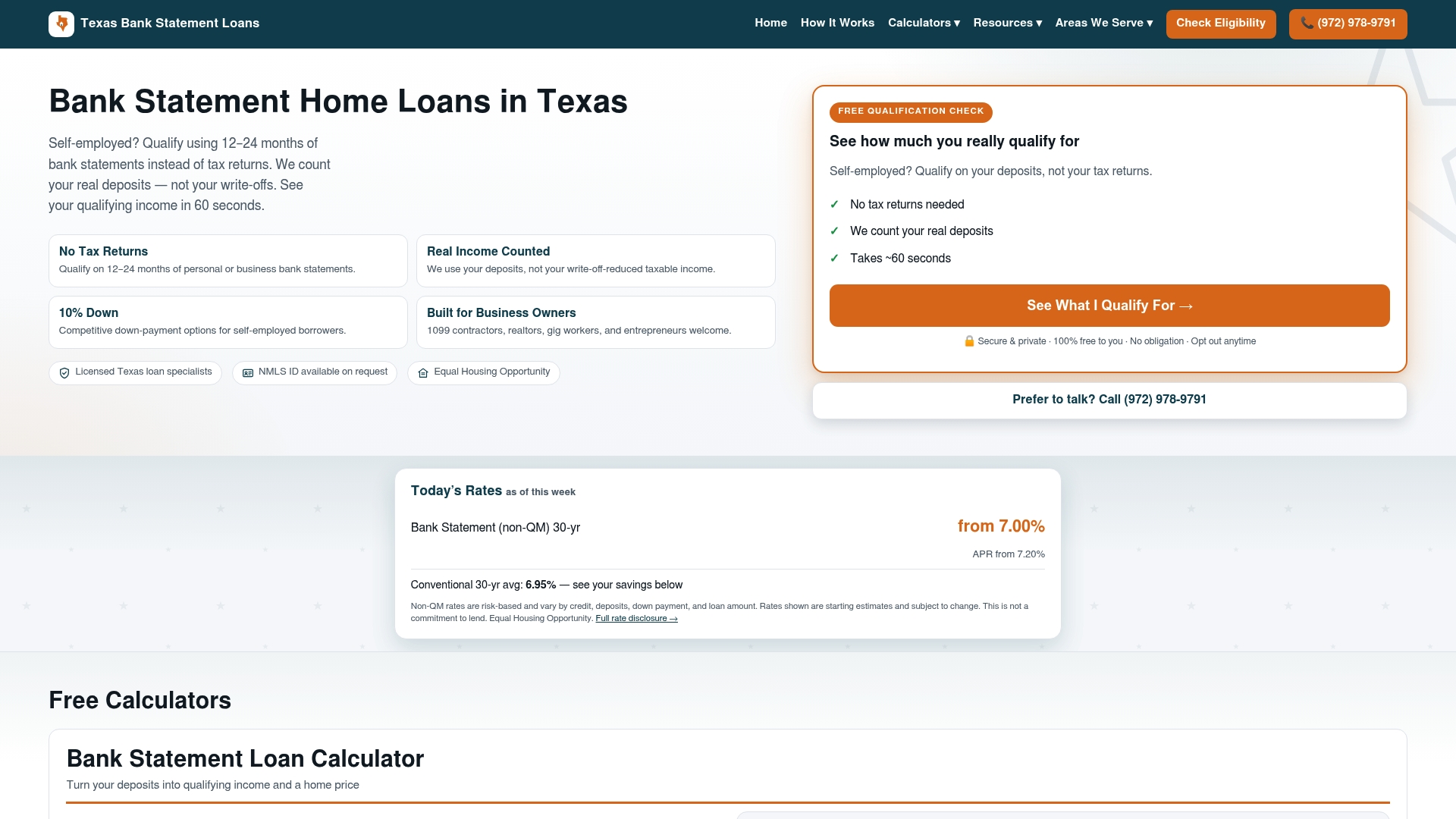
Start on our homepage for a program overview, check today’s pricing on our rates page, and estimate your numbers with our calculators. Run the qualification check now, and you will know where you stand before you make an offer.
This article is general information, not a substitute for advice from a qualified financial advisor. Consult a qualified financial professional about your own circumstances before acting on anything here.
FAQ
Can I get a mortgage using only bank deposits?
Yes, many non-QM lenders qualify self-employed borrowers on documented bank deposits instead of tax returns. The lender verifies that deposits are your own income and likely to continue, as the ability-to-repay rule requires.
How many months of bank statements do I need?
For asset verification on a purchase, lenders typically want the two most recent consecutive statements, per the CFPB. Income analysis for self-employed borrowers often uses a longer period, and the period our program evaluates depends on the borrower’s circumstances.
Will large deposits cause problems?
They can, because digital verification flags every transaction. Document the source of any large or irregular deposit, such as a gift, transfer or sale, before you apply.
What documents should I prepare first?
Start with complete bank statements, a signed year-to-date P&L, and proof of your down payment and reserves. Fannie Mae’s document list also names tax returns and 1099s as common supporting items.
Sources
- Create a loan application packet | Consumer Financial Protection Bureau
- Fhfa
- Underwriting Factors and Documentation for a Self-Employed Borrower | Fannie Mae
See what you qualify for in 60 seconds, free and no credit check. Use the eligibility check at the top of this page.