
Self-employed Texas homebuying advantages are real, measurable, and available right now to freelancers, contractors, and business owners who know where to look. Texas combines no state income tax, active down payment assistance programs, and a growing market of non-traditional mortgage products that recognize actual cash flow over tax return figures. The mortgage industry in 2026 offers more flexibility than most self-employed buyers realize. Bank statement loans, non-QM programs, and FHA options all serve borrowers whose income looks unconventional on paper but is strong in practice.
1. What mortgage programs best suit self-employed Texans?
The three main mortgage paths for self-employed buyers in Texas are conventional loans, FHA loans, and bank statement or non-QM loans. Each serves a different financial profile.
Conventional loans work well for self-employed buyers with strong credit and clean tax returns. Most lenders require 2 years of self-employment history, though some accept 18 months with strong credit and reserves. Down payments can be as low as 3% for qualified borrowers.

FHA loans offer credit flexibility and accept variable income patterns. They require a minimum 3.5% down payment and are more forgiving of income gaps. They still require tax return documentation, which can limit qualifying income for buyers with heavy deductions.
Bank statement and non-QM loans are the most powerful option for self-employed buyers with significant write-offs. These programs qualify borrowers using gross deposits minus a standard expense factor, often producing a higher qualifying income than tax returns show. Texasbankstatementloans evaluates 12-24 months of bank deposits and offers down payments starting at 10%.
| Loan type | Documentation required | Minimum down payment | Best for |
|---|---|---|---|
| Conventional | 2 years tax returns | 3% | Strong credit, clean returns |
| FHA | 2 years tax returns | 3.5% | Lower credit, variable income |
| Bank statement / non-QM | 12-24 months bank statements | 10% | High write-offs, strong cash flow |
Pro Tip: If your tax returns understate your income due to deductions, a bank statement loan will almost always produce a higher qualifying amount than a conventional or FHA loan.
2. How income verification works for self-employed buyers in Texas
Income verification is the biggest difference between a self-employed mortgage and a standard W-2 application. Lenders do not simply look at what you earn. They look at how you prove it.
Organizing documentation early speeds up approval and reduces lender requests for additional paperwork. The standard documents lenders expect include:
- Two years of personal and business tax returns (some lenders accept 18 months)
- Year-to-date profit and loss statement, prepared by a CPA
- 12-24 months of personal and business bank statements
- Business license or registration documents
- CPA letter confirming active self-employment status
Lenders average net income across 24 months when reviewing tax returns. That averaging process can hurt buyers who had one strong year and one average year. Bank statement programs sidestep this by focusing on deposit history instead.
Loan approval depends more on how income is filed on taxes than on the business entity type. An LLC owner filing as a sole proprietor faces different documentation requirements than an S-corp owner paying themselves a salary.
Pro Tip: Prepare a clean, month-by-month summary of your deposits before you apply. Lenders appreciate organized records, and it cuts weeks off the review process.
3. The impact of tax deductions on qualifying income for self-employed Texans
Tax deductions are a legal and smart financial tool. They become a problem only when you apply for a mortgage without planning for their effect on qualifying income.
Lenders average net income from tax returns over 24 months. Aggressive deductions reduce that net figure, which directly lowers the loan amount a lender will approve. A freelance consultant earning $180,000 gross but deducting $80,000 in business expenses may only qualify on $100,000 of income.
This gap between gross cash flow and taxable income is the core challenge for self-employed buyers in Texas. The good news is that bank statement loans resolve it directly. These programs calculate qualifying income from gross deposits minus a standard expense factor, not from the net income on a tax return.
- Buyers with high write-offs qualify for more with bank statement loans than with conventional programs
- The expense factor applied to deposits is typically a fixed percentage, not your actual deductions
- Planning deductions strategically in the year before applying can raise your qualifying income on tax-return-based loans
- A CPA familiar with mortgage planning can help you balance tax savings against loan qualification
The year before you plan to buy is the right time to review your deduction strategy with a tax professional. Reducing deductions temporarily can raise your qualifying income without permanently changing your tax approach.
4. Down payment assistance and credit considerations for self-employed Texans
Texas offers real financial support for buyers who qualify, and self-employed buyers are not excluded from these programs. The Texas State Affordable Housing Corporation provides down payment assistance programs with income and purchase price limits that apply to first-time buyers, including those who are self-employed.
Credit score is the second major factor lenders weigh alongside income. Credit scores starting at 620 are typically required for most programs, with higher scores unlocking better rates and terms. For self-employed buyers, a strong credit profile compensates for the income variability that lenders view as risk.
Debt-to-income ratio (DTI) management matters as much as credit score. Paying down high-payment debt before applying improves DTI and increases approval odds. Non-QM loans may allow DTI ratios up to 50%, but a lower DTI always produces better loan terms.
Liquid reserves after closing are a critical approval factor for self-employed buyers. Lenders want to see that you can cover several months of mortgage payments if business slows. Emergency funds reduce the perceived risk of variable income.
Pro Tip: Pay down credit card balances to below 30% of their limits before applying. This single step can raise your credit score by 20-40 points and meaningfully improve your loan terms.
5. Practical tips for self-employed Texans to improve mortgage approval chances
The mortgage process for self-employed borrowers requires more documentation than a standard application, but it is not harder when you prepare well. The buyers who struggle are the ones who apply without organizing their records first.
These steps give you the strongest possible application:
- Assess your documentation now. Pull two years of tax returns, 12 months of bank statements, and your current P&L before you contact a lender.
- Strengthen your credit. Make every payment on time for at least six months before applying. Pay down revolving balances.
- Prepare a clean profit and loss statement. Have a CPA prepare it. Lenders trust CPA-prepared documents more than self-prepared ones.
- Consider a bank statement loan if your returns understate income. Texasbankstatementloans offers a 60-second qualification check with no obligation.
- Work with a lender who knows Texas self-employed borrowers. Local specialists understand the Texas market and the documentation patterns common to Texas business owners.
- Build reserves. Aim for at least three to six months of mortgage payments in liquid savings before closing.
- Use a DTI calculator before you apply. Knowing your ratio in advance lets you fix problems before a lender sees them.
Pro Tip: Get a pre-qualification letter before you start house hunting. In competitive Texas markets like Austin and Dallas, sellers take pre-qualified buyers more seriously.
Self-employed buyers in Austin and Dallas face some of the most competitive housing markets in the state. Preparation is not optional in those markets. It is the difference between closing and losing the house.
Key Takeaways
Self-employed buyers in Texas have more mortgage options than most realize, and bank statement loans are the most effective tool for buyers whose tax returns understate their actual income.
| Point | Details |
|---|---|
| Bank statement loans outperform tax-return loans | Gross deposit calculations produce higher qualifying income for buyers with large write-offs. |
| Documentation readiness speeds approval | Organizing tax returns, bank statements, and P&L statements before applying cuts weeks off the process. |
| Credit score of 620+ is the baseline | Higher scores unlock better rates; paying down balances before applying raises scores quickly. |
| Texas TSAHC assists self-employed buyers | Down payment assistance programs are available to qualifying self-employed first-time buyers in Texas. |
| Liquid reserves reduce lender risk | Maintaining three to six months of mortgage payments in savings after closing strengthens approval odds. |
What I’ve learned about buying a home as a self-employed Texan
The biggest mistake I see self-employed buyers make is walking into a lender’s office with the same expectations as a W-2 employee. The process is different. Not harder, but different. And the buyers who treat it that way come out ahead.
The most underused advantage in this market is the bank statement loan. Most self-employed buyers I’ve spoken with had no idea these programs existed until they were already frustrated by a conventional rejection. If your business generates strong cash flow but your tax returns show modest net income, a bank statement loan is not a workaround. It is the right tool for your situation.
Texas adds real advantages on top of that. No state income tax means more of your income stays in your pocket, which improves your ability to save for a down payment and build reserves. The Texas State Affordable Housing Corporation programs are genuinely useful for first-time buyers, and most self-employed buyers qualify if they check the income limits.
My honest advice: start preparing 12 months before you want to buy. Review your deduction strategy with a CPA who understands mortgage qualification. Build your reserves. Get your credit above 700 if you can. Then work with a lender who specializes in self-employed borrowers in Texas. The combination of preparation and the right loan product makes homeownership very achievable here.
- Saad
Bank statement loans built for self-employed Texans
Self-employed buyers in Texas deserve mortgage options that reflect how they actually earn money, not just what their tax returns show after deductions.
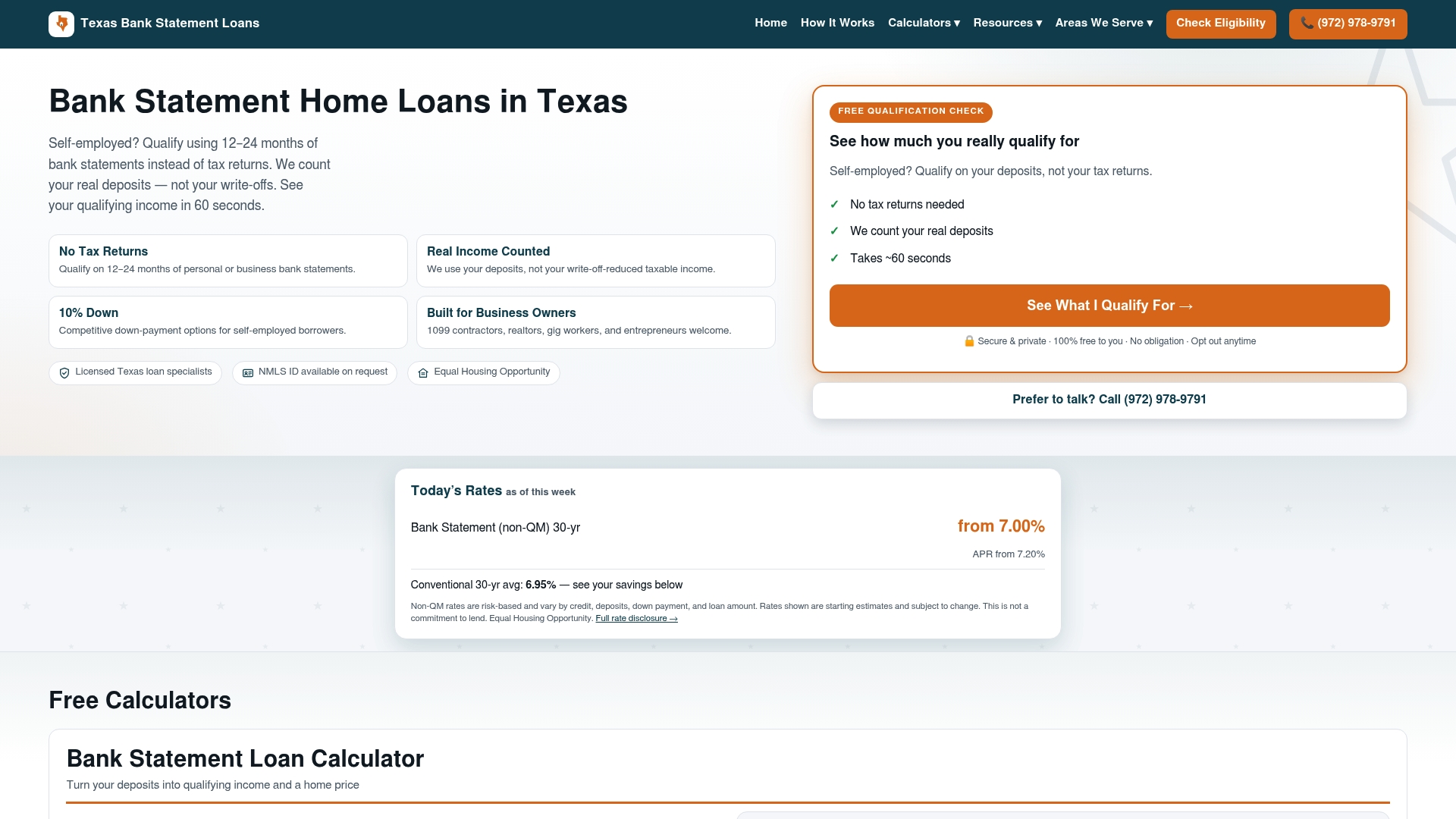
Texasbankstatementloans evaluates 12-24 months of bank deposits to calculate your real qualifying income. Down payments start at 10%, and you can check your qualification in 60 seconds with no obligation. The program serves buyers across Texas, including Houston, San Antonio, and Plano. Use the bank statement loan calculator to estimate what you can afford before you speak with a lender. If your tax returns have been working against you, Texasbankstatementloans is the direct solution.
FAQ
What is a bank statement loan for self-employed buyers?
A bank statement loan qualifies borrowers using 12-24 months of deposit history instead of tax returns. It is designed for self-employed buyers whose net income on tax returns is reduced by legitimate business deductions.
How long do I need to be self-employed to get a mortgage in Texas?
Most lenders require two years of self-employment history, though some programs accept 18 months with strong credit and reserves.
Does Texas offer down payment help for self-employed buyers?
The Texas State Affordable Housing Corporation offers down payment assistance programs that self-employed buyers can access, subject to income and purchase price limits.
What credit score do I need for a self-employed mortgage in Texas?
A credit score of 620 is the typical minimum for most programs. Higher scores produce better interest rates and loan terms, which matters more for self-employed buyers with variable income.
Can I qualify for a mortgage if my tax returns show low income?
A bank statement loan can qualify you based on gross deposits minus a standard expense factor, which often produces a higher qualifying income than your tax return net figure.
Recommended
- Bank Statement Loans for Self-Employed Buyers | Texas Bank Statement Loans
- Bank Statement Loans in Tyler, TX | Self-Employed Mortgage
- Bank Statement Loans in Austin, TX | Self-Employed Mortgage
See what you qualify for in 60 seconds, free and no credit check. Use the eligibility check at the top of this page.