
Qualified self-employed borrowers can use a profit and loss mortgage to qualify for a home loan without tax returns, but the documentation bar is specific, and lenders leave little room for improvisation. Here is what you need to clear before you apply:
- CPA/EA-prepared P&L statement signed by both preparer and borrower, dated within 60-90 days of closing
- Minimum two months of business bank statements for cross-verification (some programs require more)
- Proof of self-employment ownership of at least 25% in most programs
- Credit score typically 620 or above, with better pricing at 680+
- Down payment starting at 10% for qualified borrowers, with reserves of two to six months PITI
- Proof of business existence (business license, CPA letter, or entity documents)
If you want to see how much you can realistically qualify for before assembling the full file, Texasbankstatementloans offers a 60-second prequalification check for Texas borrowers.
Key Takeaways
Qualifying for a P&L loan comes down to three things: a credentialed preparer, clean documentation, and a qualifying income calculation that holds up to underwriting scrutiny.
| Point | Details |
|---|---|
| Preparer credential is non-negotiable | P&L must be prepared and signed by a CPA, EA, or CTEC, borrower-prepared statements are ineligible on most programs. |
| P&L freshness rule | Most programs require the P&L end date to fall within 60-90 days of closing; stale statements trigger a condition for an updated version. |
| Ownership percentage caps income | Only your proportional ownership share of adjusted net profit counts; a 40% owner claims 40% of the qualifying income figure. |
| Credit and down payment floors | Most Non-QM P&L programs start at 620 FICO and 10% down for primary residences, with better pricing at 680+. |
| When to consider bank statements instead | If your deposits are strong but your books are inconsistent or your CPA has not prepared a current P&L, a bank-statement program often closes faster with fewer conditions. |
| Texasbankstatementloans next step | Texas borrowers can run a 60-second prequalification to compare P&L and bank-statement qualifying income before assembling a full file. |
Table of Contents
- What exactly is a P&L loan and how does it differ from other options?
- Who typically qualifies for a P&L loan?
- What documents do lenders actually require?
- How underwriters convert your P&L into qualifying income
- Common problems that slow or derail P&L approvals
- Typical underwriting thresholds and what affects your rate
- Step-by-step application flow and realistic timeline
- How we evaluate P&L vs. bank-statement approaches
- What I look for when reviewing a P&L file
- Texasbankstatementloans makes P&L qualification straightforward for Texas borrowers
- Sources
What exactly is a P&L loan and how does it differ from other options?
A P&L loan is a non-QM (non-qualified mortgage) product that lets a borrower qualify using a third-party-prepared profit and loss statement rather than two years of tax returns or a full bank-deposit history. The lender treats the net profit on that statement, after adjustments, as the borrower’s income. That single shift opens the door for business owners whose tax returns show heavy deductions but whose actual cash flow is strong.
The practical differences between the three main paths are worth understanding before you pick one:
| Feature | P&L Loan | Bank Statement Loan | Conventional / Tax Return |
|---|---|---|---|
| Primary income document | CPA/EA-prepared P&L | 12-24 months of bank deposits | 2 years of tax returns |
| Bank statements required | Usually a short period of bank statements for verification purposes, often around two months | From about a year to two years of bank deposits as income source | 2-3 months (asset verification only) |
| Best fit | Clean books, organized accounting | Variable revenue, heavy deductions | W-2 or stable reported income |
| Speed | Fast when books are clean | Moderate | Standard (30-45 days) |
| Underwriting complexity | Moderate | Moderate to high | Lower |
P&L underwriting typically requires only two months of bank statements for verification, while bank-statement loans use the full deposit window as the income source itself. That distinction matters when your books are organized but your deposit patterns are irregular.
Pro Tip: If your bookkeeping is clean and your CPA files your returns, a P&L loan is usually faster. If your revenue is seasonal or your expenses are hard to categorize cleanly, a 12-24 month bank-statement program often produces a higher qualifying income. Many brokers run both scenarios and pick whichever yields the stronger number with fewer conditions.
Who typically qualifies for a P&L loan?
Self-employment history and ownership share
Most lenders require a qualifying period of self-employment in the same industry, verified by accepted documents; ownership thresholds commonly start around a quarter share, consistent with IRS treatment for mortgage purposes.
Ownership percentage is not just a checkbox. It directly caps how much of the business income you can claim. Fannie Mae’s guidance makes this explicit: only the borrower’s proportional ownership share may be counted toward qualifying income, even after addbacks.
Credit score and occupancy
Non-QM P&L programs typically have minimum credit score requirements, varying by lender and program tier. Primary residences, second homes, and investment properties are generally eligible, though investment properties may have stricter requirements.
Lender type matters
Bank lenders and credit unions offering portfolio products tend to apply stricter overlays than non-bank Non-QM lenders or brokered programs. A community bank might require 24 months of CPA-prepared P&Ls and a full business tax return review. A Non-QM wholesale lender may accept a single year-to-date P&L with two months of bank statements. The program you qualify for depends heavily on where your file lands.
What documents do lenders actually require?
The core P&L loan checklist
- CPA/EA/CTEC-prepared P&L statement covering the current year-to-date (or prior 12 months), signed by both the preparer and borrower. Strict programs require the preparer to attest they also prepared the borrower’s most recent tax returns and to provide license verification in the credit file.
- Business bank statements, typically two months for P&L-only programs, up to 12-24 months if the lender wants a fuller picture or if the file is hybrid.
- Proof of business ownership, articles of incorporation, operating agreement, business license, or a CPA letter confirming ownership percentage.
- Proof of business existence, active business license, DBA filing, or state registration documents.
- Preparer license verification, a screenshot or printout of the preparer’s PTIN registration or state license; some programs require this in the credit file. You can verify preparer credentials directly through the IRS.
- Verbal verification of employment (VVOE), a third-party confirmation that the business is operating, often done by the lender calling the business or checking a public listing.
- Reserves, two to six months of PITI in liquid or near-liquid accounts, documented with two months of asset statements.
- Property documents, purchase contract or property address for refinances, homeowners insurance binder, and title commitment.
Pro Tip: The preparer matters as much as the numbers. Lenders on strict programs want a CPA or enrolled agent who can be independently verified through the IRS PTIN directory. A bookkeeper or unlicensed tax preparer will not pass underwriting on most Non-QM P&L programs, even if the numbers are accurate.
Minimum P&L line items lenders expect
| P&L Line Item | What Lenders Look For |
|---|---|
| Gross revenue / sales | Total business income before any deductions |
| Cost of goods sold (COGS) | Direct costs tied to revenue; must be consistent with the business type |
| Gross profit | Revenue minus COGS |
| Operating expenses | Rent, utilities, payroll, marketing, professional fees |
| Owner draws / salary | Compensation paid to the borrower from the business |
| Depreciation | Non-cash expense; typically added back in underwriting |
| Net profit (bottom line) | Starting point for qualifying income calculation |
Most P&L loan programs require the P&L end date to fall within 60-90 days of closing, so a P&L prepared in January will not work for a closing in October without an updated version.
How underwriters convert your P&L into qualifying income
Lenders do not use the net profit figure on your P&L as-is. They start there, then apply a specific sequence of adjustments before arriving at the number that goes into your debt-to-income ratio.
Here is how the math typically works:
Step 1, Start with net profit. Say your P&L shows $180,000 net profit for the year.
Step 2, Add back allowable items. Underwriting allows addbacks for depreciation, one-time non-recurring expenses, and owner draws or salary that were already deducted as business expenses. If your P&L shows $12,000 in depreciation and $24,000 in owner salary already expensed, the adjusted income becomes $216,000.
$216,000 × 0.60 = $129,600 adjusted annual income.
Step 4, Divide by 12 for monthly qualifying income. $129,600 ÷ 12 = $10,800 per month.
That $10,800 is what goes into your DTI calculation against your proposed housing payment and other monthly obligations.
Ownership percentage is the lever most borrowers underestimate. A 25% owner of a highly profitable business may qualify for far less than a 100% owner of a modestly profitable one, even when the P&L revenue looks similar.
Common addbacks lenders allow: depreciation, amortization, one-time legal or casualty expenses, and owner draws or salary already deducted on the P&L. Items lenders typically disallow: recurring losses from prior years, personal expenses run through the business, and income from a business the borrower does not own at the required threshold.
Common problems that slow or derail P&L approvals
Most P&L files that stall do so for predictable reasons. Catching these before submission saves weeks.
- Borrower-prepared P&L. This is the single most common disqualifier on strict programs. If you prepared your own P&L, even with accounting software, most Non-QM lenders will not accept it. Engage a CPA or enrolled agent before you start the application.
- Deposit mismatch. If your P&L shows $250,000 in gross revenue but your two months of bank statements show deposits that do not reconcile to that run rate, underwriting will flag it. Prepare a one-page reconciliation memo that explains the difference (timing, payment processor settlements, inter-account transfers).
- Inconsistent expense categorization. Expenses that shift between categories across months, or that appear in unusual amounts relative to revenue, trigger conditions. Clean, consistent bookkeeping is the fix, not retroactive adjustments.
- Large unexplained transfers. A $40,000 transfer between accounts with no label looks like undisclosed debt or a gift. Label every significant transfer in your bank statements before submission.
- Seasonality without documentation. A landscaping business that earns 80% of revenue between April and September will show a low year-to-date P&L in February. Attach prior-year P&Ls or tax returns to show the seasonal pattern is normal and consistent.
- Stale P&L. A P&L dated more than 90 days before closing will trigger a condition for an updated statement on most programs. Time your CPA engagement so the P&L is fresh at closing.
- Missing preparer attestation. Some programs require a signed letter from the CPA confirming they prepared the borrower’s most recent tax returns. If that letter is missing, the file goes on hold until it arrives.
For COGS-heavy businesses (restaurants, contractors, retailers), underwriters will scrutinize the relationship between gross revenue and COGS closely. If your gross margin fluctuates significantly month to month, attach invoices or a receivables schedule to explain the variance.
Typical underwriting thresholds and what affects your rate
Non-QM P&L programs do not follow the same pricing grid as conventional loans, but the core variables are consistent across most investors.
Credit score ranges: Most programs start at 620. Borrowers at 660-679 will see a meaningful rate improvement over the floor tier. At 720 and above, pricing approaches the better end of the Non-QM range. A 40-point score improvement can shift your rate by 0.5-1.0 percentage points on some programs.
Loan size: Non-QM P&L programs commonly go up to $3 million or higher on jumbo products, though pricing above $2 million reflects additional risk adjustments.
Reserves: Two months PITI is a common floor; six to twelve months is often required for jumbo amounts or investment properties.
The factors that move your rate most: credit score, LTV, and documentation quality. A clean, CPA-attested P&L with reconciled bank statements and strong reserves will price better than a file with gaps, even at the same credit score.
Items borrowers can control before applying to improve pricing:
- Pay down revolving balances to lower DTI and improve credit utilization
- Season reserves in a single account for at least 60 days before application
- Engage a CPA to prepare and sign the P&L well before the application date
- Avoid large undocumented deposits in the two months before applying
State-level overlays and individual investor guidelines can tighten any of these thresholds. A Texas Non-QM lender may have different reserve requirements than a national wholesale investor, so confirming the specific program guidelines before you commit to a purchase contract is worth the call.
Step-by-step application flow and realistic timeline
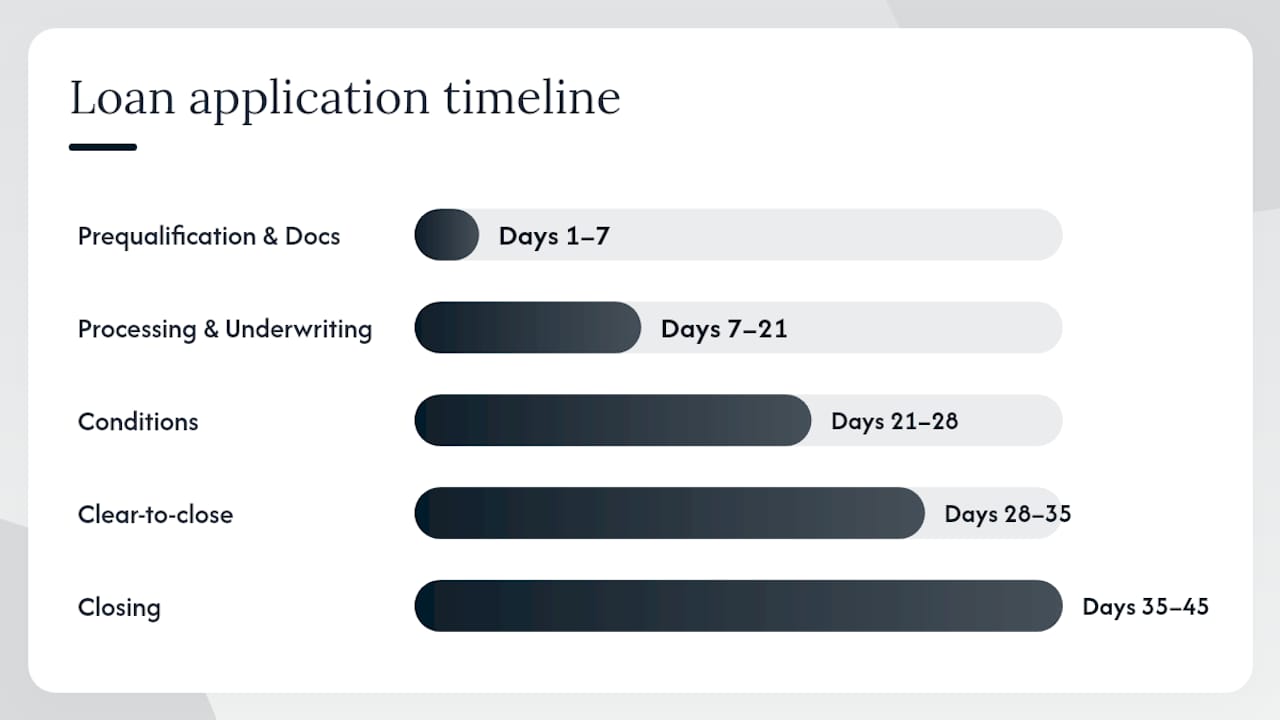
- Prequalification (Day 1-2): Submit basic income and asset information. A bank statement loan calculator or 60-second check gives you a quick affordability estimate before you pull credit.
- Documentation request (Days 3-7): Lender issues a formal document checklist. This is when you submit your CPA-prepared P&L, two months of business bank statements, proof of ownership, and asset statements.
- Processing (Days 7-14): Processor reviews the file for completeness, orders the appraisal, and confirms preparer credentials.
- Underwriting (Days 14-21): Underwriter reviews income, assets, credit, and property. This is where most conditions originate.
- Conditions (Days 21-28): Borrower responds to conditions, updated P&L, explanation letters, additional bank statements. A clean initial package cuts this phase significantly.
- Clear-to-close (Days 28-35): Final approval issued. Closing disclosure sent.
- Closing (Days 35-45): Signing and funding. Non-QM P&L loans typically close in 30-45 days when the file is complete at submission.
Pro Tip: The single biggest time-saver is submitting a complete package on day one: CPA-prepared P&L, two months of reconciled bank statements, a one-page memo showing how deposits tie to P&L revenue, and preparer license verification. Files that arrive with all of that in order move through underwriting in roughly half the time of files that trickle in document by document.
Common conditional triggers to prevent: mismatched business names across documents, large deposits in the 60 days before application, a P&L that does not match the business type on the license, and missing VVOE.
How we evaluate P&L vs. bank-statement approaches
The right documentation path is the one that produces a conservative, defensible qualifying income while generating the fewest conditions and the shortest time to close. That is not always the P&L route.
His year-to-date P&L shows $160,000 net profit after heavy equipment depreciation. His 12 months of business bank deposits total $380,000. On a pure P&L approach, after adding back $28,000 in depreciation, his qualifying income is $188,000 annually, or $15,667 per month, nearly identical. However, the bank-statement path required 12 months of statements and a longer processing window, while the P&L path closed with two months of statements and a CPA letter.
In that case, the P&L route was faster and produced a comparable number. Flip the scenario to a business with inconsistent deposits and a CPA who has not yet prepared the current-year P&L, and bank statements become the cleaner path.
Pro Tip: Run both scenarios before committing to a program. A loan officer who works both P&L and bank-statement products can model the qualifying income under each method in about 15 minutes. That comparison often reveals which path closes faster and at better pricing for your specific file.
You can verify any lender or loan originator’s licensing through NMLS Consumer Access before submitting a file.
What I look for when reviewing a P&L file
A few things stand out immediately when a P&L file lands on the desk:
- Preparer credentials front and center. If the CPA’s name, license number, and signature are not on the P&L, the file goes back before anything else is reviewed. This is non-negotiable on most Non-QM programs.
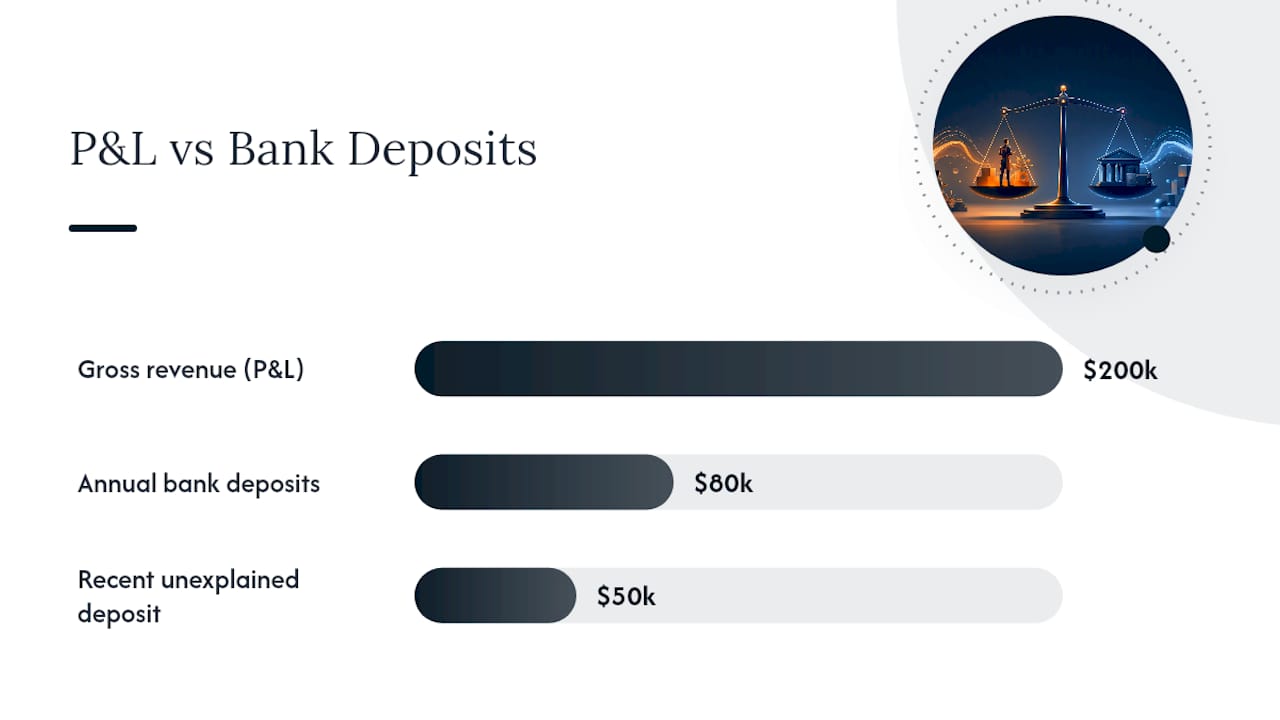
- Deposit-to-revenue reconciliation. The gross revenue on the P&L should tie, at least roughly, to the deposit pattern in the bank statements. A $200,000 revenue P&L paired with $80,000 in annual deposits raises an immediate question.
- Consistent expense categories. Bookkeeping that holds the same categories month over month signals organized operations. Expenses that jump between “professional fees” and “miscellaneous” suggest the books were assembled for the loan, not maintained throughout the year.
- Owner draws labeled clearly. If draws appear as transfers rather than payroll or owner compensation, they can look like undisclosed debt. Label them explicitly in the bank statements and on the P&L.
- No large unexplained deposits in the prior 60 days. A $50,000 deposit two weeks before application without a paper trail creates a condition that can take two weeks to resolve.
Pro Tip: Submit a one-page summary memo with your file. It should show: gross revenue, addbacks, adjusted net profit, ownership percentage, and the resulting monthly qualifying income. When the underwriter can see your math in 30 seconds, the review moves faster and conditions drop.
For inventory-heavy businesses, retailers, wholesalers, food service, attach a COGS schedule or a brief explanation of how cost of goods is calculated. Underwriters unfamiliar with your industry will ask for it anyway; providing it upfront removes a common condition.
Texasbankstatementloans makes P&L qualification straightforward for Texas borrowers
Self-employed borrowers in Texas have two strong paths to mortgage qualification: P&L loans and bank-statement loans. Texasbankstatementloans works with both, which means your file gets evaluated on the method that actually produces the best qualifying income for your situation, not the one that is easiest to process.
P&L loans, bank-statement loans, DSCR investment property loans, jumbo products, and ITIN loans are all available. Coverage spans major Texas markets including Houston, Harris County, and surrounding regions, with localized loan officers who understand Texas property values and county-level documentation norms.
Start with the 60-second prequalification to see what you qualify for before you pull together a full file. No obligation, no hard credit pull at that stage. When you are ready to move forward, a loan officer will walk through the P&L vs. bank-statement comparison for your specific income picture and get you to a real number fast.
Texasbankstatementloans operates under applicable state and federal mortgage lending regulations. Verify current licensing through NMLS Consumer Access.
Sources
These are the primary sources borrowers and their preparers should review when preparing a P&L loan file:
- Analyzing profit and loss statements
- The P&L Statement Loan Master Guide 2026: Requirements & Rates | LoanWise
- What Documentation Is Needed for Profit and Loss Mortgage Loans
- Analyzing profit and loss statements - Homebuyer
This article is general information, not a substitute for advice from a qualified financial advisor. Consult a qualified financial professional about your own circumstances before acting on anything here.
See what you qualify for in 60 seconds, free and no credit check. Use the eligibility check at the top of this page.