
Mortgage options beyond tax returns are real, accessible loan programs that qualify self-employed borrowers and gig workers based on actual cash flow rather than tax documents. Traditional lenders rely on two years of tax returns and W-2s, which systematically excludes business owners who write off expenses and report low net income. After 2008, the mortgage market shifted to accommodate this gap, producing specialized programs like bank statement loans and Non-Qualified Mortgage (non-QM) loans. These programs now serve a growing share of the workforce that earns well but documents income differently.
1. What are mortgage options beyond tax returns?
Alternative documentation mortgages are home loans that replace tax returns with other proof of income. The most common types include bank statement loans, non-QM loans, DSCR loans, and asset-based loans. Each program uses a different method to verify that a borrower can repay, but none of them require IRS Form 1040 as the primary income document. Alternative lending evaluates true cash flow by reviewing 12-24 months of bank statements, rather than relying on tax returns that reflect net income after deductions. That distinction matters enormously for anyone who runs a business with legitimate expenses.

2. Bank statement loans: the most accessible no tax return mortgage
Bank statement loans are the most widely used alternative for self-employed borrowers. A lender collects 12-24 months of personal or business bank statements and calculates qualifying income from total deposits, minus an expense factor. The expense factor typically ranges from 10% to 50% depending on the industry and whether statements are personal or business accounts.
Here is what you need to qualify:
- 12 or 24 months of bank statements showing consistent deposit activity
- A credit score generally at or above 620, though requirements vary by lender
- Down payment starting at 10%, with most programs requiring 10%-20%
- Debt-to-income ratio within the lender’s threshold, often up to 50%
- Two years of self-employment history, verified by a business license or CPA letter
Interest rates on bank statement loans run 1%-3% higher than conventional loans, reflecting the manual underwriting process and added lender risk. That premium is real, but it is often the only path to homeownership for borrowers whose tax returns understate their income.
Pro Tip: Use the self-employed affordability calculator at Texasbankstatementloans to estimate your qualifying income from bank deposits before you apply. It takes 60 seconds and gives you a realistic purchase price target.
3. Non-QM loans: flexible underwriting for borrowers without tax returns
Non-Qualified Mortgage loans are the broader category that includes bank statement loans and several other alternative documentation programs. The Consumer Financial Protection Bureau (CFPB) defines a Qualified Mortgage (QM) by strict underwriting rules, including verified income via tax returns. Non-QM loans fall outside those rules, which gives lenders the freedom to underwrite manually.
Manual underwriting in non-QM loans allows flexible income documentation with bank statements and alternative evidence instead of tax returns. A lender reviews your full financial picture, including assets, cash reserves, credit history, and business performance.
Common income documentation methods accepted by non-QM lenders:
| Documentation Type | Best For |
|---|---|
| 12-24 months bank statements | Self-employed with consistent deposits |
| 1099 income forms | Freelancers and independent contractors |
| Profit and loss statements | Business owners with a CPA |
| Asset depletion | High-net-worth borrowers with large reserves |
| DSCR (rental income) | Real estate investors |
Non-QM loans require down payments between 10% and 30% and carry interest rates 1%-3% above conventional loans. The trade-off is access. Borrowers who cannot qualify under automated underwriting systems get a real review by a human underwriter.
Pro Tip: A profit and loss statement prepared by a licensed CPA carries more weight with non-QM underwriters than a self-prepared spreadsheet. Invest in that document before you apply.
4. Other alternative mortgage options beyond tax returns
Several other loan types serve borrowers who need income verification loans that skip the tax return requirement entirely.
-
DSCR loans (Debt Service Coverage Ratio): DSCR loans qualify based on rental income from the property itself rather than the borrower’s personal income. If the property’s monthly rent covers the mortgage payment, you qualify. These are ideal for real estate investors who own multiple properties and have complex personal tax situations.
-
Asset-based loans: These programs convert liquid assets such as savings, brokerage accounts, or retirement funds into a calculated monthly income figure. A borrower with $1,000,000 in liquid assets might qualify for a loan without any income documentation at all. Asset-based loans work best for retirees or high-net-worth individuals with low reported income.
-
Portfolio loans: Banks and credit unions that hold loans on their own books instead of selling them to the secondary market can write their own underwriting rules. Portfolio lenders often accept unique income situations, including seasonal income, foreign income, or recent self-employment. Rates and terms vary widely because each lender sets its own criteria.
-
1099 loans: Some lenders accept two years of 1099 forms as the sole income documentation. This works well for independent contractors and gig workers who receive 1099s from platforms or clients but do not file business tax returns with significant deductions.
Each of these programs fills a specific gap. The right choice depends on your income source, asset position, and the property type you are buying.
5. Key differences between traditional and alternative mortgage underwriting
Traditional mortgage underwriting and alternative underwriting evaluate the same goal, which is repayment ability, but they use completely different methods to get there.
Traditional underwriting relies on two years of federal tax returns, W-2s, and automated systems like Fannie Mae’s Desktop Underwriter. These systems calculate income from net figures after deductions, which penalizes self-employed borrowers who reduce taxable income through legitimate business expenses. The system was built for salaried employees, not business owners.
Alternative underwriting applies manual review. Manual underwriting assesses a borrower’s entire financial profile including bank statements, 1099s, assets, and profit and loss statements. A human underwriter weighs compensating factors like large cash reserves, low loan-to-value ratios, and long-term banking history.
| Factor | Traditional Loans | Alternative Loans |
|---|---|---|
| Income proof | Tax returns, W-2s | Bank statements, 1099s, assets |
| Underwriting method | Automated system | Manual review |
| DTI ratio limit | Up to 43%-45% | Up to 50%-55% or higher |
| Down payment | As low as 3% | Typically 10%-30% |
| Interest rate | Conventional market rate | 1%-3% above conventional |
Alternative lenders consider broader financial health beyond rigid debt-to-income metrics. A borrower with strong equity, large reserves, and consistent deposits can qualify even if their tax return shows a modest net income.
6. Situations where alternative mortgage solutions make the most sense
Not every self-employed borrower needs an alternative loan. But for certain situations, these programs are the only viable path to homeownership.
-
Heavy business write-offs: Self-employed borrowers with fluctuating income or significant deductions often cannot qualify under conventional rules but can qualify via bank statement loans. If your Schedule C shows $40,000 in net income but your bank deposits show $120,000, a bank statement loan reflects your real financial position.
-
Gig economy workers: Rideshare drivers, freelance designers, and platform-based contractors receive income from multiple sources. Their deposits are consistent, but their 1099s span several payers. Bank statement loans and 1099 loans both accommodate this structure.
-
Unfiled or incomplete tax returns: Borrowers can often qualify despite tax challenges by demonstrating equity, cash reserves, and compensating factors evaluated in alternative mortgage solutions. A lender may accept a CPA letter and bank statements in place of filed returns, depending on the program.
-
Real estate investors: An investor buying a fifth rental property does not want their personal income scrutinized. A DSCR loan evaluates the property’s cash flow, not the borrower’s tax return, making it the standard choice for portfolio investors.
-
Recent business owners: Conventional loans require two years of self-employment history with tax returns to match. Some non-QM programs accept as little as one year of self-employment, which opens the door for borrowers who recently left salaried jobs to start businesses.
Key takeaways
Self-employed borrowers and gig workers can qualify for a mortgage using bank statements, 1099s, or assets instead of tax returns, with programs starting at 10% down.
| Point | Details |
|---|---|
| Bank statement loans lead | Lenders use 12-24 months of deposits to calculate qualifying income without tax returns. |
| Non-QM loans offer flexibility | Manual underwriting accepts multiple income types and DTI ratios up to 55% or higher. |
| Rates are higher | Alternative mortgage programs carry rates 1%-3% above conventional loans. |
| Multiple program types exist | DSCR, asset-based, portfolio, and 1099 loans each serve different borrower profiles. |
| Write-offs hurt conventional apps | Borrowers with high deductions qualify better through bank statement income than net tax income. |
Why the mortgage industry got this wrong for too long
The conventional mortgage system was designed in an era when most Americans worked for one employer and received a W-2. That model describes a shrinking share of the workforce. Entrepreneurs, consultants, and gig workers now represent a substantial portion of the economy, yet traditional underwriting still treats their income as suspicious simply because it does not arrive in a predictable paycheck.
What I find genuinely frustrating is how many qualified buyers walk away from homeownership believing they cannot get a mortgage. They have strong cash flow, solid reserves, and years of consistent deposits. Their tax returns just do not show it because they are doing exactly what their accountant told them to do: write off every legitimate business expense. The tax code rewards that behavior. The mortgage system punishes it.
The good news is that the non-QM market has matured significantly. Lenders who specialize in bank statement loans have years of performance data showing that these borrowers repay at rates comparable to conventional borrowers. That track record is pushing more lenders into the space and gradually bringing rates down. The gap between conventional and non-QM rates is narrowing, and the documentation requirements are becoming clearer.
My practical advice: do not apply for a conventional loan first and treat the rejection as a verdict on your finances. Go directly to a lender who specializes in mortgage options for self-employed buyers. Bring 24 months of bank statements, a CPA-prepared P&L, and a clear picture of your assets. That package tells a far more accurate story than your 1040.
- Saad
Bank statement loans for Texas self-employed buyers
Self-employed buyers in Texas have a direct resource in Texasbankstatementloans, which specializes in qualifying borrowers through bank deposits rather than tax documents.
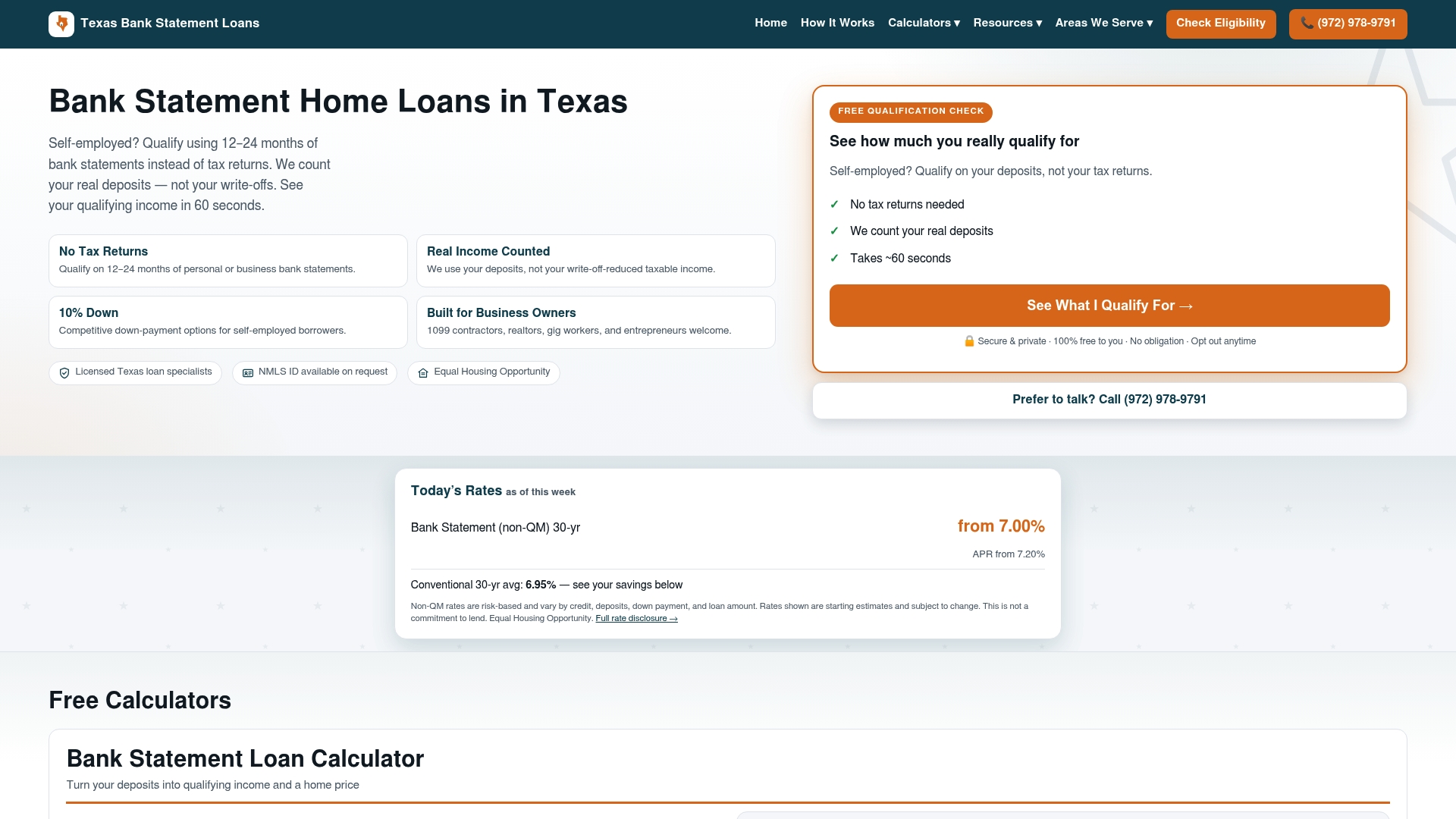
Texasbankstatementloans evaluates 12-24 months of bank statements to calculate your actual income, with down payments starting at 10% and a qualification check that takes 60 seconds. The platform serves buyers across Texas, including Houston and Plano, with tools built specifically for 1099 contractors, business owners, and gig workers. Use the bank statement loan calculator to see what you qualify for based on your real deposits, not your tax return.
FAQ
What documents replace tax returns in a bank statement loan?
Lenders accept 12-24 months of personal or business bank statements, a CPA-prepared profit and loss statement, and a business license or CPA letter confirming self-employment.
Are interest rates higher on no tax return mortgages?
Yes. No tax return loans carry rates 1%-3% above conventional mortgages, reflecting the manual underwriting process and additional lender risk.
Can I refinance using a bank statement loan?
Yes. Bank statement loans are available for both purchases and refinances, allowing self-employed borrowers to access equity or lower their rate without submitting tax returns.
What credit score do I need to qualify?
Most bank statement loan programs require a minimum credit score of 620, though some non-QM lenders accept lower scores when compensating factors like large reserves or low loan-to-value ratios are present.
How does a DSCR loan differ from a bank statement loan?
A DSCR loan qualifies based on the rental income of the property being purchased, not the borrower’s personal income. A bank statement loan qualifies based on the borrower’s own deposit history across 12-24 months.
Recommended
- Bank Statement Loans for Self-Employed Buyers | Texas Bank Statement Loans
- Self-Employed Affordability Calculator | Texas Bank Statement Loans
- Bank Statement Loans in Montgomery County, TX | Self-Employed
See what you qualify for in 60 seconds, free and no credit check. Use the eligibility check at the top of this page.