
Business owners qualify for a home loan by demonstrating stable, verifiable income through financial documents rather than traditional pay stubs. The standard industry term for this process is “self-employed mortgage qualification,” and it applies to anyone with at least a 25% ownership stake in a business or who earns 1099 income. Lenders focus on two core questions: Is your income stable? Will it continue? If you can answer yes with documentation, you have a real path to approval. This guide covers the exact criteria, loan programs, and preparation steps you need.
What are the basic qualification criteria for business owners seeking a home loan?
The minimum self-employment duration most lenders require is 2 years of steady history, defined as owning at least 25% of a business or working as a 1099 contractor. That two-year threshold exists because lenders want to see income patterns across multiple tax cycles, not just a single good year.
Exceptions do exist. Lenders can accept one year of self-employment history if you can show prior experience or formal education in the same industry. A contractor who spent five years as a salaried electrician before going independent, for example, has a credible case for the one-year exception.
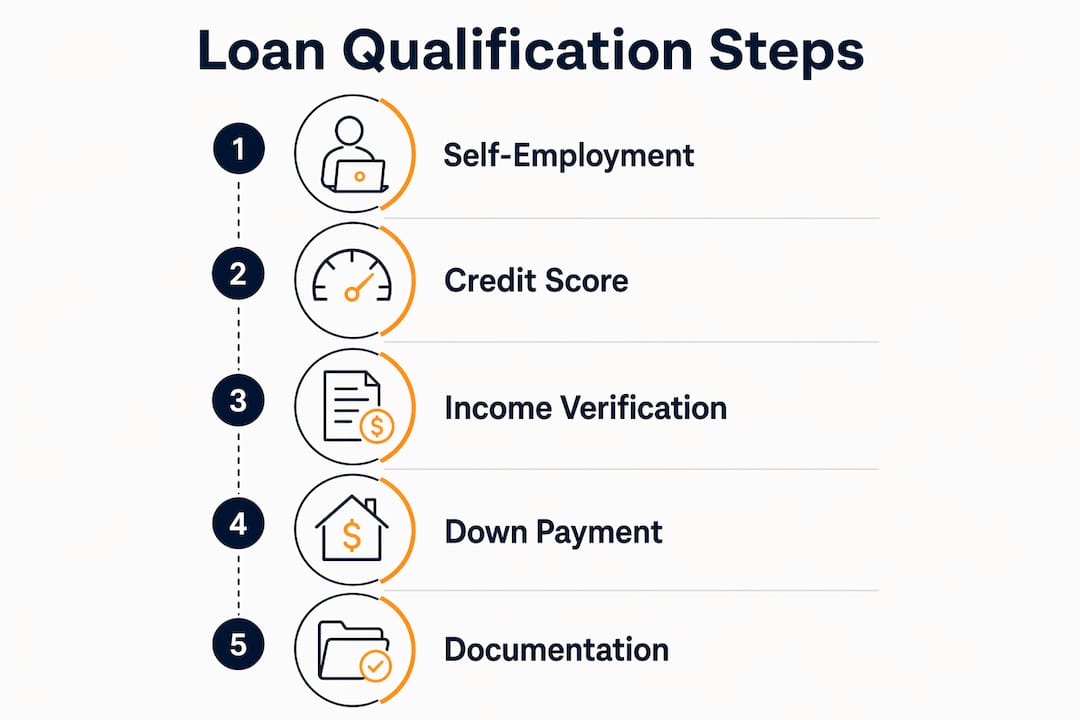
Credit score requirements follow a clear structure:
- Conventional loans: 620 minimum credit score, down payments starting at 3-5%
- FHA loans: 580 minimum credit score, down payment of 3.5%
- Non-QM loans: More flexible credit requirements, down payments starting at 10-15%
- VA loans: No set minimum from the VA, though individual lenders typically require 580-620
Beyond credit scores, lenders evaluate your debt-to-income ratio, assets, and income stability as a combined picture. A strong credit score with a high debt-to-income ratio can still result in denial.
The documentation package for a self-employed borrower is more involved than for a salaried employee. Standard requirements include:
- 2 years of personal tax returns with all schedules
- 2 years of business tax returns
- A current year-to-date profit and loss (P&L) statement
- 12-24 months of business bank statements
- Proof of business license or registration
- CPA letters if income fluctuates significantly
| Loan Type | Min. Credit Score | Min. Down Payment | Income Verification |
|---|---|---|---|
| Conventional | 620 | 3-5% | Tax returns required |
| FHA | 580 | 3.5% | Tax returns required |
| VA | 580-620 (lender set) | 0% | Tax returns required |
| Non-QM / Bank Statement | Flexible | 10-15% | Bank deposits accepted |
Pro Tip: If your credit score sits between 580 and 619, an FHA loan gives you access to lower down payment requirements that conventional loans do not. Work on your score before applying if you want conventional terms.
Which loan programs are best suited for self-employed business owners?
Not every mortgage program treats self-employed income the same way. Choosing the right program is as important as gathering the right documents.

Conventional loans work well when your documentation is clean and your taxable income is high enough to support the loan amount. Fannie Mae guidelines require lenders to use Form 1084 cash flow analysis to adjust gross revenue for business expenses and depreciation. That adjustment can significantly reduce the income figure lenders use. A business generating $200,000 in gross revenue could qualify on as little as $60,000 in net income after lender adjustments. That gap surprises many business owners.
FHA loans are accessible for first-time buyers or those with lower credit scores. They still require tax returns, so business owners who take heavy deductions may find their qualifying income reduced here too.
VA loans offer the strongest terms for eligible veterans who also run businesses. No down payment and no private mortgage insurance make these the most cost-effective option when you qualify.
Non-QM loans, including bank statement loans, are the most practical option for business owners with strong cash flow but low taxable income. Non-QM loans use bank deposits to qualify borrowers, bypassing the tax return income constraints entirely. This is the program that most directly solves the self-employed income problem.
The right program depends on your specific situation:
- Strong tax return income and 620+ credit score: conventional loan
- Lower credit score or first-time buyer: FHA loan
- Veteran with business income: VA loan
- High deposits but low taxable income: non-QM or bank statement loan
How to prepare your documents for a self-employed mortgage application
Document preparation is where most self-employed mortgage applications succeed or fail. Lenders cannot approve what they cannot verify, so your job is to make verification easy.
-
Gather 1-2 years of personal and business tax returns. Include every schedule. Missing schedules trigger delays and additional document requests. If you filed extensions, include the extension confirmation along with the completed return.
-
Prepare a current year-to-date P&L statement. This should be prepared or reviewed by a CPA. Lenders trust CPA-prepared statements more than self-prepared ones. The P&L shows income trends that tax returns, which are always one year behind, cannot capture.
-
Collect 12-24 months of business bank statements. Lenders look for consistent deposit patterns. Large one-time deposits or irregular cash flow will prompt questions. Annotate any unusual deposits before the lender asks.
-
Obtain proof of business existence. This includes your business license, articles of incorporation, or a DBA registration. Some lenders also accept a letter from a licensed CPA confirming your business has been operating for at least two years.
-
Compile asset statements. Two months of bank and investment account statements show you have reserves beyond the down payment. Lenders want to see that a slow business month will not immediately threaten your mortgage payments.
Pro Tip: Create a single digital folder with clearly labeled subfolders for each document category. Lenders who receive organized packages process them faster and request fewer follow-up items. A disorganized submission signals financial disorganization.
Supporting documentation like CPA letters, client contracts, and business licenses strengthens your application beyond the minimum requirements. Treat every document as evidence in your favor.
Common challenges business owners face when qualifying for a home loan
The biggest obstacle for most business owners is the gap between actual income and taxable income. Aggressive deductions lower your tax bill, but they also lower the income figure lenders use to qualify you. A business owner earning $150,000 who deducts $80,000 in legitimate business expenses may only qualify on $70,000 of income. That math directly limits the loan amount available.
Lenders also prefer steady income, which conflicts with the reality of running a business. Seasonal revenue, project-based income, and year-over-year fluctuations all raise underwriting questions. The solution is documentation that explains the pattern rather than hiding it.
“The most common mistake self-employed borrowers make is assuming lenders will see through the tax return to the real business. Lenders follow guidelines. Your job is to present income in the format those guidelines recognize.”
Other common challenges include:
- Insufficient self-employment history: Less than two years of documented self-employment limits your loan program options significantly.
- LLC ownership complications: LLCs are viewed as higher risk by lenders, often resulting in higher interest rates and stricter underwriting criteria than loans to individuals.
- Inconsistent bank records: Mixing personal and business transactions in the same account creates documentation problems that slow approvals.
- Low credit scores: A score below 620 closes the door on conventional loans and requires you to work with FHA or non-QM programs.
- High debt-to-income ratio: Business debt that appears on your personal credit report reduces the loan amount you can qualify for.
The most effective workaround for the taxable income problem is a bank statement loan. These programs use 12-24 months of bank deposits to calculate qualifying income, which means your actual cash flow counts rather than your adjusted taxable income. Texasbankstatementloans specializes in exactly this approach, making it a direct solution for business owners who are profitable but tax-efficient.
Key Takeaways
Business owners can qualify for a home loan by meeting documentation standards, maintaining a 620+ credit score, and choosing the right loan program for their income structure.
| Point | Details |
|---|---|
| Two-year history standard | Most lenders require 2 years of self-employment before approving a mortgage. |
| Credit score thresholds | Conventional loans need 620+; FHA loans accept scores as low as 580. |
| Tax deductions reduce qualifying income | Aggressive deductions lower taxable income, which directly limits your loan amount. |
| Bank statement loans solve the gap | Non-QM programs use bank deposits instead of tax returns to verify income. |
| Document organization matters | A complete, organized document package speeds approval and reduces follow-up requests. |
What I have learned helping business owners get mortgages
The conventional mortgage system was built for W-2 employees. That is not a flaw. It is just a design choice that leaves self-employed borrowers working harder to prove what salaried workers prove automatically. After years of watching business owners navigate this process, the pattern is clear: the ones who succeed prepare earlier and document more thoroughly than they think they need to.
The biggest mindset shift I recommend is this: stop thinking about your mortgage application as a financial transaction and start treating it as a presentation. You are presenting a case that your income is real, stable, and likely to continue. Every document is a piece of evidence. A CPA-prepared P&L, annotated bank statements, and a clean credit report tell a story that a lender can approve.
The other thing I have seen consistently is that business owners wait too long to explore non-QM options. They spend months trying to make a conventional loan work, adjusting their tax strategy or waiting for their credit score to improve, when a bank statement loan would have qualified them a year earlier. The self-employed affordability calculator at Texasbankstatementloans gives you a realistic number in 60 seconds. Run that number before you decide which program to pursue.
Preparation and the right program choice are not separate decisions. They are the same decision made at different stages.
- Saad
How Texasbankstatementloans helps business owners qualify using bank deposits
Self-employed business owners in Texas have a direct path to mortgage approval that does not require tax returns to tell the whole story.
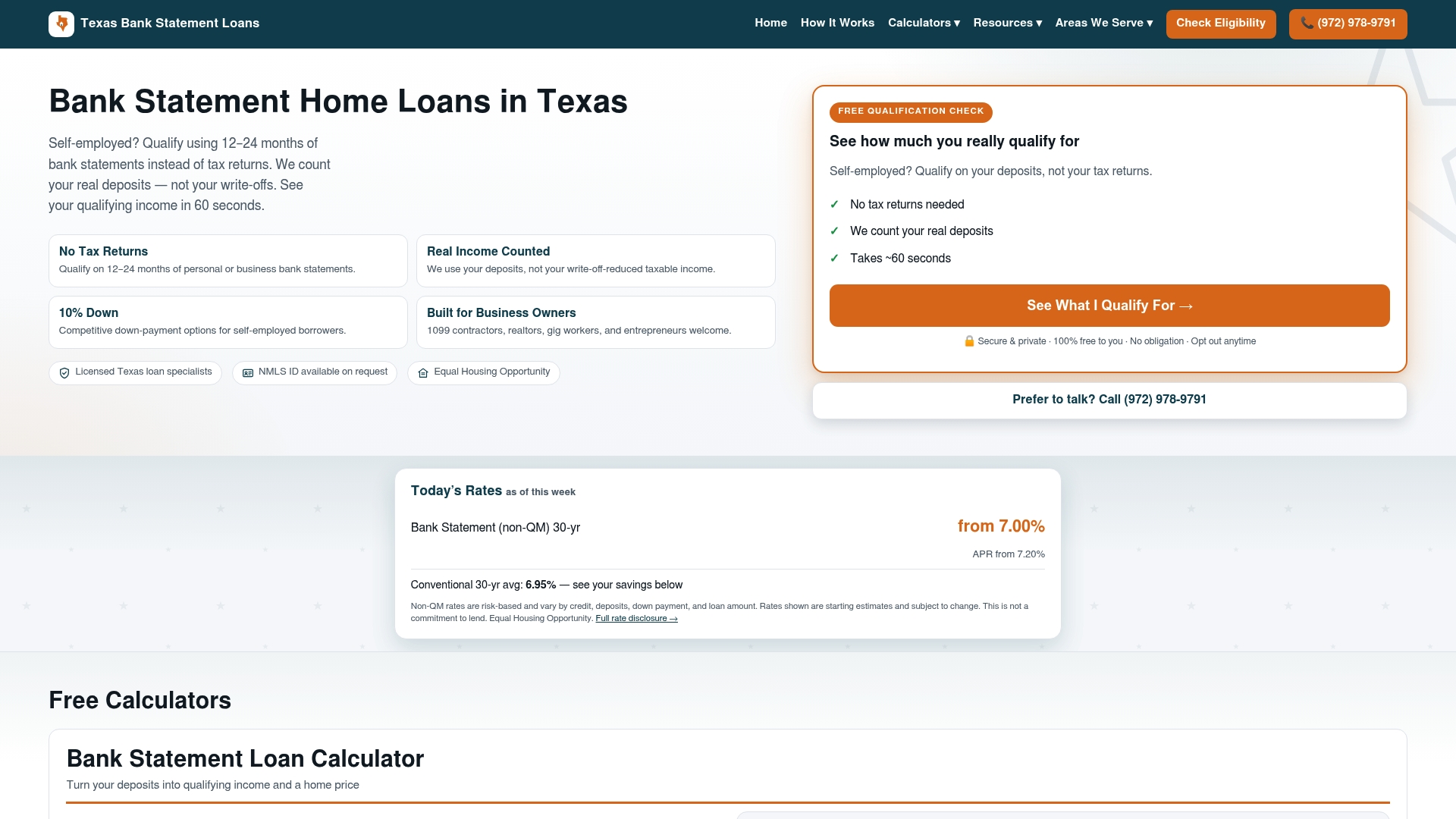
Texasbankstatementloans evaluates 12-24 months of bank deposits to determine qualifying income, which means your actual cash flow counts rather than your adjusted taxable income. Down payments start at 10%, and the qualification check takes 60 seconds with no obligation. Whether you are buying in Houston, Central Texas, or anywhere across the state, bank statement loan options are available for business owners who have the income but not the traditional paperwork. Check today’s current loan rates and see what you actually qualify for.
FAQ
How long do you need to be self-employed to get a mortgage?
Most lenders require 2 years of self-employment history to qualify for a conventional mortgage. One year may be accepted if you have prior experience or formal education in the same field.
What credit score does a business owner need for a home loan?
Conventional loans require a 620 credit score at minimum, while FHA loans accept scores as low as 580. Non-QM and bank statement loans offer more flexibility depending on the lender.
Can a business owner qualify if their taxable income is low?
Yes. Non-QM bank statement loans qualify borrowers based on bank deposits rather than taxable income. This directly addresses the problem of business deductions reducing the income figure on tax returns.
What documents does a self-employed borrower need for a mortgage?
The standard package includes 2 years of personal and business tax returns, a current P&L statement, 12-24 months of bank statements, and proof of business existence such as a license or CPA letter.
Can an LLC owner get a residential mortgage?
An individual who owns an LLC can get a residential mortgage in their personal name. Applying through the LLC itself is treated differently. LLCs face higher interest rates and stricter underwriting than individual borrowers, so most business owners apply personally.
Recommended
- Bank Statement Loans in Houston, TX | Self-Employed Mortgage
- Bank Statement Loans in Dallas, TX | Self-Employed Mortgage
- Bank Statement Loans in Killeen, TX | Self-Employed Mortgage
- Bank Statement Loans in Odessa, TX | Self-Employed Mortgage
See what you qualify for in 60 seconds, free and no credit check. Use the eligibility check at the top of this page.