
Most bank statement loans close in 21 to 45 days, faster than the 43-day average for a typical purchase loan when your file is complete and digitally verified. The biggest blocker isn’t income eligibility. It’s documentation gaps: missing statement pages, unexplained large deposits, and appraisal scheduling. Fix those upfront and you’re looking at the front half of that range, not the back.
TL;DR:
- Preparing and submitting complete, well-organized bank statements can reduce the typical 43-day closing time to as little as 21 to 30 days.
- The main delays often stem from documentation gaps, such as missing statement pages or unexplained large deposits, rather than income eligibility.
- Digital verification tools and automated underwriting significantly cut processing times, with the fastest lenders closing in 21 to 30 days.
- Responding quickly to document requests and clarifying deposit sources in advance can save several days during underwriting.
- A thorough review of the three-day Closing Disclosure and careful preparation of deposit explanations further accelerates the closing process.
Table of Contents
- Bank Statement Loan Timeline: What to Expect at Each Milestone
- What Happens at Each Stage of a Bank Statement Loan Closing?
- What Documents Do Lenders Need for Bank Statement Income?
- How Fast Do Bank Statement Loans Really Close, According to Lender Data?
- How Can You Speed Up Your Bank Statement Loan Closing?
- Why Do Bank Statement Loans Sometimes Need Extra Underwriting Review?
- What Happens During the Three-Day Closing Disclosure Window?
- Three Things Self-Employed Borrowers Should Prioritize
- Get a Faster Path to Closing With Bank Statement Loans
- Sources
- FAQ
Bank Statement Loan Timeline: What to Expect at Each Milestone
Here’s the honest range: purchase loans using bank statements typically close in 30 to 60 days, averaging around 43 days industry wide, based on Chase’s closing timeline data.
Borrowers who show up with a complete, well-organized digital file can push that down to 21 to 30 days, according to one lender’s published guidance on bank statement loans. The gap between those two numbers is almost entirely about preparation, not luck.

Refinances tend to track similarly, though they skip the purchase contract negotiation and sometimes move a notch faster once underwriting is settled.
Here’s roughly how the milestones stack up on a typical file:
- Application submitted: Day 0. Your lender pulls credit and requests bank statements.
- Loan Estimate issued: Within 3 business days of application, by federal requirement.
- Document collection and underwriting begins: Days 3 to 15, depending on how fast you respond.
- Appraisal ordered and completed: Typically days 7 to 20, though rural properties or busy markets can push this later.
- Clear to close: Usually days 20 to 40, once underwriting conditions clear.
- Closing Disclosure issued: At least 3 business days before signing, non-negotiable under federal law.
- Closing and funding: Days 25 to 45 on average, sometimes sooner with a clean file.
What Happens at Each Stage of a Bank Statement Loan Closing?
The clock doesn’t run evenly across a bank statement loan’s life span. Some stages are fast and procedural. Others are where self-employed borrowers actually lose days.
-
Application and Loan Estimate. The moment you submit your application, federal rules require the lender to send you a Loan Estimate within 3 business days. This stage rarely causes delays on its own, but it sets the tone: a sloppy application here means more back-and-forth later.
-
Document collection and underwriting. This is where bank statement loans diverge from conventional ones. Instead of pulling tax returns, your underwriter reviews 12 to 24 months of personal or business bank statements to calculate qualifying income. Every large or irregular deposit gets flagged, and the CFPB’s checklist for closing steps notes that document requests and source-of-funds questions are standard parts of this phase. Expect this stage to run anywhere from a week to three weeks depending on how clean your statements are.
-
Appraisal ordering and completion. Appraisers get scheduled once the lender has enough of your file to justify ordering one. In busy markets or rural counties, this alone can eat 10 to 14 days. There’s little you can do to speed this up beyond confirming access to the property quickly.
-
Clear to close. Once underwriting signs off on every condition, including any explanations for deposits, you get a clear to close. This is the finish line for document review, but it triggers the legally mandated waiting period before you can sign.
-
Funding after signing. Purchase loans typically fund the same day or next business day after signing. Refinances carry a rescission period in most cases, which can push funding a few extra business days out.
What Documents Do Lenders Need for Bank Statement Income?
Bank statement loans replace tax returns with real deposit history, but that trade comes with its own paperwork. Lenders generally want 12 to 24 months of personal or business bank statements, and they average your monthly deposits over that window to arrive at qualifying income. A longer look-back period smooths out seasonal swings, which matters if you’re a contractor with uneven cash flow.
Large or irregular deposits are the single biggest friction point. If a deposit doesn’t match your normal pattern, expect a request for source documentation, things like a signed bill of sale, an invoice, a gift letter, or a bank-to-bank transfer record with a short explanation memo. The CFPB’s compliance guidance on verifying income treats bank records as acceptable proof of income and assets, but only when they’re complete and traceable.
Beyond the statements themselves, you’ll also need:
- Government-issued photo ID for every borrower on the loan.
- Proof of homeowner’s insurance before closing.
- Title company documentation and a preliminary title report.
- Appraisal access confirmation for the property.
- Any business license or entity documentation if you’re self-employed under a formal business structure.
Pro Tip: Number every page of your bank statements and write a one-line note next to any deposit over a few thousand dollars explaining where it came from. Underwriters spend less time chasing you down when the answer is already on the page.
Missing statement pages are the most common, and most avoidable, cause of delay. Download every statement directly from your bank’s portal rather than screenshotting, since PDFs from the source rarely drop pages.
How Fast Do Bank Statement Loans Really Close, According to Lender Data?
The 43-day average Chase reports for purchase loans isn’t a fixed number. It’s an industry midpoint, and where a given loan lands within the 30 to 60 day range depends heavily on how the lender processes documentation.

Digital income and asset validation shaves roughly 9 to 10 days off the average closing cycle, according to Freddie Mac’s mortgage closing cycle time benchmarking study. That gap comes almost entirely from cutting out manual document chasing and re-verification loops.
The same study found a wide spread between top and bottom performers:
| Performance Tier | Approximate Closing Time | Primary Driver |
|---|---|---|
| Top-performing lenders | 21 to 30 days | Heavy use of digital verification and automated underwriting |
| Average lenders | Around 43 days | Mixed manual and digital processes |
| Slower-performing lenders | 30 to 60 days | Manual document review, slower response cycles |
That 20-day spread between the fastest and slowest lenders is largely about process, not paperwork volume. Lenders that use electronic bank data retrieval and automated deposit analysis reduce processing time by cutting out much of the back-and-forth involved in manual reviews. This is particularly important for self-employed borrowers, whose income documentation is typically more complex than W2 borrowers’.
How Can You Speed Up Your Bank Statement Loan Closing?
You control more of this timeline than most borrowers realize. The stages that eat the most time, document review and deposit verification, are exactly the stages where a prepared borrower can cut days off the process.
- Gather 12 to 24 months of statements before you apply, and make sure every page is included, not just summary pages.
- Write a short explanation for any deposit that doesn’t match your normal monthly pattern, and attach supporting proof like an invoice or transfer record.
- Upload documents through your lender’s portal the same day they’re requested, and confirm receipt rather than assuming an email went through.
- Avoid opening new credit accounts, moving large sums between accounts, or changing your normal banking pattern in the 60 days before closing.
- Ask your loan officer directly whether their process uses digital deposit validation, since that alone can be the difference between a 30-day and a 50-day close.
Pro Tip: Ask your loan officer for a written, stage-by-stage timeline estimate at application. It won’t be perfect, but it gives you a benchmark to flag delays early instead of wondering three weeks in why nothing’s moved.
Small, boring habits like responding to document requests within 24 hours instead of a week routinely save more time than any single piece of paperwork.
Why Do Bank Statement Loans Sometimes Need Extra Underwriting Review?
Underwriters calculating income from bank statements aren’t just adding up deposits. They’re averaging total qualifying deposits across your 12 to 24 month look-back period, then applying an expense factor if you’re using business account statements instead of personal ones. That averaging process is precise, but it means every included month has to be documented and every excluded deposit has to be explained.
Fannie Mae’s Desktop Underwriter validation service adds its own clock. The DU validation timing rules require the first DU submission within 30 days of the report date, and the loan must close within 120 days of that same report date. Miss either window and the lender has to re-pull or re-verify the report, adding real days back onto your timeline.
A few things that commonly trigger manual review instead of an automated pass:
- Deposits that jump significantly month to month with no clear seasonal pattern.
- A business that’s been operating for less than two years.
- Transfers between multiple personal and business accounts that aren’t clearly linked.
- Reserve requirements that need extra verification, since bank statement programs often require more months of reserves than conventional loans.
Digital validation tools reduce how often manual review gets triggered in the first place, which is part of why lenders using them close faster on average. But when a file does need manual eyes, expect that stage to add anywhere from a few days to two weeks depending on how quickly you supply what’s requested.
What Happens During the Three-Day Closing Disclosure Window?
Federal law requires lenders to deliver your Closing Disclosure at least three business days before signing. That’s not a formality to skim past. Treat it as an active review window, because it’s your last real chance to catch a costly error before it’s locked in.
Compare the Closing Disclosure line by line against your original Loan Estimate. Interest rate, loan amount, monthly payment, and closing costs should all be close to what you were originally quoted. Any change beyond normal tolerances should get a direct question to your loan officer before you sign anything.
At closing itself, you’ll need government-issued photo ID, your down payment funds (typically via wire transfer or cashier’s check), and time to review every page with either your closing agent or attorney, depending on your state. Funding usually happens the same day or next business day after signing for a purchase.
- Review the Closing Disclosure the moment you receive it, not the night before signing.
- Flag any cost increase beyond typical tolerances immediately.
- Confirm wire instructions directly with your title company by phone, since wire fraud targeting closings is common.
- Bring backup documentation for your down payment source in case it’s requested at the table.
Three Things Self-Employed Borrowers Should Prioritize
The conventional advice for mortgage borrowers, “gather your documents and wait,” doesn’t quite fit bank statement loans. Your income isn’t a single number on a W2. It’s a pattern across dozens of pages, and the pattern is what gets scrutinized.
Prioritize three things. First, complete and annotated bank statements with every large deposit explained before anyone asks. Second, ask directly whether your lender uses digital deposit validation, since that single factor separates a 25-day close from a 50-day one more than almost anything else you can control. Third, treat the three-day Closing Disclosure window as your last checkpoint, not a formality to sign past. Borrowers who do these three things consistently close faster than borrowers who wait to be told what’s wrong with their file.
- Saad
Get a Faster Path to Closing With Bank Statement Loans
Bank statement loans provide an alternative to a tax-return-based mortgage process for self-employed borrowers: instead of underwriting write-offs, they evaluate 12 to 24 months of actual bank deposits, so the income the lender sees reflects the income you actually earn.
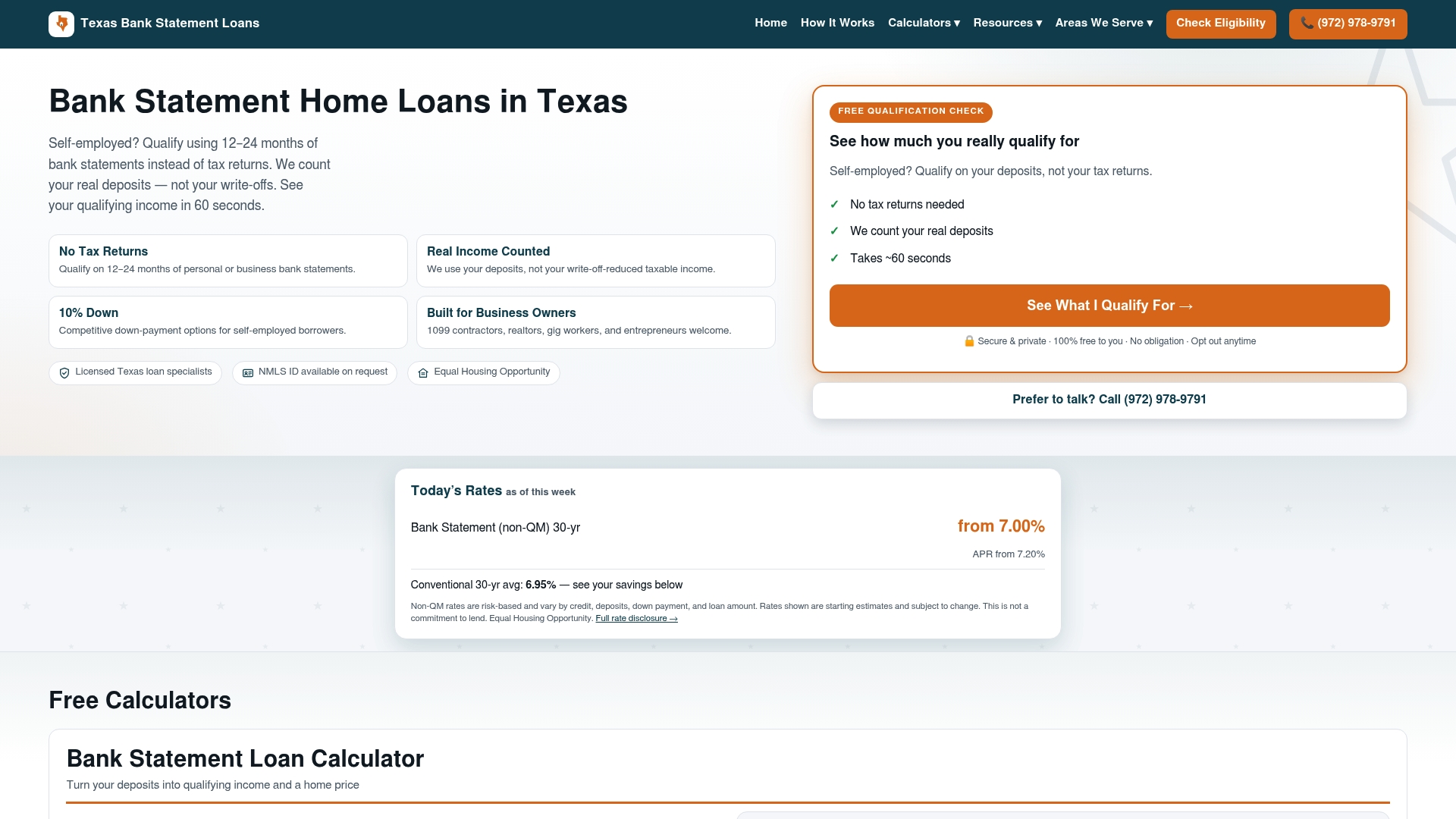
That distinction matters most at the exact friction points covered above, deposit documentation and manual review, since those are the stages a bank-statement-focused process is built to move through faster. You can run your numbers through the bank statement loan calculator to estimate what you might qualify for, or check current terms on the Bank Statement non-QM 30-year rate page. If you’re weighing an investment property purchase alongside a primary residence, the DSCR loan tool is worth a look too. Start with the qualification check, then talk to a loan officer about a realistic closing timeline for your specific file.
This article is general information, not a substitute for advice from a qualified financial advisor. Consult a qualified financial professional about your own circumstances before acting on anything here.
Sources
- How long does it take to close on a house? | Chase
- DU validation service: using the service | Fannie Mae
- Mortgage closing cycle time benchmarking study | Freddie Mac
FAQ
Do Lenders Ask for Bank Statements Before Closing?
Yes. Bank statement loan lenders typically request 12 to 24 months of personal or business bank statements upfront, and they may ask follow-up questions about specific deposits throughout underwriting. The CFPB confirms bank records are an accepted way to verify income and assets during the mortgage process.
How Long Before Closing Is a Loan Approved?
Most loans reach “clear to close” status, essentially full approval, somewhere between 20 and 40 days into the process, depending on how quickly documentation clears underwriting. After that, federal law still requires the Closing Disclosure to arrive at least three business days before signing, so approval and signing aren’t the same moment.
What Are the Requirements for a Bank Statement Loan?
Lenders generally require 12 to 24 months of bank statements to calculate qualifying income by averaging deposits, along with standard documents like photo ID, proof of insurance, and title paperwork.
What Are the Pros and Cons of a Bank Statement Loan?
The main advantage is qualifying based on real deposit activity instead of taxable income reduced by write-offs, which helps self-employed borrowers, contractors, and business owners show their true earning power. The tradeoff is more document scrutiny around large or irregular deposits, and closings can run longer than a straightforward W2 loan if statements are incomplete or deposits go unexplained.
See what you qualify for in 60 seconds, free and no credit check. Use the eligibility check at the top of this page.