
Property taxes are deductible on your federal return only if you itemize on Schedule A instead of taking the standard deduction, and the benefit is now capped by the state and local tax limit. For 2026, that SALT cap sits at $40,400 for most filers ($20,200 if you’re married filing separately), a notable increase from previous limits. Whether that deduction actually helps you depends on how your total itemized expenses stack up against the 2026 standard deduction: $16,100 for single filers and married filing separately, $32,200 for married filing jointly, and $24,150 for head of household.
Three distinct pathways determine how your property taxes actually get treated on your return:
- Personal residence: Reported on Schedule A, subject to the SALT cap alongside your state income or sales taxes.
- Rental or investment property: Reported on Schedule E, fully deductible as a business expense with no SALT cap in play.
- Mixed-use property: Split between Schedule A and Schedule E based on actual rental versus personal use.
Pro Tip: If you own a property that’s part rental, part personal residence, don’t default to claiming the whole tax bill on Schedule A. Shifting the rental share to Schedule E can dodge the SALT limit entirely and often saves more than people expect.
Key Takeaways
Property taxes are deductible only if you itemize on Schedule A, and the 2026 SALT cap of $40,400 (or $20,200 for married filing separately) limits how much of that benefit you can actually claim.
| Point | Details |
|---|---|
| Itemizing is required | You must file Schedule A instead of taking the standard deduction to claim any property tax write-off. |
| Know the 2026 SALT cap | Combined state/local taxes are capped at $40,400 ($20,200 for married filing separately) for 2026. |
| Compare against the standard deduction | 2026 standard deductions are $16,100 single, $32,200 joint, and $24,150 head of household. |
| Separate rental and personal use | Allocate mixed-use property taxes by days of use; the rental share goes on Schedule E and skips the SALT cap. |
| Keep proof of payment | Save Form 1098, escrow statements, and county tax receipts for at least three years after filing. |
Table of Contents
- What Counts as a Deductible Property Tax
- Should You Itemize or Take the Standard Deduction?
- How Does the SALT Cap Affect Your Property Tax Deduction?
- Where Do You Report Property Taxes on Schedule A?
- Which Property Tax Charges Don’t Qualify, and Where Filers Go Wrong
- How Do Rental and Mixed-Use Properties Handle the SALT Cap?
- What Records Do You Need to Prove Your Deduction?
- Worked Examples: When Itemizing Actually Pays Off
- Quick Checklist: Decide in Five Minutes
- What Preparers Wish Homeowners Knew
- Frequently Asked Questions
- Sources
What Counts as a Deductible Property Tax
Not every line on your county tax bill is deductible, and this trips up more filers than you’d think. The IRS only allows a deduction for taxes that are assessed uniformly across a jurisdiction and levied for general public welfare, according to Topic 503. That covers standard real property taxes on your home and, in many states, personal property taxes on vehicles or boats when the tax is based on the item’s value rather than its weight or a flat fee.
Here’s where it gets messy. Plenty of charges that show up on a property tax statement are not deductible at all:
- Trash and sewer fees, these pay for a specific service, not general government functions.
- Special assessments for sidewalks, streetlights, or sewer line installation, these increase your property’s value, so the IRS treats them as capital improvements, not taxes.
- HOA dues, never deductible; they’re not a tax at all, just a private contractual fee.
- Transfer taxes and recording fees, one-time charges tied to a sale, not an annual property tax.
Say your county bill shows $6,200 for “Total Amount Due,” but $340 of that is a stormwater management fee and $180 is a sidewalk assessment from a 2024 municipal project. Only the remaining $5,680 qualifies as a deductible real property tax.
Pro Tip: Look for the word “assessment” tied to a specific improvement project. If your bill mentions a named project (new curbs, drainage upgrades, sidewalk repair), that line is almost always a capital assessment, not a tax, even if it’s collected by the same tax office.
Should You Itemize or Take the Standard Deduction?
You have to file Schedule A with Form 1040 to claim any property tax deduction, and choosing that route means giving up the standard deduction entirely. It’s an either/or decision, not a stacking one. For 2026, the standard deduction amounts set the bar you need to clear:
| Filing status | 2026 standard deduction |
|---|---|
| Single | $16,100 |
| Married filing separately | $16,100 |
| Head of household | $24,150 |
| Married filing jointly | $32,200 |
Run a quick tally before you commit to either route:
- Add up your mortgage interest for the year (found on Form 1098).
- Add your deductible state and local property taxes.
- Add state and local income or sales taxes (subject to the same combined SALT cap).
- Add charitable contributions with proper documentation.
- Add any other qualifying itemized items (certain medical expenses above the AGI threshold, casualty losses in federally declared disaster areas).
- Compare that total to your standard deduction amount above.
If your total clears the threshold for your filing status, itemizing wins. A married couple filing jointly with $18,000 in mortgage interest and $9,000 in state and local taxes already hits $27,000, still short of $32,200. Add $6,000 in charitable giving and they’re at $33,000, which edges past the standard deduction by $800. That’s a real but modest win, and it explains why so many middle-income homeowners in lower-tax states end up better off just taking the standard deduction.
How Does the SALT Cap Affect Your Property Tax Deduction?
The SALT cap bundles three categories into a single limit: state and local property taxes, plus either state and local income taxes or general sales taxes (you pick whichever is higher, not both). For 2026, that combined total caps out at $40,400 for single filers, heads of household, and married couples filing jointly, and $20,200 for married filing separately, under Revenue Procedure RP-26-01.
This cap replaced the $10,000 limit that had squeezed homeowners in high-tax states since 2018, and the increase changes the math considerably for anyone in places with steep property valuations or state income taxes.
Only taxes assessed uniformly for the general public welfare, real property taxes and certain value-based personal property taxes, qualify for the deduction; service fees and special benefit assessments fall outside that definition even when they appear on the same bill.
Consider a homeowner paying $22,000 in property taxes and $15,000 in state income tax, for a combined $37,000 in SALT-eligible expenses. That falls under the $40,400 cap, so the full amount is deductible on Schedule A. Now change the property tax to $30,000 (not unusual on a high-value home in a high-rate county), and the combined total hits $45,000. The taxpayer loses $4,600 of otherwise-legitimate deduction to the cap, no matter how the taxes are split between categories.
The cap is indexed for inflation going forward, and Tax-prep resources like TurboTax note that the increased limit under the One Big Beautiful Bill shifts the itemize-versus-standard calculation for a meaningful share of taxpayers, particularly those near the old $10,000 ceiling who previously had no reason to track SALT closely.
Where Do You Report Property Taxes on Schedule A?
Real estate taxes get entered on Schedule A in the section covering taxes you paid, generally on lines 5a through 5e, with line 5b specifically capturing state and local real estate taxes and line 5e applying the SALT cap to your combined total, per the draft Schedule A instructions.
Before you fill in a single number, gather your paperwork:
- Pull your Form 1098 from your mortgage servicer, which often reports property taxes paid through escrow alongside mortgage interest.
- Request or locate your county tax receipt showing the exact amount billed and paid for the year.
- Check your escrow statement for a year-end summary of disbursements, since the amount your lender paid out of escrow may differ from what was billed if there was a shortfall or surplus.
- If you bought or sold the property mid-year, pull your closing disclosure or settlement statement to see the prorated tax amount credited or charged at closing.
- Cross-check all four documents against each other; discrepancies between Form 1098 and your county receipt are common and worth resolving before you file.
A few reporting rules catch people off guard:
- You deduct property taxes in the year they’re actually paid, not the year they’re billed for. A tax bill covering 2026 that you pay in January 2027 gets deducted on your 2027 return.
- Escrow disbursements count as paid on the date your lender actually sends the money to the taxing authority, which you can verify on your annual escrow statement.
- If you prepay next year’s taxes in December to accelerate the deduction, confirm the payment was actually assessed and due; prepaying an amount not yet billed generally isn’t deductible in that earlier year.
- A property tax refund you receive must reduce your deduction (or count as income in some cases) for the year you receive it.
Which Property Tax Charges Don’t Qualify, and Where Filers Go Wrong
Even careful taxpayers misread their tax bills every filing season. The Schedule A instructions walk through several charges that regularly get lumped in with deductible taxes by mistake:
- Homeowners association dues billed alongside property taxes by a master-planned community.
- Special assessments for local improvements like new sidewalks, sewer connections, or road paving that raise your property’s value.
- Service charges for trash collection, water, or sewer usage, even when the county bundles them into one combined bill.
- Late fees or penalty interest added to a delinquent tax bill.
Beyond misclassifying charges, three mistakes come up constantly:
- Claiming the seller’s delinquent taxes. If you bought a home mid-year and the seller owed back taxes that got settled at closing, that amount isn’t yours to deduct, only the taxes allocable to your period of ownership count.
- Double-counting escrow payments. Some filers claim the amount billed by the county and separately claim the escrow disbursement shown on Form 1098, effectively deducting the same tax twice.
- Misallocating mixed-use taxes. Claiming 100% of the tax bill on Schedule A for a property that’s partly rented out overstates the deduction and understates rental expenses.
A property tax line that jumps dramatically from one year to the next with no corresponding reassessment, or a vague “other charges” line with no itemized breakdown, is the kind of thing that draws IRS attention if the return gets pulled for review.
Pro Tip: When a bill looks unclear, call the taxing authority directly or check the district’s website for a breakdown by levy. Most counties publish a rate schedule showing exactly what each portion of your bill funds, which settles the tax-versus-fee question in minutes.
How Do Rental and Mixed-Use Properties Handle the SALT Cap?
Property taxes on rental or business property are deducted as an ordinary business expense on Schedule E, and that deduction is not subject to the SALT cap at all, according to Topic 415. This is one of the most underused workarounds available to anyone who owns more than one property in Texas.
For a property that’s part rental, part personal use, allocate the tax bill using a documented method:
- Track the actual number of days the property was rented at fair market value versus used personally during the year.
- Divide rental days by total days used to get your rental-use percentage.
- Apply that percentage to the total property tax bill to determine the Schedule E portion.
- Report the remaining personal-use percentage on Schedule A, subject to the SALT cap as usual.
- Keep a calendar, lease agreements, and bank deposit records showing rental income received, since these support the allocation if questioned.
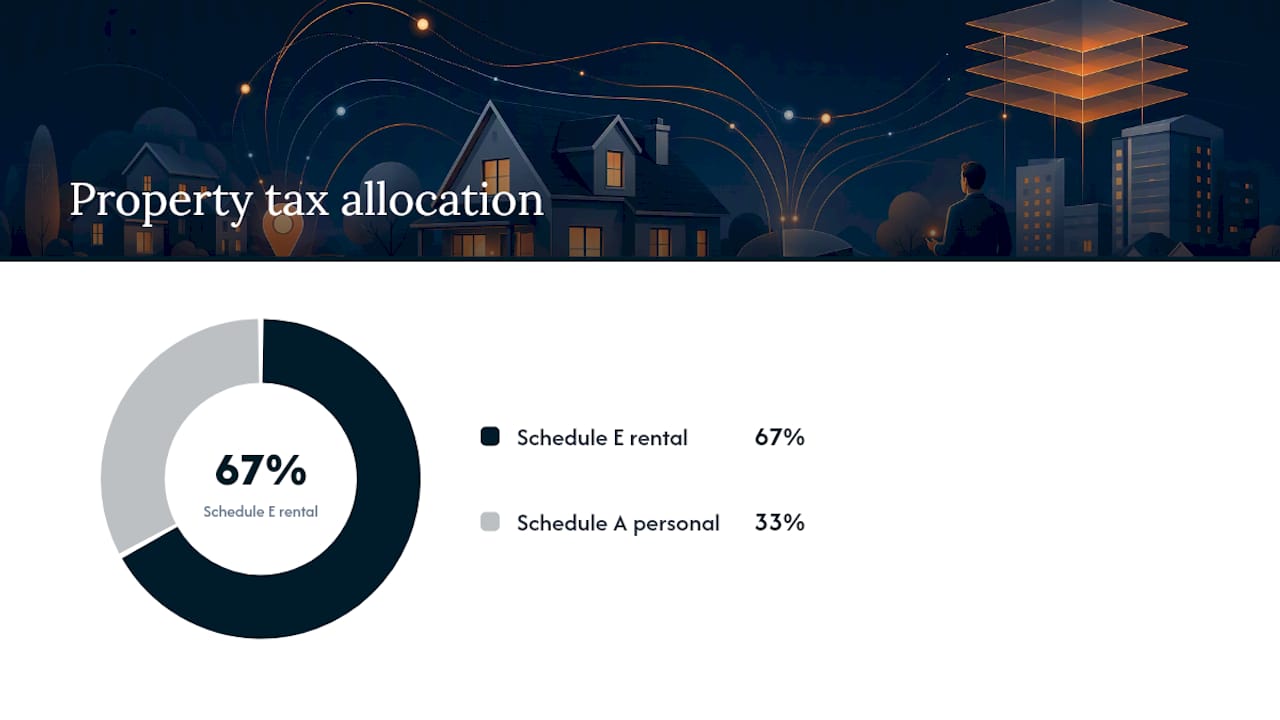
Here’s how that plays out with real numbers. Say a lake house near Hill County generates a $9,000 annual property tax bill, and the owner rented it out 120 days and used it personally for 60 days (180 total days of qualified use). That’s a 67% rental allocation, meaning $6,030 goes to Schedule E as a fully deductible rental expense, while just $2,970 lands on Schedule A subject to the SALT cap. Compare that to claiming the entire $9,000 on Schedule A, where it competes with the cap alongside every other state and local tax the owner pays.
- Allocation percentages that shift dramatically year to year without a clear reason (a new lease, a change in personal use) can flag a return for review.
- The NerdWallet guide on this topic recommends allocating strictly by days of use rather than square footage when the property is a single dwelling used for both purposes, since days-of-use is the method the IRS most consistently accepts.
The dollar amounts at stake usually justify the fee, especially once you’re shifting five figures between Schedule A and Schedule E.*
What Records Do You Need to Prove Your Deduction?
Substantiating a property tax deduction comes down to five document types, and keeping them organized takes minutes compared to reconstructing them during an IRS inquiry:
- Paid tax bills or receipts from your county or municipal taxing authority showing the amount billed and confirmation of payment.
- Escrow statements from your mortgage servicer detailing exactly what was disbursed and when.
- Form 1098 for the tax year in question, cross-referenced against your escrow statement.
- Closing or settlement statements if you bought or sold the property, showing the prorated tax credit or charge.
- Canceled checks or bank statements confirming direct payment if you don’t escrow your taxes.
Keep these records for at least three years from the date you filed the return claiming the deduction, which matches the standard IRS statute of limitations for audits. If you’ve claimed a loss from a mixed-use property or made a significant proration adjustment at purchase or sale, hang onto the documents for six years, since understated income claims can extend the lookback period.
For digital organization, scan every document into a single folder labeled by tax year, and add a short note to your closing statement clarifying your exact ownership start or end date. That single note resolves proration disputes faster than anything else in your file.
Worked Examples: When Itemizing Actually Pays Off
Numbers settle this faster than any general rule. Here are three scenarios that cover the situations most homeowners actually face.
Example 1: Straightforward itemizer. A single filer in a mid-tax state pays $8,500 in mortgage interest, $5,200 in property taxes, and $2,000 in state income tax, plus $1,800 in charitable donations.
| Expense category | Amount |
|---|---|
| Mortgage interest | $8,500 |
| Property tax | $5,200 |
| State income tax | $2,000 |
| Charitable donations | $1,800 |
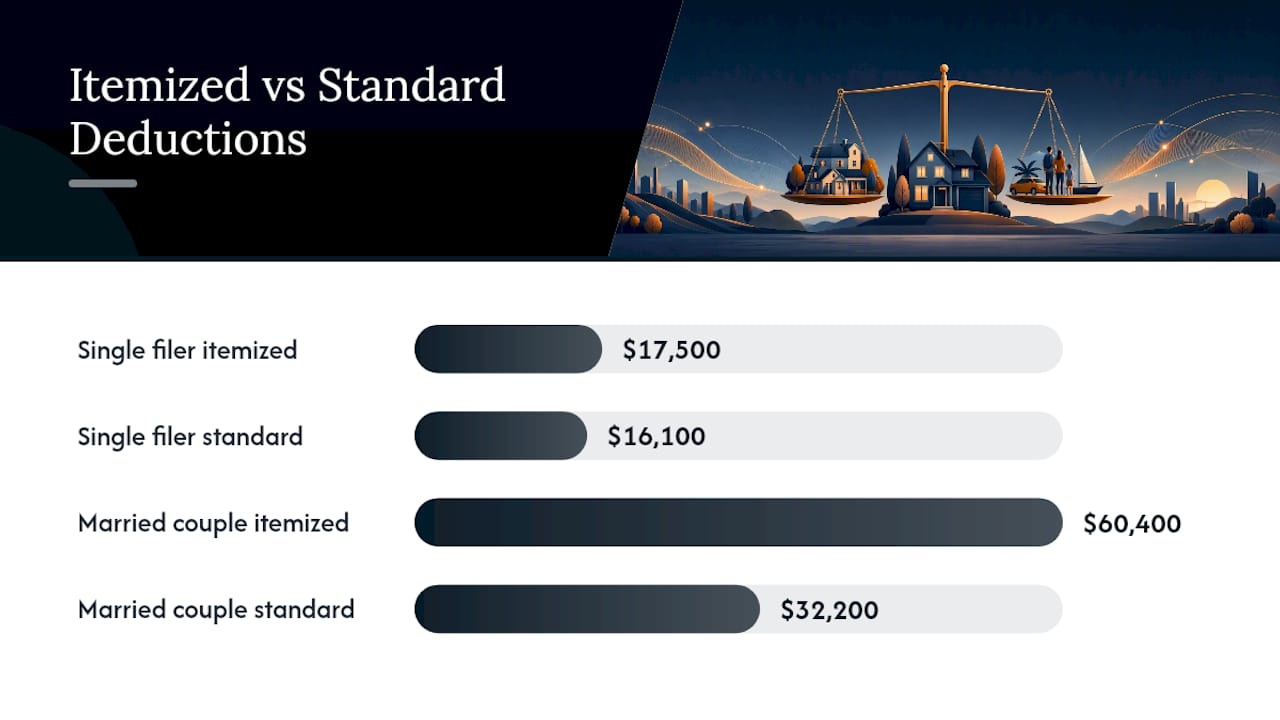
| Total itemized | $17,500 |
| 2026 standard deduction (single) | $16,100 |
Itemizing wins by $1,400, a modest but real reduction in taxable income.
Example 2: SALT-capped homeowner. A married couple filing jointly in a high-property-value county pays $28,000 in property taxes and $16,000 in state income tax, for a combined $44,000 in SALT-eligible expenses. That’s above the $40,400 cap, so they lose $3,600 of the deduction outright, capped at $40,400 regardless of category mix. Add $20,000 in mortgage interest and their itemized total is $60,400, well past the $32,200 standard deduction for joint filers, even after the SALT haircut.
Example 3: Mixed-use allocator. An owner with a $12,000 property tax bill on a property rented 200 days and used personally 40 days (83% rental) shifts $9,960 to Schedule E and keeps just $2,040 on Schedule A. That $9,960 never touches the SALT cap at all, preserving cap room for other state and local taxes.
To run your own numbers, list mortgage interest, property tax, state and local tax, and charitable giving in a simple four-row table, apply the SALT cap to rows two and three combined, then compare the total against your filing status’s standard deduction.
Quick Checklist: Decide in Five Minutes
Run through these steps before you open any tax software:
- Pull last year’s mortgage interest statement, property tax receipt, and charitable donation records.
- Add mortgage interest, property tax, state/local income or sales tax (capped combined at $40,400 for 2026), and charitable gifts.
- Compare that total to your filing status’s 2026 standard deduction.
- Flag any rental or mixed-use property and separate its tax portion before adding to your Schedule A total.
- If your itemized total clears the standard deduction by a meaningful margin, plan to file Schedule A; if it’s close or below, the standard deduction is simpler and safer.
- When allocations, multiple properties, or self-employment income complicate the picture, bring in a tax preparer or run a Schedule A preview in tax software before committing.
What Preparers Wish Homeowners Knew
The biggest gap between what taxpayers assume and what actually happens on a return comes down to documentation timing, not tax law complexity. People wait until March to hunt down a county tax receipt that would’ve taken thirty seconds to save in September. Checking your Form 1098 against your actual county receipt every year, not just in years you suspect a problem, catches escrow shortfalls and double-counted amounts before they become filing errors.
The Schedule E allocation for mixed-use property is the most underused move available to owners with rental or vacation properties, and it’s also the one most likely to go wrong without documentation. If your rental percentage is anywhere near 50%, or your usage pattern changed mid-year, that’s the moment to get a second set of eyes on the allocation rather than guessing and hoping the numbers hold up.
Track property tax payments and escrow disbursements as they happen throughout the year instead of reconstructing everything in April. A simple spreadsheet updated each time a payment posts saves hours of digging later and prevents the classic mistake of confusing a billed amount with a paid amount.
Frequently Asked Questions
Does property tax count as an itemized deduction?
Yes, but only if you file Schedule A instead of taking the standard deduction, and only for taxes assessed uniformly on real property or qualifying personal property, per IRS Topic 503.
What is the 2026 SALT cap for property tax deductions?
The combined state and local tax cap is $40,400 for single, head of household, and married filing jointly, and $20,200 for married filing separately, covering property taxes plus state income or sales taxes together.
How do I know if itemizing beats the standard deduction?
Add your mortgage interest, property taxes, state and local taxes (capped combined), and charitable donations, then compare that total against your 2026 standard deduction amount for your filing status.
Can I deduct property taxes on a rental property without hitting the SALT cap?
Yes. Property taxes on rental or business property are deducted as an expense on Schedule E and aren’t subject to the SALT limit at all, unlike taxes on your personal residence.
What documents prove I paid my property taxes?
Form 1098, escrow statements from your mortgage servicer, county tax receipts, and closing or settlement statements for the year of purchase or sale all serve as substantiation.
Are HOA dues or special assessments for sidewalks deductible as property taxes?
No. HOA dues aren’t a tax at all, and special assessments for improvements that increase your property’s value are treated as capital costs, not deductible taxes.
This article is general information, not a substitute for advice from a qualified financial advisor. Consult a qualified financial professional about your own circumstances before acting on anything here.
Sources
- IRS releases tax inflation adjustments for tax year 2026, including amendments from the One, Big, Beautiful Bill
If you’re self-employed and juggling property taxes alongside irregular income, qualifying for a mortgage through traditional underwriting can be its own headache, especially when your tax returns don’t reflect your actual cash flow. Texasbankstatementloans built its approval process around 12 to 24 months of real bank deposits instead of tax returns, so 1099 contractors, gig workers, and business owners can qualify based on what they actually earn. Down payments start at 10%, and you can check what you qualify for in about 60 seconds with no obligation.
See what you qualify for in 60 seconds, free and no credit check. Use the eligibility check at the top of this page.