
Yes, DSCR loans can finance short-term rentals when the lender accepts platform history or a third-party revenue projection and the property has legal permission to operate as an Airbnb. Approval comes down to whether your post-haircut DSCR clears the lender’s minimum, usually somewhere between 1.0 and 1.25. The deals that fall apart do so for predictable reasons: a banned STR zone, an HOA that says no, or revenue projections that shrink once the lender applies its discount.
TL;DR:
- Borrowers must ensure the property’s short-term rental permit is valid and check HOA restrictions before applying for a DSCR loan.
- Typical minimum DSCR thresholds range from 1.0 to 1.25, with a common requirement of 12 to 24 months of verified rental income statements.
- Lenders discount projected rental income by 75 to 80 percent to account for vacancies, fees, and platform commissions.
- Qualification depends more on property-level income and documentation rather than borrower’s tax returns, making DSCR loans suitable for self-employed and high-ADR investors.
- Strong applications require conservative expense modeling, verified permit status, and direct lender questions about income haircuts and reserve requirements.
Table of Contents
- Why Investors Use DSCR Loans for Short-Term Rentals
- How Do Lenders Calculate Qualifying STR Income?
- Calculating DSCR for a Short-Term Rental
- What Do Lenders Require for an STR DSCR Loan?
- What Kills STR DSCR Deals Before They Close?
- How to Prepare a Strong STR DSCR Application
- What Underwriting STR Files Actually Teaches You
- How Texas Bank Statement Home Loans Helps STR Investors Qualify
- Sources
Why Investors Use DSCR Loans for Short-Term Rentals
DSCR loans qualify the property, not the borrower. That single fact changes the whole calculus for STR investors. There’s no tax return review, no debt-to-income ratio dragging down your file because your Schedule E shows a paper loss from depreciation and repairs. If the property produces enough rental income to cover the mortgage, the loan works, regardless of what your 1040 says.
That structure fits three kinds of investors especially well:
- Owners with multiple financed properties who’ve maxed out conventional lending limits
- Self-employed hosts whose tax filings understate real cash flow
- Buyers targeting high-ADR, high-occupancy markets where nightly rates make the math work
The trade-off is cost. DSCR loan interest rates are usually higher than conventional investment property rates, and lenders often ask for larger reserves on STR deals than on long-term rentals, given the greater occupancy fluctuations.
Pro Tip: If your last two years of tax returns show a loss because of aggressive deductions, don’t fight that on a conventional application. A DSCR loan sidesteps the issue entirely by underwriting the property’s income instead of yours.
How Do Lenders Calculate Qualifying STR Income?
Lenders won’t just take your word for what a listing earns. They lean on one of three evidence paths, and which one applies depends on whether you already own the property.
- Trailing platform statements. If you’ve operated the listing for 12 months or more, Airbnb or VRBO payout history is the gold standard. Lenders trust actual deposits over projections.
- Third-party market data. For a new purchase with no operating history, lenders typically pull an AirDNA market report and apply it to a comparable property.
- Appraiser-supported STR premium. Some appraisals include a short-term rental market study showing what similar listings nearby actually earn.
Whichever path applies, the number rarely survives untouched. Lenders commonly discount AirDNA or market-report projections by applying a 75 to 80 percent factor before counting the income toward qualification, a haircut meant to absorb vacancy gaps, cleaning turnover, and platform commissions that eat into gross booking revenue.
To convert that into a usable number, take the discounted annual revenue, divide by 12, and plug the result into your DSCR formula as gross monthly rental income.
Calculating DSCR for a Short-Term Rental
DSCR is simple once you strip away the jargon: gross rental income divided by PITIA. PITIA covers principal, interest, taxes, insurance, and association dues if the property sits in an HOA. A ratio of 1.0 means the rent exactly covers the mortgage payment. Above 1.0, the property throws off surplus cash. Below it, you’re feeding the mortgage out of pocket every month.

For an STR, the “rental income” figure is whatever survived the lender’s haircut, not your optimistic AirDNA projection or your best month on the calendar.
Here’s a worked example:
- A cabin projects $4,200/month in gross short-term rental revenue based on comparable listings
- The lender applies a 75% factor, bringing qualifying income to $3,150/month
- PITIA on the loan totals $2,800/month
- DSCR = $3,150 ÷ $2,800 = 1.13
That clears a typical 1.0 to 1.1 minimum but might miss a stricter 1.25 threshold some lenders set for STR-specific products. Running the DSCR calculator before you make an offer tells you exactly where you land, before an underwriter tells you.
What Do Lenders Require for an STR DSCR Loan?
Guideline specifics vary by lender, but a consistent pattern shows up across most STR DSCR programs:
- Minimum credit score commonly starts in the mid-600s, though some programs go lower with a larger down payment
- Down payments on STR-specific DSCR loans often run higher than standard investment loans, frequently around one-fifth to one-quarter of the purchase price
- Minimum DSCR thresholds typically fall between 1.0 and 1.25, depending on the lender and the property’s income cushion
- Reserve requirements tend to run higher than long-term rental files, often several months of PITIA held in liquid accounts post-close, to cushion seasonal occupancy swings
On documentation, underwriters generally want 12 to 24 months of platform payout statements or PMS export reports, a market report if the property lacks operating history, recent bank statements, proof of funds for closing and reserves, and entity formation documents if you’re closing in an LLC.
Pro Tip: Pull your Airbnb or VRBO payout report directly, not a summary spreadsheet you built yourself. Raw platform exports reconcile faster with bank deposits and cut down on underwriter follow-up requests.
What Kills STR DSCR Deals Before They Close?
The financial math is often the easy part. The regulatory layer is where files die.
Confirm short-term rental permits and HOA rules before you write an offer, not after. Many STR guides flag permit and HOA restrictions as the single most common non-financial reason a file collapses, especially in cities that cap permits or require owner-occupancy.
- Verify whether an existing STR permit transfers to a new owner or resets at closing
- Check condo association bylaws separately from city rules; associations often ban short-term stays even where the city allows them
- Build in extra reserves for shoulder-season months when occupancy drops
- Request a property management letter or comparable STR revenue data if the appraiser’s initial report doesn’t reflect short-term use
How to Prepare a Strong STR DSCR Application
- Confirm the property’s legal right to operate as an STR: city permit status, HOA restrictions, and whether any permit transfers with the sale.
- Pull 12 to 24 months of Airbnb, VRBO, or PMS payout statements if you already own the listing.
- Order an AirDNA or comparable market report if you’re buying without operating history.
- Model expenses conservatively: platform fees, cleaning turnover, property management, utilities, and insurance, all before applying the lender’s income haircut.
- Run your numbers through a bank statement loan calculator or DSCR calculator to see where you land against typical minimums.
- Ask your lender directly: What haircut percentage do you apply to third-party projections? How many months of reserves do you require? Does your appraiser credit an STR premium or discount to it?
Pro Tip: Ask about the appraisal policy before you order one. Some lenders won’t credit any STR premium at all, valuing the property as a standard long-term rental, which can quietly tank your qualifying DSCR.
What Underwriting STR Files Actually Teaches You
The biggest mistake I see isn’t math error. It’s investors trusting a rosy AirDNA number instead of the discounted figure a lender will actually use. Model conservatively from the start, verify permits before you’re under contract, and keep your platform statements clean. DSCR solves the tax-paper-loss problem beautifully, but it rewards discipline on documentation and reserves, not optimism.
- Saad
How Texas Bank Statement Home Loans Helps STR Investors Qualify
This service is designed for borrowers who find it difficult to qualify through conventional lenders, particularly self-employed hosts whose tax returns may not reflect their actual earnings. The underwriting process considers 12 to 24 months of bank deposits alongside property-level DSCR calculations.
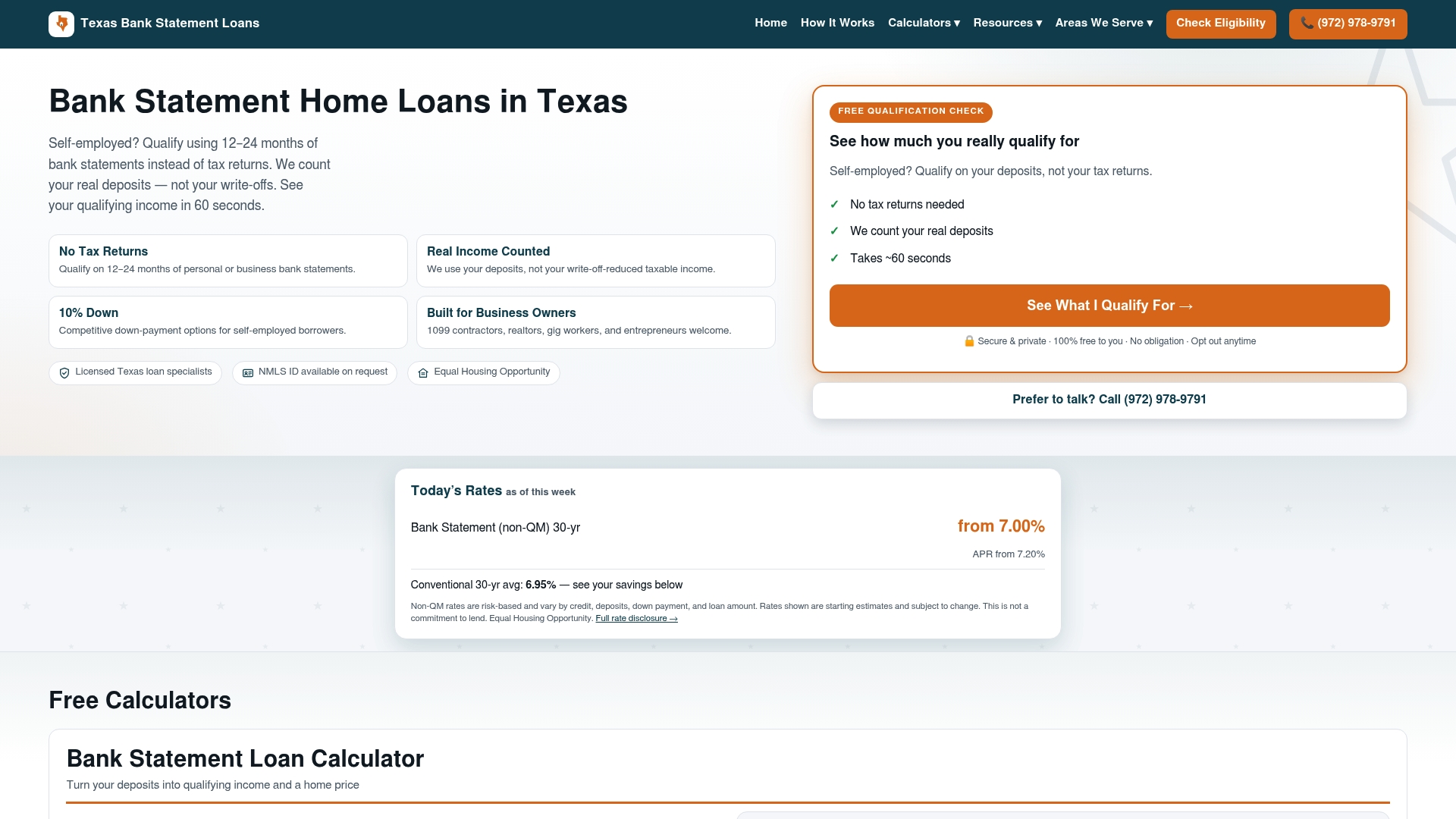
That means a gig worker, 1099 contractor, or STR owner-operator can qualify using real cash flow, not the diminished number a tax accountant optimized for a different goal. Down payment options are available, and the self-employed affordability calculator can provide an estimate of affordability in about 60 seconds, with no obligation. If you’re weighing a short-term rental purchase or refinance in Texas, start with a quick qualification check on the Texas Bank Statement Home Loans site and see where your numbers land before you make an offer.
Sources
Verify lender legitimacy through the Consumer Financial Protection Bureau and NMLS Consumer Access, and model your own numbers with the DSCR calculator.
This article is general information, not a substitute for advice from a qualified financial advisor. Consult a qualified financial professional about your own circumstances before acting on anything here.
- DSCR Loans for Airbnb & STR Properties 2026, DSCR Capital Partners
- Can You Get a DSCR Loan for Short-Term Rentals?, Lower Mortgage
- The Investor’s Guide to DSCR Loans for Short-Term Rentals in 2026, Overline
Recommended
See what you qualify for in 60 seconds, free and no credit check. Use the eligibility check at the top of this page.