
What are the best low down payment mortgage options for self-employed business owners?
Self-employed business owners can qualify for a low down payment mortgage in 2026 through several programs, including conventional loans starting at 3% down, FHA loans at 3.5%, VA and USDA loans with no down payment requirements, and Non-QM bank statement loans starting at 10% down.
The core challenge is income documentation. Most lenders want two years of tax returns, but business owners who write off aggressively often show taxable income far below what they actually earn. That gap kills approvals on conventional loans, which is why Non-QM products exist.
Here is a quick snapshot of your main options:
- Conventional loans: 3% down, 620 credit score minimum; requires two years of tax returns and business documentation
- FHA loans: 3.5% down, 580 credit score minimum; flexible income documentation, government-backed
- VA loans: 0% down for eligible veterans and active-duty service members; no private mortgage insurance required
- USDA loans: 0% down for qualifying rural and suburban properties; income limits apply
- Non-QM bank statement loans: 10-20% down, credit scores typically 660-720; income verified through 12-24 months of bank deposits instead of tax returns
The right fit depends on your credit profile, how your income is documented, and whether you qualify for any government-backed program.

1. Types of low down payment mortgages available to self-employed borrowers
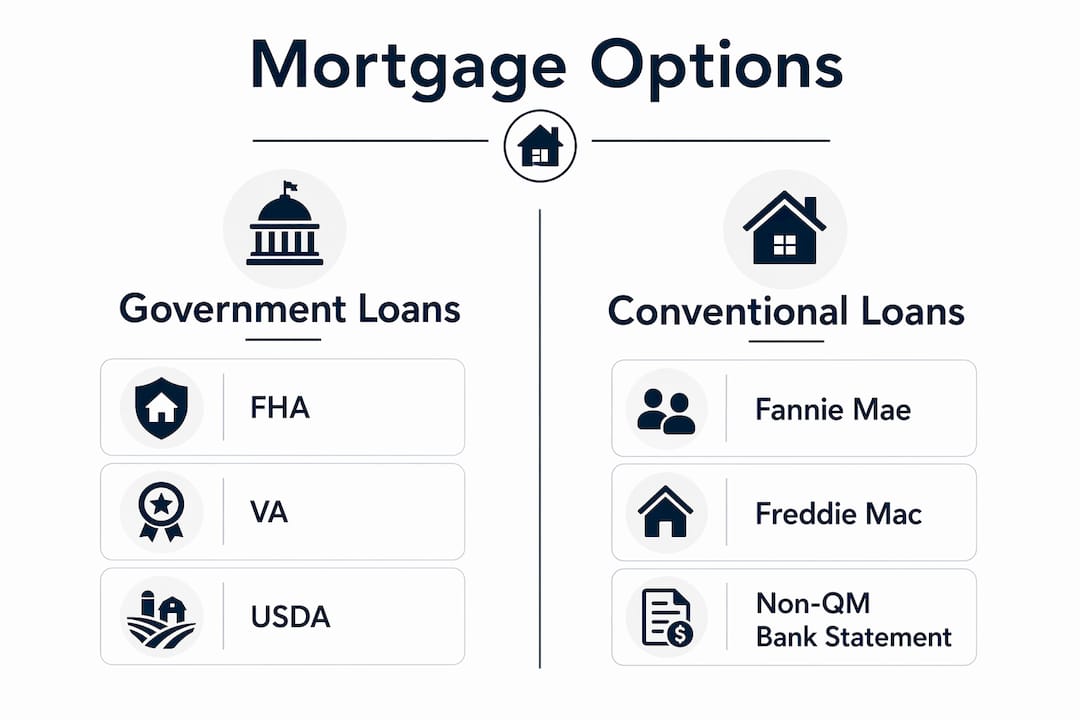
Conventional loans through Fannie Mae and Freddie Mac
Conventional loans backed by Fannie Mae and Freddie Mac are the most common path for self-employed buyers with solid credit. You need a minimum 620 credit score and can put as little as 3% down. The catch is income verification: lenders want two years of personal and business tax returns, and they average the net income across both years. If your write-offs are heavy, your qualifying income shrinks accordingly.
Fannie Mae’s guidelines also require that your business has been operating for at least two years, and lenders will typically request a CPA-prepared profit and loss statement to confirm current-year income trends. Private mortgage insurance kicks in when you put down less than 20%, which adds to your monthly payment.
FHA loans for lower credit scores
FHA loans, insured by the Department of Housing and Urban Development, allow a 3.5% down payment with a 580 credit score. Drop below 580 but stay above 500, and you can still qualify with 10% down. For self-employed borrowers with a few credit blemishes, FHA is often the most accessible government-backed option. The income documentation requirements mirror conventional loans, so the same tax return averaging applies.
FHA loans carry an upfront mortgage insurance premium plus an annual premium, which stays for the life of the loan if you put down less than 10%. That cost is worth factoring into your total monthly budget before committing.
VA loans for veteran business owners
VA loans, guaranteed by the U.S. Department of Veterans Affairs, offer 0% down payment with no private mortgage insurance for eligible veterans, active-duty service members, and surviving spouses. If you served and now run your own business, this is the most financially favorable program available. The VA does not set a minimum credit score, though most lenders require at least 620. Income documentation follows the same two-year self-employment history standard.
USDA loans for rural and suburban properties
USDA loans through the U.S. Department of Agriculture’s Rural Development program also require 0% down, but the property must be in an eligible rural or suburban area and your household income must fall within program limits. Self-employed borrowers qualify using the same tax return documentation as conventional loans. The program charges an upfront guarantee fee and an annual fee, both of which are lower than FHA mortgage insurance in most cases.
Non-QM bank statement loans
Bank statement loans skip tax returns entirely and calculate your income from 12-24 months of bank deposits. Down payments typically run 10-20%, and lenders generally want credit scores between 660 and 720. These loans are not backed by Fannie Mae or Freddie Mac, so they carry slightly higher interest rates than conventional products. For business owners who write off most of their income, the trade-off is often worth it: you qualify on what you actually deposit, not what your Schedule C shows.
2. What qualification criteria do self-employed borrowers need to meet?
Credit score minimums vary by loan type, with conventional and VA loans generally requiring a credit score considered fair, FHA loans accepting somewhat lower scores, and Non-QM products typically aiming for good credit scores. Your debt-to-income ratio (DTI) is equally important. Most conventional and FHA lenders cap DTI at 43-45%, meaning your total monthly debt payments, including the proposed mortgage, cannot exceed that share of your gross qualifying income.
For self-employed borrowers, DTI is where approvals often fall apart. Because lenders use net income from tax returns rather than gross revenue, a business owner earning $300,000 in revenue but showing $80,000 in net income after deductions will qualify for a much smaller loan than their actual cash flow suggests.
Income documentation by business structure
The documents you need depend on how your business is organized:
- Sole proprietors: Two years of personal tax returns (Form 1040) with Schedule C; lenders average the net profit across both years
- LLC members: Two years of personal returns plus K-1 forms if the LLC is taxed as a partnership; business returns (Form 1065) may also be required
- S-corp owners: Two years of personal returns, K-1 forms, and corporate returns (Form 1120-S); lenders add back W-2 wages plus your share of business income
- C-corp owners: Two years of personal and corporate returns (Form 1120); income calculation is more complex and varies by lender
Beyond tax returns, lenders typically require business licenses, proof of insurance, and a CPA-prepared profit and loss statement covering the current year. That P&L helps lenders confirm your business is still generating income at or above the level shown on your returns.
Cash reserves and business credit
Strong cash reserves and a separate business credit history both influence underwriting decisions. Most lenders want to see several months of mortgage payments sitting in liquid accounts after closing. For low down payment loans, that reserve requirement can be the deciding factor between approval and denial. Business credit history matters too: a well-established business credit profile signals financial stability and reduces the lender’s perceived risk.

Pro Tip: Keep your business and personal finances in completely separate accounts for at least 12 months before applying. Lenders look for clean financial separation as a sign of business legitimacy, and commingled funds can trigger additional documentation requests that slow the process.
Using business funds for the down payment
If you plan to use business account funds for your down payment or closing costs, Fannie Mae’s guidelines require proof that the withdrawal will not harm your business’s cash flow. Expect to provide a business balance sheet and a letter from your CPA confirming the business can sustain operations after the transfer.
3. What down payment assistance programs are available to self-employed buyers?
Self-employed buyers often overlook down payment assistance programs, assuming they are only for W-2 employees. Most programs do not exclude self-employed applicants; they focus on income limits and purchase price caps instead.
Common assistance programs include:
- State Housing Finance Agency (HFA) programs: Most states run HFA programs offering grants or second mortgages for down payment and closing costs. Income limits typically apply, and some programs require first-time buyer status (defined as not owning a home in the past three years).
- HUD-approved local programs: The Department of Housing and Urban Development funds local nonprofits and housing agencies that offer forgivable grants, often tied to staying in the home for a set period.
- USDA and FHA-compatible grants: Many assistance programs are specifically designed to layer on top of FHA or USDA loans, covering the required down payment so you effectively purchase with zero out-of-pocket upfront.
- Employer-assisted housing programs: Some municipalities and employers offer down payment help as a benefit, which self-employed borrowers can access through local economic development offices.
Eligibility for most programs hinges on household income relative to the area median income (AMI), the property’s purchase price, and whether you’ve owned a home recently. Self-employed income is calculated the same way lenders calculate it: from tax returns or bank statements, depending on the program. Working with a HUD-approved housing counselor can help you identify which programs stack with your loan type.
4. How to strategically prepare for a low down payment mortgage application
Time your application after a strong income year
Lenders base qualifying income on your most recent fiscal year, so applying after a high-earning year gives you the best shot at the largest loan amount. If your business had a breakout year, do not wait. File your taxes quickly, get your returns in hand, and start the mortgage process before another year of returns comes into play.
Reduce deductions strategically before applying
Financial advisors often recommend reducing discretionary write-offs for one to two years before applying. Yes, you will pay more in taxes. But showing higher net income on your returns can meaningfully increase your qualifying loan amount. The math usually favors the larger loan: the tax savings from aggressive deductions rarely outweigh the cost of a smaller home purchase or a denied application. A tax planning consultation before you apply can help you model the trade-off.
Build reserves and separate your accounts
Aim for several months of projected mortgage payments in liquid savings before you apply. That reserve cushion does two things: it satisfies lender requirements, and it demonstrates financial discipline. Separate business and personal accounts if you have not already. Lenders want to see that your business income and personal finances operate independently.
Get your documentation in order early
Gather two years of personal and business tax returns, three to six months of bank statements, a current CPA-prepared profit and loss statement, your business license, and proof of business insurance. Having these ready before you start shopping lenders saves weeks. Many self-employed borrowers lose rate locks or miss purchase windows because documentation takes longer than expected.
Pro Tip: Work with a lender who specializes in self-employed borrowers rather than a general mortgage broker. Lenders experienced with variable income know which underwriting overlays to avoid and which loan products fit your income profile. The difference in approval odds can be significant.
5. Common questions self-employed mortgage applicants ask
What is the minimum down payment for a self-employed borrower? It depends on the loan type. Conventional loans require as little as 3% down with a 620 credit score. FHA loans require 3.5% with a 580 score. VA and USDA loans offer 0% down for eligible borrowers. Bank statement loans typically start at 10% down.
What documents do I need to verify my income? Most lenders require two years of personal and business tax returns, a CPA-prepared profit and loss statement, three to six months of bank statements, a business license, and proof of insurance. Bank statement loans replace tax returns with 12-24 months of bank deposit records.
Can I qualify if my tax returns show low income due to deductions? Yes, but your options narrow. Conventional and FHA lenders use net income from your returns, so heavy deductions reduce your qualifying amount. Bank statement loans solve this by calculating income from actual deposits rather than taxable income.
How does my business structure affect my application? It affects which forms you submit and how income is calculated. S-corp owners can add back W-2 wages plus their share of business income. Sole proprietors use Schedule C net profit. LLC members may need partnership returns and K-1 forms. Each structure has a slightly different income calculation method.
Do lenders care about my business credit score? Yes. A strong business credit profile signals stability and can support your application, especially for Non-QM loans. Lenders may also check whether your business has outstanding liens or judgments that could affect your personal finances.
How much in reserves do I need? Most lenders want several months of mortgage payments in liquid accounts after your down payment and closing costs. For low down payment loans, reserves are often the deciding factor in borderline approvals.
6. How Texasbankstatementloans offers a flexible low down payment path
For self-employed borrowers whose tax returns do not reflect their actual income, Texasbankstatementloans offers a direct alternative to the conventional documentation model. Instead of tax returns, the program evaluates 12-24 months of bank deposits to determine qualifying income, which means your real revenue drives the approval rather than your write-offs.
Key features of the Texasbankstatementloans approach:
- Down payments starting at a low double-digit percentage, making homeownership accessible without requiring a large upfront cash reserve
- Bank statement income verification using 12-24 months of deposits, designed for business owners, 1099 contractors, and gig economy workers
- Quick qualification check that lets you see how much you can realistically borrow in about 60 seconds, with no obligation
- Flexible underwriting that accounts for the income variability typical of self-employed borrowers
- Coverage across Texas markets, including Houston, San Antonio, Midland, and surrounding metro areas
The program is built specifically for the borrower that traditional lenders struggle to serve: someone with strong cash flow, real assets, and a legitimate business, but a tax return that tells a different story. If you have been turned down by a conventional lender or told your qualifying income is too low, bank statement loans are worth a serious look.
Key Takeaways
Self-employed business owners have more low down payment mortgage options than most realize, but the right path depends entirely on how your income is documented and which loan type fits your credit profile.
| Point | Details |
|---|---|
| Multiple loan types available | Conventional (3% down), FHA (3.5% down), VA and USDA (0% down), and bank statement loans (10% down) all serve self-employed borrowers. |
| Documentation drives approval | Two years of tax returns, a CPA-prepared profit and loss statement, and 6-12 months of bank statements are standard requirements. |
| Reserves matter as much as the down payment | Lenders want 6-12 months of mortgage payments in liquid savings after closing, especially for low down payment loans. |
| Tax strategy affects qualifying income | Reducing deductions before applying can increase your qualifying income, though it raises your tax bill for that year. |
| Texasbankstatementloans offers a bank statement path | Down payments start at 10%, with income verified from 12-24 months of deposits instead of tax returns. |
What most self-employed borrowers get wrong about mortgage qualification
The conventional wisdom says self-employed buyers face a harder road to homeownership. That is partially true, but the real problem is not being self-employed. It is the mismatch between how business owners manage their taxes and what mortgage lenders need to see.
Most business owners spend years minimizing taxable income. That is smart tax strategy. But when you apply for a mortgage, those same deductions work against you. A borrower who earns $200,000 in gross revenue but shows $60,000 in net income after write-offs will qualify for a loan sized around that $60,000 figure. The lender does not care about your revenue. They care about what the IRS says you earned.
The mistake I see most often is waiting too long to think about this. Business owners apply for a mortgage, get a low qualifying number, and then scramble to explain their income. The time to address it is one to two years before you plan to buy, not the week you find a house you want. Reducing deductions strategically, building reserves, and separating business and personal accounts are all moves that take time to show up in your financial profile.
The other underrated option is the bank statement loan. Many self-employed buyers assume these products are a last resort with punishing rates. The reality is more nuanced. Yes, rates run slightly higher than conventional loans. But for a borrower who qualifies for a $250,000 conventional loan on paper and a $500,000 bank statement loan based on actual deposits, the higher rate on the larger loan often produces a better outcome. The math depends on your specific numbers, but the option deserves a real comparison rather than a reflexive dismissal.
The lender you choose matters more than most buyers realize. A loan officer who primarily works with W-2 employees will often misread a self-employed file and either deny it or quote terms that do not reflect your actual options. Find someone who works with business owners regularly. They know which documentation to request, which underwriting overlays to avoid, and which products fit your income profile.
Texasbankstatementloans: built for the business owner who earns more than their tax return shows
Self-employed buyers in Texas often qualify for far less than they should, simply because their tax returns do not capture their real income. Texasbankstatementloans was built to fix exactly that.
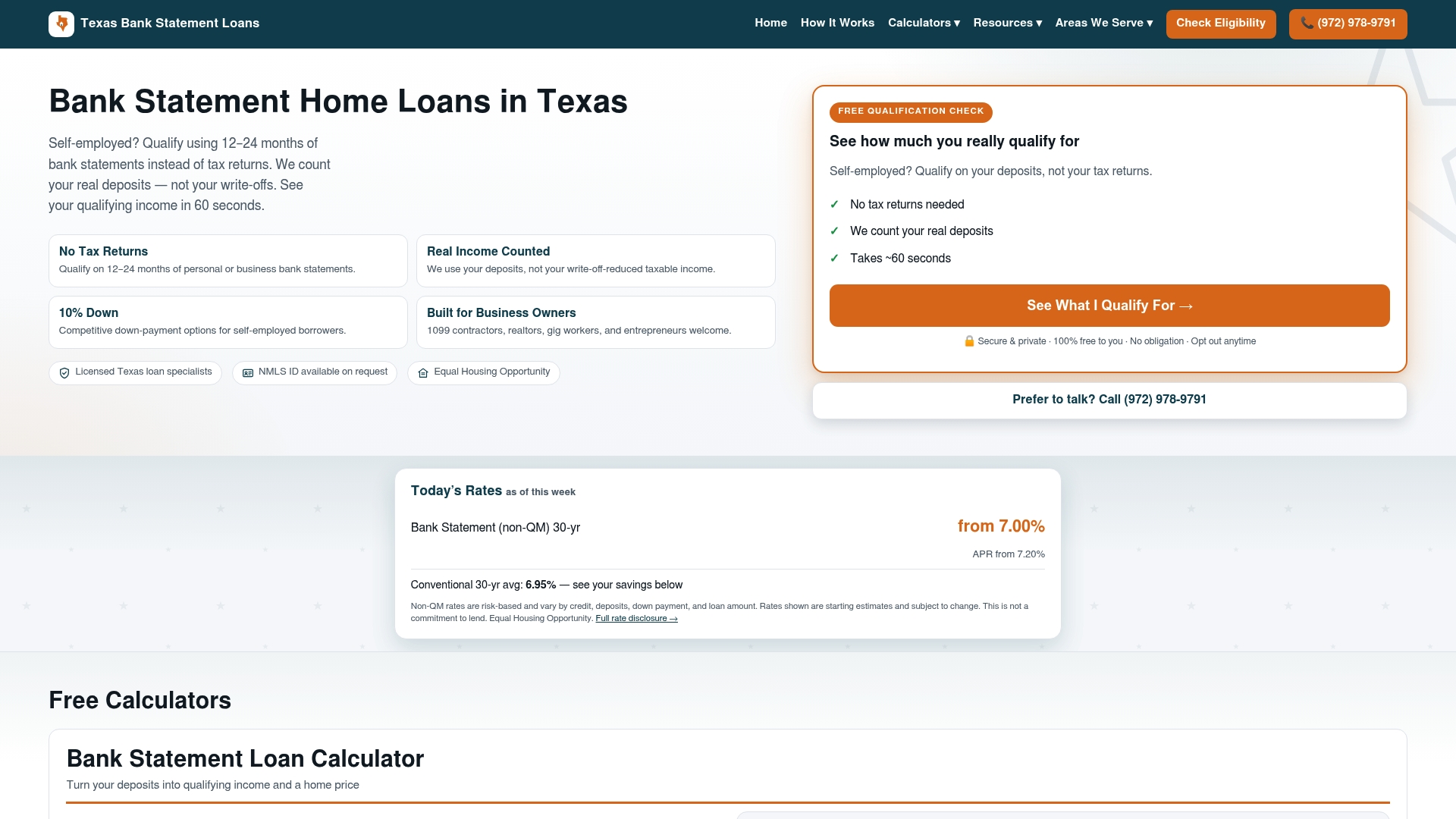
The program uses 12-24 months of bank deposits to calculate your qualifying income, with down payments starting at 10% and no requirement to hand over years of tax returns. Whether you are a business owner in Houston, a 1099 contractor in San Antonio, or a gig worker anywhere in Texas, the qualification process takes about 60 seconds to start. No obligation, no commitment, just a clear picture of what you can actually afford. If you have been told your income does not qualify, it is worth checking whether your deposits tell a different story. You can also run the numbers yourself with the bank statement loan calculator before speaking with anyone.
Recommended
- Bank Statement Loans in Midland, TX | Self-Employed Mortgage
- Bank Statement Loans in El Paso, TX | Self-Employed Mortgage
- Bank Statement Loans in Houston, TX | Self-Employed Mortgage
See what you qualify for in 60 seconds, free and no credit check. Use the eligibility check at the top of this page.