
Mortgage underwriting is the process a lender uses to verify your financial profile and decide whether to approve your home loan. The underwriter checks three core elements, known in the industry as the “three Cs”: Credit, Capacity, and Collateral. CFPB guidelines describe these as the foundational criteria for evaluating loan risk. Credit covers your borrowing history and score. Capacity measures whether your income is sufficient to handle the monthly payment. Collateral refers to the property itself, confirmed through an appraisal.
The documents an underwriter reviews typically include:
- Credit reports from all three major bureaus
- Pay stubs, W-2s, or tax returns for income verification
- Bank statements and investment account records
- A property appraisal and title search
- Employment verification letters or records
The process ends in one of three outcomes: full approval, conditional approval (where you must satisfy specific requirements before closing), or denial. Understanding where you stand on each of the three Cs before you apply is the single most useful thing you can do to prepare.
How mortgage underwriting works, step by step
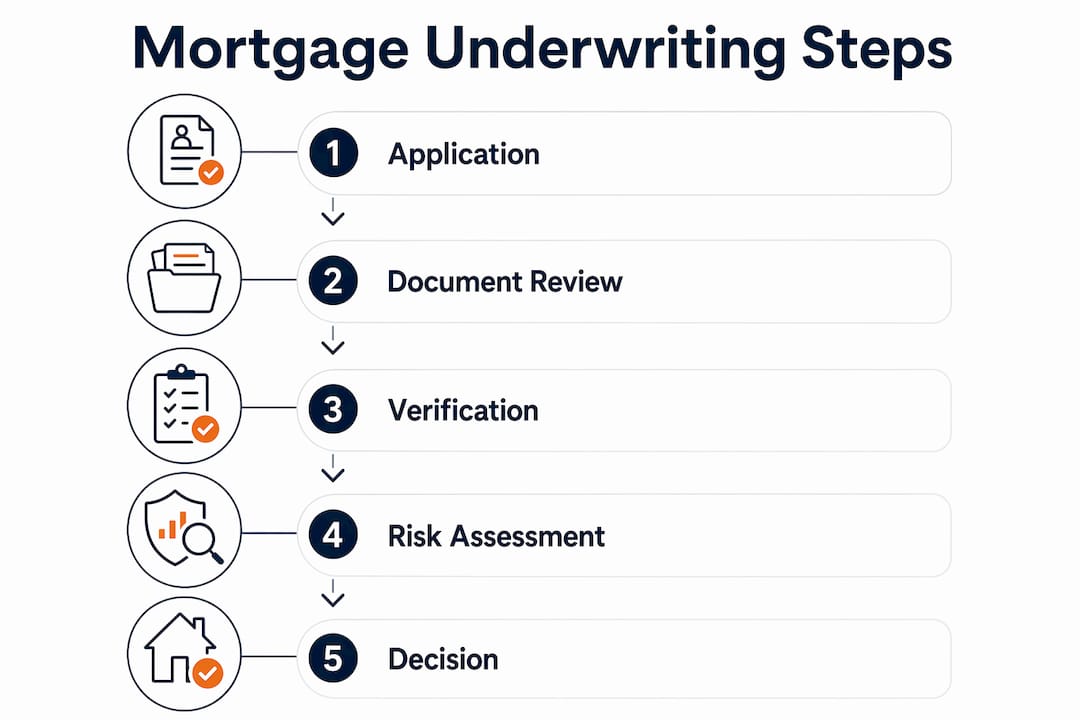
Underwriting follows a defined sequence. Knowing each phase helps you stay ahead of requests and avoid delays.
-
Loan application submission. You complete a Uniform Residential Loan Application (Form 1003), disclosing income, assets, debts, and employment. This triggers the formal process and sets the documentation checklist.
-
Initial document collection. The lender’s processor gathers your pay stubs, bank statements, tax returns, and identification. Gaps here are the most common source of early delays.
-
Automated underwriting system (AUS) review. Most lenders run your file through an automated underwriting system such as Fannie Mae’s Desktop Underwriter or Freddie Mac’s Loan Product Advisor. The AUS scores your application against agency guidelines and returns a recommendation: approve, refer, or refer with caution.
-
Manual underwriting review. When the AUS flags complexity, a human underwriter steps in. Manual review takes longer but allows for context that an algorithm cannot weigh, such as a documented medical gap in employment.
-
Income and employment verification. The underwriter confirms your stated income against IRS transcripts, employer records, and pay stubs. Self-employed borrowers face additional scrutiny here because business deductions often reduce reported income on tax returns.
-
Asset verification. Bank statements covering 60-90 days are reviewed to confirm you have enough for the down payment, closing costs, and cash reserves. Large deposits that appear without explanation trigger follow-up questions.
-
Property appraisal review. An independent licensed appraiser values the home. The underwriter compares that value against the loan amount to calculate the loan-to-value (LTV) ratio. A low appraisal can require renegotiation or a larger down payment.
-
Title search. A title company checks for liens, ownership disputes, or encumbrances on the property. Clear title is required before any lender will fund.
-
Debt-to-income ratio calculation. The underwriter adds up all monthly debt obligations, divides by gross monthly income, and compares the result against program limits. This single calculation is the most common point of failure in the process.
-
Underwriting decision. The underwriter issues a decision: clear to close, conditional approval, or denial. Conditional approvals list specific items you must provide before the loan can fund.
-
Condition clearance. If you receive a conditional approval, you submit the requested documents promptly. Delays at this stage can push your closing date or, in the worst case, void the approval.
-
Final verification before closing. Just before funding, the lender runs a final check on your credit, employment, and bank accounts. Any new debt, job change, or large withdrawal at this stage can trigger a last-minute denial.
How long does mortgage underwriting take?
Underwriting typically takes 3 to 6 weeks, though that range shifts depending on several factors.
- Borrower complexity. Self-employed income, multiple properties, or non-standard assets require more documentation and review time.
- Document responsiveness. Every day you wait to return a requested document adds roughly a day to your timeline.
- Lender workload. High-volume purchase seasons, particularly spring and early summer, stretch processing queues at most lenders.
- Automated vs. manual review. Files that clear the automated underwriting system quickly can move to closing faster, sometimes in under two weeks. Manual underwriting adds time, sometimes several weeks.
- Appraisal scheduling. In competitive markets, licensed appraisers book out, and a delayed appraisal holds up everything downstream.
Pro Tip: Submit every document the lender requests within 24 hours. Borrowers who respond quickly consistently close faster than those who batch their responses.
For context on how mortgage approval timelines compare across different lending environments, the pattern holds: documentation speed is the variable most within your control.

Common obstacles in mortgage underwriting and how to handle them
Several problems show up repeatedly in underwriting files. Knowing them in advance gives you time to fix them before they become denials.
-
High debt-to-income ratio. DTI is the leading cause of mortgage denial, responsible for a significant portion of denials according to 2024 HMDA data analyzed by the CFPB. The 50% DTI threshold functions as a hard ceiling for most lenders in 2026, with denial rates jumping sharply above that level. Use a DTI calculator to check your ratio before you apply.
-
Low or recently damaged credit. A credit score drop from a new account, a missed payment, or a collections item during the underwriting period can change your rate or kill your approval. Freeze new credit applications from the day you submit your loan application until after closing.
-
Appraisal shortfalls. When the appraised value comes in below the purchase price, you either renegotiate with the seller, cover the gap with cash, or walk away. Ordering a pre-listing appraisal on a property you are serious about can surface this risk early.
-
Unexplained deposits. A $5,000 transfer from a family member, a freelance payment, or a sold asset that appears in your bank statements without documentation will trigger a letter of explanation request. Document every large deposit before you apply.
-
Employment changes. Switching jobs during underwriting, even for higher pay, can pause your file entirely. Lenders want to see stability, and a new employer means new verification from scratch.
-
Rising interest rates. Higher rates mechanically push DTI ratios up, moving borderline borrowers over the denial threshold without any change in their actual financial behavior. Check current loan rates before locking in a purchase price.
Pro Tip: Avoid any major financial move between pre-approval and closing. No new car loans, no furniture financing, no balance transfers. Underwriters run a final credit check right before funding.

What you should expect during the underwriting stage
Underwriting is not a passive waiting period. Your active participation directly affects the outcome.
The underwriter will request documents and clarifications throughout the review. Common requests include letters of explanation for credit inquiries, proof of gift funds, updated pay stubs if your initial ones expire, and additional bank statement pages. Treat each request as time-sensitive.
- Verification scope. Expect the underwriter to verify your credit history, all income sources, every debt account, asset balances, and the property’s value and title status.
- Your role. Submit accurate, complete documents the first time. Partial submissions slow the process and sometimes raise questions that a complete package would have answered automatically.
- Possible outcomes. Full approval means you are clear to close. Conditional approval means you must satisfy listed conditions before the loan funds. Denial means the application did not meet the lender’s guidelines, and you will receive a written explanation under the Equal Credit Opportunity Act.
- Financial stability up to closing. Changes to employment or new debts right before closing are among the most common causes of last-minute denials. Keep your financial profile static from application through funding.
- Conditional approval timelines. Responding to outstanding conditions within 48 hours keeps your file moving. Delays beyond that can stall loan progress or push your closing date.
Pre-approval is an estimate based on stated information. Underwriting is the definitive verification. The two are not interchangeable, and treating a pre-approval letter as a guarantee is one of the most common and costly mistakes buyers make.
Bank statement loans: a better path for self-employed borrowers
Traditional underwriting relies heavily on W-2s and tax returns, which creates a real problem for self-employed borrowers. Business owners, 1099 contractors, and gig workers often show lower taxable income than they actually earn because legitimate business deductions reduce the number on paper. The result is a qualified borrower who looks unqualified on a standard application.
Bank statement loans solve this by using 12-24 months of bank deposits as the income basis instead of tax returns. The underwriter averages the deposits over the review period to calculate qualifying income, which typically reflects actual cash flow far more accurately than a Schedule C.
Key features of this loan type:
- Income verification method. Deposits from personal or business accounts replace W-2s and tax transcripts entirely.
- Who qualifies. Business owners, freelancers, independent contractors, and gig workers with consistent deposit history are the primary candidates.
- Down payment. Options start at 10%, making entry accessible without requiring a large cash reserve.
- Texas market access. The Texas housing market moves fast. A self-employed affordability calculator can show you a realistic purchase range in under 60 seconds, before you start competing for properties.
- Geographic reach. Texasbankstatementloans serves borrowers across the state, including Dallas, Austin, and surrounding metro areas.
For self-employed borrowers who have been turned away by traditional lenders, bank statement underwriting is not a workaround. It is a purpose-built qualification method that matches how your income actually works.
Key Takeaways
Mortgage underwriting is the lender’s definitive risk assessment, verifying credit, income, assets, and property value before any loan funds.
| Point | Details |
|---|---|
| The three Cs drive every decision | Credit, Capacity, and Collateral are the core criteria underwriters evaluate on every application. |
| DTI is the top denial trigger | Debt-to-income ratio accounts for 36% of denials; the 50% threshold functions as a hard ceiling for most lenders in 2026. |
| Timeline is 3-6 weeks on average | Document responsiveness is the variable most within your control; slow replies extend the timeline directly. |
| Financial stability is required through closing | New debts, job changes, or large unexplained deposits between application and closing are leading causes of last-minute denials. |
| Texasbankstatementloans serves self-employed borrowers | Bank statement loans use 12-24 months of deposits instead of tax returns, with down payments starting at a relatively low percentage. |
What most borrowers get wrong about underwriting
The standard advice is to get pre-approved early and gather your documents. That is correct, but it misses the more consequential insight: underwriting is not a judgment call. It is a mechanical process governed by documented thresholds.
The CFPB is clear that underwriting relies on verified financial data, not subjective lender opinion. That means your outcome is largely determined before you walk in the door, by your DTI, your credit history, and your property’s appraised value. The underwriter is not deciding whether they like your story. They are checking whether your numbers clear the thresholds their guidelines require.
This has a practical implication most borrowers overlook. Improving your odds is not about making a better impression. It is about moving specific numbers. Pay down a credit card balance to drop your DTI two points. Dispute an error on your credit report before you apply. Avoid financing anything in the six months before you submit. These are mechanical fixes to a mechanical process.
The other thing worth understanding is the gap between pre-approval and actual approval. Pre-approval is based on stated, unverified information. Underwriting verifies everything. Borrowers who treat a pre-approval letter as a guarantee sometimes make financial moves, like quitting a job or financing furniture, that they would never make if they understood how much verification still lies ahead.
The borrowers who close without drama are the ones who treat the underwriting period like a financial freeze. Nothing changes. No new accounts, no new debts, no large unexplained transfers. That discipline, more than any document you can submit, is what gets you to the closing table.
Self-employed in Texas? There is a faster way to qualify
For self-employed buyers, the traditional mortgage process is built around income documentation that actively works against you. Tax returns show deductions, not cash flow. W-2s do not exist. The result is a qualification gap between what you earn and what a conventional underwriter will count.
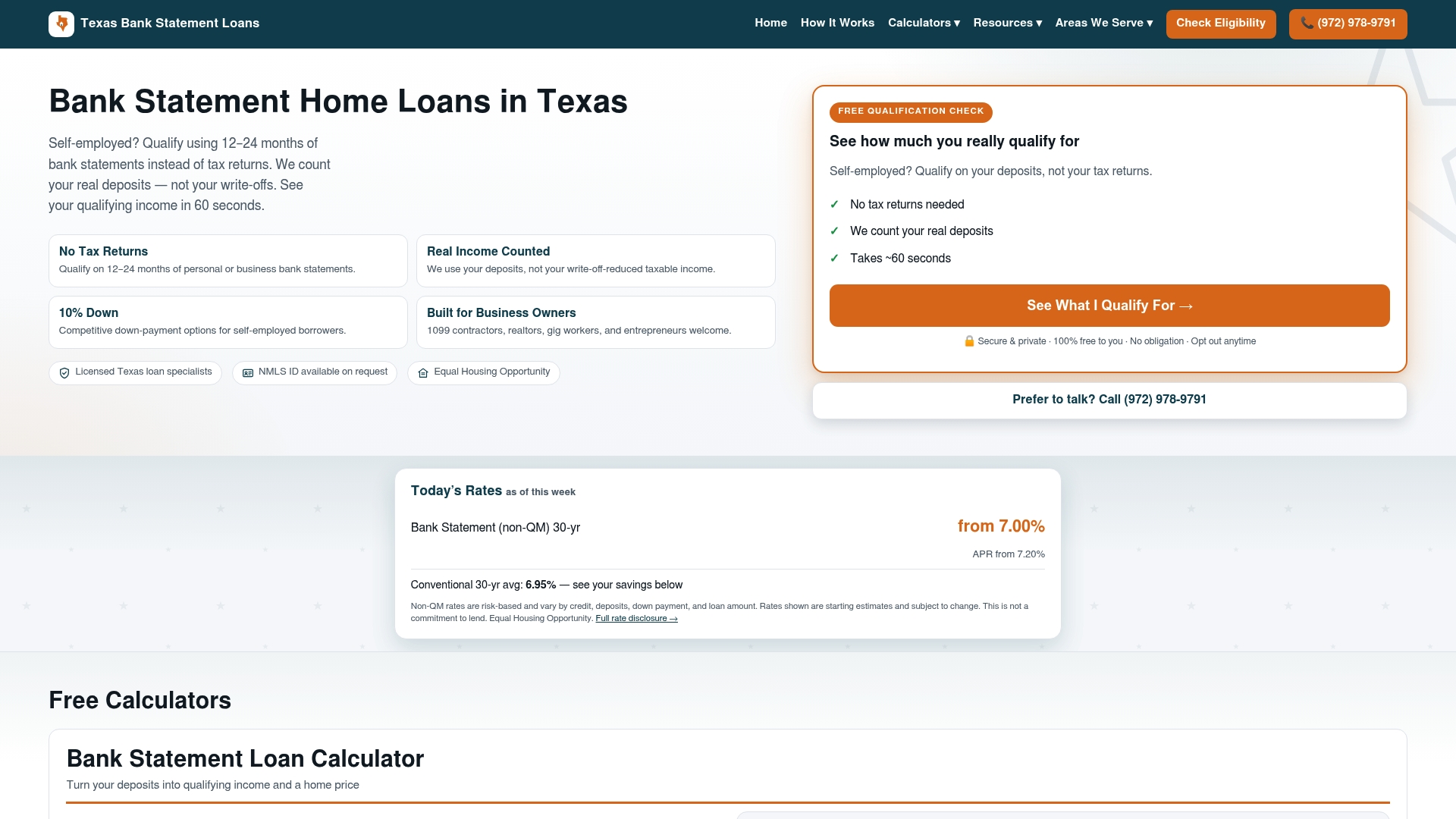
Texasbankstatementloans was built specifically for this situation. Instead of tax returns, qualification is based on 12-24 months of bank deposits, which reflects how your income actually flows. Down payments start at 10%, and a 60-second affordability check at texasbankstatementloans.com shows you a realistic purchase range before you spend time on a full application. For buyers in Houston, Plano, Midland, and across Texas, this is a direct path to homeownership that conventional underwriting closes off. Check today’s bank statement loan rates and see what you qualify for.
Recommended
See what you qualify for in 60 seconds, free and no credit check. Use the eligibility check at the top of this page.