
Here’s the quick decision rule: if your current rate is already competitive with today’s market, skip the full refinance and request appraisal-based cancellation instead. It costs a few hundred dollars rather than thousands. Refinance when you can also lock in a meaningfully lower rate, or when your loan type (FHA, USDA, or lender-paid PMI) makes cancellation impossible without a new loan.
Three things to check right now: your current LTV based on a realistic home value estimate, today’s refinance rates versus your existing rate, and a rough closing cost figure from a lender. Those three numbers tell you almost everything.
Key Takeaways
| Point | Details |
|---|---|
| The core decision rule | Refinance when LTV is at or below 80% on the new loan and the break-even is shorter than your planned ownership horizon. |
| Appraisal-only vs. full refinance | Choose appraisal-only cancellation when your rate is competitive; choose refinance when you also gain a rate drop of 0.75% or more. |
| FHA and lender-paid PMI | These loan types require a full refinance into a conventional loan to eliminate mortgage insurance. |
| Key documents and next step | Gather your mortgage statement, income proof, and bank statements, then confirm your servicer’s seasoning requirement before ordering an appraisal. |
| Texasbankstatementloans option | Self-employed borrowers can qualify for a conventional refinance using 12-24 months of bank deposits, removing the tax-return barrier to PMI elimination. |
Table of Contents
- How refinancing actually removes PMI and when it will not
- What are your legal rights for PMI cancellation under the HPA?
- How to calculate whether refinancing to remove PMI is worth it
- How to check whether you qualify to remove PMI by refinancing
- What are the alternatives to refinancing for removing PMI?
- Common pitfalls when refinancing to remove PMI
- Self-employed borrowers: how bank-statement underwriting changes the refinance process
- Concrete next steps: your refinance-to-remove-PMI checklist
- Self-employed in Texas? Here is how Texasbankstatementloans fits this picture
- Sources
How refinancing actually removes PMI and when it will not
When you refinance, the lender orders a new appraisal and underwrites a brand-new loan. The old loan, along with its PMI, is paid off at closing. Simple in theory. A few wrinkles in practice.
The step flow:
- You apply for a refinance and the lender orders an appraisal.
- The underwriter calculates LTV on the new loan: new loan balance ÷ appraised value.
- If LTV is 80% or below on a conventional loan, no PMI is required on the new loan.
- The old loan closes out, and PMI coverage on it terminates.
Where it gets complicated by loan type:
- Conventional PMI is borrower-paid and cancellable under the Homeowners Protection Act (HPA). A refinance that hits 80% LTV eliminates it cleanly.
- FHA mortgage insurance premium (MIP) is a different animal. For FHA loans with case numbers assigned after June 3, 2013, MIP typically runs for the life of the loan unless you refinance into a conventional mortgage. Requesting cancellation does not work here. Refinancing is the only exit.
- USDA annual guarantee fees follow similar logic. They do not cancel under the HPA.
- Lender-paid PMI is embedded in your interest rate. You cannot cancel it because there is no separate PMI line item to remove. The only way out is a new loan at a lower rate without lender-paid coverage.
When refinancing still will not remove PMI:
- The appraisal comes in lower than expected and the new LTV stays above 80%.
- You roll too much into the new loan (closing costs, cash-out) and push the balance past 80% LTV.
- The lender structures the new loan with lender-paid PMI again, hiding it in the rate.
Refinancing into a conventional loan at or below 80% LTV based on a current appraisal typically eliminates borrower-paid PMI, and combining that with a rate reduction compresses the break-even timeline considerably.
What are your legal rights for PMI cancellation under the HPA?
The Homeowners Protection Act gives you three distinct rights, and knowing which one applies to your situation determines whether you need a refinance at all.
Not the current value. This is the number that trips people up. Your servicer may require a good payment history, certification that no junior liens exist, and in some cases a new appraisal to confirm value has not declined.
Automatic termination: Under 12 U.S.C. §4902, servicers must terminate PMI automatically when your balance reaches 78% of the original value based on the original amortization schedule. You do not have to ask. The servicer is required to act.
Final midpoint termination: Even if neither threshold is met, PMI must terminate at the midpoint of the loan’s amortization period. On a 30-year loan, that is halfway through the term (typically around month 180).
Refund timing: Servicers must return unearned PMI premiums to borrowers no later than 45 days after termination or cancellation. The CFPB’s compliance bulletin on PMI cancellation documents a recurring pattern of servicer failures: delayed terminations, refunds incorrectly credited to escrow rather than returned to the borrower, and outright failures to cancel on schedule.
One important distinction: “original value” under the HPA is fixed at origination. If your home has appreciated significantly, the HPA’s 80% threshold may still be years away even though your current LTV is already well below 80%. That gap is exactly where investor-guideline cancellation or a refinance becomes useful.
How to calculate whether refinancing to remove PMI is worth it
The break-even formula is straightforward:
Total refinance costs ÷ (monthly PMI savings + monthly interest savings) = months to break even
If you plan to stay in the home longer than the break-even period, refinancing wins. If you might sell or refinance again before then, it probably does not.
Worked example: appraisal-only cancellation vs. full refinance
Appraisal-only cancellation path:
-
Appraisal cost: $500 (appraisal fees typically range from several hundred to over a thousand dollars depending on market and property type)
-
Monthly savings: $175 (PMI eliminated, rate unchanged)
-
Break-even calculations vary, but appraisal-only cancellation often breaks even in a few months
-
Closing costs are typically several thousand dollars, generally a low single-digit percentage of the loan amount
-
Monthly PMI savings: the full PMI amount
-
Monthly interest savings depend on the loan amount and rate reduction but can be significant
-
Total monthly savings: $394
-
Break-even calculations vary, but full refinance break-even often ranges from more than a year to multiple years
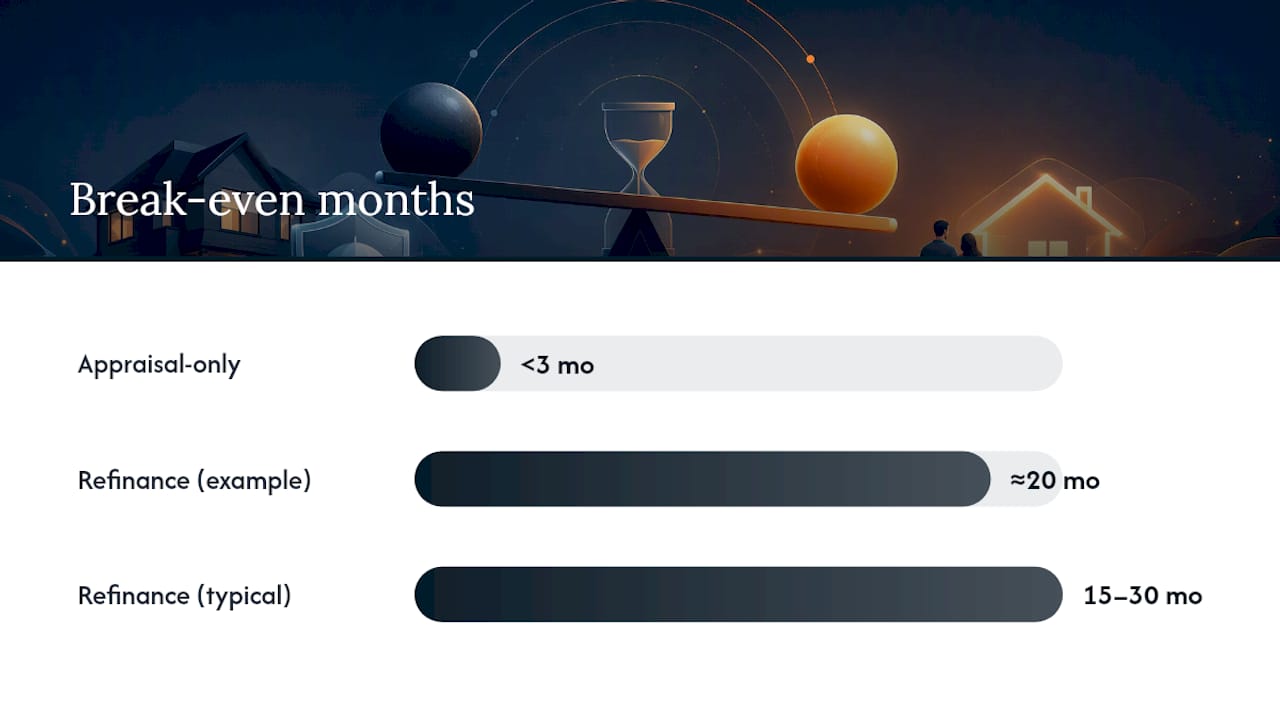
The appraisal-only route breaks even in under three months. The refinance takes about 20 months but permanently reduces the interest rate. If you plan to stay five or more years, the refinance generates far more total savings. If you might move in two years, the appraisal route is the clear winner.
Use the mortgage payment calculator to run your own numbers with your actual balance and rate.
| Input | Appraisal-Only | Full Refinance |
|---|---|---|
| Upfront cost | $350-$1,100 | several thousand dollars |
| Monthly PMI savings | Full PMI amount | Full PMI amount |
| Monthly interest savings | $0 | Depends on rate drop |
| Break-even (example) | Under 3 months | 15-30 months typical |
| Best for | Rate already competitive | Rate drops 0.75%+ |
Pro Tip: Before you run the math, ask your lender whether closing costs can be rolled into the new loan. If they can, your out-of-pocket is zero at closing, but your loan balance rises and the monthly savings shrink slightly. Run the break-even on the higher balance, not the original one.
When a refinance removes PMI and meaningfully reduces the interest rate, the combined savings often compress the break-even to under three years, which makes it a strong move for homeowners planning to stay long term.
How to check whether you qualify to remove PMI by refinancing
Work through these steps in order before calling a lender.
-
Pull your current mortgage statement. Find your outstanding principal balance and your original loan amount. Note your current interest rate and monthly PMI amount.
-
Estimate your home’s current value. Use recent comparable sales in your neighborhood (Zillow, Redfin, or a local agent’s informal comp pull). Be conservative. Lenders will order their own appraisal, and an overestimate will cost you time.
-
Calculate your current LTV. Divide your loan balance by the estimated home value. If the result is 0.80 or below, you are in range for PMI removal. If it is above 0.80, a refinance will not eliminate PMI unless you bring cash to closing.
-
Check today’s refinance rates. Compare current market rates to your existing rate. A drop of 0.75% or more generally makes a full refinance worth modeling. For current bank-statement refinance rates, check today’s rates.
-
Call a lender for a preliminary appraisal estimate or pre-approval. Ask specifically whether your estimated LTV would qualify for a no-PMI conventional loan and what the lender’s seasoning requirements are.
-
Confirm your servicer’s seasoning policy before ordering an appraisal. Servicers often require a seasoning period of at least 12 months before accepting a new appraisal for cancellation. Paying for an appraisal before confirming this wastes money.
Documents to have ready:
- Current mortgage statement (balance, rate, PMI amount)
- Proof of income (W-2s, 1099s, or 12-24 months of bank statements for self-employed borrowers)
- Two months of bank statements
- HOA dues and property tax records
- Payoff statement if you need the exact balance
Questions to ask your servicer or lender:
- Is my PMI borrower-paid or lender-paid?
- Do you have a seasoning requirement before accepting an appraisal-based cancellation?
- Will you accept a recent independent appraisal, or do you require a servicer-ordered one?
- What is the minimum LTV required for PMI removal on a refinance?
What are the alternatives to refinancing for removing PMI?
Refinancing is not always the lowest-cost path. Four other routes exist, and each fits a specific situation.
This costs nothing beyond a written request, though the servicer may require an appraisal to confirm value has not declined. This works only on conventional loans and only when the HPA threshold is met based on the original value.
Do nothing and let the amortization schedule do the work. Slow, but free.
Investor-guideline cancellation using current appraised value Some lenders’ investor guidelines allow PMI cancellation based on the current appraised value rather than the original value, even when the HPA does not require it. This can accelerate removal significantly if your home has appreciated. It requires a lender-ordered appraisal and servicer cooperation, but the cost is one appraisal fee rather than full closing costs.
Extra principal payments It avoids all transaction costs. The downside: it ties up capital that might earn more elsewhere, and it still uses the original value, not the current one.
Recast or lender-paid PMI conversion Lender-paid PMI, on the other hand, is not a removal strategy. It just buries the cost in your rate permanently.
Loan types where refinancing is effectively the only option:
- FHA loans with case numbers after June 3, 2013 (MIP for life of loan)
- USDA loans (annual guarantee fee does not cancel under HPA)
- Any loan with lender-paid PMI (no separate PMI line to cancel)
An appraisal-only route often beats a full refinance when your rate is already near market. Full refinance wins when you also lower your rate meaningfully or when the loan type requires it.
Common pitfalls when refinancing to remove PMI
Most problems fall into three categories: appraisal surprises, servicer policy traps, and hidden costs that flip the math.
Appraisal risk Now you either need to bring cash to closing to buy down the balance, accept PMI on the new loan, or walk away and pay the appraisal fee for nothing. Mitigate this by pulling recent comparable sales yourself before applying. If the comps are thin or trending down, get an informal broker price opinion first.
Seasoning traps Servicers sometimes require 12-24 months of payment history before accepting a new appraisal for cancellation. If you bought or last refinanced recently, you may be locked out of appraisal-based removal regardless of your LTV. Always confirm the seasoning requirement before paying for anything.
Hidden costs that break the math:
- Prepayment penalties on the existing loan (rare on post-2014 loans, but check)
- Escrow shortages at closing when property taxes or insurance have risen
- A higher rate on the new loan that partially or fully offsets the PMI savings
- Billing errors where PMI continues past the cancellation date (a documented CFPB supervisory finding)
- Refunds credited to escrow rather than returned to you directly
Servicer errors and delayed refunds The CFPB’s compliance bulletin identifies a pattern of servicers failing to cancel PMI on schedule and mishandling unearned-premium refunds. After any cancellation or refinance payoff, check your next two mortgage statements to confirm PMI is gone. If a refund is owed, it must arrive within 45 days under the HPA. If it does not, file a complaint with the CFPB.
Self-employed borrowers: how bank-statement underwriting changes the refinance process
For W-2 employees, refinancing is a documentation exercise. For self-employed borrowers, it can feel like qualifying for the first time all over again, especially if tax returns show lower income than the business actually generates.

Bank-statement underwriting sidesteps that problem. Instead of tax returns, the lender reviews 12-24 months of personal or business bank deposits to calculate qualifying income. The deposit average becomes the income figure used in the debt-to-income (DTI) calculation. For a business owner whose Schedule C shows heavy write-offs, this can mean qualifying for a significantly larger loan, or qualifying at all.
What self-employed borrowers should have ready for a bank-statement refinance:
- 12-24 months of personal or business bank statements (lender specifies which)
- Current mortgage statement showing balance, rate, and PMI amount
- Business license or CPA letter confirming self-employment
- Recent appraisal if available (lender may order a new one regardless)
- Two years of business ownership documentation
Practical questions to ask the lender:
- Do you accept personal statements, business statements, or both?
- What expense ratio do you apply to business deposits when calculating income?
- How does the resulting DTI affect my rate offer compared to a full-doc loan?
The expense ratio question matters. A borrower depositing $15,000 per month in a business account might qualify on $7,500 per month of income. Knowing this in advance lets you model whether the refinance will actually hit the LTV and DTI targets needed to drop PMI.
Bank-statement refinance products can help self-employed borrowers convert FHA MIP or lender-paid PMI situations into conventional loans without the standard tax-return burden. For a business owner stuck in an FHA loan with lifetime MIP, this path can be the difference between paying mortgage insurance indefinitely and eliminating it within a year.
Concrete next steps: your refinance-to-remove-PMI checklist
This week (immediate):
- Pull your mortgage statement and write down: current balance, original loan amount, current rate, and monthly PMI amount.
- Estimate home value using recent comparable sales. Calculate LTV: balance ÷ estimated value.
- Check current refinance rates and note the gap between your rate and today’s market.
- Determine your loan type: conventional, FHA, USDA, or lender-paid PMI. This dictates which removal path is available.
Next 30 days:
- Call your servicer and ask: “What is your seasoning requirement for appraisal-based PMI cancellation, and what documentation do you require?” Get the answer in writing.
- If LTV is already at or below 80% of original value, submit a written cancellation request under the HPA.
- If LTV requires a current appraisal, request a preliminary appraisal quote from a lender-approved appraiser. Budget $350-$1,100.
- Get pre-approval from at least two lenders for a refinance. Ask each one to confirm whether the new loan will carry PMI and at what LTV.
Next 60 days:
- Run the break-even calculation using actual closing cost quotes and your confirmed monthly savings.
- Compare loan offers side by side: rate, closing costs, PMI status, and break-even.
- Select the best offer and lock the rate.
At closing:
- Review the Closing Disclosure line by line. Confirm no PMI line item appears on the new loan.
- Verify escrow accounting is correct, especially if property taxes or insurance have changed.
- After closing, check that your first new mortgage statement shows no PMI charge.
- If a PMI refund is owed on the old loan, confirm it arrives within 45 days.
Sample email to a refinance lender:
Subject: Refinance inquiry, PMI removal question
I am exploring a refinance to remove PMI on my current [conventional/FHA] loan. My current balance is approximately $[X], and my home’s estimated value is $[Y], putting my LTV at roughly [Z]%. My current rate is [X]% and my monthly PMI is $[X].
Can you confirm whether a refinance with your institution would result in no PMI on the new loan at this LTV? What are your current rates for a [30/15]-year conventional loan, and what are your estimated closing costs? I would also like to understand your seasoning requirements if I were to pursue appraisal-based cancellation instead.
Sample written cancellation request to your servicer:
I am writing to request cancellation of my private mortgage insurance under the Homeowners Protection Act. My current loan balance is $[X], which represents [X]% of the original property value of $[Y]. I believe I meet the 80% threshold for borrower-requested cancellation. Please confirm your requirements for processing this request, including any appraisal or documentation needed.
The case for running the break-even before you do anything else
Most homeowners who refinance to remove PMI make the decision based on the monthly savings alone, which is the wrong frame. The monthly number looks great. The total cost picture is what actually matters.
A $500 appraisal that breaks even in three months beats a $9,000 refinance that breaks even in 22 months, even if the refinance eventually generates more total savings. The question is always how long you plan to stay.
That combination, PMI elimination plus a rate drop plus an exit from a loan type that traps you, compresses the break-even fast and generates savings for as long as you own the home.
In that case, a written cancellation request costs you nothing but a stamp. Run the break-even. If you are within 36 months of breaking even on an appraisal-only cancellation, do that first.
Self-employed in Texas? Here is how Texasbankstatementloans fits this picture
Qualifying for a conventional refinance is the step that eliminates PMI for most FHA borrowers and lender-paid PMI situations. For self-employed homeowners, that qualifying step is where the process usually stalls, because tax returns understate income and standard underwriting rejects the application.
Texasbankstatementloans underwrites refinances using 12-24 months of bank deposits rather than tax returns, which means business owners, 1099 contractors, and gig workers can qualify on actual cash flow.
To get started, have your 12-24 months of bank statements, current mortgage statement, and a recent appraisal or home value estimate ready. Use the self-employed affordability calculator to get a quick read on your qualifying income, then request a pre-qualification at Texasbankstatementloans to see whether a bank-statement refinance can remove your PMI.
Sources
These are the primary references worth bookmarking before you contact a servicer or lender.
- When can I remove private mortgage insurance (PMI) from my loan?, Consumer Financial Protection Bureau
- Can I cancel PMI if my home value increases? How to get rid of it, HomeLight
- Refinance to Remove PMI: When it pays and when it doesn’t, RobotRefi
This article is general information, not a substitute for advice from a qualified financial advisor. Consult a qualified financial professional about your own circumstances before acting on anything here.
See what you qualify for in 60 seconds, free and no credit check. Use the eligibility check at the top of this page.