
Bank statement loans use the same closing cost categories as conventional mortgages: appraisal, title, recording, and prepaid items. What differs is how much cash you actually need on hand, because non-QM lenders often set higher reserve requirements and origination fees than programs like Texas Bank Statement Home Loans structure to fit self-employed income. The next sections break down dollar ranges, program differences, and specific ways to lower your number.
TL;DR:
- Bank statement loans generally require larger reserves, often covering several months of payments, on top of closing costs and down payments.
- Reserves and higher origination fees are typical due to the non-QM nature of these loans, with lender-specific guidelines causing significant fee variation.
- Lenders want to see seasoned, traceable funds for closing and reserve requirements based on your deposit history and account activity over 12 to 24 months.
- Negotiating fees with title companies, comparing lender credit offers, and understanding how costs roll into the loan can significantly reduce your upfront expenses.
- Using tools like a qualification check and a bank statement loan calculator can help estimate your cash-to-close and reserve needs before house hunting.
Table of Contents
- What closing costs typically include and how much to expect
- How bank statement loans handle closing costs differently
- Lender credits, points, and no-closing-cost tradeoffs
- Preparing your bank statements to cover cash-to-close
- Negotiating and shopping closing costs before you commit
- What to expect from contract to closing day
- Lender practices and agency guidance behind these numbers
- What experienced borrowers get wrong about closing costs
- How Texas Bank Statement Home Loans helps you plan for closing
- Primary sources for verification and further reading
- Sources
- FAQ
What closing costs typically include and how much to expect
Closing costs fall into a handful of predictable buckets, whether you’re using tax returns or bank deposits to qualify. The line items are standard across nearly every purchase loan:
- Appraisal fee: pays for a licensed appraiser to confirm the home’s value.
- Title insurance and search: protects the lender and buyer against ownership disputes.
- Recording fees: paid to the county to officially record the deed and mortgage.
- Prepaid property taxes and homeowners insurance: collected upfront to fund your escrow account.
- Origination and underwriting fees: charged by the lender for processing and approving the loan.
- Credit report and attorney or settlement fees: smaller but standard charges tied to closing.
According to Freddie Mac, total closing costs typically run between 2% and 5% of the purchase price, not counting your down payment. On a $100,000 home, closing costs typically run a few thousand dollars. For higher purchase prices like $300,000 or $500,000, expect the closing costs to proportionally increase, typically several thousand to tens of thousands of dollars.
Freddie Mac estimates closing costs at 2% to 5% of the purchase price, meaning a $200,000 purchase could carry $4,000 to $10,000 in fees alone.

Some items shift by state, particularly recording fees, transfer taxes, and attorney requirements. Others, like origination charges and underwriting fees, are set entirely by the lender you choose, which is exactly where bank statement loan borrowers tend to see the biggest variation.
How bank statement loans handle closing costs differently
Bank statement loans fall under the non-QM category, meaning they don’t follow the standardized underwriting rules that govern conventional or FHA loans. Each lender sets its own guidelines for income calculation, documentation, and fees, so two bank statement lenders can quote noticeably different closing costs for the same borrower.
The bigger difference shows up in reserves. Because these loans carry a different risk profile than conforming programs, lenders frequently require larger post-closing reserves, meaning liquid assets that must remain in your accounts after the closing transaction is complete. That requirement doesn’t appear as a line item on your Closing Disclosure, but it directly affects how much cash you need available.
A few practical distinctions worth flagging:
- Reserve requirements often run several months of payments, on top of your closing costs and down payment.
- Origination and underwriting fees can run higher than conventional loans since manual underwriting takes more time.
- Documentation flexibility cuts both ways: no tax returns needed, but expect closer scrutiny of deposit patterns.
Pro Tip: Ask your lender for both your cash-to-close figure and your required post-closing reserve amount in writing before you shop for a home, not after you’re under contract.
The Consumer Financial Protection Bureau recommends treating both cash-to-close and post-closing reserves as fixed numbers you need to qualify, rather than figures to negotiate down.
Lender credits, points, and no-closing-cost tradeoffs
Points and lender credits move money between your closing table and your monthly payment. Points are fees paid upfront to buy down your interest rate. Lender credits work in reverse: you accept a higher rate in exchange for the lender covering some or all of your closing costs.

A “no-closing-cost” loan isn’t actually free. The CFPB notes that these offers typically shift your closing costs into a higher interest rate or a larger loan balance, so you pay the same money over time, just in a different form.
Here’s how that plays out for a self-employed borrower weighing options:
- Paying costs upfront keeps your rate lower and your total interest expense down over the life of the loan.
- Taking lender credits frees up cash for reserves or renovation, but raises your monthly payment.
- Rolling costs into the loan increases your loan amount and the interest you pay on that added balance.
Say you’re comparing two offers on the same $300,000 bank statement loan. One charges $9,000 in closing costs at a lower rate. The other offers a $9,000 lender credit but raises your rate enough to add roughly $50 a month. You’d need about 15 years to make the credit worth less than paying cash upfront, a timeline worth mapping against how long you expect to keep the loan. Comparing current bank statement loan rates side by side makes this math easier before you commit.
Preparing your bank statements to cover cash-to-close
Lenders need to see that your closing funds are real, seasoned, and traceable. Most bank statement programs review 12 to 24 months of personal or business account activity, and the same accounts used to qualify you for income often need to demonstrate the funds for your down payment and reserves.
Steps to get your documentation ready:
- Identify which accounts you’ll use for closing funds and confirm with your loan officer whether personal, business, or both are acceptable.
- Let large deposits season for at least two months before closing so underwriters aren’t flagging fresh, unexplained cash.
- Separate business operating funds from personal closing funds where possible, since mixing the two often triggers requests for transfer documentation.
- Keep a paper trail for any gift funds, asset sales, or transfers between accounts, including dated bank records.
- Avoid moving money between accounts in the final 30 days before closing unless your lender has already reviewed and approved the transfer.
Pro Tip: If you’re self-employed and run deposits through a business account, ask your lender in advance which account will count toward reserves so you’re not scrambling to document a transfer days before closing.
Underwriters typically re-verify bank statements shortly before closing, so a large, unexplained wire that shows up two weeks out can delay your closing date even if the money is legitimately yours.

Negotiating and shopping closing costs before you commit
Not every fee on your Loan Estimate is fixed. The CFPB advises borrowers to focus on the charges that vary by lender, specifically origination fees, lender credits, and any service you’re allowed to shop for yourself.
Practical moves that actually reduce your number:
- Get quotes from at least two title companies, since title insurance and settlement fees aren’t always locked to your lender’s referral.
- Ask directly whether origination fees are negotiable, particularly if you have strong reserves or a large down payment.
- Compare lender credit offers against a straight-cost quote to see which actually costs less over your expected time in the home.
- Ask whether costs can be rolled into the loan and how that changes your monthly payment and total interest.
- Discuss seller concessions with your agent, since a seller covering part of your closing costs in a purchase contract can lower your out-of-pocket number without changing your loan terms.
Seller concessions typically get capped as a percentage of purchase price, so confirm the limit with your lender before writing an offer that assumes a specific concession amount.
What to expect from contract to closing day
Your timeline runs on a few fixed checkpoints. You’ll receive a Loan Estimate within three business days of applying, and a Closing Disclosure at least three business days before your scheduled closing. Compare both documents line by line.
A simple sequence to follow:
- Review your Loan Estimate immediately and flag anything that doesn’t match verbal quotes from your loan officer.
- Compare your Closing Disclosure against the Loan Estimate the moment it arrives, paying close attention to your final cash-to-close figure.
- Confirm wire instructions directly with your title company by phone, never by email alone, to avoid wire fraud.
- Bring a government-issued ID and your certified funds to the closing appointment.
- Set up your escrow account details for property tax and insurance payments before you leave the closing table.
After closing, expect trailing documents like the final title policy or recorded deed to arrive by mail. Post-closing review is standard practice, so don’t be alarmed if your lender or title company follows up for a signature or missing document weeks later.
Lender practices and agency guidance behind these numbers
Federal banking guidance shapes how mortgage closings actually get handled behind the scenes. The OCC’s Comptroller’s Handbook directs lenders to maintain complete closing files and follow trailing-document procedures, which is part of why bank statement lenders ask for thorough income and asset documentation before funding.
For self-employed borrowers, that translates into concrete tools rather than guesswork:
- 12 to 24 months of bank deposits substitute for tax returns when calculating qualifying income.
- A quick, no-obligation qualification check gives you a realistic affordability estimate in about 60 seconds.
- Low down payment options starting at 10% widen access for business owners and contractors.
- A bank statement loan calculator helps translate your deposit history into an estimated cash-to-close and reserve target.
Running your numbers through a bank statement loan calculator before you make an offer gives you a working estimate of both your closing funds and your reserve cushion, which is the exact pairing underwriters will check.
What experienced borrowers get wrong about closing costs
The most common mistake is treating the Loan Estimate as the final number and forgetting reserves entirely. Self-employed borrowers often budget for the closing costs on the disclosure but overlook the extra months of payments a non-QM lender wants left in their accounts afterward.
My priority list for non-W-2 buyers: confirm your reserve requirement in writing early, reconcile any Loan Estimate changes the moment they appear, and model a lender-credit scenario against a straight-cost quote before assuming either one is the better deal.
- Saad
How Texas Bank Statement Home Loans helps you plan for closing
Texas Bank Statement Home Loans evaluates 12 to 24 months of your bank deposits instead of tax returns, which is useful when your write-offs make your taxable income look smaller than your actual cash flow. Low down payment options start at 10%, and the free qualification check gives you a realistic affordability number in about 60 seconds, no obligation attached.
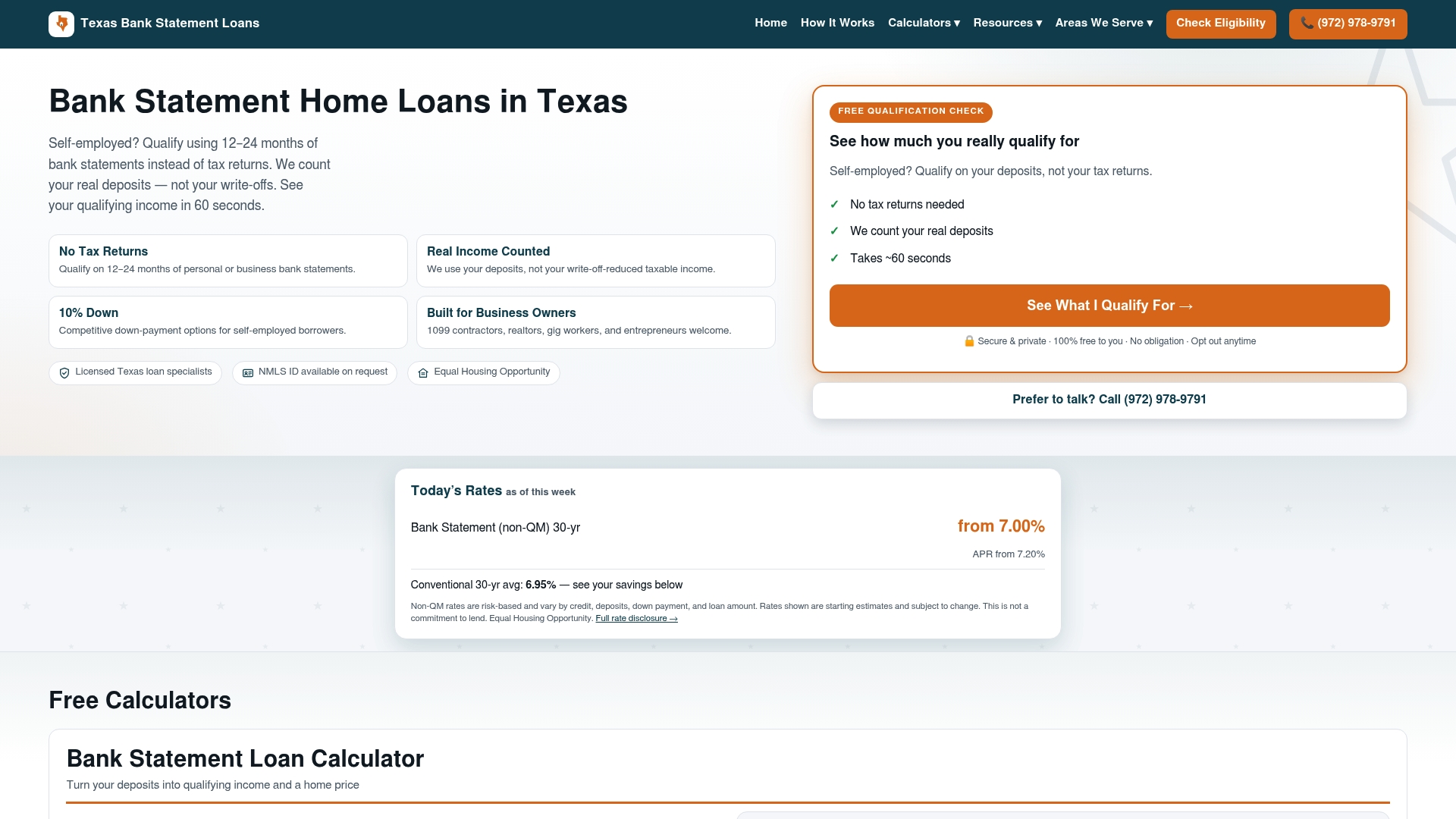
Use the tools below to build your own cash-to-close estimate before you start touring homes:
- Run the qualification check to see your realistic price range.
- Use the bank statement loan calculator to estimate monthly payment and reserve needs.
- Compare current rates to see how lender credit options affect your upfront number.
| Tool | What it estimates |
|---|---|
| Qualification check | Realistic price range in about 60 seconds |
| Bank statement loan calculator | Estimated payment and cash-to-close |
| Rates page | Current pricing and credit tradeoffs |
Start with the bank statement loan calculator to get a number you can bring into conversations with a loan officer.
Primary sources for verification and further reading
For deeper reading, the CFPB’s loan cost guide and Closing Disclosure explainer cover fee categories in detail, while Freddie Mac’s closing cost overview breaks down typical ranges by purchase price. For lending-side procedure, see the OCC’s residential lending handbook, and for a non-QM primer, The Texas Mortgage Pros’ explainer covers documentation basics for self-employed borrowers.
This article is general information, not a substitute for advice from a qualified financial advisor. Consult a qualified financial professional about your own circumstances before acting on anything here.
Sources
- Compare and negotiate your loan offers | Consumer Financial Protection Bureau
- What are closing costs and how much will I pay? | Freddie Mac
- Residential real estate lending | Comptroller’s Handbook (OCC)
FAQ
What are the typical closing costs for a $300,000 loan?
Based on Freddie Mac’s 2% to 5% range, closing costs typically run between 2% and 5% of the purchase price, excluding the down payment. Bank statement loans often add a reserve requirement on top of that figure, which raises the total cash you need available.
What are the pros and cons of a bank statement loan?
Bank statement loans let self-employed borrowers qualify using deposit history instead of tax returns, which helps when write-offs shrink taxable income on paper. The tradeoff is typically higher reserve requirements and more lender-to-lender variation in fees, since these are non-QM programs without standardized underwriting rules.
Can I provide 3 months of bank statements for my mortgage application?
Most bank statement programs require 12 to 24 months of personal or business account history to establish a reliable income pattern, not just 3 months. Check directly with your lender, since documentation requirements vary by program and by how income is calculated.
How much are closing costs on a $100,000 loan?
Using Freddie Mac’s typical 2% to 5% range, closing costs typically run between 2% and 5% of the purchase price, excluding the down payment. The exact figure depends on your location, lender fees, and which third-party services you shop around for.
Recommended
See what you qualify for in 60 seconds, free and no credit check. Use the eligibility check at the top of this page.