
Yes, you can get a bank-statement loan after foreclosure, but timing and documentation decide everything. Most alt-doc lenders want 24 to 36 months of seasoning, while agency loans require seven years unless you document extenuating circumstances, which can cut that to three. Your next move: pull your foreclosure completion paperwork and 12 to 24 months of complete bank statements, then request a lender-specific prequalification before you assume anything.
TL;DR:
- Foreclosure on record generally requires 24 to 36 months of seasoning for non-QM loans, but extenuating circumstances can reduce that to three years with documentation.
- Lenders treat foreclosure as a higher-risk derogatory event, leading to stricter reserve requirements, lower LTV caps, and higher interest rates.
- Bank-statement loans demand 12 or 24 months of deposits and still require full income verification and proof of ability to repay.
- Proper documentation of the foreclosure event and a clean recent payment history are essential for improving approval chances.
- The specific waiting periods and conditions vary between agency loans and non-QM lenders, so understanding each lender’s rules is crucial.
Table of Contents
- What Bank-Statement Loans Are and Why Foreclosure Changes the Math
- How Long After Foreclosure Can You Get a Mortgage?
- What Documents Do Post-Foreclosure Borrowers Need?
- How to Build Your File and Time Your Reapplication
- How Texas Bank Statement Home Loans Reviews Post-Foreclosure Files
- Ready to See What You Qualify For?
- Primary Sources and Further Reading
- Sources
- FAQ
What Bank-Statement Loans Are and Why Foreclosure Changes the Math
A bank-statement loan qualifies you using deposits into your business or personal accounts instead of tax returns. If you write off a large share of your income to lower your tax bill, this is often the only realistic path to a mortgage, since a Schedule C that shows $40,000 in net income won’t get you approved for a house that actually fits your real cash flow.
Most programs ask for either 12 or 24 months of statements. Twelve months tends to carry a slightly higher rate; 24 months give underwriters a longer income pattern and can soften pricing. Some lenders offer a hybrid: personal statements plus a profit-and-loss statement prepared by an accountant that can help when your bank deposits alone don’t tell the full income story.
Foreclosure changes how a lender reads your file, even inside these flexible programs. Investors treat foreclosure as one of the more severe derogatory events on a credit report, ranking it alongside bankruptcy in terms of risk weight. That’s not a moral judgment. It’s a statistical one: foreclosure correlates with a higher chance of future default, so lenders build in overlays to offset that risk.
Here’s what typically shifts once a foreclosure shows up in your history:
- Reserve requirements climb. Where a clean-credit borrower might need two months of reserves, a post-foreclosure file often needs six to twelve.
- LTV caps tighten. A borrower who might otherwise get 90% financing could be capped at 75% to 80% until more seasoning passes.
- Property type restrictions appear. Condos, rural properties, and non-warrantable buildings often get excluded until the borrower is further out from the event.
- Rate add-ons apply. Expect a pricing hit, sometimes half a point to a full point, layered on top of standard bank-statement pricing.
- Full documentation still applies. Bank-statement programs simplify how you prove income; they don’t simplify whether the lender must verify it.
That last point trips people up more than any other. A bank-statement loan is not a document-light loan. Every originator making these loans must still confirm you can repay the debt, verify assets, and check that deposits are legitimately yours under Ability-to-Repay rules from the CFPB. The paperwork changes shape. The scrutiny doesn’t shrink.
Pro Tip: Order your bank statements directly from your bank’s portal as PDFs rather than screenshotting a mobile app. Underwriters flag inconsistent formatting, and a full, unedited statement with every page numbered in sequence moves through review faster than a patchwork of partial exports.
How Long After Foreclosure Can You Get a Mortgage?
The honest answer is: it depends on which door you walk through. Agency-backed loans and non-QM bank-statement loans run on completely different clocks, and confusing the two leads to wasted applications and needless disappointment.
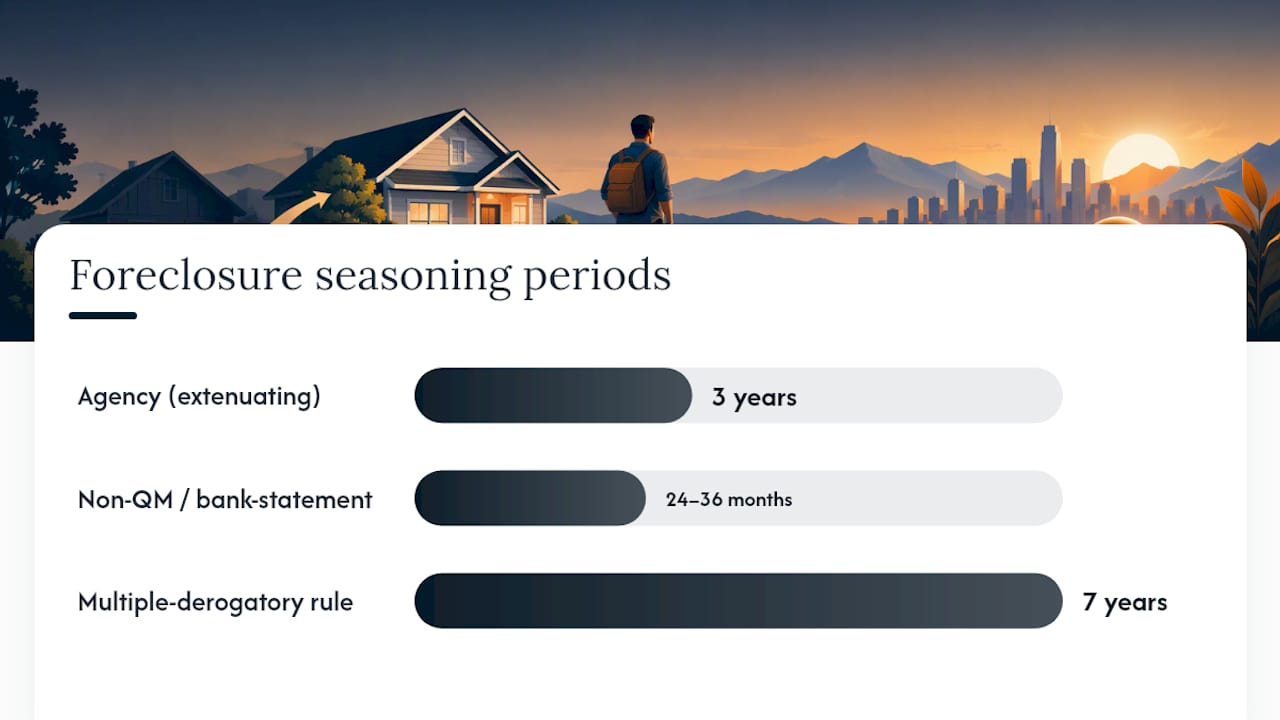
1. Agency loans (conventional financing tied to Fannie Mae guidelines). Fannie Mae’s standard waiting period after a completed foreclosure is several years. That clock starts on the completion date of the foreclosure, not the date you stopped making payments and not the date you moved out. If you can document that the foreclosure resulted from extenuating circumstances beyond your control, that window can shrink to three years, though Fannie Mae imposes additional conditions between years three and seven, including a maximum 90% LTV and a requirement that the event be clearly non-recurring.
2. Non-QM and bank-statement lender matrices. These operate on their own published guidelines rather than agency rules. Many set foreclosure seasoning at 24 to 36 months from the settlement date, and some product guides explicitly prohibit approval if you’ve had multiple derogatory housing events within a seven-year window, even if each individual event would otherwise clear seasoning on its own. This is where lender-by-lender variance matters most. One originator’s matrix might allow 24 months with strong reserves and a clean payment history since; another might hold firm at 36 regardless of your file’s strength.
Not every housing setback counts as a foreclosure, and that distinction affects your timeline directly:
- Foreclosure, the lender completes the legal repossession process; this typically carries the longest seasoning requirement.
- Deed-in-lieu of foreclosure, you voluntarily transfer the deed to avoid foreclosure; agency guidelines often treat this with a shorter waiting period than a completed foreclosure.
- Short sale (preforeclosure sale), the home sells for less than the mortgage balance with lender approval; seasoning is generally shorter than foreclosure.
- Mortgage charge-off, the lender writes off the unpaid balance without completing foreclosure; this has its own waiting period distinct from the others.
If your event doesn’t fit neatly into “completed foreclosure,” get the exact classification from your prior servicer before you tell a new lender what happened. Misclassifying the event on an application can stall underwriting or trigger a denial that a correct classification would have avoided.
Building your extenuating-circumstances file. If you’re hoping to use the shorter three-year path, you need more than a story. Lenders want contemporaneous documentation: job-separation letters, medical bills, insurance claim records, divorce decrees, or a business closure filing, paired with a written borrower statement that ties the event directly to your inability to pay. A vague explanation like “things got hard financially” won’t clear underwriting. A letter referencing a specific job loss date, supported by a severance notice, backed by an unemployment claim, gives an underwriter something concrete to substantiate.
What Documents Do Post-Foreclosure Borrowers Need?
Your file needs to answer two questions for an underwriter: what happened, and can you repay a new mortgage now. Every document you gather should serve one of those two purposes.
For the foreclosure itself, you’ll need the settlement statement or deed showing the completion date, since that date anchors your entire seasoning calculation. If you’re claiming extenuating circumstances, add the supporting evidence described above along with your written narrative.
For income, bank-statement programs require every page of statements for every account used in qualification, typically 12 to 24 months. Missing pages or gaps in the sequence create red flags immediately. If money moves between a business account and a personal account, you’ll need a simple ledger showing the transfer so the underwriter doesn’t double-count the same dollars as separate income. Unexplained or unidentified deposits generally cannot be counted as income under ATR rules, so a large one-time deposit from selling a truck or receiving a gift needs a short written explanation and, ideally, a paper trail.
Consistency beats size. A lender reading your statements cares less about your highest ending balance and more about whether deposits repeat in a predictable pattern month over month. Recurring $8,000 deposits from client payments read as sustainable income. A single $60,000 deposit that never repeats reads as a one-time event that shouldn’t be counted toward your qualifying income at all.
Round out the file with proof of self-employment continuity (invoices, signed contracts, a business license renewal), proof of funds for your down payment and reserves, a government-issued ID, and a credit report pulled early enough to catch and dispute errors.
Here’s what typically shifts as you move further past the foreclosure date on agency loans:
- Years 3 to 7 (with extenuating circumstances documented): expect a 90% LTV ceiling, mandatory homeownership education in some cases, and continued scrutiny of your credit history since the event.
- Year 7 and beyond: standard underwriting applies with no special foreclosure-related overlay, assuming your credit and income otherwise qualify.
- DTI: most bank-statement programs cap qualifying debt-to-income somewhere between 43% and 50%, though this varies by lender and compensating factors like reserves.
- Credit score: many alt-doc programs set a floor in the 620 to 660 range post-foreclosure, sometimes higher depending on LTV and reserves.
The fastest way to blunt the pricing hit that comes with a foreclosure on your record is disclosure, not concealment. Tell the loan officer about the foreclosure on your first conversation, not after a credit pull surprises everyone. Correct any credit-reporting errors tied to the event before you apply, since a foreclosure reported twice or with a wrong date can push your file into a worse category than it deserves. And build a clean 12 to 24 month payment history on everything else, rent, credit cards, auto loans, because that recent track record often matters more to an underwriter than the foreclosure itself.
How to Build Your File and Time Your Reapplication
Rebuilding eligibility after foreclosure isn’t a passive waiting game. It’s a sequence of concrete steps, and doing them in order saves you months.
-
Get your foreclosure completion or settlement paperwork first. This document contains the single most important date in your entire recovery timeline, since it starts the seasoning clock for both agency and non-QM paths. Request it from the prior servicer or your county recorder if you don’t already have a copy.
-
Assemble 12 to 24 months of complete bank statements. Pull every page for every account you plan to use for qualification, and reconcile any transfers between business and personal accounts with a simple spreadsheet ledger. Gaps or missing pages are the number one reason bank-statement files get sent back for more documentation.
-
Document your self-employment continuity. Gather invoices, signed client contracts, and a profit-and-loss statement if your accountant can prepare one. This shows an underwriter your income didn’t just survive the foreclosure, it kept functioning through it.
-
Write your extenuating-circumstances letter if it applies. Pair it with contemporaneous evidence like severance letters, medical records, or insurance documentation. Skip this step entirely if your situation doesn’t genuinely fit the extenuating-circumstances definition; a weak claim can do more harm than simply waiting out the standard seasoning period.
-
Clean up your credit report. Dispute any errors tied to the foreclosure, including duplicate reporting or an incorrect completion date, and spend the months before you apply building a spotless payment record on rent, cards, and any remaining installment debt.
-
Request a lender-specific seasoning matrix and prequalification. Every non-QM lender publishes its own rules, so don’t assume the first “no” you hear applies everywhere. Disclose the foreclosure upfront every time; a prequalification built on incomplete information isn’t worth the paper it’s printed on.
Pro Tip: Start step two the same week you get your completion paperwork, not after you’ve decided you’re “ready” to apply. Bank statement gathering takes longer than people expect, especially if you need to request archived statements from a bank that only keeps 12 months visible online by default.
You can check whether a loan officer or mortgage company is properly licensed through NMLS Consumer Access before you hand over sensitive financial documents to anyone.
How Texas Bank Statement Home Loans Reviews Post-Foreclosure Files
Texas Bank Statement Home Loans looks at 12 to 24 months of actual deposits rather than tax returns, which matters most for self-employed borrowers whose write-offs make their Schedule C income look far smaller than their real cash flow. A foreclosure on your record doesn’t automatically disqualify you here; it changes what your file needs to show, not whether the door is open.
The quickest way to find out where you stand is the no-obligation qualification check, which takes about 60 seconds and gives you a realistic read on affordability before you commit hours to paperwork. Have your foreclosure completion documents and bank statements gathered first, since a check run on incomplete information only gives you a rough guess.
For borrowers who clear the seasoning bar, low down payment options starting at 10% can make a real difference in how fast you get back into a home. Coverage extends across major Texas markets, including service tailored to the Greater Houston area, where self-employed borrowers make up a meaningful share of the local housing market.
Ready to See What You Qualify For?
If you’ve read this far, you already know the two things that matter most: your seasoning timeline and a complete bank-statement file. Texas Bank Statement Home Loans is built specifically for the borrower a traditional bank turns away, the self-employed owner whose tax returns understate real income and whose foreclosure history needs a lender who actually reads the full story instead of stopping at a credit alert.
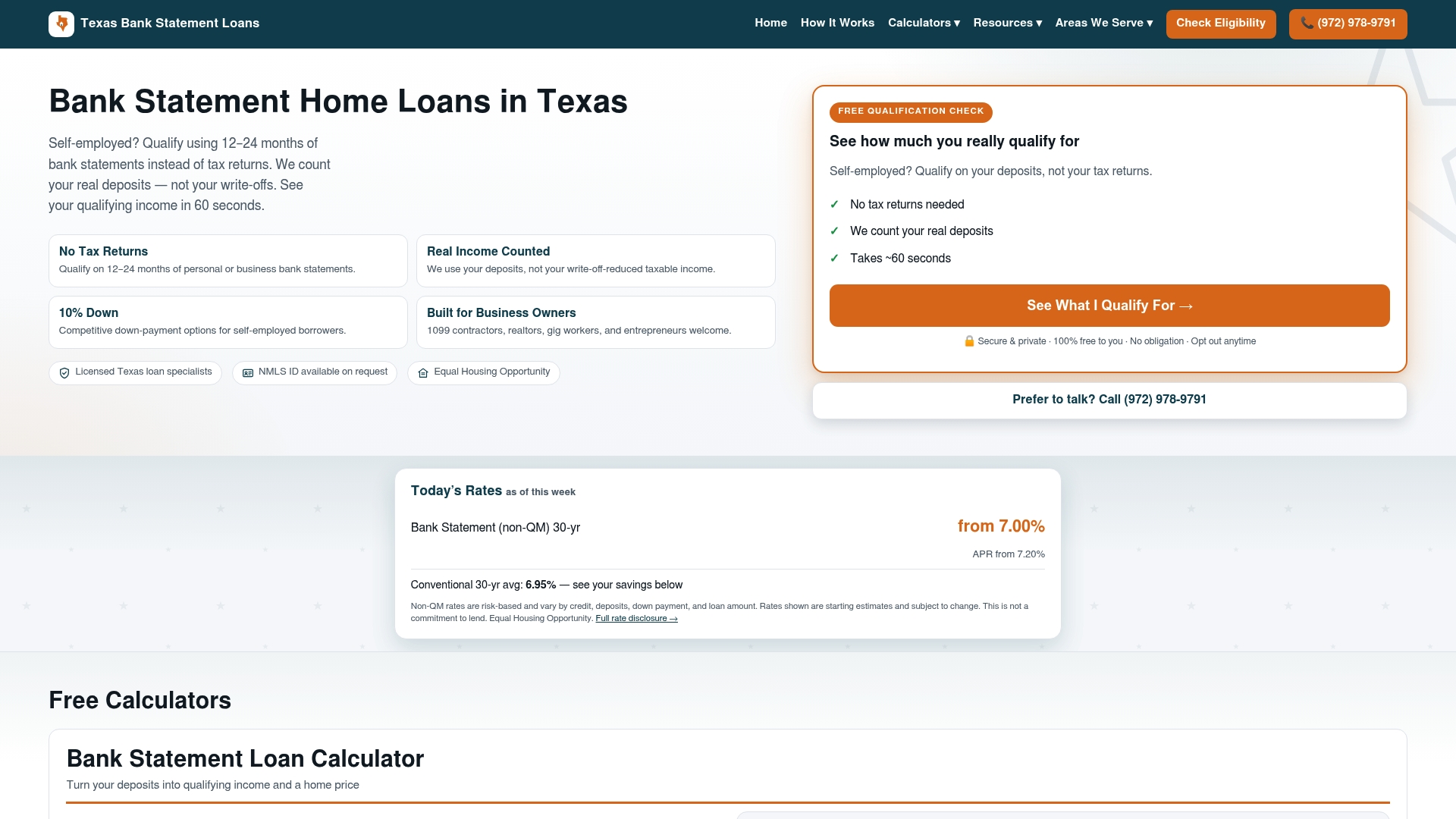
Run the free qualification check to see a realistic estimate of what you can afford in about 60 seconds, no obligation attached. Bring your foreclosure completion paperwork, 12 to 24 months of bank statements, a government ID, and proof of reserves, and you’ll get a far more useful answer than a generic prequalification. Current rates and terms for the Bank Statement (non-QM) 30-year program start at 7.00% per year, and you can review the full structure before deciding whether now is the right time to apply. If your property is an investment purchase rather than a primary residence, the DSCR loan calculator is worth running instead, since qualification there depends on rental income rather than your personal deposits. Either way, start with the qualification check and build your file from there.
Primary Sources and Further Reading
The seasoning and underwriting rules discussed above come from primary regulatory and agency sources, not lender marketing pages. Reviewing them directly is worth your time before you sign anything.
- Fannie Mae, Significant Derogatory Credit Events, Waiting Periods and Re-establishing Credit (B3-5.3-07)
- Fannie Mae, Extenuating Circumstances for Derogatory Credit (B3-5.3-08)
- CFPB, Ability-to-Repay and Qualified Mortgage (ATR/QM) Small Entity Compliance Guide
- OCC, Residential Real Estate Lending, Comptroller’s Handbook
This article is general information, not a substitute for advice from a qualified financial advisor. Consult a qualified financial professional about your own circumstances before acting on anything here.
Sources
- Significant Derogatory Credit Events, Waiting Periods and Re-establishing Credit | Fannie Mae
- Extenuating Circumstances for Derogatory Credit | Fannie Mae
- Ability-to-Repay and Qualified Mortgage (ATR/QM) small entity compliance guide | CFPB
- Residential Real Estate Lending, Comptroller’s Handbook | OCC
FAQ
How Hard Is It to Get a Bank-Statement Loan After Foreclosure?
It’s harder than a standard bank-statement approval but far from impossible once you clear your lender’s seasoning requirement. Most non-QM lenders want 24 to 36 months since the foreclosure’s settlement date, plus stronger reserves and a clean payment history since the event.
Can I Get a Mortgage With Just My Bank Statements?
Yes, bank-statement programs qualify you using 12 to 24 months of deposits instead of tax returns, which works well for self-employed borrowers with significant write-offs. Lenders still verify those deposits represent legitimate income under ATR requirements, so unexplained large deposits won’t automatically count.
How Far Back Do Mortgage Lenders Look at Bank Statements?
Most bank-statement programs review 12 or 24 months of statements, with 24 months sometimes earning slightly better pricing since it shows a longer income pattern. Agency loans generally don’t rely on bank statements for income at all, but they do check your credit history back through the seven-year foreclosure waiting period.
What Looks Bad on Bank Statements for a Mortgage?
Large, unexplained deposits are the biggest red flag, since underwriters can’t count income they can’t trace back to a source. Missing statement pages, frequent overdrafts, and inconsistent or declining deposit patterns also raise concerns because they suggest your income isn’t as stable as your application claims.
Does a Foreclosure Disqualify Me From a Non-QM Loan?
Not permanently. Most non-QM lenders set their own seasoning period, often 24 to 36 months from the foreclosure’s completion date, after which you can qualify if your credit, reserves, and deposit history meet the lender’s matrix.
See what you qualify for in 60 seconds, free and no credit check. Use the eligibility check at the top of this page.