
Traditional mortgages exclude freelancers primarily because lenders cannot easily verify income that comes without a W-2, a consistent pay stub, or a third-party employer confirming what you earn. The system was built for salaried workers. Fannie Mae and Freddie Mac guidelines, which govern most conventional loans, require standardized documentation that freelancers simply cannot produce. Your income may be real and healthy, but if it doesn’t fit the template, automated underwriting systems reject it before a human ever looks at your file.
The scale of the problem is hard to ignore. Approximately 19 million self-employed individuals operate in the US workforce in 2026, running over 30 million businesses, yet the conventional mortgage market was never designed with them in mind. The core issue comes down to a few structural realities:
- W-2 income is verified by a third party (your employer); freelance income is self-reported and requires manual review
- Freelancers often minimize taxable income through legal deductions, which reduces the net income lenders see on tax returns
- Income variability across months and years makes lenders nervous about repayment consistency
- Fannie Mae and Freddie Mac guidelines prioritize documentation that most freelancers cannot produce
- Manual cash flow analysis takes more time and expertise than most conventional lenders want to invest
How lenders calculate and verify freelancer income
When a lender does agree to evaluate a freelance borrower, the process looks nothing like reviewing a W-2. Lenders rely on tax returns as the starting point, but the analysis goes several layers deeper than just reading a number off the page.
- Schedule C (sole proprietors and single-member LLCs): lenders average net profit over two years, then add back non-cash expenses
- Schedule K-1 (partnerships and S-corps): lenders pull the borrower’s share of income from Forms 1065 or 1120-S
- Add-backs: non-cash deductions like depreciation and depletion are added back to net income because they reduce taxable income without reducing actual cash flow
- Profit and loss statements: a CPA-prepared P&L for the current year helps bridge the gap when tax returns are dated
- Bank statements: lenders use these to cross-check that deposits align with reported income
The challenge is that this analysis is entirely manual. A salaried borrower’s income takes minutes to verify. A freelancer’s file can take days, and the result depends heavily on the underwriter’s experience with self-employed cash flow. That inconsistency is one reason many conventional lenders simply decline to take on these files.
What income documents freelancers need for a mortgage
Getting your paperwork right is half the battle. Lenders evaluating self-employed mortgage applications expect a heavier documentation package than they’d ask of a salaried borrower, and gaps slow everything down.
- Federal tax returns (two years): the foundation of any self-employed application; lenders average net income across both years
- 1099 forms: document contractor earnings and support the income figures on your returns
- Bank statements (12-24 months): show actual cash deposits and are the primary document for bank statement loan programs
- CPA-prepared profit and loss statement: covers the current year and helps lenders assess whether income is trending up or down
- Business license or CPA letter: confirms you’ve been operating for at least two years, which most lenders require
Organization matters as much as the documents themselves. A complete, clearly labeled package moves through underwriting faster and signals to the lender that you run a real, stable business. Disorganized or incomplete files invite delays and additional scrutiny.
Pro Tip: Have your CPA prepare a year-to-date P&L statement even if the lender hasn’t asked for one yet. It gives underwriters a current snapshot of your business and can offset concerns about a down year in your tax returns.

Alternative mortgage options built for freelancers
The good news is that the mortgage market has adapted, even if conventional lenders haven’t. Non-QM loans now represent about 9% of the US mortgage market, roughly $239 billion in 2025, driven largely by demand from self-employed borrowers who can’t qualify through traditional channels.
- Bank statement loans: income is calculated from 12-24 months of deposits rather than tax returns; lenders subtract a standard expense ratio or use actual documented expenses to arrive at qualifying income
- Non-QM loans: these don’t conform to Fannie Mae or Freddie Mac guidelines, giving lenders freedom to assemble a financial narrative from multiple document types rather than forcing everything through a single formula
- 1099-only loans: designed specifically for contractors and freelancers who receive 1099 income and want to qualify without filing two years of full business returns
- Asset depletion loans: for freelancers with significant savings, lenders divide total assets by the loan term to create a qualifying income figure
The trade-off is real. These programs typically carry higher interest rates than conventional loans because lenders price in the additional underwriting complexity and perceived risk. But for a freelancer who earns well and can document it through bank deposits, a slightly higher rate on an approved loan beats a lower rate on a rejection. Texasbankstatementloans evaluates 12-24 months of bank deposits rather than tax returns, with down payments starting at 10%, which puts homeownership within reach for borrowers who’ve been turned away by conventional lenders.
What credit scores and down payments freelancers should expect
Freelancers don’t face dramatically different credit score requirements than salaried borrowers, but lenders do apply stricter scrutiny to the overall financial picture when income is variable.
- Credit score: most conventional lenders want a minimum of 620; Non-QM and bank statement lenders often require 660-700 or higher to offset income documentation risk
- Down payment: for conventional loans, requirements are similar to salaried borrowers, with options as low as 3% (conventional) or 3.5% (FHA); bank statement and Non-QM programs often start at 10%
- Cash reserves: lenders want to see several months of mortgage payments sitting in liquid accounts after closing; strong reserves compensate for income variability in ways that a credit score alone cannot
- Debt-to-income (DTI) ratio: this is where freelancers often run into trouble; because tax deductions reduce reported net income, DTI can look worse on paper than it is in reality; add-backs help, but the calculation still starts from a lower base than a salaried borrower with equivalent gross earnings
- Business history: most lenders require at least two years of self-employment, though some accept one year with a documented prior work history in the same field
A strong credit score combined with healthy reserves can move a borderline application across the approval line. Lenders weigh the full picture, and a freelancer with a 720 credit score, 12 months of reserves, and two years of stable deposits is a far better risk than the tax return alone might suggest.
Why working with a specialized lender changes the outcome
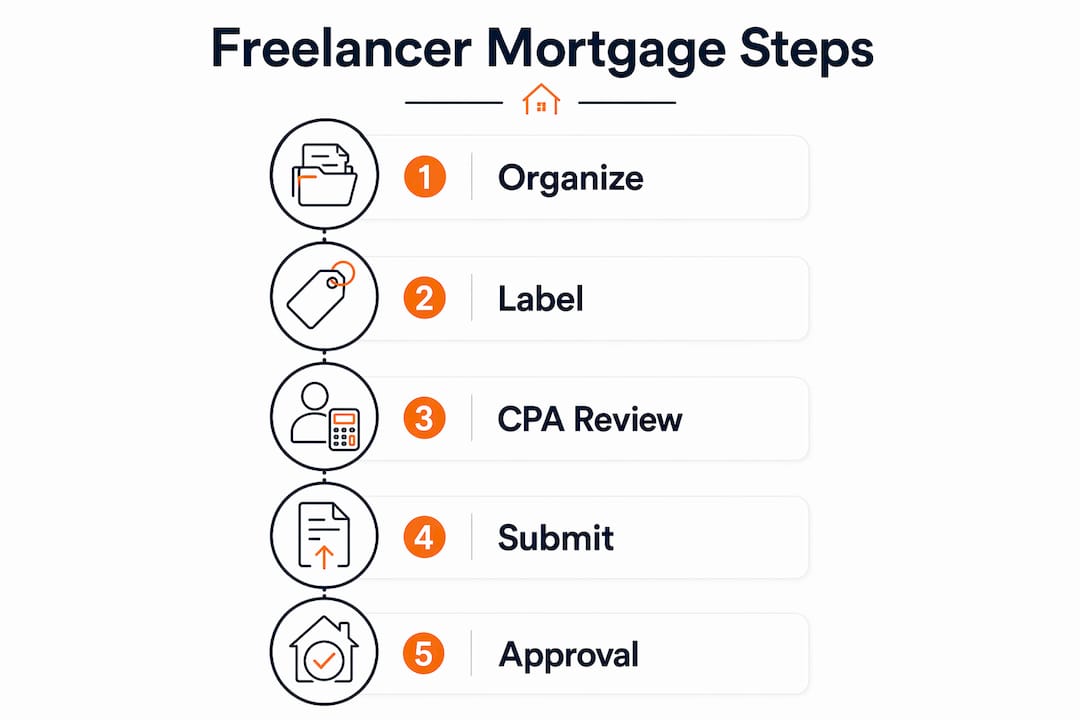
Most conventional lenders process self-employed files reluctantly, if at all. Specialized lenders and mortgage advisors who focus on self-employed borrowers approach the same file completely differently.

Specialized lenders use flexible underwriting methods that conventional banks don’t offer. They know how to identify legitimate add-backs, how to read a Schedule C for actual cash flow rather than just net profit, and which loan programs fit which borrower profiles. An experienced advisor in this space can spot income streams that a generalist underwriter would overlook entirely.
The preparation process also matters. Before you approach any lender, organize two years of tax returns, 12-24 months of bank statements, a current P&L, and your business license. Lenders who specialize in self-employed files move faster when the package arrives complete. A mortgage advisor experienced with freelancers can tell you exactly what a specific lender wants to see before you submit, which eliminates the back-and-forth that kills timelines.
One common pitfall: applying to a conventional lender first, getting declined, and then applying to a Non-QM lender. Each hard credit inquiry affects your score, and multiple declines in a short window can complicate the next application. Go to the right lender first.
How to improve your mortgage eligibility without hurting your finances
The instinct many freelancers have when preparing for a mortgage is to reduce deductions so their taxable income looks higher. Mortgage advisors caution against this approach. Paying more taxes to qualify for a loan is rarely the right trade-off, especially when legitimate add-backs can achieve the same result.
Work with your CPA and your mortgage advisor together, not separately. Your CPA’s job is to minimize your tax liability. Your mortgage advisor’s job is to maximize your qualifying income. These goals can conflict, but a knowledgeable advisor knows how to use the tax code’s own provisions, like depreciation add-backs, to present your income accurately without changing your filing strategy. You can also explore self-employment tax deductions to understand which deductions affect qualifying income and which don’t.
Build reserves deliberately. Lenders look at what’s in your accounts after closing, not just at the down payment. Twelve months of mortgage payments in a liquid account is a strong signal of financial stability. Start building that cushion 12-18 months before you plan to apply, and keep your business and personal accounts clearly separated so deposits are easy to trace.
Pro Tip: Use a self-employed affordability calculator to model how different income scenarios affect your qualifying loan amount before you sit down with a lender. Knowing your numbers in advance puts you in a much stronger position.
Common misconceptions about freelancer mortgage eligibility
A lot of freelancers assume they simply can’t get a mortgage. That’s wrong, but the misconceptions that lead to that conclusion are understandable given how conventional lenders behave.
“I need to show W-2 income to qualify.” You don’t. Bank statement loans, Non-QM programs, and 1099-specific products all exist precisely because W-2 income isn’t the only valid proof of repayment capacity. The IRS itself defines self-employed individuals broadly, and lenders who specialize in this space have built programs around that reality.
“My deductions disqualify me.” Not necessarily. Deductions reduce taxable income, but add-backs restore non-cash expenses to the qualifying calculation. Depreciation, depletion, and certain business use deductions are accounting entries, not cash outflows, and lenders who understand self-employed underwriting know how to treat them correctly.
“I need two full years of freelancing before I can apply.” Most lenders do require two years, but some accept one year of self-employment combined with a prior work history in the same field. If you spent five years as a salaried graphic designer and then went freelance, that history counts.
“A higher income means automatic approval.” Income is one factor. DTI, credit score, reserves, and business stability all feed into the decision. A freelancer earning well but carrying high personal debt and thin reserves can still face a difficult approval process.
Why lenders apply stricter standards to freelancers
The stricter standards aren’t arbitrary. They trace directly to regulatory frameworks and the economics of mortgage lending.
Fannie Mae and Freddie Mac set the guidelines that govern conventional loans, and those guidelines were written for predictable, third-party-verified income. When a lender originates a conventional loan, they typically sell it to the secondary market. That means the loan has to meet Fannie Mae or Freddie Mac standards at the time of sale. A freelancer’s income, which requires manual analysis and judgment calls, creates risk that the secondary market buyer may not accept. Lenders protect themselves by declining files that don’t fit the template cleanly.
Non-QM loans don’t get sold to Fannie Mae or Freddie Mac. They stay on the lender’s books or get sold to private investors who accept the additional complexity. That’s why Non-QM lenders can use bank statements, asset depletion, or financial narratives to qualify borrowers. They’re operating outside the government-sponsored enterprise framework entirely. The NMLS Consumer Access registry lets you verify that any lender offering these programs is properly licensed, which is worth checking before you share financial documents with anyone.
The Texas Department of Savings and Mortgage Lending at sml.texas.gov also regulates mortgage lenders operating in Texas, providing an additional layer of consumer protection for borrowers working with state-licensed lenders.
Key Takeaways
Traditional mortgages exclude freelancers because standard underwriting requires W-2 income verification that self-employed borrowers cannot provide, but bank statement loans, Non-QM programs, and specialized lenders offer real paths to approval in 2026.
| Point | Details |
|---|---|
| Core exclusion reason | Fannie Mae and Freddie Mac guidelines require standardized W-2 documentation that freelancers cannot produce. |
| Income calculation method | Lenders average two years of net income from tax returns and add back non-cash expenses like depreciation. |
| Best alternative for most freelancers | Bank statement loans use 12-24 months of deposits to calculate qualifying income instead of tax returns. |
| Non-QM market size | Non-QM loans represent about 9% of the US mortgage market, roughly $239 billion in 2025. |
| Key preparation step | Build 12 months of liquid reserves and keep business and personal accounts clearly separated before applying. |
See what you qualify for in 60 seconds, free and no credit check. Use the eligibility check at the top of this page.