
Yes, you can get a mortgage while owning multiple businesses or applying alongside co-owners, but lenders will scrutinize every enterprise separately. Underwriters look at each owner’s stake, credit profile, and how stable the cash distributions from each business really are. Expect income to get calculated business-by-business rather than as one blended number, and expect a documentation request that covers every entity you have a meaningful stake in.
TL;DR:
- Lenders analyze each business separately, focusing on actual distributions and cash flow stability rather than just reported profit, affecting your qualifying income.
- Ownership stakes of 20% or more generally require full documentation, with higher thresholds (25%) classifying you as self-employed and triggering detailed review rules.
- Using bank-statement loans can better reflect your true income, especially if tax returns understate cash flow due to deductions or recent business changes.
- Properly organizing and documenting separate accounts and owner draws before applying can significantly reduce underwriting delays and paperwork rework.
- Different loan types have varying rules for multiple-business income, with conventional loans relying on tax forms, while bank-statement and DSCR loans focus on deposit activity or property income.
Table of Contents
- Quick Checklist: What to Prepare Before You Apply
- How Lenders Evaluate Multiple Owners and Multiple Businesses
- Step-by-Step Application Roadmap for Owners With Multiple Businesses or Co-Owners
- How Different Loan Types Treat Multiple-Business Income
- Practical Examples: Presenting Income and Documentation From Multiple Businesses
- How Texas Bank Statement Home Loans Can Help Multi-Business Owners Qualify
- Author Perspective: Practical Pitfalls We’ve Seen and Best Quick Wins
- Primary Sources and Guides Lenders Use
- Sources
Quick Checklist: What to Prepare Before You Apply
Before you call a loan officer, sort out who actually needs to be on the application. Anyone with a significant ownership stake in a business tied to your qualifying income will likely need to sign. That changes the shape of the whole file.
Run through this before your first conversation with a lender:
- Confirm which owners must appear on the loan and whether any will sign as co-borrowers versus guarantors.
- Pull two years of business tax returns, K-1s, bank statements, profit-and-loss statements, and proof-of-ownership documents for each business.
- Request personal credit reports for every signing owner and run combined debt-to-income scenarios together, not separately.
- Decide which loan type fits your situation. Conventional, SBA, bank-statement, and DSCR loans all treat multi-business income differently.
- Line up backup options. Extra cash reserves, a larger down payment, or a co-signer can offset a thin income history on a newer venture.
Pro Tip: Build a one-page summary of each business before you talk to a lender. List ownership percentage, years operating, and average monthly distribution. It cuts weeks off the back-and-forth underwriters usually need to piece this together themselves.
How Lenders Evaluate Multiple Owners and Multiple Businesses
Ownership percentage decides almost everything about how a lender treats your file. Fannie Mae’s underwriting guidance classifies you as self-employed once you hold 25% or more in a business, which triggers the full self-employment documentation trail: tax returns, K-1s, and often a written cash-flow analysis. Some lenders set their own internal bar lower, requiring signatures and documentation from anyone at 20% ownership or above, so ask early which threshold your specific lender uses.
Once you clear that threshold, underwriters analyze each business separately, examining actual earnings, distributions to the owner, and income stability over time. A business posting significant paper profit but distributing a smaller amount to its owner gets qualified on the smaller amount, not the larger paper profit. Fannie Mae’s guidance is explicit that reported profit and cash actually available to the borrower are two different numbers, and lenders are supposed to verify which one you can actually spend on a mortgage payment.
Here’s where multi-business borrowers hit friction that a single-business owner never sees. Lenders don’t just evaluate one profit-and-loss statement. They run a business-by-business analysis, evaluate each enterprise on its own merits, then combine only the portion of income they consider reliable and continuing. Fannie Mae permits the use of a Comparative Income Analysis, sometimes called Form 1088, or an automated income calculator to reconcile taxable income against distributions and cash flow trends across multiple years. Each business can even be measured against its own history for the standard longevity benchmark, which matters a great deal if one of your ventures is five years old and another launched eighteen months ago.

That last point deserves its own attention. If you’ve personally guaranteed a business loan, a line of credit, or equipment financing, that liability typically counts against your personal debt-to-income ratio, even though the payments come out of the business account. Lenders read personal guarantees as personal exposure, which may increase your DTI calculation accordingly.
Businesses with a short track record or a recent structural change get extra scrutiny. Freddie Mac’s 2024 update tightens how lenders treat borrowers whose business history doesn’t cleanly span two full years, and clarifies that a change in legal structure, say converting from a sole proprietorship to an S corp, can interrupt the continuity underwriters need to see. When that happens, lenders often default to the lower of the new business income or whatever stable income you had in a prior occupation, rather than taking the newer, possibly inflated figure at face value.
If you’ve recently closed one business and opened another, or shifted primary income from one venture to a newer one, be ready to explain it in writing. Underwriters are trained to ask why, and a clear explanation backed by bank statements resolves the question faster than silence does.
Step-by-Step Application Roadmap for Owners With Multiple Businesses or Co-Owners
Getting through underwriting with a multi-business file comes down to sequencing. Skip a step and you’ll end up redoing paperwork three weeks into the process.
- Decide who signs and how. Map out every owner with a stake above your lender’s threshold, and determine upfront who will be a full co-borrower versus a guarantor on a business liability. This single decision reshapes the entire documentation list.
- Assemble documentation for every business, not just your primary one. That means two years of business and personal tax returns, K-1s for every entity, twelve to twenty-four months of business bank statements, current profit-and-loss statements, and formal proof of ownership for each business.
- Run your own preliminary numbers before a lender does. Estimate qualifying income conservatively, based on distributions rather than reported profit, then calculate combined DTI across every co-owner. Figure out your realistic down payment and reserve requirements before you’re surprised by them later.
- Match your situation to the right loan type. A borrower with strong reported profits across two stable businesses fits a conventional path well. A borrower whose tax returns understate real cash flow may do better with a bank-statement loan that evaluates deposits instead of adjusted gross income.
- Write a short cash-flow narrative for each business. One or two paragraphs per entity explaining what the business does, how long it’s operated, and how distributions have trended. This single document often prevents the most common underwriting delays.
- Prepare for follow-up questions on distributions and related-party transactions. If you’re pulling extra cash out of a business account right before closing to cover a down payment, expect the underwriter to ask about it. Document the transfer and its source before they do.
Pro Tip: If two of your businesses share a bookkeeper or bank, keep their financial records completely separate anyway. Underwriters flag commingled accounts almost immediately, and untangling them after the fact slows a file down more than any single missing document.
How Different Loan Types Treat Multiple-Business Income
The loan type you target changes how forgiving, or unforgiving, the underwriting process is toward income spread across several ventures.
- Conventional loans (Fannie Mae and Freddie Mac): These rely heavily on tax returns, K-1s, and a formal business-by-business cash-flow analysis. Fannie Mae’s business structure guidance spells out exactly which forms, Schedule C, Form 1065, Form 1120S, apply to your entity type, and that structure determines documentation and how much liability transfers to you personally. Expect the strictest two-year continuity requirements here.
- SBA loans: These are business financing tools, not home mortgages. The SBA’s guidance on building business credit is useful for strengthening your businesses’ financial profile ahead of a mortgage application, but an SBA loan itself won’t help you buy a house. Don’t confuse the two products when you’re planning your approach.
- Bank-statement loans: Instead of leaning on tax returns that often understate real income after deductions, these loans qualify you off 12 to 24 months of actual bank deposits. Wells Fargo’s guidance for self-employed borrowers confirms that lenders will accept alternative documentation for self-employed applicants, though they still scrutinize consistency closely. This route tends to favor owners whose businesses show strong deposit activity even when write-offs shrink their taxable profit.
- DSCR and investor-focused loans: These qualify the loan against the income the property itself generates rather than your personal or business income. If your qualifying income is fragmented across three different ventures and none of them alone tells a clean story, a debt-service-coverage-ratio loan on an investment property sidesteps that problem entirely.
- FHA and VA loans: These government-backed programs generally follow similar self-employment documentation standards to conventional loans, though some lenders apply more flexible reserve requirements for self-employed borrowers with shorter business histories. The core two-year income trend expectation still applies in most cases.
Practical Examples: Presenting Income and Documentation From Multiple Businesses
Consider a borrower who owns two LLCs: one is an established landscaping company generating steady monthly distributions, the other a six-month-old marketing consultancy still reinvesting most of its revenue back into growth. An underwriter will likely count the landscaping distributions at full weight given its history, while treating the consultancy’s income far more conservatively, or excluding it entirely, until it clears a longer track record. That’s not a rejection of the second business. It’s simply how lenders weigh continuity against ambition.
That minority income can sometimes count toward qualifying income, but only with documentation proving consistent receipt, typically K-1s plus bank statements showing the money actually landed in a personal account. Consumer guides breaking down Fannie Mae’s business structure rules note that minority stakes get less scrutiny on the two-year longevity rule but more scrutiny on proving the cash actually reached the borrower.
The most useful thing you can hand an underwriter is a short cash-flow narrative for each business, one or two paragraphs describing what the company does, how long it’s operated, ownership percentage, and how distributions have trended over the past two years. Pair each narrative with its supporting documents and you’ve built exactly what Fannie Mae requires lenders to produce internally: a written cash-flow evaluation justifying the qualifying income figure.
| Documentation piece | What it proves | Common pitfall |
|---|---|---|
| K-1s (2 years, per business) | Ownership share and allocated income | Confusing allocated income with cash actually received |
| Business bank statements (12 to 24 months) | Real deposit activity and distribution consistency | Commingling personal and business funds in one account |
| Profit-and-loss statement | Current-year trend versus prior tax filings | Unreviewed or self-prepared P&Ls with no supporting deposits |
| Proof of ownership documents | Legal stake and signing authority | Missing amendments after a partner buyout or entity conversion |
Two mistakes show up more than any others in multi-business files. The first is commingled accounts, personal and business funds moving through the same account with no clear line between them, which makes it nearly impossible for an underwriter to isolate real distributions. The second is undocumented owner draws, cash pulled from the business informally without a paper trail. If you’re planning to use business funds toward a down payment, document that transfer weeks in advance, not the day before closing. Templates for organizing income documentation can help you build a clean paper trail before a lender ever asks for one.
How Texas Bank Statement Home Loans Can Help Multi-Business Owners Qualify
If your tax returns tell a smaller story than your bank account does, that’s exactly the gap Texasbankstatementloans is built to close. Instead of leaning on adjusted gross income after every deduction and write-off across two or three ventures, the qualification process reviews 12 to 24 months of personal or business bank statements to reflect what you actually deposited, not what your accountant minimized on paper.
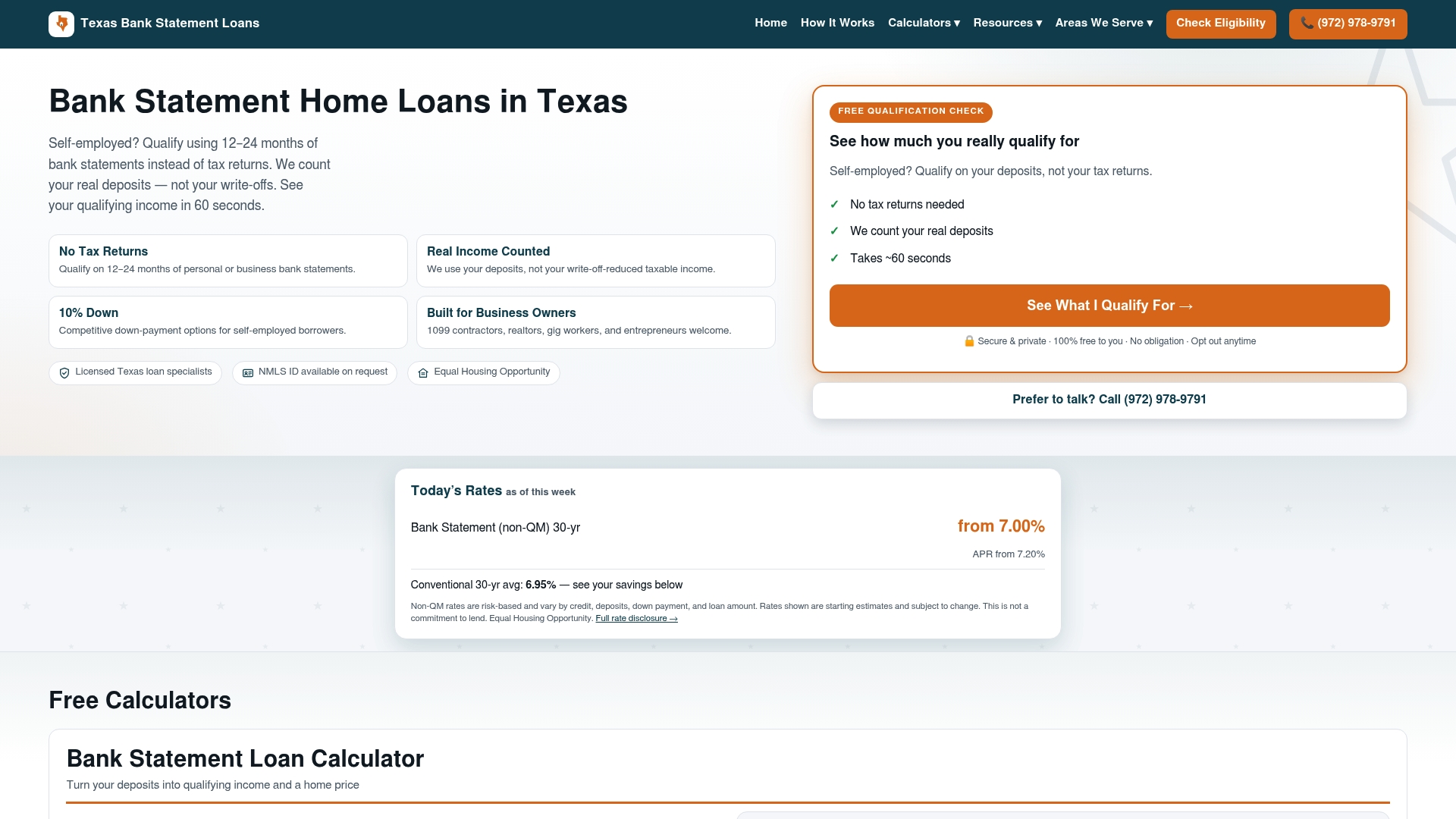
This approach tends to fit 1099 contractors, gig workers, business owners running multiple ventures, and realtors whose deposit history is strong even when combined K-1s and Schedule Cs paint a messier picture. The qualification check takes about 60 seconds, requires no obligation, and gives you a realistic read on affordability before you commit hours to gathering tax returns and K-1s for every entity you own. If a bank-statement path sounds closer to how your income actually works, run the numbers with the bank statement loan calculator and see what a lender would likely qualify you for today.
Author Perspective: Practical Pitfalls We’ve Seen and Best Quick Wins
Most multi-business owners lose time on the same handful of mistakes. They keep personal and business money in one account, they assume K-1 income equals cash they can actually spend on a mortgage, and they walk into underwriting without a written explanation for why one business looks stronger than another on paper.

The fix is almost boring in its simplicity. Separate your accounts before you ever apply, not after a lender asks why they’re mixed. Gather 12 to 24 months of bank statements for every business you own, even the ones you think won’t matter, because underwriters will ask about them anyway. Pay down high-interest personal debt before you apply if you can, since it directly improves your combined DTI. And if your reserves are thin, a slightly larger down payment often does more to smooth an underwriting file than any amount of paperwork.
None of this is complicated. It’s just detail work that most owners put off until an underwriter forces the issue, at which point it costs weeks instead of days.
- Saad
Primary Sources and Guides Lenders Use
Loan officers and underwriters rely on a handful of primary references worth bookmarking. Fannie Mae’s underwriting guidance for self-employed borrowers and its business structures guide cover conventional documentation rules in detail. Freddie Mac’s 2024 bulletin explains recent tightening around short business histories. For business-purpose credit versus mortgage financing, the SBA’s guide to building business credit draws a clear line between the two. FDIC’s analytical resources offer broader context on lender risk appetite tied to market conditions.
This article is general information, not a substitute for advice from a qualified financial advisor. Consult a qualified financial professional about your own circumstances before acting on anything here.
Sources
- Underwriting factors and documentation for a self-employed borrower | Fannie Mae
- Freddie Mac guidance (August 7, 2024 bulletin)
See what you qualify for in 60 seconds, free and no credit check. Use the eligibility check at the top of this page.