
Yes, many non-QM lenders offer temporary rate buydowns that lower a borrower’s initial monthly payments for one to three years. The catch is that the note rate never changes, so lenders must qualify borrowers at the full rate from day one. That makes a buydown a short-term cash-flow tool, best suited to borrowers who expect income to grow or simply want breathing room while they settle into a new payment.
TL;DR:
- Borrowers often pay for buydowns through a lump sum at closing, which covers the difference between the reduced monthly payments and the full note rate, not principal or interest.
- A 3-2-1 buydown can lower the interest rate by up to 3% in year one, 2% in year two, and 1% in year three, with the cost increasing as the reduction duration lengthens.
- Funding sources for buydowns include sellers, builders, lenders, and occasionally borrowers, but contributions must stay within Fannie Mae’s interest party contribution limits to avoid ineligibility.
- Lenders qualify borrowers at the full note rate, not the reduced rate, to prevent payment shock once the buydown subsidy expires.
- Coordination before closing-such as early contract inclusion, documenting funding sources, and confirming disclosures-is essential to prevent last-minute funding issues.
Table of Contents
- How a temporary buydown actually works
- Common buydown structures and the math behind them
- Who pays and where IPC limits create eligibility traps
- Underwriting rules that keep buydowns from causing payment shock
- Documenting and closing a buydown without last-minute surprises
- A transitional tool, not a substitute for real affordability
- How Texas Bank Statement Home Loans supports buydown-ready borrowers
- Sources
- FAQ
How a temporary buydown actually works
A temporary buydown is a separate agreement layered on top of the loan, not a change to the loan itself. The promissory note still lists the full interest rate the borrower agreed to pay. What changes is the monthly bill during the buydown period, and that happens through a lump sum, often called a subsidy, collected at closing.
That money does not go toward principal or interest directly. Instead, it sits in a custodial or buydown account, and the servicer draws from it each month to cover the difference between the reduced payment the borrower actually makes and the full payment the note requires, according to Fannie Mae’s overview of temporary buydowns. If the loan pays off early or the borrower refinances before the subsidy is exhausted, investor and servicer rules typically apply the remaining balance to the loan’s principal or issue a refund, per Fannie Mae’s selling guide. The note itself never reflects the temporary reduction at any point.

Common buydown structures and the math behind them
Three structures dominate the non-QM market, and each front-loads relief differently, as described in Fannie Mae’s buydown job aid:
- 1-0 buydown: the rate drops by 1% in year one, then reverts to the note rate.
- 2-1 buydown: the rate drops by 2% in year one, 1% in year two, then reverts.
- 3-2-1 buydown: the rate drops by 3% in year one, 2% in year two, 1% in year three, then reverts.
A 3-2-1 buydown on a $300,000, 30-year fixed loan at a 7% note rate would carry an effective rate near 4% in year one, 5% in year two, and 6% in year three before settling at 7% in year four. The lump-sum subsidy a seller or lender funds at closing is calculated by summing the monthly payment difference across each discounted year, so a deeper buydown with more years costs proportionally more upfront. That cost interacts with any points or lender credits already built into the loan, and stacking too many concessions can push the deal against interested party contribution limits before the buydown even gets approved.
Who pays and where IPC limits create eligibility traps
Buydown funds typically come from one of a few sources:
- Sellers, often as a negotiating tool to close a sale faster.
- Builders, on new construction where the incentive is baked into pricing.
- Lenders, sometimes in exchange for a slightly higher note rate.
- Borrowers or other interested parties, though this is less common.
Whatever the source, the contribution counts against Interested Party Contribution limits, which are tied to loan-to-value ratio and occupancy type under Fannie Mae’s IPC guidelines. Exceeding those caps does not just trim the benefit, it can make the loan ineligible for funding altogether.
Pro Tip: Run the IPC math against the purchase price before the buydown is written into the contract, not after the Loan Estimate is issued.
Underwriting rules that keep buydowns from causing payment shock
Lenders qualify every non-QM borrower at the full note rate, never the temporarily reduced rate. That single rule exists because of the risk of payment shock, the jump a borrower feels when a subsidized rate expires and the full payment kicks in. Interagency guidance on nontraditional mortgage products warns that lenders should evaluate repayment capacity at the fully indexed or note rate and watch for risk layering when reduced documentation, high loan-to-value, or high debt-to-income ratios stack on top of a buydown, according to interagency guidance on nontraditional mortgage risk.
A reasonable underwriting checklist for a buydown file includes:
- Debt-to-income calculated at the full note rate, not the year-one discounted payment.
- Reserves sufficient to cover several months at the full payment, especially for variable-income borrowers.
- Documentation depth appropriate to the risk, since reduced documentation combined with a buydown adds layered risk.
- Compensating factors like lower LTV or stronger credit to offset any thinner income documentation.
Documenting and closing a buydown without last-minute surprises
Getting a buydown funded at closing takes coordination well before the closing table. A few steps keep the process from falling apart:
- Write the buydown into the purchase contract early, specifying who funds it and the exact dollar amount.
- Confirm the buydown agreement covers funding source, custodial account rules, refund conditions if the loan pays off early, and servicer transfer procedures, consistent with standard Fannie Mae and Freddie Mac buydown practices.
- Check the Loan Estimate and Closing Disclosure for the buydown deposit, lender credits, and total cash to close, since these figures shift as concessions are finalized, per the CFPB’s guidance on comparing loan offers.
Pro Tip: Ask for the buydown agreement in draft form before the final Closing Disclosure goes out, so any funding gap surfaces while there’s still time to fix it.
A transitional tool, not a substitute for real affordability

Temporary buydowns work best when they buy time, not when they paper over a payment a borrower can’t actually sustain. The full note rate qualification rule exists for a reason: it forces a hard look at what happens once the subsidy runs out.
For self-employed borrowers, bank statement underwriting already tells a fuller income story than tax returns often do, which means the full-note-rate qualification is based on income that better reflects what a borrower actually earns. Pairing that with a self-employed affordability calculator before signing a buydown agreement is a practical way to confirm the math holds up in year four, not just year one.
- Saad
How Texas Bank Statement Home Loans supports buydown-ready borrowers
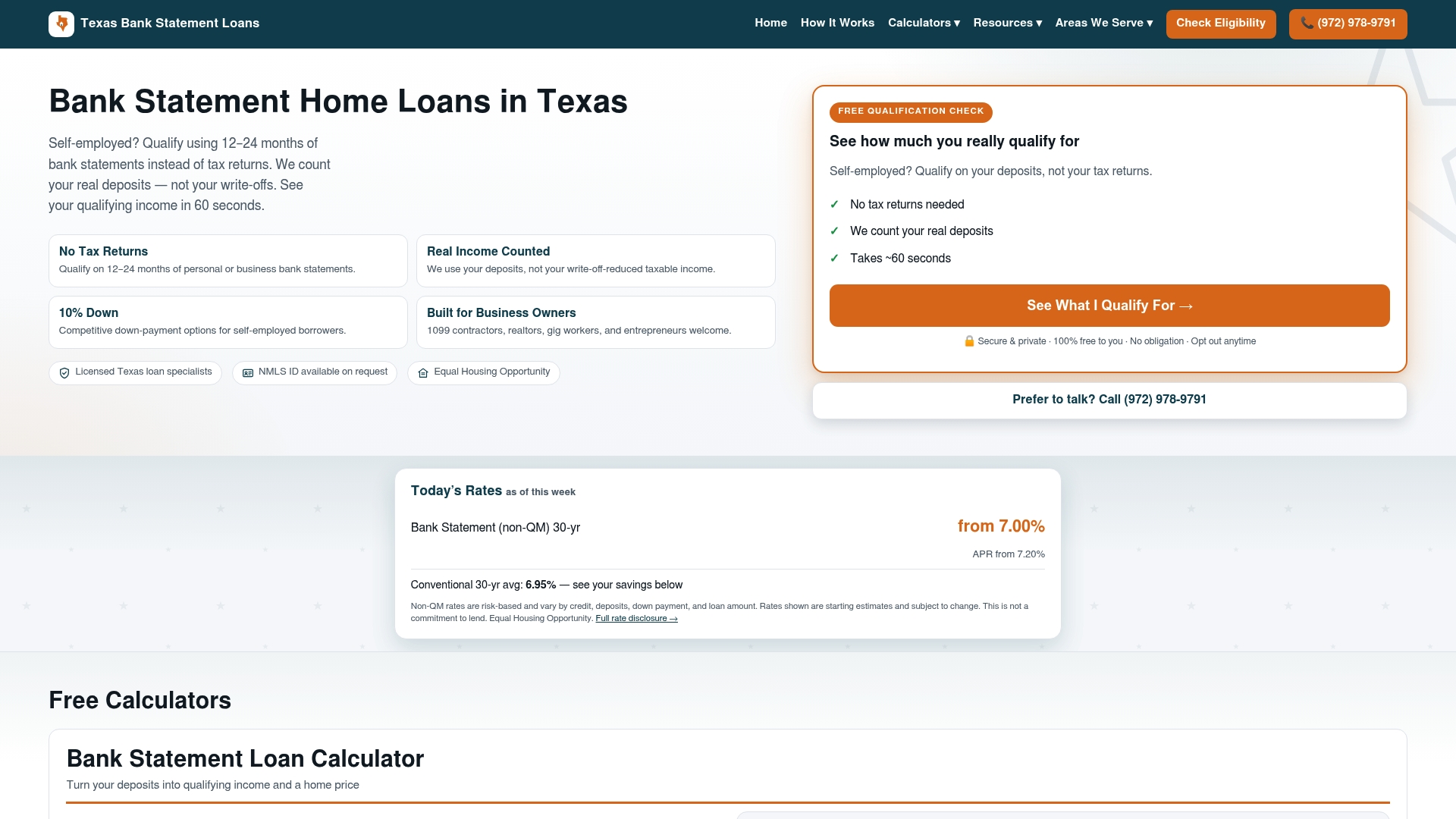
Self-employed borrowers, 1099 contractors, and business owners often get turned away by traditional underwriting long before a buydown conversation even starts. Texas Bank Statement Home Loans evaluates 12 to 24 months of bank deposits instead of tax returns, which means income that gets buried under write-offs on a tax return still counts toward qualifying.
Relevant options for borrowers weighing a buydown include:
- Bank Statement (non-QM) 30-yr loans, priced from 7.00% per year, with structures that can accommodate a temporary buydown.
- Low down payment options, which help preserve cash that could otherwise fund part of a buydown.
- DSCR loan options for investment property borrowers weighing similar rate concessions.
- Free calculators and tools to model payments before committing to a buydown structure.
A free, no-obligation qualification check takes about 60 seconds and shows what a borrower can realistically afford. Start by checking your rates and eligibility or explore the full range of calculators to model your own buydown scenario.
Sources
- Fannie Mae selling guide, Temporary interest rate buydowns
- Fannie Mae job aid, Overview of temporary buydown
- OCC / OTS exam handbook, Interagency guidance on nontraditional mortgage product risks
- CFPB, Compare and negotiate your loan offers
FAQ
What are the current rates for non-QM loans?
Non-QM rates vary by lender, loan type, and borrower profile, so there is no single published figure. Texas Bank Statement Home Loans lists its Bank Statement (non-QM) 30-year rates starting from 7.00% per year, which borrowers can check directly for current pricing.
Is a mortgage rate buydown worth it?
A buydown is worth considering when a borrower expects income to rise or wants lower payments during a specific stretch, since it delivers real short-term savings funded by a seller, builder, or lender credit. It is not a substitute for qualifying at the full note rate, which every non-QM borrower must do regardless of the buydown, according to Fannie Mae’s buydown guidance.
Who benefits most from a rate buydown?
Borrowers with a clear path to higher income, such as newly self-employed individuals or those expecting a raise or bonus structure, tend to benefit most, since the reduced payments bridge a gap that closes over time. Buyers in a seller’s or builder’s incentive program also benefit because someone else typically funds the subsidy.
How much does it cost to buy down 1% of an interest rate?
The cost depends on the loan amount, term, and how many years the reduction lasts, since the lump-sum subsidy equals the sum of the monthly payment differences over the buydown period. A 3-2-1 buydown that reduces the rate by 3% in year one costs more upfront than a 1-0 buydown that only reduces it by 1% for a single year.
What documentation does a buydown agreement require?
A buydown agreement needs to specify the funding source, the custodial account rules, what happens to unused funds if the loan pays off early, and how the servicer transfers the account if the loan is sold. These terms follow standard Fannie Mae and Freddie Mac buydown practices and should be finalized before the Closing Disclosure is issued.
Recommended
See what you qualify for in 60 seconds, free and no credit check. Use the eligibility check at the top of this page.