
Lenders typically want to see anywhere from zero to six months of PITI in reserves for many conventional, owner-occupied purchases, but self-employed borrowers using bank-statement programs usually see that number climb to 3 to 12 months or more. Reserves exist so you can still make your payment if income stalls right after closing. The exact figure moves with your credit score, loan-to-value ratio, and how your income gets documented.
TL;DR:
- Reserve requirements for self-employed and bank-statement borrowers can range from three to twelve months of PITI, depending on credit and loan type.
- Liquid assets such as checking, savings, and money market accounts count fully, while stocks and retirement funds are weighted at 70% to 60% respectively, with timing relative to application also critical.
- Bank-statement, non-QM, and jumbo loans typically demand more reserves-up to twelve months of PITI-especially for investment properties or higher LTVs.
- Proper documentation, including consecutive bank statements and a gift letter if applicable, is essential; unsupported deposits frequently cause delays or denials.
- Showing more reserves can improve pricing tiers and increase borrowing capacity, particularly for self-employed applicants, but excess reserves add limited value if your file is already at the optimal tier.
Table of Contents
- What Are Bank Statement Loan Reserves, Exactly?
- What Counts As Mortgage Reserves And How Do Lenders Measure Them?
- Reserve Expectations By Loan Program
- How Lenders Verify Reserves: Documents And Red Flags
- How Reserves Change Approval Odds And Pricing
- Reserve Strategy For Self-Employed And Bank-Statement Borrowers
- Checklist To Prepare Your Reserves Before You Apply
- A Loan Officer’s Take On Reserve Surprises
- Bank Statement Home Loans For Self-Employed Texas Buyers
- Where To Verify Reserve Rules Yourself
- Sources
What Are Bank Statement Loan Reserves, Exactly?
Reserves are the cash or liquid assets left over after you’ve covered your down payment and closing costs, expressed in months of your future mortgage payment. Lenders measure everything against PITI: principal, interest, taxes, and insurance. If your monthly PITI is $2,400 and your program requires six months of reserves, you need $14,400 sitting in accounts the underwriter can verify, on top of whatever you’re putting down.
Reserve requirement snapshot:
- Some conventional loans for primary residences with strong credit and low LTV may require no reserves
- A typical reserve range for many conventional purchases falls between a few months, according to Bankrate’s reserve breakdown
- 3 to 12 months: common for bank-statement and non-QM programs, according to LoanWise’s bank-statement guide
- Investment properties and many jumbo loans usually require a substantial reserve buffer, often measured in multiple months of PITI
Pro Tip: Calculate your PITI first, then multiply by the months your program requires. A quick way to check where you land is running your numbers through a self-employed affordability calculator before you ever talk to a loan officer.
One exception worth flagging: investment properties almost always sit at the high end of the range, no matter how clean your credit is. Lenders treat rental income as less stable than a paycheck, so the buffer requirement rarely drops below six months even for borrowers with excellent files.
What Counts As Mortgage Reserves And How Do Lenders Measure Them?
Reserves have to be liquid, meaning you can turn them into cash quickly without penalty, and they have to belong to you in a verifiable way. Fannie Mae’s selling guide spells out exactly which asset types qualify and how much of each an underwriter can actually count.
Checking and savings accounts count in full. Most lenders will also accept a portion of brokerage and retirement account balances, but rarely all of it.
Sources that typically count, and how they’re valued:
- Checking and savings accounts: counted at 100% of the verified balance
- Money market and CD accounts: counted at 100%, though early-withdrawal penalties can affect timing
- Stocks, bonds, and mutual funds in a taxable brokerage account: usually counted at 70% to account for market volatility
- Vested retirement funds (401(k), IRA): usually counted at 60% to 70% of vested balance, and only if the funds are accessible without triggering excessive penalties
- Gift funds: sometimes acceptable for reserves, but usually only after the down payment and closing costs are covered, and only with a signed gift letter
Sources that usually don’t count:
- Unsecured loans or credit card cash advances
- Funds borrowed against the property being purchased
- Business accounts still needed to operate the borrower’s business (a real sticking point for self-employed applicants)
- Cash on hand that isn’t in a verifiable financial institution account
Timing matters as much as the source. Reserves are calculated on what’s left after your down payment and closing costs are paid, not your total account balance the day you apply. If you have $40,000 in savings and you’re putting $25,000 down with $8,000 in closing costs, your reserve calculation starts from roughly $7,000, not $40,000. Underwriters also want to see that balance held steady, not freshly inflated by a deposit that shows up the week before your loan application.
Reserve Expectations By Loan Program
Reserve rules shift meaningfully depending on the loan type, and lender overlays add another layer of variation on top of the baseline guidelines. Two borrowers applying for the same loan amount can face different reserve mandates simply because one has a 680 credit score and the other has a 740.
Conventional loans
Fannie Mae’s minimum reserve requirements may start at zero for well-qualified, owner-occupied purchases with low loan-to-value ratios and strong credit. As LTV rises or the property becomes a second home, most conventional guidelines require a few months of PITI in reserves as conditions and risk factors increase…
FHA, VA, and USDA loans
FHA loans generally don’t carry a blanket reserve requirement for a single-unit primary residence, though HUD’s Single Family Housing Policy Handbook 4000.1 does impose reserve conditions in specific situations, including certain multi-unit properties and manual underwriting scenarios where compensating factors matter more. VA loans typically skip a formal reserve requirement for primary residences entirely, since the VA guaranty itself functions as a risk offset. USDA loans follow a similar pattern to FHA, with reserves usually not mandatory but sometimes requested as a compensating factor when a file has other weaknesses.
Bank statement and non-QM loans
This is where reserve requirements jump the most, and it’s not arbitrary. Bank-statement programs remove tax returns from the income picture entirely, relying instead on 12 to 24 months of deposit history to calculate qualifying income. That documentation method is inherently less standardized than a W-2, so lenders offset the added risk by requiring more liquidity on the back end. Industry guidance on non-QM lending puts typical bank-statement reserve requirements at 3 to 12 months, with the higher end reserved for lower credit scores, higher LTV, or investment purchases layered on top of the bank-statement approach.
Investment, second-home, and jumbo loans
Investment properties financed through DSCR or bank-statement programs typically require several months of reserves, and it’s rare to see that waived even for strong files. Jumbo loans follow a similar logic since the dollar exposure per loan is higher. A borrower buying a $700,000 investment property with a $4,200 monthly PITI and a nine-month reserve requirement would need roughly $37,800 in verified liquid reserves, separate from the down payment.
Quick reserve math: PITI × required months = dollar reserve target. A $3,000 PITI at six months means $18,000. At twelve months, that same payment requires $36,000 sitting untouched after closing.
How Lenders Verify Reserves: Documents And Red Flags
Verification is where a lot of otherwise-qualified borrowers hit a wall, usually because they didn’t realize how closely underwriters trace every deposit.
Documents lenders typically request:
- Two to three months of consecutive bank statements for conventional loans, or 12 to 24 months for bank-statement programs, with every page included, not just the summary page
- Brokerage and retirement account statements showing vested balances if those assets are being counted toward reserves
- A clear asset ledger reconciling any large or irregular deposits
- A signed gift letter if any portion of the funds came from a relative or approved donor
- A CPA letter verifying business income and confirming that reserve funds aren’t needed to keep the business operating, which is especially common for self-employed and 1099 files
Underwriters trace large deposits by asking for a documented paper trail: a sale contract if you sold a car or an asset, a settlement statement if funds came from selling property, or the donor’s own bank statement showing a matching withdrawal if the money was a gift. Valley West Mortgage’s breakdown of bank-statement underwriting notes that unsupported deposits, ones without a clean explanation and matching documentation, routinely trigger underwriting conditions or outright denial.
Pro Tip: Stop moving money between accounts in the 60 days before you apply. Every transfer creates a new “large deposit” that needs its own explanation, even if it’s your own money moving from savings to checking.
Any one of these can stall a file for weeks while you track down paperwork you didn’t know you’d need.
How Reserves Change Approval Odds And Pricing
Reserves function as a compensating factor. Automated underwriting systems set floors based on credit, DTI, and LTV, but reserves above the minimum can offset a weaker spot elsewhere in the file, like a slightly higher debt ratio or a thinner credit history.
On bank-statement loans specifically, reserves do more than satisfy a checkbox. Since non-QM pricing is risk-based, a borrower who shows 12 months of reserves instead of the program minimum of 6 often qualifies for a better rate tier and sometimes a higher allowable LTV on the same income profile.
| Scenario | Reserves shown | Likely outcome |
|---|---|---|
| Bank-statement borrower, 700 credit, minimum reserves | 3 months PITI | Approved, standard non-QM pricing tier |
| Same borrower, same credit, extra reserves | 9 to 12 months PITI | Often eligible for a better rate tier and more LTV flexibility |
| Bank-statement borrower, minimum reserves only | 3 months PITI | Higher likelihood of a rate add-on or reduced LTV cap |
| Same borrower, stronger reserves | 12 months PITI | Reserves can partially offset the lower credit score in underwriting |
The gap between those rows isn’t cosmetic. A borrower with the same income and credit score can land in a meaningfully different pricing bracket purely based on documented liquidity, which is one of the few levers self-employed applicants can pull without waiting for their credit score to improve or their business tenure to lengthen. Checking current bank-statement loan rate tiers before you apply gives you a realistic sense of where extra reserves might actually move the needle for your specific file.
Reserves don’t help in every scenario, though. If your file is already at the strongest tier available, credit, LTV, and documentation all maxed out, additional reserves beyond the program minimum won’t buy you a better rate. The lever only works when there’s room to move.

Reserve Strategy For Self-Employed And Bank-Statement Borrowers
Bank-statement programs ask for more reserves because they’ve already traded one form of certainty (tax returns) for another (deposit history), and that trade shifts risk onto the lender in a way that liquid reserves help balance out. The IRS Schedule C that most self-employed filers submit is built to minimize taxable income, which is exactly why it often understates real cash flow and why bank-statement underwriting exists in the first place.
Reserve targets by profile, as a conservative starting point:
- Credit 740+, LTV under 75%: aim for 6 months of PITI even if your program’s minimum is lower
- Credit 680 to 739, LTV 75% to 85%: aim for 9 to 12 months
- Credit under 680, or LTV above 85%: expect to need 12 months or more, and treat that as a floor rather than a stretch goal
Documentation habits that make underwriting faster:
- Keep business and personal accounts fully separate; commingled accounts make income calculation harder and slow down every stage of review
- Label large or unusual deposits as they happen, in your own records, so you’re not reconstructing an explanation four months later
- Keep 12 to 24 months of clean, consecutive statements with no gaps, since most bank-statement programs pull that full window
- Have your CPA prepared to write a letter confirming that reserve funds aren’t needed for business operations, particularly if your reserves sit in a business account
Pro Tip: If your tax returns don’t reflect your real income because of deductions, depreciation, or how your CPA structures your filings, that’s the exact situation bank-statement loans were built for. A program using 12 to 24 months of actual deposits can qualify you for a loan amount your tax returns alone never would.
Texas Bank Statement Home Loans evaluates 12 to 24 months of personal or business bank deposits instead of tax returns, which lets business owners, 1099 contractors, and gig workers present income that actually reflects what they earn. Options starting at 10% down give self-employed borrowers a realistic path into ownership that conventional underwriting often closes off.

Checklist To Prepare Your Reserves Before You Apply
Getting your reserves in order before you start shopping saves weeks of back-and-forth once you’re under contract.
- Pull consecutive bank statements for every account you plan to use, making sure every page is included, not just the summary
- Flag any deposit larger than a normal paycheck and gather the paper trail now: sale contracts, settlement statements, or donor bank statements
- Ask your CPA for a letter confirming business income and, if relevant, that reserve funds aren’t required to run the business
- Calculate your target PITI and multiply by your program’s expected reserve months so you know the real dollar figure you need to hold
- Stop moving money between accounts and stop opening new credit in the 60 to 90 days before you plan to apply
- Build a single folder, digital or physical, with statements, letters, and asset documentation ready to upload the moment your loan officer asks
Timing catches more borrowers than the actual dollar amount does. Moving a large sum into your account two weeks before applying doesn’t add to your usable funds; it adds a documentation task. Let money sit for at least one full statement cycle, ideally two, before you count on it as reserves.
A Loan Officer’s Take On Reserve Surprises
Reserves catch more borrowers off guard than almost anything else in the mortgage process, mostly because everyone fixates on the down payment and assumes that’s the finish line. It isn’t. I’ve seen files stall for weeks over a single unexplained $3,000 deposit that would have taken five minutes to document if the borrower had just kept the receipt.
The fastest way to clear a reserves condition is boring but effective: stop touching your money in the months before you apply, and keep a paper trail for anything unusual. Underwriters aren’t trying to catch you doing something wrong. They’re trying to confirm the money is really yours and really liquid. That’s it.
If there’s one thing self-employed borrowers underestimate, it’s how much extra reserves can work in their favor on a bank-statement file. Showing 12 months instead of the bare minimum doesn’t just check a box, it can shift your pricing tier. Start thinking about reserves the same week you start thinking about your down payment, not after your offer gets accepted.
- Saad
Bank Statement Home Loans For Self-Employed Texas Buyers
Texas Bank Statement Home Loans exists specifically for borrowers whose tax returns don’t tell the real income story: business owners, 1099 contractors, gig workers, and realtors who write off enough that a conventional lender sees far less income than actually hits their accounts each month. Instead of tax returns, the program evaluates 12 to 24 months of personal or business bank deposits and offers low down payment options starting at 10%.
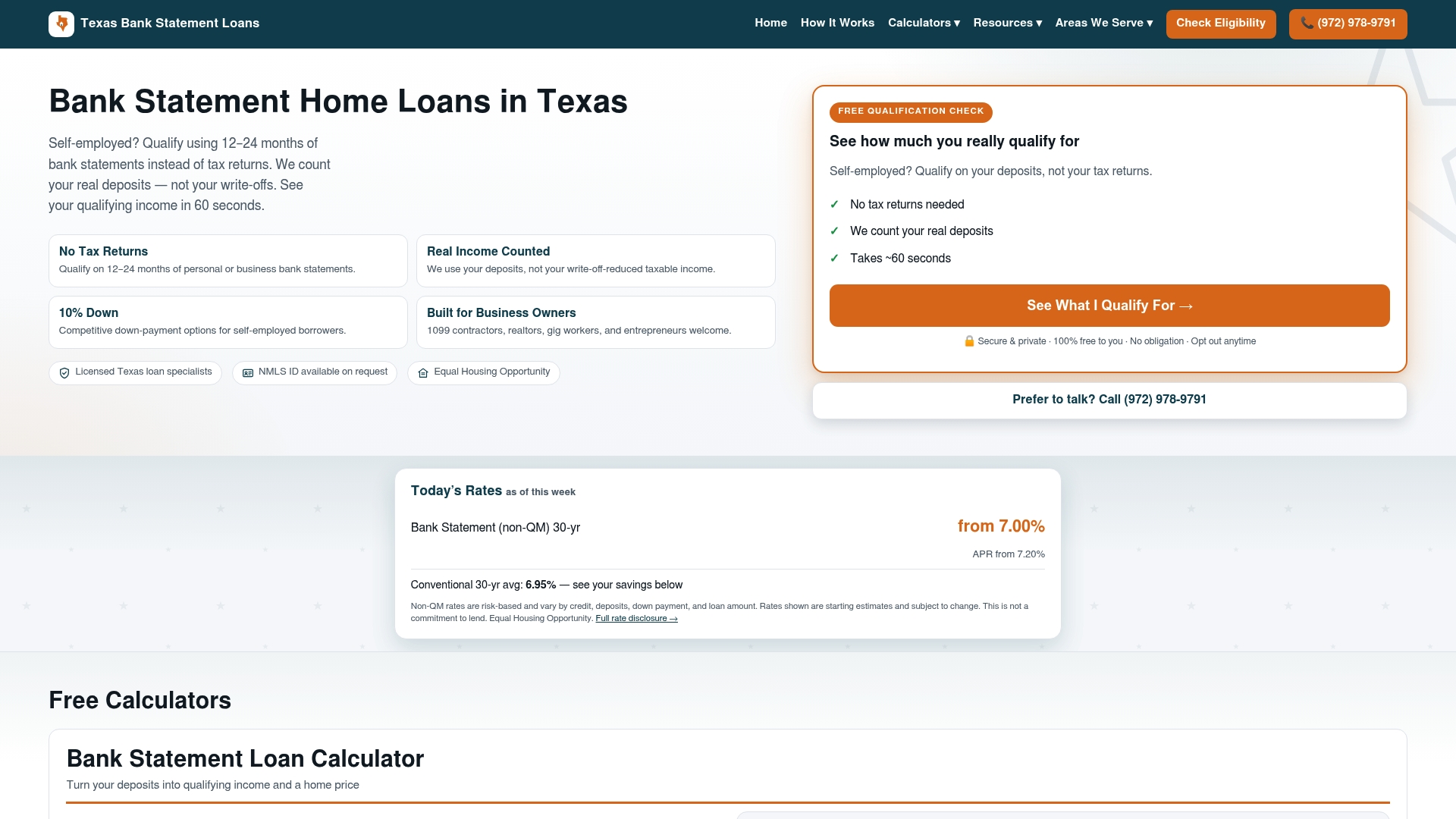
If you’ve already been turned down or discouraged by a conventional lender because your tax returns understate your income, that’s the exact signal to look at a bank-statement route instead of continuing to shop traditional programs. The self-employed affordability calculator gives you a real sense of what you can qualify for in about 60 seconds, and the current bank-statement loan rate tiers show how your reserves and credit profile affect pricing before you commit to anything. Start with a no-obligation qualification check at Texas Bank Statement Home Loans to see where your actual deposit history puts you.
Where To Verify Reserve Rules Yourself
For definitive reserve requirements, consult Fannie Mae’s selling guide and FHA-specific rules in HUD’s Handbook 4000.1. For consumer advice, see the CFPB’s homeownership guidance, while Bankrate’s reserves explainer provides typical reserve amounts by loan type. Non-QM programs and bank-statement loans are covered in more detail at LoanWise’s bank-statement guide. If you need help organizing the actual paperwork lenders request, this breakdown of mortgage document packaging is a useful reference, and if a timing gap between closing and reserve availability comes up, this bridge loan qualification checklist explains short-term financing options worth knowing about.
This article is general information, not a substitute for advice from a qualified financial advisor. Consult a qualified financial professional about your own circumstances before acting on anything here.
Sources
- HUD FHA Single Family Housing Policy Handbook 4000.1
- CFPB, Prepare for homeownership
- What Are Mortgage Reserves And Who Needs Them? | Bankrate
- The Bank Statement Mortgage Master Guide 2026: Self-Employed Requirements | LoanWise
See what you qualify for in 60 seconds, free and no credit check. Use the eligibility check at the top of this page.