
A bank statement loan is a non-QM (non-qualified mortgage) that lets borrowers qualify based on their actual bank deposit history instead of tax returns or W-2s. For self-employed workers, freelancers, and gig economy borrowers, this distinction is the difference between buying a home and being turned away. The non-QM lending market reached $239 billion in 2025, serving roughly 10% of the U.S. workforce that earns income outside traditional employment. Understanding why 2026 bank statement loans matter means understanding how the American labor market has permanently shifted away from the W-2 model that conventional mortgage underwriting was built for.
Why 2026 bank statement loans matter more than ever
The core problem is simple. Self-employed borrowers write off legitimate business expenses on their taxes. Those deductions reduce taxable income, which is exactly what conventional lenders use to calculate how much mortgage you can afford. A freelance designer earning $120,000 in gross deposits might show only $60,000 in net income after deductions. A conventional lender sees the $60,000 and denies the loan. A bank statement loan lender sees the $120,000 in deposits and qualifies the borrower on actual cash flow.
Tax write-offs lower qualifying income for self-employed borrowers in ways that have nothing to do with their ability to repay a mortgage. The write-off is a tax strategy, not a sign of financial weakness. Bank statement loans correct this distortion by going directly to the source: the money actually flowing through the borrower’s accounts.

The non-QM market grew from roughly $40-50 billion annually to $239 billion by 2025. That growth reflects real demand from a workforce that no longer fits the mold conventional mortgage guidelines were designed around.
How do bank statement loans verify income compared to conventional mortgages?
Conventional mortgages rely on two years of tax returns, W-2s, and pay stubs. Bank statement loans replace all of that with 12-24 months of bank statements. Lenders average monthly deposits across that window, then apply an expense ratio to estimate net income. The expense ratio accounts for business costs and varies by industry, typically ranging from 10% to 50%.
Here is how the calculation works in practice:
- Gross monthly deposits: $15,000 averaged over 24 months
- Expense ratio applied: 30% (lender’s standard for your industry)
- Qualifying monthly income: $10,500
- Annualized qualifying income: $126,000
That figure goes into the debt-to-income calculation, just like a W-2 salary would. The key difference is that the lender is working from real cash flow, not a tax-optimized number.
Lenders treat personal and business bank statements differently. Personal accounts lead to simpler income calculations, while business accounts require detailed expense factor analysis that can reduce qualifying income. Using personal statements when possible is a meaningful advantage.
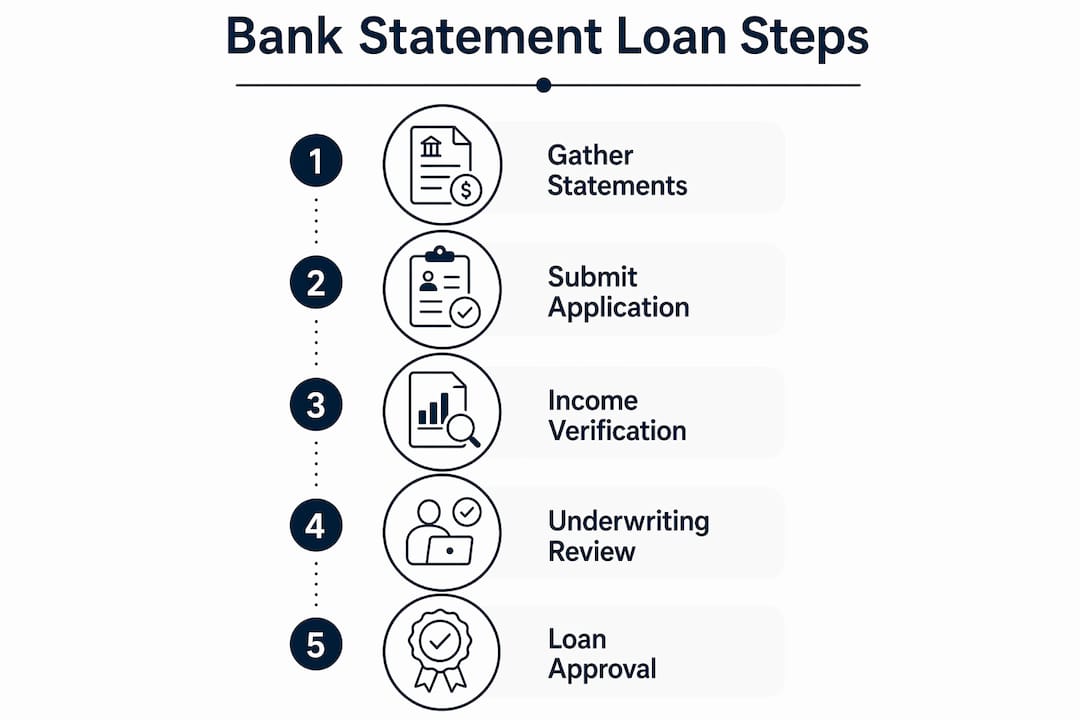
Seasonality also matters. A contractor who earns $200,000 in summer and $40,000 in winter looks inconsistent over 12 months. A 24-month average smooths that pattern and often produces a higher qualifying income. Lenders who offer both windows give borrowers more flexibility.
Pro Tip: Ask your lender to run both a 12-month and a 24-month calculation before committing to a loan structure. The difference in qualifying income can be significant, especially if your business had a strong recent year.
What are the qualification requirements and typical costs?
Bank statement loans carry specific underwriting criteria that differ from conventional guidelines. Knowing these upfront prevents surprises during the application process.
| Requirement | Typical Range |
|---|---|
| Credit score minimum | 620-660+ |
| Self-employment history | 2 years minimum |
| Bank statements required | 12-24 months |
| Minimum down payment | 10%-20% |
| Cash reserves required | 3-12 months of payments |
| Interest rate premium | 0.5%-1.5% above conventional |
Interest rates on bank statement loans run 0.5%-1.5% higher than conventional loans. That premium exists because non-QM underwriting is manual and labor-intensive. Lenders review every deposit, flag irregularities, and build a custom income picture for each borrower. That work costs more than running a W-2 through an automated system.
The rate premium is real, but it does not make these loans a bad deal. A borrower who cannot qualify conventionally has no alternative. Paying a slightly higher rate to buy a home beats renting indefinitely while waiting for a tax situation that may never satisfy conventional guidelines.
Down payments starting at 10% make these loans accessible. Texasbankstatementloans offers programs with down payments at that floor, which matters in a Texas market where home prices in Houston, San Antonio, and Austin have risen steadily. You can check current loan rates to see how today’s pricing compares to conventional benchmarks.
Reserve requirements vary by lender and loan size. Most programs require 3-6 months of mortgage payments held in liquid accounts after closing. Larger loan amounts often require up to 12 months. Building reserves before applying strengthens the file and can improve pricing.
Why self-employed workers need this option in 2026
Self-employed workers represent approximately 10% of the U.S. workforce, and that share has grown steadily as gig platforms, remote work, and independent contracting have expanded. Conventional mortgage underwriting was designed for salaried employees with predictable, documented income. It has not kept pace with how Americans actually earn money.
The practical barriers for self-employed borrowers using conventional loans include:
- Two years of tax returns that show reduced net income after deductions
- Difficulty documenting income stability when revenue fluctuates by season or project
- Lender overlays that add requirements beyond standard guidelines
- Automated underwriting systems that flag non-W-2 income as higher risk
“Bank statement loans provide a crucial alternative for borrowers whose tax returns understate income due to legitimate business deductions, making homeownership more accessible.”
The regulatory environment in 2026 continues to support non-QM lending as a legitimate mortgage category. Lenders who specialize in these products have refined their underwriting processes, and broker networks have expanded access to competitive pricing. The market is more mature than it was five years ago, which benefits borrowers through better rates and more program options.
Self-employed borrowers in Texas face the same challenges as those nationwide, compounded by a competitive housing market. Texasbankstatementloans serves borrowers across the state, including in markets like Houston and Midland, where self-employment in energy, construction, and tech is common.
How can borrowers improve their approval chances?
Preparation is the single biggest factor separating approvals from denials on bank statement loans. Lenders reward clean, consistent financial records with better pricing and faster decisions.
-
Separate your accounts completely. Keep business income in a dedicated business account and personal expenses in a personal account. Mixing funds forces lenders to apply more conservative expense ratios and creates documentation headaches. Consistent deposits and clean accounts directly influence loan pricing.
-
Document every large or unusual deposit. A $30,000 wire from a client needs a paper trail. Prepare invoices, contracts, or transfer records for any deposit that stands out. Unexplained large deposits raise underwriting flags and can reduce qualifying income.
-
Build your statement history before applying. Lenders look back 12-24 months. If you recently started a business or switched from W-2 employment, wait until you have a full two-year deposit history before applying. Applying too early limits your options.
-
Work with a broker who specializes in non-QM loans. Specialized brokers who access multiple lenders can save 0.25%-0.5% in rates compared to going directly to a single lender. That difference compounds significantly over a 30-year loan.
-
Plan your refinance from day one. Refinancing from a bank statement loan to a conventional mortgage is common once borrowers can qualify conventionally. If your tax situation changes or your business matures, a conventional refinance can reduce your rate and lower monthly payments.
-
Use bank statement loans strategically, not by default. Mortgage experts advise using these loans when conventional financing is genuinely unavailable due to tax-reporting issues. If you can qualify conventionally, that route typically costs less.
Pro Tip: Use the bank statement loan calculator at Texasbankstatementloans to estimate your qualifying income before you speak with a lender. Knowing your number going in gives you negotiating leverage.
Key Takeaways
Bank statement loans are the most practical mortgage option for self-employed borrowers whose tax deductions prevent them from qualifying conventionally, and preparation directly determines both approval odds and rate.
| Point | Details |
|---|---|
| Income verification method | Lenders average 12-24 months of deposits and apply an expense ratio to calculate qualifying income. |
| Cost trade-off | Expect rates 0.5%-1.5% above conventional loans, with down payments starting at 10%. |
| Account separation matters | Keeping business and personal accounts separate produces simpler, more favorable income calculations. |
| Broker advantage | Working with a non-QM specialist broker can reduce your rate by 0.25%-0.5% versus a single lender. |
| Strategic use | Use bank statement loans when conventional financing is unavailable, and plan to refinance when your tax profile improves. |
Why I think self-employed borrowers underestimate this tool
Most self-employed borrowers I have seen come to bank statement loans as a last resort, after a conventional lender has already turned them down. That is the wrong sequence. The borrowers who get the best outcomes are the ones who recognize early that their tax strategy and their mortgage strategy are in conflict, and they plan accordingly.
The rate premium on these loans is real, but it is not the whole story. A borrower who buys a home in a rising market at a slightly higher rate builds equity. A borrower who waits for a conventional approval that never comes pays rent and builds nothing. The math usually favors acting sooner with the right product over waiting indefinitely for the ideal product.
What I find most overlooked is the refinance path. Borrowers treat bank statement loans as permanent, when they are often a bridge to conventional financing. Clean up your tax picture over two years, document your income more favorably, and refinance. The higher rate is temporary. The home equity is not.
Professional guidance matters more here than in conventional lending. Non-QM underwriting has more variables, more lender-specific overlays, and more room for a knowledgeable broker to find a better fit. Do not shop this loan the same way you would shop a 30-year fixed. Find someone who works in this market every day.
- Saad
Self-employed in Texas? Texasbankstatementloans has programs built for you
Self-employed borrowers across Texas have access to bank statement loan programs through Texasbankstatementloans, with down payments starting at 10% and qualification based on actual deposit history rather than tax returns. Whether you are in Houston, San Antonio, Midland, or anywhere else in the state, the team works with business owners, 1099 contractors, and gig workers who have been turned away by conventional lenders.
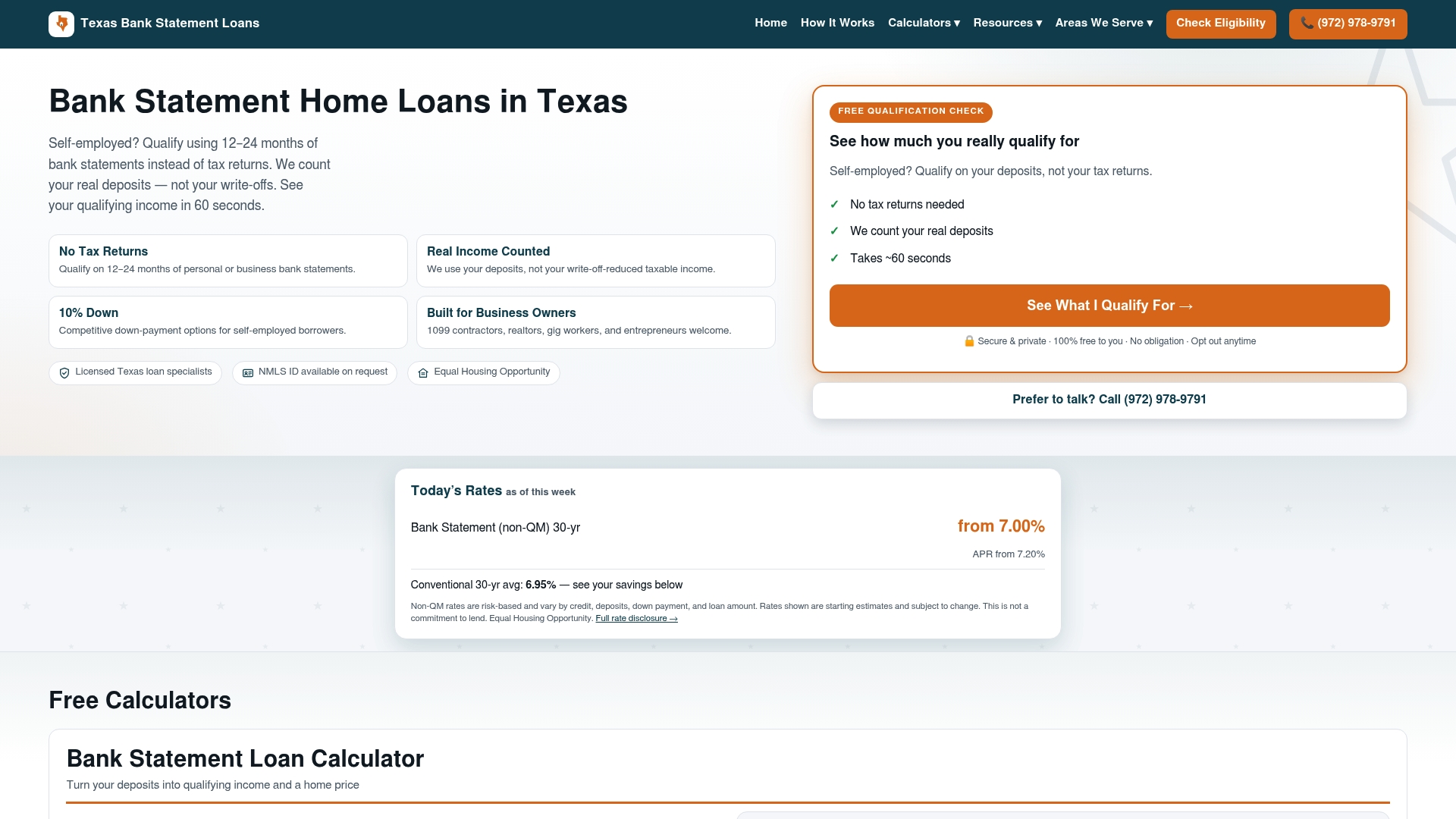
You can check how much you qualify for in 60 seconds with no obligation. Texasbankstatementloans offers personalized rate quotes and expert guidance for self-employed buyers across Texas. If you are in the Houston area, the Houston loan programs page shows current options and local underwriting criteria specific to that market.
FAQ
What is a bank statement loan?
A bank statement loan is a non-QM mortgage that qualifies borrowers using 12-24 months of bank deposit history instead of tax returns or W-2s. It is designed for self-employed borrowers, freelancers, and gig workers whose tax deductions reduce their reported income below conventional qualifying thresholds.
What credit score do I need for a bank statement loan?
Most bank statement loan programs require a minimum credit score of 620-660. Higher scores typically unlock better rates and lower down payment requirements.
How much more do bank statement loans cost than conventional mortgages?
Bank statement loans carry interest rates 0.5%-1.5% above conventional loan rates. Down payments typically range from 10%-20%, and reserve requirements of 3-12 months of mortgage payments are common after closing.
Can I refinance a bank statement loan into a conventional mortgage later?
Yes. Refinancing from a bank statement loan to a conventional mortgage is a common strategy once borrowers can document income conventionally. Improving your tax profile or increasing documented income over two years often makes conventional refinancing possible.
Should I use personal or business bank statements?
Personal bank statements produce simpler, more favorable income calculations. Business statements require detailed expense factor analysis that can reduce qualifying income. Use personal statements when possible, and keep business and personal accounts cleanly separated before you apply.
See what you qualify for in 60 seconds, free and no credit check. Use the eligibility check at the top of this page.