
Prequalification is a quick, self-reported estimate of what you might be able to borrow. Preapproval is a stronger, document-verified conditional commitment that carries real weight with sellers and agents. Neither one guarantees you’ll close on a loan.
- Prequalification: best for early budgeting, no documents required, usually a soft credit pull.
- Preapproval: best before you start making offers, requires income and asset verification, usually a hard credit pull.
- Sellers and listing agents almost always want to see a preapproval letter before they’ll take an offer seriously.
Key Takeaways
Preapproval beats prequalification for making offers because it’s verified, harder to dispute, and what sellers actually expect to see.
| Point | Details |
|---|---|
| Prequalification is an estimate | Self-reported numbers, often a soft credit pull, useful only for early budgeting. |
| Preapproval is verified | Requires income, asset, and credit documentation plus a hard credit pull. |
| Letters expire | Preapproval letters commonly expire in 30 to 90 days, so timing matters. |
| Neither guarantees closing | Final approval depends on underwriting and appraisal after your offer is accepted. |
| Self-employed alternative exists | Texas Bank Statement Home Loans uses 12 to 24 months of bank deposits instead of tax returns to qualify buyers. |
Readers can verify these standards directly through the CFPB’s guidance on preapproval and prequalification, Regulation C’s interpretation of preapproval programs, and Fannie Mae’s mortgage documents checklist.
Table of Contents
- Mortgage Prequalification vs Preapproval: How Prequalification Works
- What Preapproval Verifies and What the Letter Actually Says
- What Documents Do Lenders Require for Preapproval?
- How Sellers and Agents Actually Use These Letters
- When Should You Get Prequalified Instead of Preapproved?
- Alternatives for Self-Employed Borrowers Who Don’t Fit the Standard Mold
- How Texas Bank Statement Home Loans Helps Buyers With Nonstandard Income
- Frequently Asked Questions
- Sources
Mortgage Prequalification vs Preapproval: How Prequalification Works
Prequalification runs on the honor system. You tell a lender your income, debts, and assets, and the lender plugs those numbers into a formula to spit out a rough borrowing range. Some lenders run a soft credit pull to sharpen the estimate, but many skip verification entirely at this stage.
The appeal is speed. You can get a prequalification in minutes, often through an online form, which makes it useful for figuring out whether you’re shopping in a $300,000 range or a $450,000 range before you’ve even called a real estate agent.
- Good for: setting a realistic budget, narrowing your search area, deciding if now is the right time to buy.
- Not good for: submitting with an offer, proving to a seller you can actually close.
The catch is that a prequalification is only as accurate as what you told the lender. If you rounded up your income or forgot about a car loan, the number you get back is fiction.
What Preapproval Verifies and What the Letter Actually Says
Preapproval is a different animal. Instead of taking your word for it, a lender pulls your credit report, verifies your employment, checks your income against pay stubs or tax documents, and confirms where your down payment money is actually sitting. According to the Consumer Financial Protection Bureau, this deeper review typically involves a hard credit inquiry, unlike the soft pull common at the prequalification stage.
A preapproval letter typically states:
- A conditional loan amount you’re approved for
- An estimated interest rate
- An expiration date, usually 30 to 90 days out
Regulation C, the rule that governs how lenders report mortgage data, draws a formal line between the two: a preapproval program requires a comprehensive review that ends in a written commitment valid for a set period, while a prequalification request isn’t treated as a full application under the same standard.
That said, preapproval still isn’t a done deal. It’s conditional on the property appraising for the sale price and on underwriting confirming everything the lender already reviewed. Some lenders verify almost everything upfront; others do a lighter pass and save deeper scrutiny for underwriting, so it pays to ask your loan officer exactly what their preapproval process checks.
What Documents Do Lenders Require for Preapproval?
Gathering paperwork before you apply saves days, sometimes weeks. Lenders use these documents to calculate your debt-to-income ratio, confirm your down payment source, and verify that your income is stable enough to support the loan.
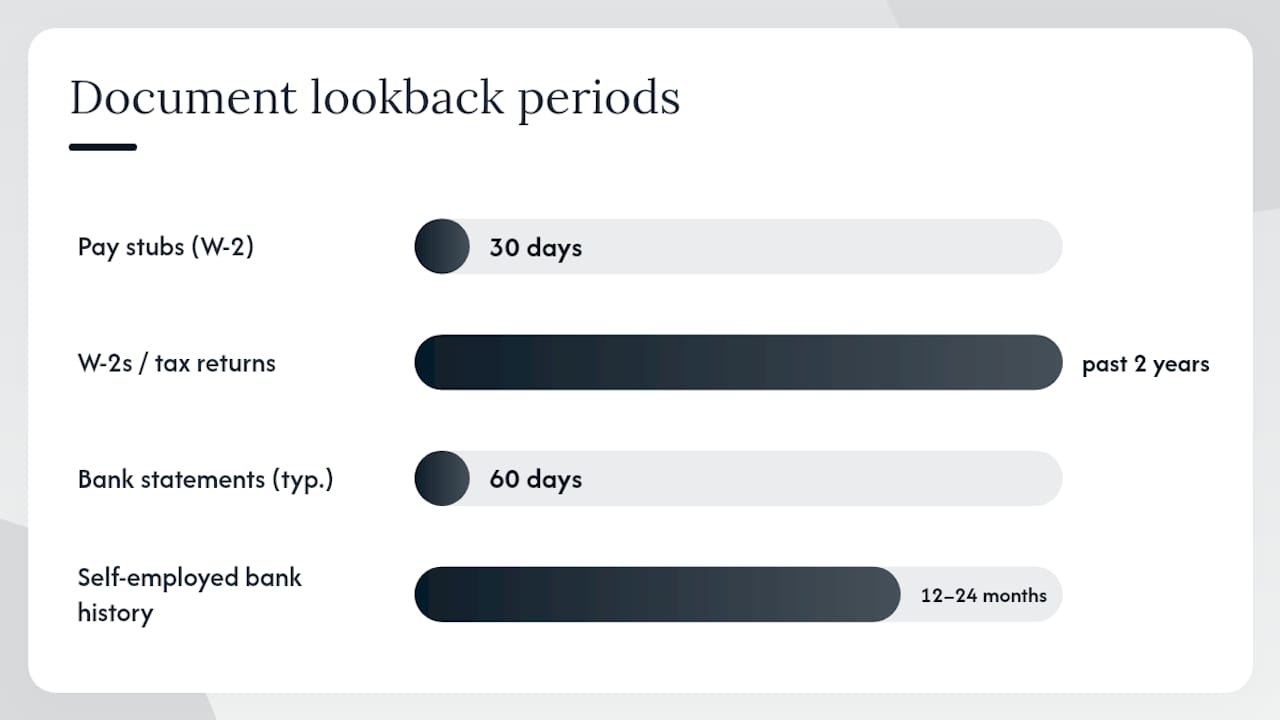
- Pay stubs covering the last 30 days, for W-2 employees.
- W-2s or tax returns from the past two years.
- Recent bank statements, typically 60 days, to verify assets and down payment funds.
- Government-issued ID and Social Security number for identity verification.
- Asset statements for retirement accounts, investment accounts, or other savings.
Self-employed borrowers, 1099 contractors, and gig workers often hit friction here because tax returns can understate real cash flow after deductions. Lenders may instead ask for profit-and-loss statements or, increasingly, 12 to 24 months of bank statements that show what actually landed in the account.
Pro Tip: Pull your own bank statements and tax transcripts before you contact a lender. Reviewing them yourself first means you’ll catch a missing deposit or a mismatched income figure before an underwriter does.
How Sellers and Agents Actually Use These Letters
Real estate agents see dozens of offers a year, and they’ve learned that a prequalification letter tells them almost nothing. A preapproval letter is the document sellers actually rely on to judge whether a buyer can close, which is why competitive markets often require one before an offer even gets a second look.
- Early house hunting or open houses: prequalification is often enough to walk through the door.
- Writing an offer, especially in a multiple-offer situation: sellers expect preapproval.
- Final loan approval still doesn’t happen until after your offer is accepted, once underwriting and the appraisal are complete.
Timelines, Expiration Windows, and the Credit Score Question
Prequalification can happen in minutes. Preapproval takes longer, ranging from a few hours to several days depending on how fast you supply documents. Once issued, preapproval letters commonly expire within a few weeks to a few months, since income, debt, and rates can shift.
On credit: a soft pull for prequalification doesn’t affect your score. A hard pull for preapproval typically causes a small, temporary dip, usually just a few points, that recovers within a few months.
When Should You Get Prequalified Instead of Preapproved?
The right move depends on where you are in the process, not on which one sounds more impressive.
- Just starting to browse listings or run numbers? Get prequalified. It costs you nothing and gives you a budget to work from.
- Touring homes seriously or planning to write an offer soon? Get preapproved. Agents and sellers will expect it, and waiting until you find “the one” leaves you scrambling.
- Self-employed, rebuilding credit, or dealing with irregular income? Start the preapproval process early. Verification takes longer for nonstandard income, and starting early gives you time to fix credit report errors or gather extra documentation before you’re racing a closing deadline.
Steps That Strengthen Your Preapproval
A few moves before you apply can mean the difference between a smooth preapproval and a stressful one.
- Pull your credit report and dispute any errors. Correcting mistakes early and paying down high-interest balances can noticeably improve your debt-to-income ratio.
- Gather documentation before you apply rather than after a lender asks for it, and avoid opening new credit or changing jobs before closing.
- Once you have a signed purchase contract, compare Loan Estimates across lenders. That’s the point where rates and fees become genuinely comparable, not before.
Pro Tip: Lock in your paperwork before you shop for rates. A lender can’t give you an accurate estimate off incomplete information, and re-submitting documents mid-process is how closings get delayed.
Alternatives for Self-Employed Borrowers Who Don’t Fit the Standard Mold
Traditional preapproval leans hard on tax returns, and tax returns are exactly where self-employed income looks smaller than it actually is once deductions are factored in. Bank-statement programs work around that by calculating qualifying income from 12 to 24 months of actual deposits instead of a net income figure shaped by write-offs.
- Business owners, 1099 contractors, and gig workers often qualify for more than their tax returns would suggest.
- Texas Bank Statement Loans offers a 60-second qualification check and down payment options starting at 10%.
Deposits tell a more honest story about cash flow than a tax return built around minimizing taxable income. For a business owner whose write-offs are aggressive but whose bank account tells a healthier story, that distinction can be the difference between a denial and a preapproval.
An Editorial Take on Timing
Most buyers wait too long to get preapproved, treating it like a formality instead of a strategic step. Start the process before you fall in love with a house. If your income doesn’t fit a W-2 box, look into a bank-statement program well before you need a letter in hand.
How Texas Bank Statement Home Loans Helps Buyers With Nonstandard Income
If your tax returns undersell what your business actually brings in, a standard preapproval process can work against you before it ever gets to underwriting. Texas Bank Statement Home Loans reviews 12 to 24 months of personal or business bank statements instead, so deposits, not deductions, determine what you qualify for.
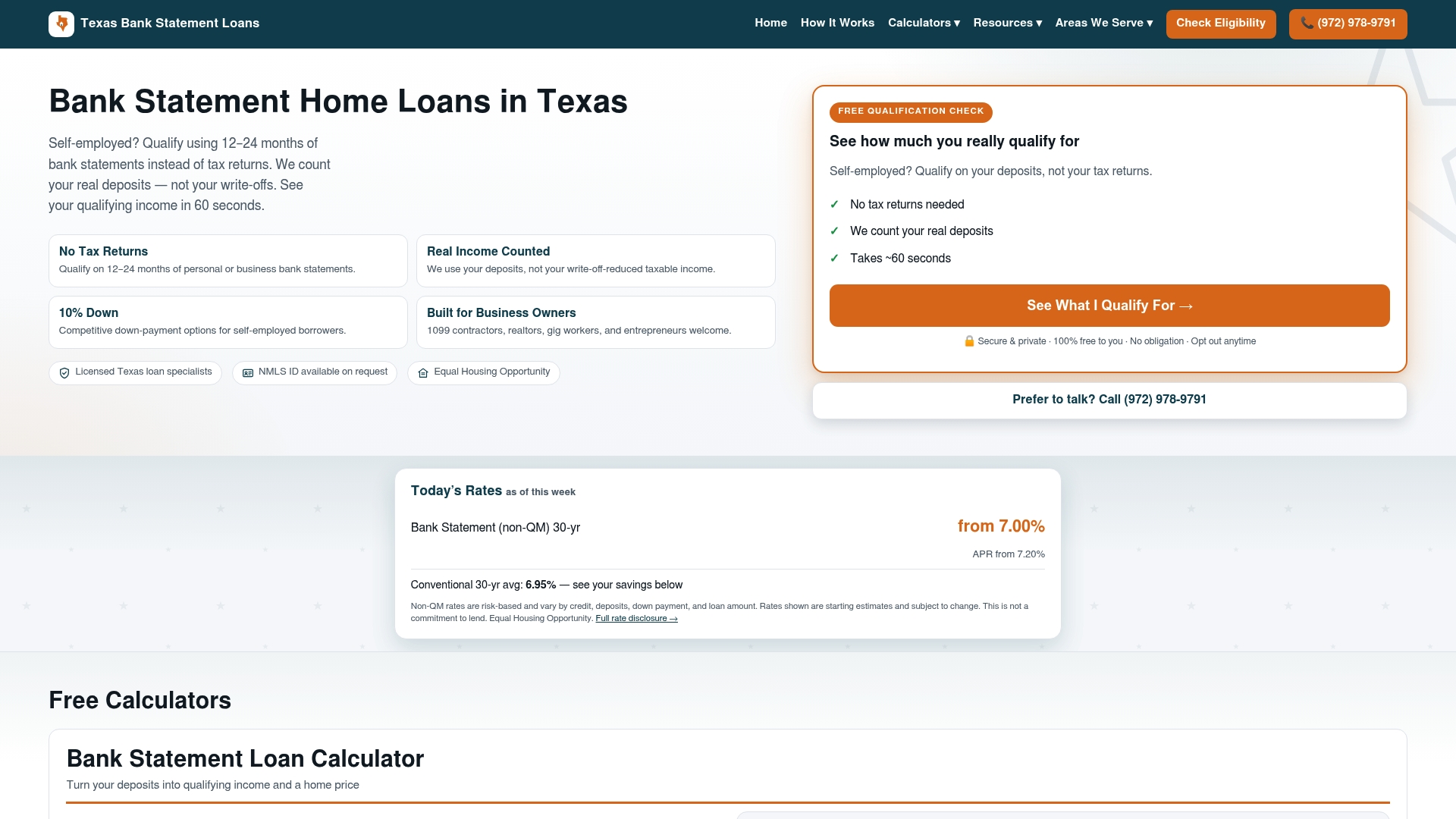
The process starts with a free, no-obligation qualification check that takes about 60 seconds and gives you a realistic sense of what you can afford. From there, gather your recent bank statements, and connect with a loan officer to talk through preapproval alternatives suited to self-employed income, including down payment options starting at 10%. Down payment funds tied to a loan also factor into loan-to-value calculations the same way they do on other loan types, an idea explained well in this overview of loan-to-value basics. Any preapproval you receive stays conditional, so once you have a signed purchase contract, compare Loan Estimates before committing. Start with the qualification check to see where you stand.
Frequently Asked Questions
Does mortgage prequalification affect your credit score? Usually not. Most lenders use a soft credit pull for prequalification, which doesn’t affect your score. Preapproval typically requires a hard pull, which can cause a small, temporary dip.
Can you get preapproved instantly? Not quite as fast as prequalification, but if your documents are ready, some lenders can complete preapproval in under a day. Without documents on hand, expect several days.
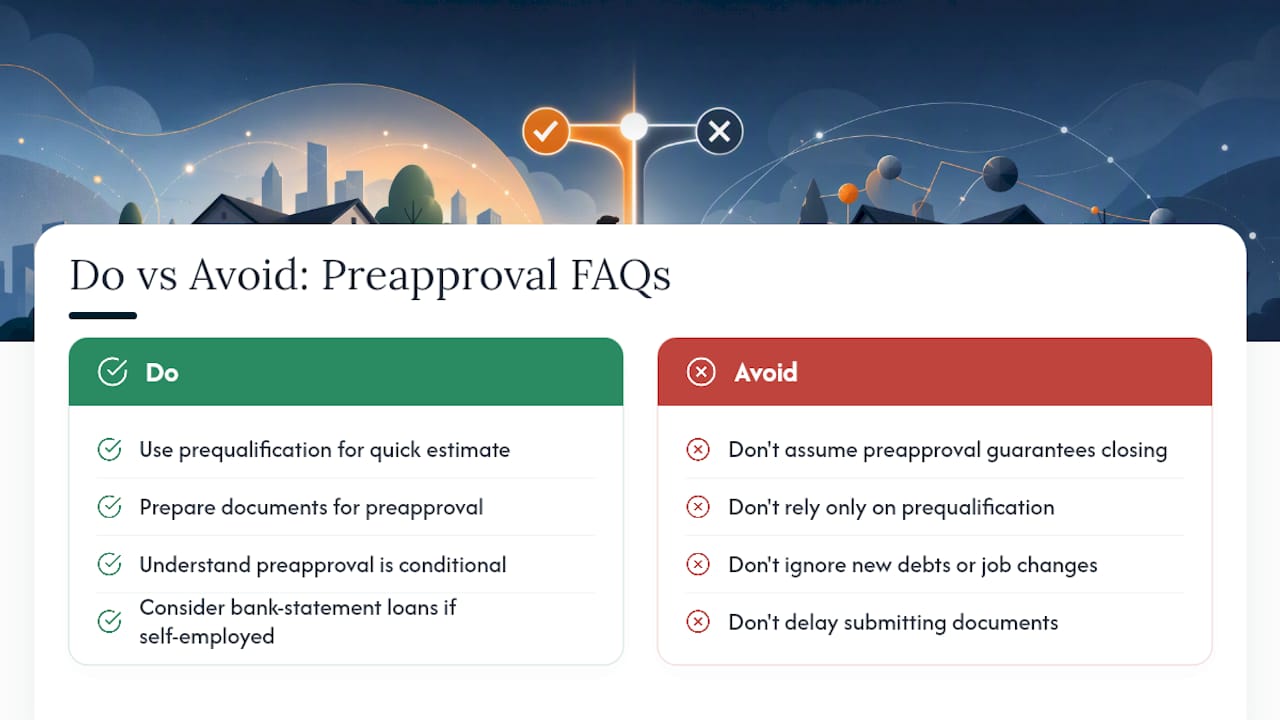
Does preapproval guarantee my loan will close? No. Preapproval is conditional on underwriting confirming your financial details and the property appraising at or above the sale price. Circumstances like a new debt or job change can still derail approval.
What’s the biggest myth about prequalification vs preapproval? That they’re interchangeable. Agents and sellers treat them very differently, and showing up with only a prequalification letter in a competitive market often means your offer gets passed over.
Is preapproval harder for self-employed borrowers? It can be, since tax returns often understate real income after deductions. Bank-statement programs that evaluate actual deposits instead of tax returns exist specifically to address this gap.
This article is general information, not a substitute for advice from a qualified financial advisor. Consult a qualified financial professional about your own circumstances before acting on anything here.
Sources
- What’s the difference between a prequalification letter and a preapproval letter? | Consumer Financial Protection Bureau
- Documents you need to apply for a mortgage | Fannie Mae
- What documents do you need for mortgage pre-approval? | Zillow
See what you qualify for in 60 seconds, free and no credit check. Use the eligibility check at the top of this page.