
A bank statement loan is a mortgage that qualifies borrowers using 12-24 months of bank deposit history instead of W-2s, pay stubs, or tax returns. This loan type exists because tax deductions reduce income on returns, leaving self-employed borrowers, 1099 contractors, and business owners looking underfunded on paper even when their cash flow is strong. The industry term for this product is a non-QM mortgage, short for non-Qualified Mortgage. Texasbankstatementloans specializes in exactly this type of financing for Texas borrowers who cannot qualify through conventional channels.
What is a bank statement loan and how does it work?
A bank statement loan is a non-QM mortgage where the lender estimates qualifying income using your deposit history rather than employer-issued documents. The lender reviews either personal bank statements, business bank statements, or both, covering a window of 12-24 months. That deposit history becomes the foundation for calculating your income.
The income calculation differs depending on which account type you use. For business accounts, lenders apply an expense factor to your total deposits. A typical expense factor for business accounts runs between 30% and 60%, meaning the lender counts only 40%-70% of deposits as qualifying income. Personal accounts may count 100% of deposits, but every transaction gets scrutinized for legitimacy. A $50,000 wire transfer from a family member does not count as income.

Lenders also examine deposit consistency across all months. A business owner who deposits $20,000 in january and $3,000 in february raises underwriting questions. Seasonal businesses, like landscapers or holiday retailers, can explain those swings with documentation. The key is that every deposit must tie back to real business activity.
Pro Tip: Before applying, print 24 months of statements and flag any large, irregular deposits. Write a brief explanation for each one. Underwriters will ask anyway, and having answers ready speeds up approval.
Personal vs. business bank statement review
Personal bank statement reviews work best for sole proprietors and freelancers who run all income through one account. Business bank statement reviews suit LLCs, S-corps, and partnerships where revenue flows through a dedicated business account. Some borrowers submit both account types, and lenders will average the income across all statements provided.
Who qualifies for a bank statement loan?
The ideal bank statement loan candidate earns real income but reports low taxable income due to legitimate deductions. Fannie Mae guidelines acknowledge that cash flow and distributions often tell a more accurate story than net income on a tax return. This is the gap that bank statement loans fill.
Borrowers who benefit most from this product include:
- Self-employed business owners who write off significant expenses and show low net income on Schedule C
- 1099 contractors in construction, real estate, or consulting who lack employer-issued W-2s
- Gig workers and freelancers with multiple income streams that don’t consolidate neatly on a tax return
- Real estate investors whose rental income and depreciation deductions distort their taxable income picture
- Seasonal business owners with strong annual deposits but uneven monthly cash flow
Credit score requirements are real. Most lenders require a minimum credit score of 620-700 and a debt-to-income ratio of 50% or less. That DTI ceiling matters because it limits how much total debt you can carry relative to your calculated income. Down payments typically start at 10%, which is lower than many borrowers expect for a non-QM product.
The benefits of bank statement loans for contractors are direct. A general contractor billing $300,000 per year but deducting $180,000 in materials and labor shows only $120,000 on a tax return. A bank statement review of the same contractor’s deposits may qualify them for a significantly larger loan. That gap between taxable income and actual cash flow is exactly what this product addresses.
How do bank statement loans compare to traditional mortgages?
Non-QM loans like bank statement loans are fully underwritten and documented. They are not the “no-doc” loans that existed before 2008. The difference is that they use different paperwork to assess ability to repay, not less paperwork.
| Feature | Bank Statement Loan | Conventional Mortgage | FHA Loan |
|---|---|---|---|
| Income verification | 12-24 months bank deposits | W-2s, pay stubs, tax returns | W-2s, pay stubs, tax returns |
| Loan category | Non-QM | Qualified Mortgage | Government-backed QM |
| Minimum credit score | 620-700 | 620-740 | 580 |
| Down payment | From 10% | From 3%-5% | From 3.5% |
| Interest rates | Higher than conventional | Market rate | Near market rate |
| Borrower protections | Limited vs. QM | Full QM protections | Full QM protections |
| Best for | Self-employed, contractors | W-2 employees | First-time buyers |
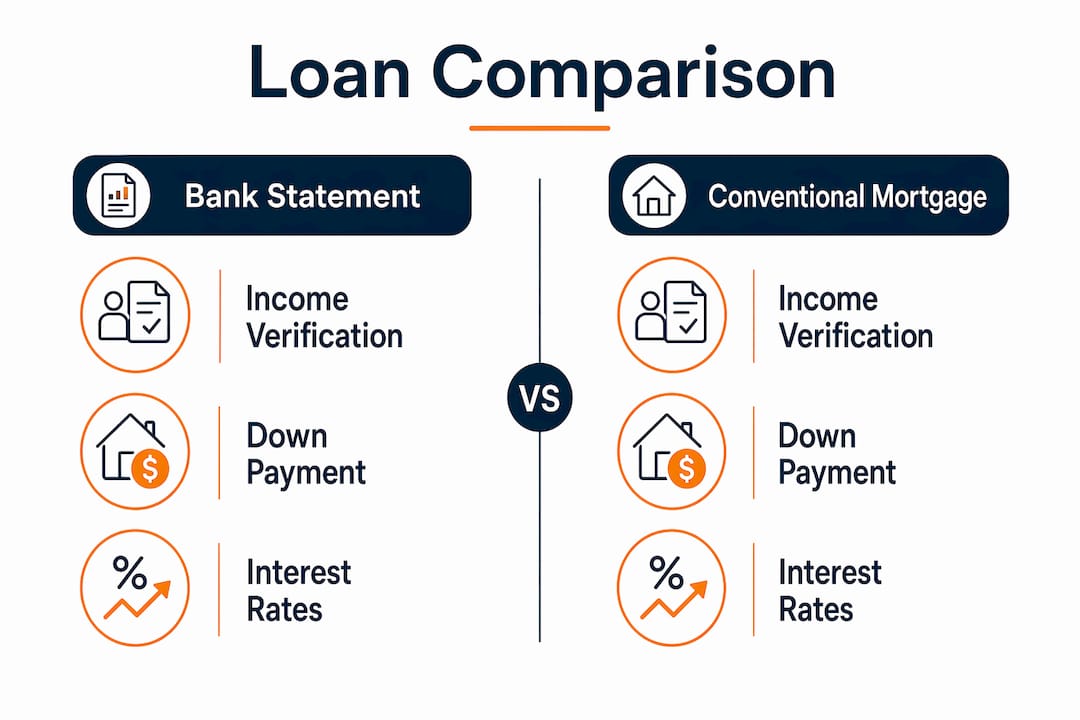
The cost difference is real and worth understanding before you commit. Bank statement loans may include higher fees, longer repayment terms, and fewer regulatory protections than FHA, VA, or USDA loans. That higher cost reflects the lender’s increased risk when income verification relies on deposit analysis rather than employer confirmation.
Why do bank statement loans cost more? The lender takes on more underwriting risk. Without a W-2 or tax return confirming a stable employer, the lender relies on deposit patterns and borrower explanations. That risk premium shows up in the interest rate. Borrowers can check current loan rates to understand what that premium looks like in today’s market.
Pro Tip: Ask your lender for a side-by-side cost comparison between a bank statement loan and a conventional loan before signing. If you can qualify for a conventional product, the cost savings over 30 years are substantial.
How to apply for a bank statement loan
The application process for a bank statement loan follows a clear sequence. Preparation before you contact a lender makes the difference between a smooth approval and a frustrating back-and-forth.
- Gather 12-24 months of bank statements. Print or download complete statements, not summaries. Every page must be included, including pages that show no transactions.
- Identify and document large or irregular deposits. Write a one-paragraph explanation for any deposit that does not come from your primary business activity. Transfers from investment accounts, insurance payouts, and gifts all need sourcing.
- Pull your credit report. Review it before the lender does. Dispute any errors at least 60 days before applying. A score below 620 will disqualify most applications.
- Calculate your estimated DTI. Add up all monthly debt payments, including car loans, student loans, and credit cards. Divide by your estimated qualifying income. If the result exceeds 50%, pay down debt before applying.
- Prepare asset documentation. Lenders want to see reserves, typically 3-6 months of mortgage payments held in liquid accounts. Retirement accounts and brokerage statements count.
- Submit the application and respond quickly. Underwriters work on timelines. A delayed response to a document request can push your closing date back by weeks.
Underwriting success depends on deposit consistency, seasonality explanations, and whether deposits clearly tie to real business activity. Lenders are not looking for perfection. They are looking for a pattern that makes sense. A freelance graphic designer with 18 months of consistent $8,000-$12,000 monthly deposits is a strong candidate. The same designer with three months of $25,000 deposits and nine months of $1,000 deposits will face hard questions.
The loan amount calculation uses your average monthly deposits, adjusted by the expense factor, multiplied by 12 to produce an annual income figure. That annual income then drives your maximum loan amount based on standard DTI limits.
Key Takeaways
A bank statement loan qualifies borrowers on deposit history, not tax returns, making it the most direct path to homeownership for self-employed buyers with strong cash flow but low taxable income.
| Point | Details |
|---|---|
| Core definition | A non-QM mortgage using 12-24 months of bank deposits to verify income. |
| Expense factor matters | Business accounts are discounted 30%-60%; personal accounts may count 100% of deposits. |
| Credit and DTI thresholds | Most lenders require a 620-700 credit score and a DTI at or below 50%. |
| Higher cost than conventional | Expect higher rates and fees compared to FHA, VA, or conventional loans. |
| Preparation drives approval | Consistent deposits and documented explanations for irregular transactions are the keys to underwriting success. |
My take on bank statement loans in 2026
The biggest misconception I see is that bank statement loans are a last resort for borrowers who can’t qualify anywhere else. That framing is wrong. For a business owner who writes off $150,000 in legitimate expenses, a bank statement loan is not a fallback. It is the correct tool for the situation.
What concerns me more is borrowers who rush into these loans without understanding the cost structure. The rate premium over a conventional mortgage compounds over 30 years into a significant dollar amount. If you can qualify conventionally, do it. If you cannot, a bank statement loan is a legitimate and fully underwritten path to ownership, not a risky workaround.
The 2026 market adds another layer. Rates remain elevated across all mortgage categories, which means the spread between bank statement loans and conventional products is more visible than it was in a low-rate environment. Borrowers need to model the total cost, not just the monthly payment. A self-employed affordability calculator can help you run those numbers before you commit.
One more thing worth saying directly: Non-QM loans are fully documented and underwritten for ability to repay. Anyone telling you this is a “no-doc” loan is either misinformed or misleading you. The documentation is different, not absent.
- Saad
Bank statement loan options with Texasbankstatementloans
Self-employed buyers in Texas have a direct path to mortgage approval through Texasbankstatementloans, which evaluates 12-24 months of bank deposits rather than tax returns. Down payment options start at 10%, and a no-obligation qualification check takes 60 seconds.
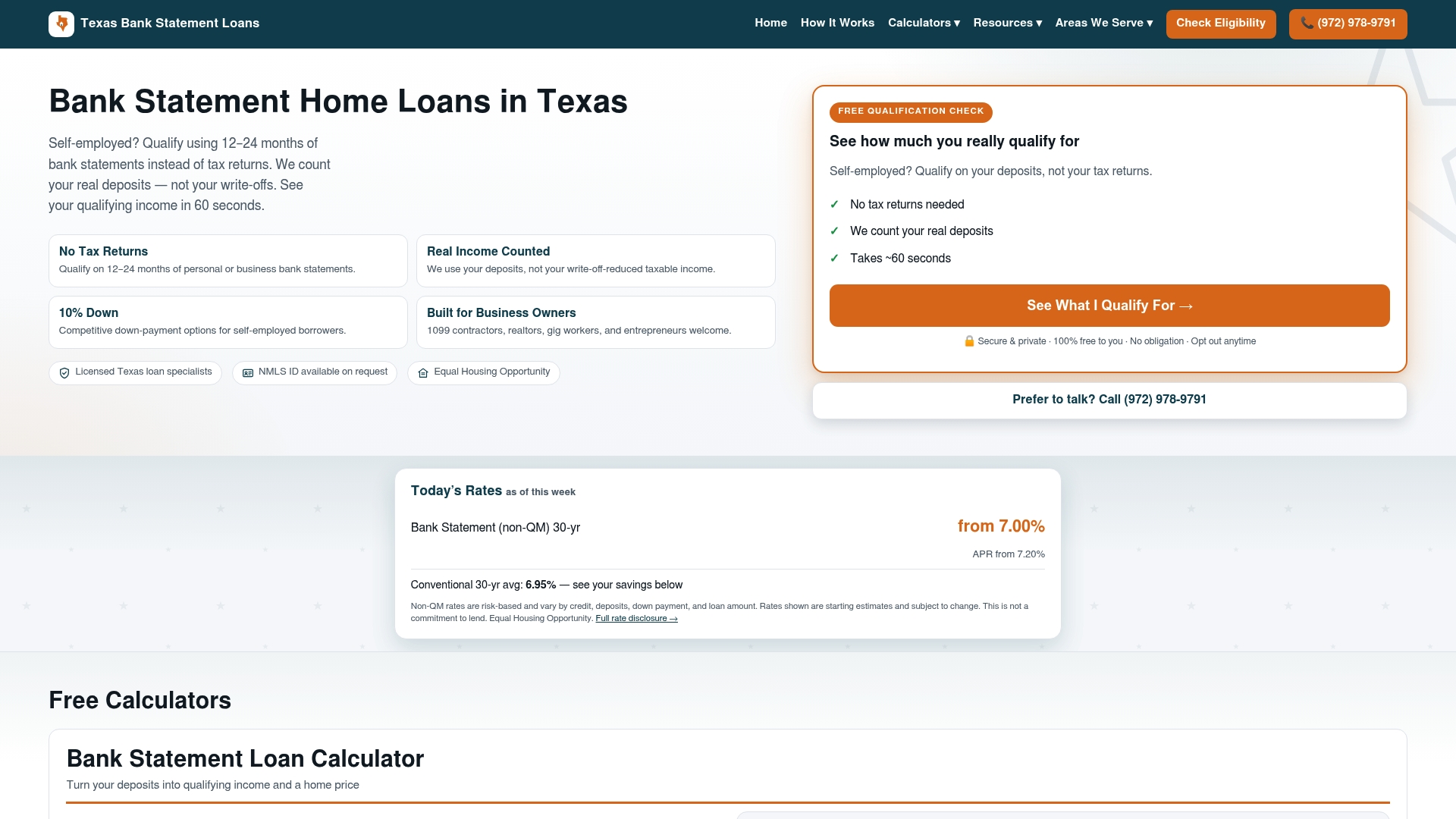
Texasbankstatementloans works with business owners, 1099 contractors, and gig workers across Texas, including Houston borrowers and buyers throughout the state. Use the loan calculator to estimate your qualifying amount based on your actual deposits. When you’re ready to see real numbers, visit Texasbankstatementloans to start your qualification.
FAQ
What is a bank statement loan in simple terms?
A bank statement loan is a mortgage that uses your deposit history, typically 12-24 months of statements, to verify income instead of W-2s or tax returns. It is designed for self-employed borrowers and contractors whose taxable income does not reflect their actual cash flow.
Who are the best candidates for a bank statement loan?
Self-employed business owners, 1099 contractors, freelancers, and real estate investors with strong bank deposits but low reported taxable income are the best candidates. Most lenders require a credit score of 620-700 and a debt-to-income ratio at or below 50%.
Why do bank statement loans have higher interest rates?
Bank statement loans carry higher rates because the lender takes on more underwriting risk without employer-confirmed income. That risk premium is built into the rate and fees, which are generally higher than FHA, VA, or conventional mortgage products.
How does the expense factor affect my qualifying income?
For business bank accounts, lenders apply an expense factor of 30%-60%, meaning only 40%-70% of your total deposits count as qualifying income. Personal accounts may count 100% of deposits, but every transaction is reviewed for legitimacy.
How many months of bank statements do I need?
Most lenders require 12-24 months of complete bank statements, with 24 months being the standard for business accounts. Every page of every statement must be included, and large or irregular deposits will require written explanations.
Recommended
- Bank Statement Loan Calculator | Texas Bank Statement Loans
- Bank Statement Loan Rates Today | Texas Bank Statement Loans
- Bank Statement Loans in Plano, TX | Self-Employed Mortgage
See what you qualify for in 60 seconds, free and no credit check. Use the eligibility check at the top of this page.