
Yes, entrepreneurs in Texas can get a mortgage, and most who struggle are missing one of three practical routes: conventional financing with income add-backs, a bank-statement (non-QM) loan, or a DSCR loan for rental property. The real tradeoff is documentation versus rate. Add-backs usually win on price. Bank statements win on flexibility. Run the add-back math before you assume you need non-QM.
TL;DR:
- Bank-statement loans are a preferred option for entrepreneurs with large tax deductions, because qualifying income is based on deposits rather than tax returns.
- Conventional loans offer better rates if your tax returns already show strong income, but a significant tax gap favors bank-statement or DSCR loans despite higher costs.
- Gathering two years of tax returns, 12 to 24 months of bank statements, and a profit-and-loss statement before applying can significantly speed up the mortgage process.
- Borrowers should run Form 1084 add-backs and bank-statement averaging calculations in advance to identify the most cost-effective financing route.
- Texas entrepreneurs should verify lender licenses through NMLS and understand that bank-statement loans typically carry a modest premium and longer closing timelines than conventional mortgages.
Table of Contents
- Which Loan Type Fits an Entrepreneur Mortgage in Texas?
- Bank Statement (Non-QM) Loans in Practice
- How Lenders Calculate Your Qualifying Income
- Documents to Assemble Before You Apply
- How to Choose a Lender: A Decision Checklist
- What Bank-Statement Loans Cost and How Long They Take
- What I’d Prioritize First
- How Texas Bank Statement Home Loans Fits In
- Where to Verify the Details
- Sources
- FAQ
Which Loan Type Fits an Entrepreneur Mortgage in Texas?
Most self-employed Texans qualify through one of four loan families, and the right one depends on how your tax returns compare with what actually lands in your bank account.
- Conventional loans work best when your write-offs are modest and Form 1084 add-backs bring your qualifying income close to your real cash flow. Best rates, strictest paperwork.
- FHA or VA loans suit entrepreneurs with lower credit scores or thinner reserves, provided two years of tax returns show consistent (even if modest) net income.
- Bank-statement (non-QM) loans fit business owners whose tax returns may understate income due to deductions. Qualifying income is estimated from deposits rather than tax filings.
- DSCR loans apply only to investment property and qualify based on the property’s rental income rather than your personal income at all.
If your tax returns already reflect strong income, don’t overthink it. Conventional financing is cheaper. If your accountant has spent a decade minimizing your tax bill, that same optimization is now working against your mortgage application, and bank-statement lending exists specifically for that gap.
Bank Statement (Non-QM) Loans in Practice
A bank-statement loan lets you document income through 12 to 24 months of bank deposits instead of tax returns.
Business account statements usually get a higher expense-factor deduction than personal accounts, since personal deposits are assumed closer to net income already. Some lenders let you blend both account types, which helps gig workers who split income between a business checking account and a personal one.
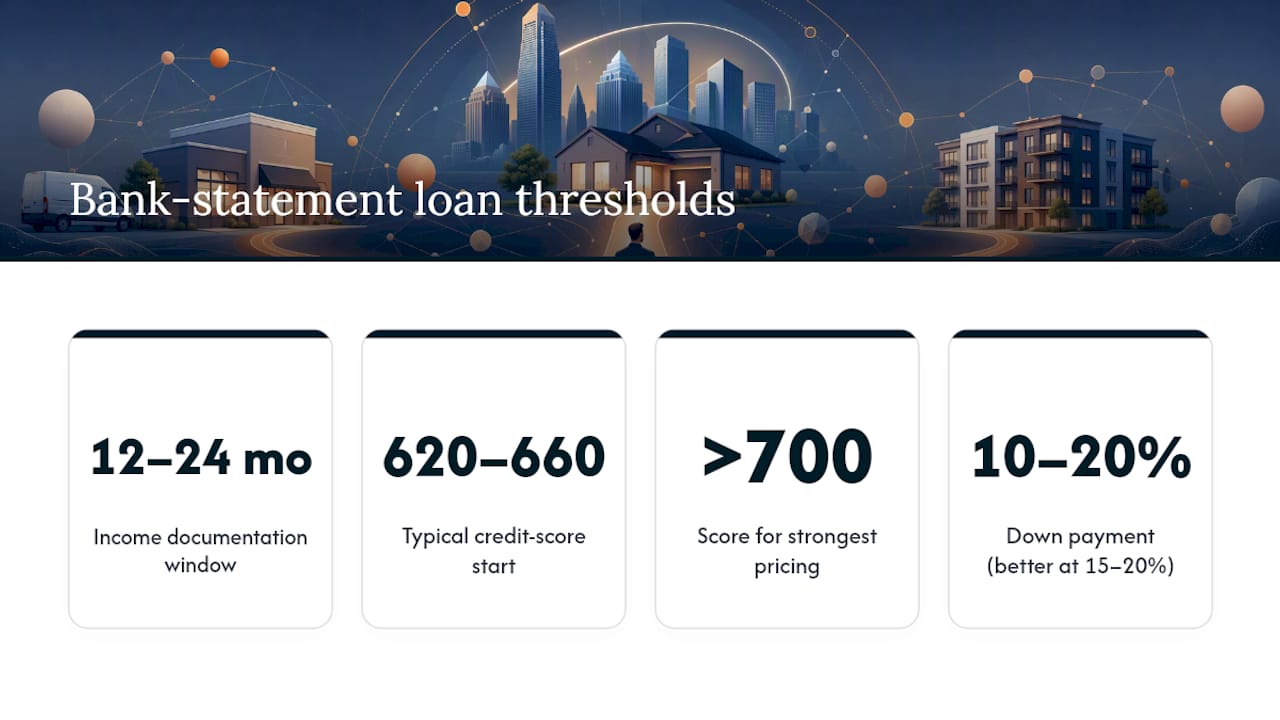
Credit score minimums typically start in the 620 to 660 range, with the strongest pricing reserved for borrowers above 700. Down payments often start around 10%, though 15% to 20% gets meaningfully better terms. Expect a rate somewhat above conventional pricing. Market commentary on non-QM programs shows premiums cluster in a modest range rather than the punitive spreads borrowers often fear, largely because these are regulated products with published underwriting floors, not the risk-loaded subprime loans of the mid-2000s.
Pro Tip: If your business had one unusually strong or unusually weak year in your statement window, ask about a 24-month average instead of 12. Averaging out a spike or a dip often changes your qualifying income more than switching lenders does.
Many entrepreneurs use a bank-statement loan as a bridge. Once two full years of stronger, cleaner tax returns exist, refinancing into a conventional loan usually brings the rate back down.
How Lenders Calculate Your Qualifying Income
Two math paths exist, and running both before you apply saves money almost every time.
Path one: Form 1084 add-backs. Fannie Mae’s Form 1084 worksheet lets underwriters add back non-cash and one-time expenses to your net income, including:
- Depreciation and depletion
- Amortization
- One-time or non-recurring business losses
- Business use of a home deduction
A CPA letter or a current profit-and-loss statement can support these add-backs, and lenders sometimes accept a P&L in place of the most recent year’s tax return if the business has strong, consistent history. Practitioner guidance from the mortgage industry confirms these manual adjustments frequently push qualifying income well above the number that shows up on your Schedule C.
Path two: bank-statement averaging, described above.
The workflow that saves the most money: run Form 1084 add-backs first. If that number clears the mortgage you want, stop there and take the conventional rate. If it falls short, move to bank-statement analysis.
Documents to Assemble Before You Apply
Gathering paperwork before you talk to a lender shaves weeks off the process.
- Two years of personal tax returns, plus business returns if you file separately.
- 12 to 24 months of bank statements, personal and business, depending on program.
- A year-to-date profit-and-loss statement.
- A CPA letter confirming your business structure and income, if available.
- Two months of asset statements (savings, investment, retirement accounts).
- Government-issued ID and your business license or DBA filing.
When you present statements, flag and exclude internal transfers between your own accounts. Underwriters count transfers as inflated deposits if you don’t label them, which can trigger a request for source-of-funds documentation and slow things down. Large, unexplained deposits are the single most common reason a file gets stuck in underwriting.
How to Choose a Lender: A Decision Checklist
Start by sizing the gap between your tax-return income and your actual bank deposits. A gap under roughly 20% usually means conventional financing still wins on price; a gap above 30% is where bank-statement programs typically make economic sense despite the higher rate.
Before signing with any lender or broker, ask directly:
- Do you offer both 12-month and 24-month statement options?
- What expense factor do you apply to business deposits?
- What’s your minimum FICO score and minimum down payment for this program?
- How many months of reserves do you require after closing?
- Will you run a Form 1084 analysis before recommending non-QM?
- Which wholesale lenders do you have access to?
Pro Tip: If a loan officer can’t answer the expense-factor question specifically, that’s a sign they don’t originate much non-QM volume. Ask a broker instead. Brokers who shop several wholesale lenders with one packaged file get faster answers and better pricing than borrowers who resubmit to lenders one at a time.
Verify any lender or broker’s license directly through NMLS Consumer Access before handing over financial documents.
What Bank-Statement Loans Cost and How Long They Take
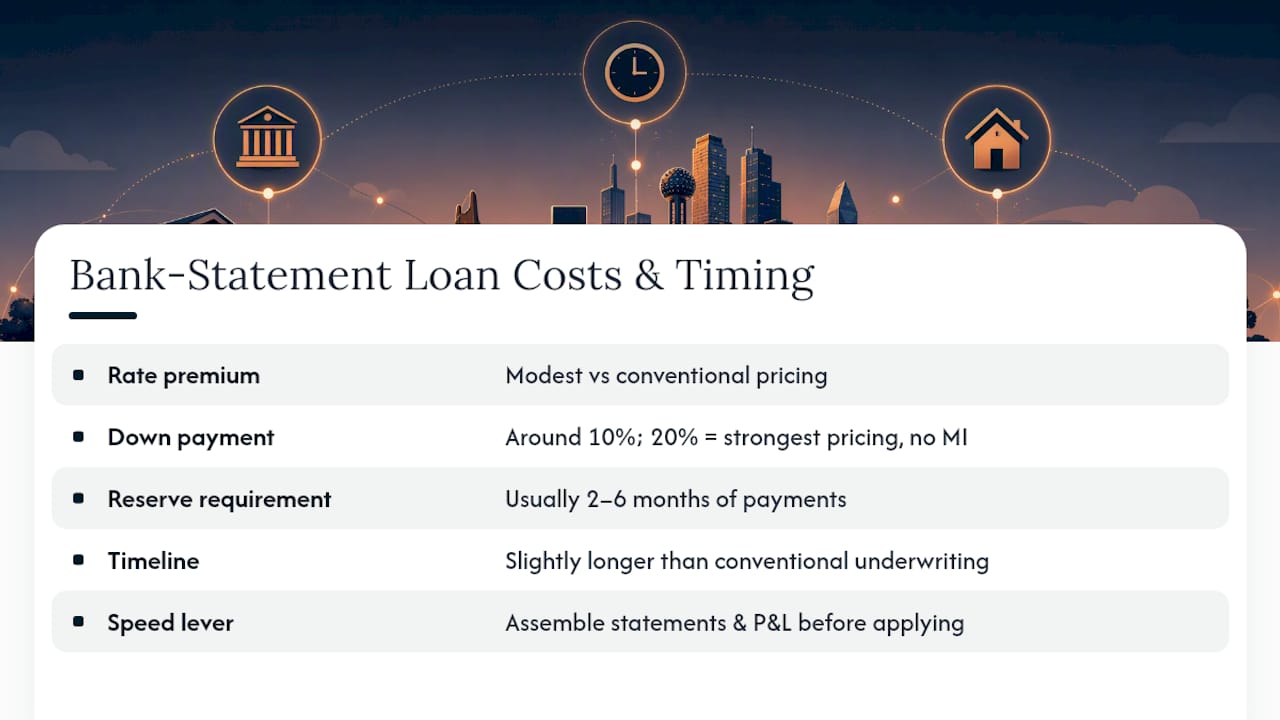
Expect a rate premium over conventional pricing, generally in the range non-QM market data describes as modest rather than punitive, since these are regulated, mainstream loan products with defined underwriting floors.
Down payments starting around 10% exist through some bank-statement programs, though 20% down typically unlocks the strongest pricing tier and avoids mortgage insurance. Reserve requirements (cash left over after closing) usually run two to six months of payments, higher than what conventional loans often require.
Timeline runs slightly longer than conventional underwriting because deposit analysis takes more manual review. Assembling your statements and P&L before you apply is the single biggest lever you have over closing speed.
What I’d Prioritize First
Run the add-back math before assuming you need non-QM. Document every deposit source in writing. And when the file is complex, shop it through a broker rather than one bank at a time.
- Saad
How Texas Bank Statement Home Loans Fits In
If your tax returns understate what your business actually earns, some lenders qualify you using 12 to 24 months of real bank deposits instead of forcing you to justify every write-off to an underwriter. That’s the core difference from the conventional add-back route covered above: no CPA letter fights, no waiting on amended returns.
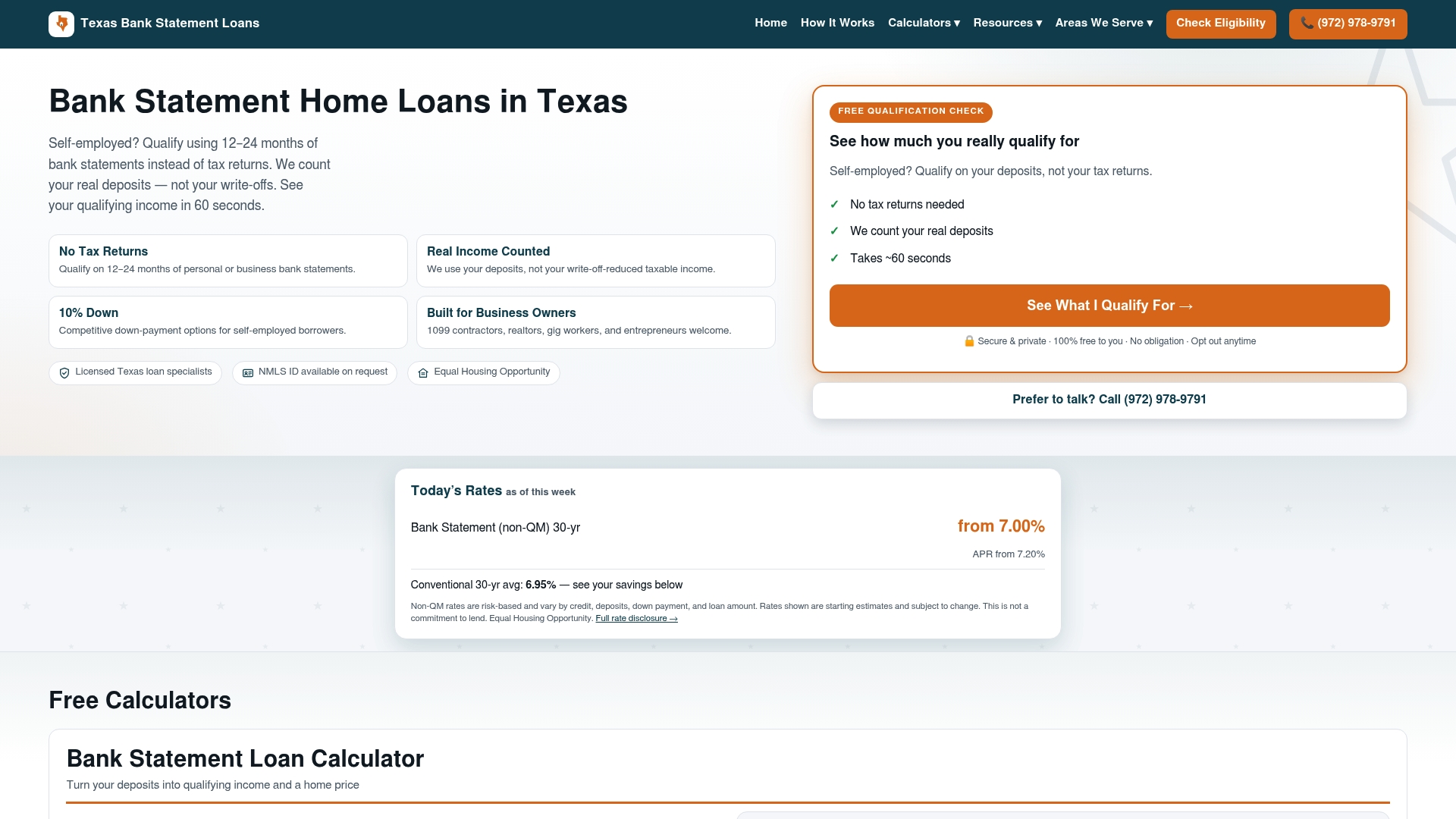
Some services offer a free, no-obligation qualification check that takes about 60 seconds and gives you a realistic sense of what you can afford before you talk numbers with a loan officer. If you’re an investor rather than an owner-occupant, the site’s DSCR loan tools qualify you on the property’s rental income instead of your personal tax situation.
Check current bank-statement loan rates or start your qualification check on the main Texas Bank Statement Home Loans page to see where you stand.
Where to Verify the Details
- CFPB: shopping guidance and consumer protections.
- Fannie Mae Selling Guide: official Form 1084 methodology.
- NMLS Consumer Access: lender and broker license lookup.
This article is general information, not a substitute for advice from a qualified financial advisor. Consult a qualified financial professional about your own circumstances before acting on anything here.
Sources
- What is a bank statement loan? (Experian)
- How to qualify self-employed borrowers when tax returns fall short (National Mortgage Professional)
- Owning a home (Consumer Financial Protection Bureau)
- Selling Guide | Fannie Mae
- Bank statement loans: the self-employed mortgage alternative (Stacking Capital)
FAQ
What Loan Payment Should I Expect on a $1,000,000 Business Loan?
The payment depends entirely on the rate, term, and whether it’s amortizing or interest-only, so there’s no single figure that applies across lenders or loan types. A business or DSCR loan at a given rate and 30-year amortization will run in monthly payments that vary depending on loan amount and terms, but you should run your exact terms through a mortgage calculator rather than relying on a rule of thumb.
Is There a $10,000 Grant for Small Businesses in Texas?
Various state and local programs periodically offer small-business grants in Texas, but availability and amounts change frequently and aren’t tied to mortgage qualification. Check with your local Small Business Development Center or the Texas Economic Development office directly, since grant terms shift year to year.
What Should I Avoid Telling a Lender?
Avoid volunteering information about job changes, large undocumented deposits, or new debt you’re planning to take on before closing, since these can trigger additional underwriting scrutiny. Answer questions honestly, but don’t offer unsolicited details about business plans that could raise red flags about income stability.
How Much Commission Does a Loan Officer Make on a $500,000 Loan?
Loan officer commission structures vary by company and loan type, typically running as a percentage of the loan amount rather than a fixed fee. This detail isn’t publicly standardized across the industry, so it’s not something a borrower needs to factor into their own costs.
Does Texas Bank Statement Home Loans Charge for a Qualification Check?
No. The qualification check is free and comes with no obligation, and it takes about 60 seconds to see what you might qualify for. Actual loan pricing, including the bank-statement 30-year rate, is available once you start the process.
Recommended
- Bank Statement Loans in Dallas, TX | Self-Employed Mortgage
- Bank Statement Loans in Runnels County, TX | Self-Employed
See what you qualify for in 60 seconds, free and no credit check. Use the eligibility check at the top of this page.