
Yes. Lenders accept rental income shown on bank statements through three distinct paths: conventional financing using Schedule E and leases, bank-statement (non-QM) programs that review 12 to 24 months of deposits, or DSCR loans that qualify the property instead of you. Your first move is simple: pull 12 to 24 consecutive months of statements, gather your current leases, and put together a rent roll before you talk to a lender.
TL;DR:
- Lenders accept rental income via 12 to 24 months of bank statements, with the most recent statements within about 90 days of the loan date.
- Conventional financing requires two years of Schedule E filings, signed leases, and matching rent rolls, or 75% of appraised rent for new landlords.
- Bank-statement programs typically account for deposits with a default 50% expense factor, adjusting for actual costs, while DSCR loans qualify rental income based solely on whether cash flow covers mortgage payments.
- Proper documentation should clearly separate rental deposits from other income, avoid commingling, and include explanations for any large, unusual deposits to speed underwriting.
- Borrowers with strong deposit patterns but low taxable income benefit most from bank-statement loans, while DSCR loans suit investors avoiding personal financial disclosures, and Schedule E remains the most cost-effective for stable landlords.
Table of Contents
- What Documents Do Lenders Need for Rental Income Bank Statements?
- How Do Underwriters Calculate Qualifying Income From Rental Deposits?
- Preparing Your Bank Statements: Steps and Pitfalls to Avoid
- Bank-Statement Loan vs. DSCR vs. Schedule E: Which Fits You?
- What Underwriting Actually Rewards
- How Texas Bank Statement Home Loans Helps You Qualify
- Sources
- FAQ
What Documents Do Lenders Need for Rental Income Bank Statements?
The paperwork you need depends entirely on which path you’re taking, and mixing them up is the fastest way to stall an underwriting file.
If you’re going the conventional route, lenders want two years of Schedule E filings alongside current signed leases and a rent roll that matches what’s on the tax forms. Bought the property too recently to have a Schedule E history? Fannie Mae’s guidance under B3-3.1-08 lets you qualify using 75% of the appraiser’s Fair Market Rent instead, which solves the chicken-and-egg problem new landlords run into constantly.
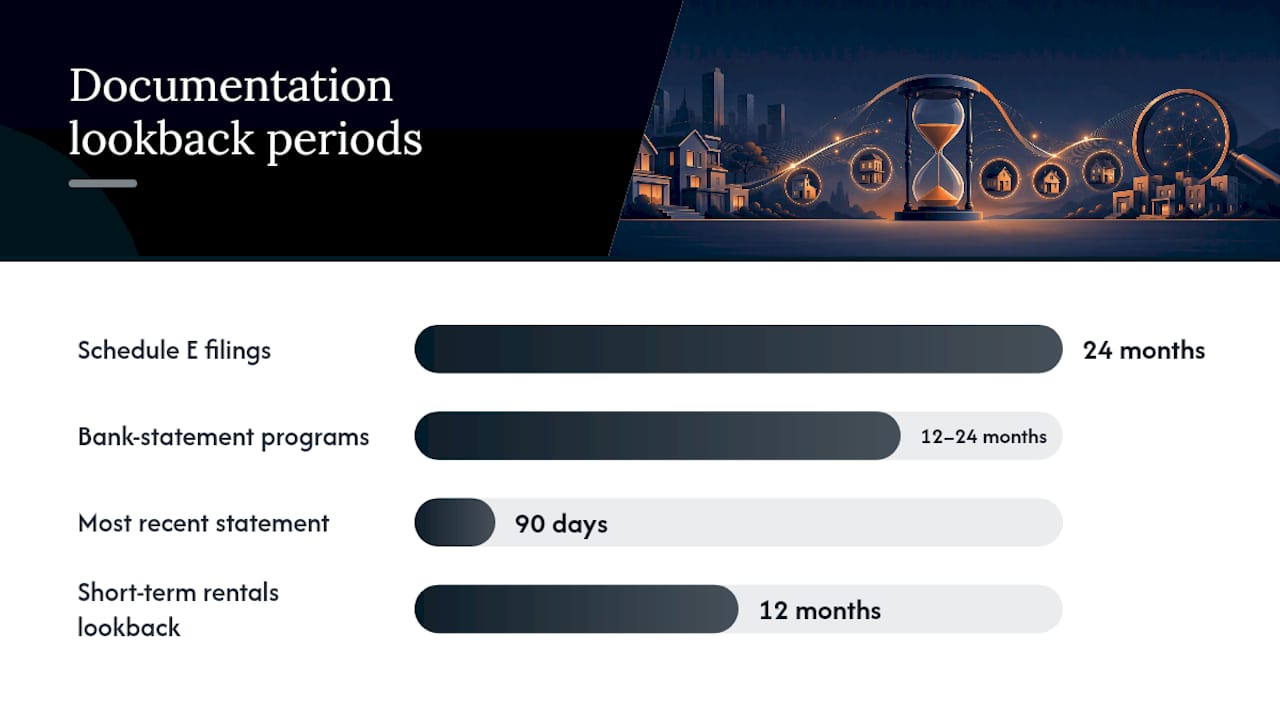
Bank-statement programs work differently. You’ll supply either 12 or 24 consecutive months (one or two years) of personal or business statements, and the most recent one generally needs to be dated within about 90 days of the note date. Miss that window and you’re refreshing statements right before closing, which nobody enjoys.
Beyond the core statements, expect to hand over:
- Proof of ownership for every rental property listed (deed, title, or closing statement)
- Platform payout statements from Airbnb or VRBO if you run short-term rentals
- Bank records showing deposits that match your lease amounts, not just round numbers that look convenient
Short-term rental operators get a bit of flexibility here. A 12-month lookback can account for seasonal swings, but the deposits still need to trace back to the specific property rather than sitting in one undifferentiated account with everything else you own.
How Do Underwriters Calculate Qualifying Income From Rental Deposits?
The math changes depending on which program is reviewing your file, and the gap between methods can be the difference between an approval and a denial.
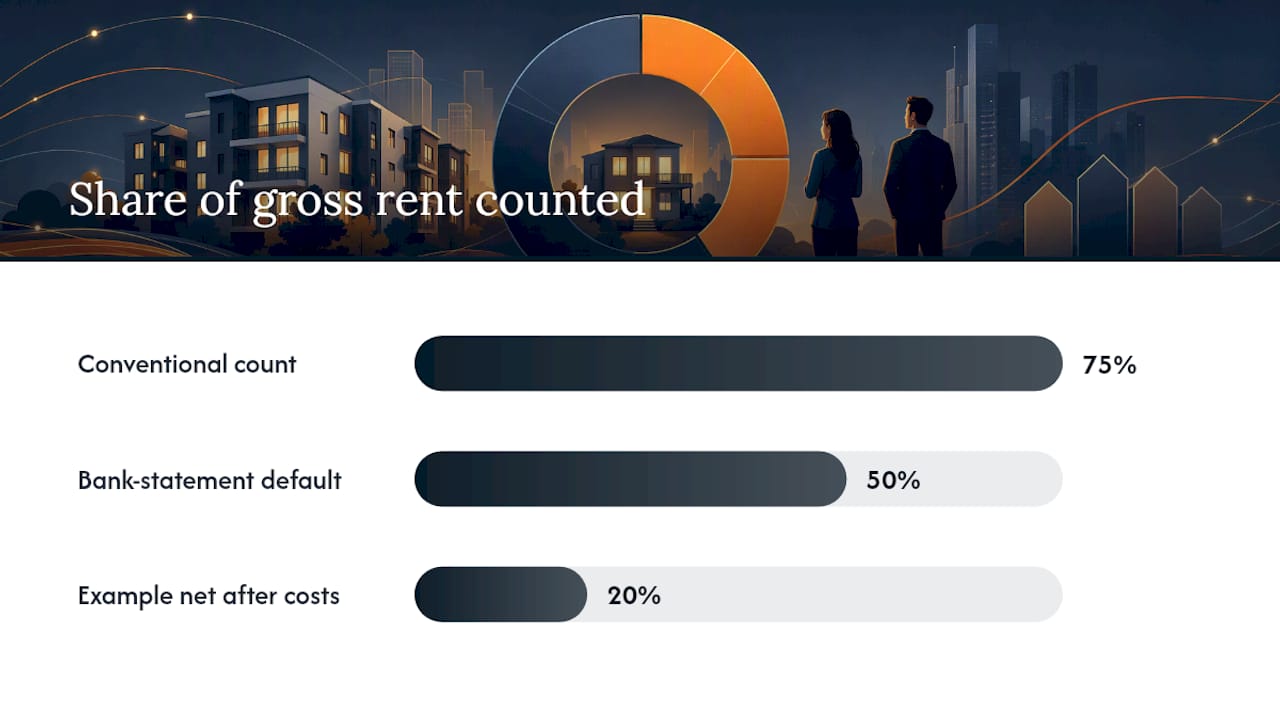
Under conventional underwriting, lenders typically count 75% of gross rent, assuming the other 25% covers vacancy and turnover costs, then subtract mortgage payments, property taxes, insurance, and HOA dues to land on net rental income. Say you collect $2,000 a month in rent. That’s $1,500 counted as gross qualifying rent. If your mortgage, taxes, and insurance run $1,100 a month, you’re left with $400 in monthly net rental income feeding your debt-to-income ratio.
Bank-statement underwriting follows a different sequence:
- Total all eligible deposits across the 12 or 24-month period.
- Strip out anything that isn’t actual income, transfers, loan proceeds, refunds, one-time sale proceeds.
- Apply the lender’s default expense factor, commonly 50%, to account for the cost of running the property or business.
- Multiply by your ownership percentage if the account is jointly held.
- Divide the result by the number of months reviewed to get a monthly qualifying figure.
That 50% expense factor is a default, not a fixed law of physics, and it’s worth challenging when your actual costs run lower.
Preparing Your Bank Statements: Steps and Pitfalls to Avoid
The biggest income reductions underwriters make aren’t because borrowers lied. They happen because the paperwork looked messier than the underlying business actually was.
Start by separating your rental accounts from your business operating account and your personal checking. When everything lands in one account, an underwriter often has no way to distinguish rent from revenue, and commingled deposits get treated as general business income subject to the default expense factor instead of the more favorable rental calculation. Keep a rent ledger that ties each deposit to a specific tenant, unit, and lease amount.
Next, flag anything that isn’t income before the underwriter has to ask. Transfers between your own accounts, loan proceeds, insurance refunds, and proceeds from selling a property all need labels and explanations, or they risk getting counted as unexplained deposits, which slows or sinks approval.
A few habits make the file stronger:
- Submit every page of every statement, including blank transaction pages; missing pages read as missing months.
- If you switched banks mid-window, include the closing and opening statements from both institutions so there’s no gap.
- Attach a simple reconciliation showing how deposits tie to your rent roll.
Pro Tip: *If your actual operating costs are well below the lender’s default expense factor, ask your CPA or EA for a signed expense letter.
Bank-Statement Loan vs. DSCR vs. Schedule E: Which Fits You?
Your income profile decides this more than your preference does.
- Bank-statement loans work best for self-employed borrowers or landlords whose deposits look strong but whose taxable income looks thin after deductions. Expect a rate premium over conventional pricing, roughly 0.5 to 1.5 percentage points, and down payments that commonly require a substantial portion upfront depending on lender and property type.
- DSCR loans ignore your personal income entirely and qualify the property based on whether its rental cash flow covers the mortgage payment. This route suits portfolio investors buying under an LLC who’d rather not surface personal financials at all.
- Conventional Schedule E financing remains the cheapest option if you already have two years of stable rental income on your tax returns. It relies on the 75% gross rent rule and generally comes with the most competitive rates of the three.
Running the DSCR math on a specific property before you commit to a program can save weeks of back and forth. Texasbankstatementloans’s DSCR calculator gives you that number before you ever submit an application.
What Underwriting Actually Rewards
Files that close fast share a pattern: clean separation between rental accounts and everything else, a rent roll that reconciles to the deposits without explanation gaps, and quick turnaround when underwriting asks for one more document. The files that stall almost always involve a large unexplained deposit or a CPA letter requested after the fact instead of prepared in advance.
Expect underwriters to ask for source explanations on any deposit that looks out of pattern, and expect a request to refresh statements if your file sits open past 90 to 120 days. Neither is a red flag on its own. It’s routine, and borrowers who treat it as routine move through underwriting noticeably faster than those who panic at the first follow-up email.
Tools that estimate qualifying income before you apply, rather than after a lender has already reviewed your file, change how these conversations go. You walk in with a number instead of a guess.
- Saad
How Texas Bank Statement Home Loans Helps You Qualify
Some companies look at what your rental income actually deposits into your account, not what your tax return says after deductions, write-offs, and depreciation shrink it down. That distinction matters most for self-employed borrowers and landlords whose real cash flow is far stronger than their taxable income suggests.
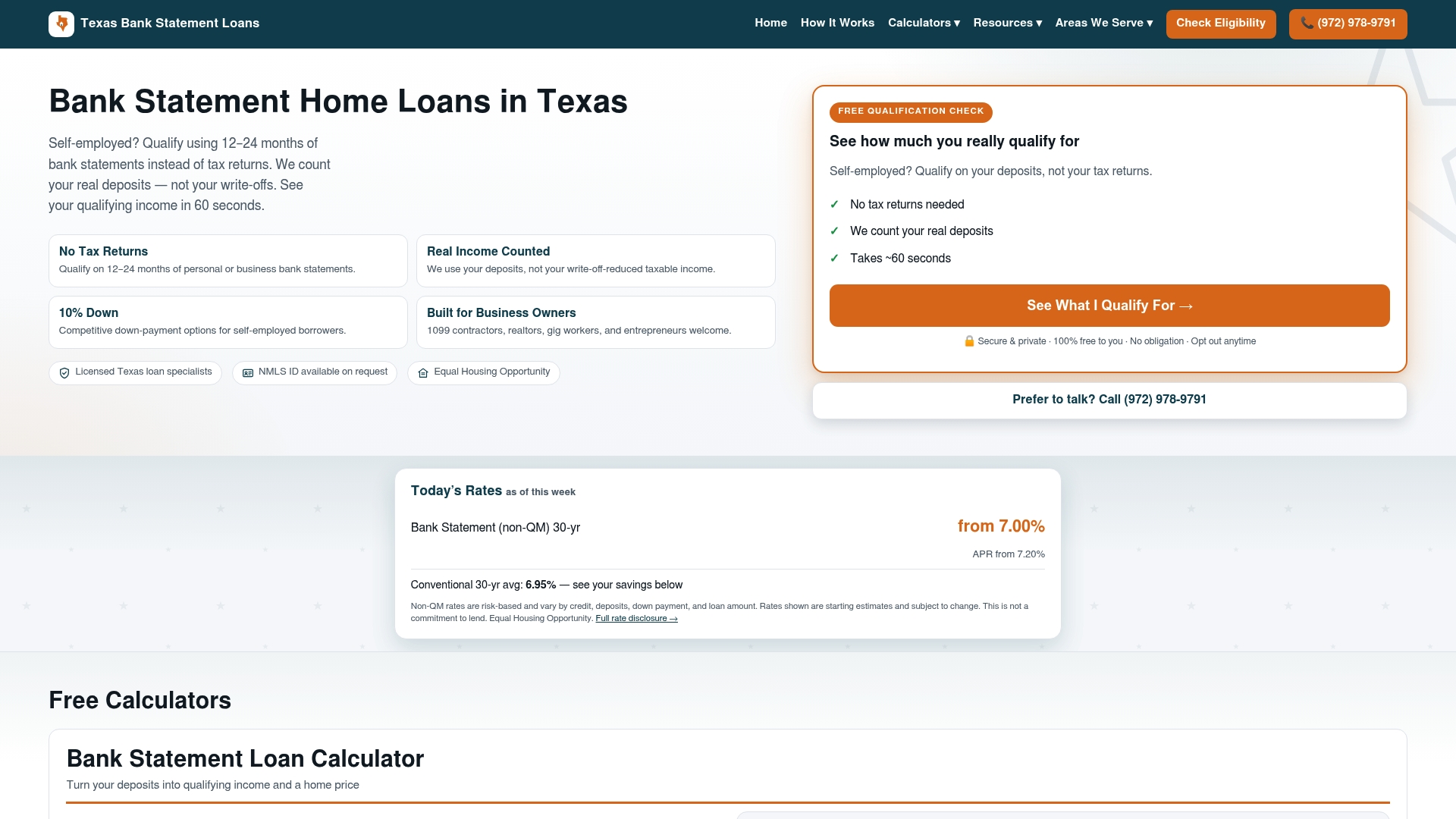
The process starts with a review of 12 to 24 months of your bank statements instead of two years of tax returns, which means deductions that lower your tax bill don’t also lower your borrowing power. You can run a no-obligation qualification check in about 60 seconds, and the Bank Statement Loan Calculator shows you an estimated qualifying amount before you submit a single document. If you’re ready to see where your rental deposits put you, start with the qualification check on Texasbankstatementloans and get a real number instead of a guess.
This article is general information, not a substitute for advice from a qualified financial advisor. Consult a qualified financial professional about your own circumstances before acting on anything here.
Sources
- Bank Statement Loans for Self-Employed Borrowers: How They Work in 2026 and What Lenders Actually Want to See | HomeWealthMap
- Proof of income for a mortgage (FAQ excerpts) | Opendoor
- Bank Statement Loans for Self-Employed Real Estate Investors: What the Deposits Need to Show | 4Homes Mortgage Guide
FAQ
Can rental income on bank statements alone qualify me for a mortgage?
Yes, through bank-statement (non-QM) loan programs that review 12 or 24 consecutive months (one or two years) of deposits, though most lenders still want supporting documents like leases or a rent roll.
How many months of bank statements do lenders require?
Most non-QM programs require either 12 or 24 consecutive months (one or two years), with the most recent statement dated within about 90 days of your note date.
What percentage of rental deposits counts as qualifying income?
Bank-statement programs commonly apply a 50% default expense factor to deposits, while conventional underwriting counts 75% of gross rent under the standard vacancy assumption.
Do I need two years of tax returns to use rental income?
Not necessarily. Bank-statement programs and DSCR loans were built specifically for borrowers who can’t or don’t want to rely on two years of tax returns to prove income.
What’s the biggest mistake landlords make when submitting bank statements?
Commingling rental deposits with personal or business operating funds, which often causes underwriters to apply a less favorable expense factor to the entire account instead of treating rent as its own income stream.
Recommended
- Bank Statement Loans in Dallas, TX | Self-Employed Mortgage
- Bank Statement Loans in Lubbock, TX | Self-Employed Mortgage
- Bank Statement Loans in Sugar Land, TX | Self-Employed Mortgage
- Bank Statement Loans in Greater Houston | Texas Bank Statement Loans
See what you qualify for in 60 seconds, free and no credit check. Use the eligibility check at the top of this page.