
Texas buyers typically see closing costs land somewhere between a leaner, title-and-recording-only figure and the broader 2% to 5% of the purchase price that lenders and the Consumer Financial Protection Bureau cite for full closing costs. Which number applies depends on what’s being counted, and Texas adds a twist: because title insurance premiums are set by state regulation, they don’t swing the way they do in other states.
TL;DR:
- Budget 2% to 5% of the purchase price for full closing costs, or $8,000 to $20,000 on a $400,000 home.
- Title insurance premiums are state regulated and identical across Texas title companies, but escrow, tax certificate, and delivery charges vary, so compare itemized quotes.
- Buyers usually pay lender fees, appraisal costs, and prepaid taxes and insurance; sellers often pay commissions, while title policy responsibility and credits remain negotiable.
- Review both disclosures and challenge added fees or a higher cash to close figure; the final disclosure is due three business days before closing.
Table of Contents
- State averages and real-dollar examples at common purchase prices
- What closing costs include in Texas: itemized breakdown
- Who pays closing costs in Texas: buyer vs. seller conventions
- How to estimate closing costs for your purchase price
- How to lower or shift closing costs in Texas
- Texas title insurance rules and sample settlement items
- Loan Estimate vs. Closing Disclosure: when to check the numbers
- A quick checklist for avoiding last-minute surprises
- How we help self-employed Texas buyers plan for closing costs
- FAQ
- Sources
State averages and real-dollar examples at common purchase prices
Two different numbers circulate for Texas closing costs, and they measure different things. State-focused data studies that track mainly title and recording charges tend to land in a narrower band, while the CFPB’s broader closing-cost guidance covers lender fees, prepaids, and escrow setup on top of title charges, which pushes the total toward 2% to 5% of the sale price.

That gap explains why you might see wildly different “average” figures depending on the source. A title-only measurement skips origination fees, prepaid property taxes, and the initial escrow deposit, all of which add up fast on a six-figure purchase.
Here’s how the two measures compare at common price points in Texas:
- A $350,000 home: narrower title and recording charges versus 2% to 5% in full closing costs, or roughly $7,000 to $17,500.
- A $400,000 home: the same scope difference applies, with the 2% to 5% range translating to roughly $8,000 to $20,000.
- A $500,000 home: the 2% to 5% range works out to roughly $10,000 to $25,000.
| Purchase price | 2% of price | 5% of price |
|---|---|---|
| $350,000 | $7,000 | $17,500 |
| $400,000 | $8,000 | $20,000 |
| $500,000 | $10,000 | $25,000 |
These are percentage-based calculations, not fixed quotes. Your actual number depends on your loan type, your lender’s fee schedule, and which non-premium title fees you negotiate.
What closing costs include in Texas: itemized breakdown
Your Closing Disclosure groups charges into a few buckets: Loan Costs, Other Costs, and Prepaids plus the Initial Escrow Payment. Each bucket behaves differently when it comes to shopping around.
- Loan Costs cover origination fees, underwriting, and any discount points you choose to pay.
- Title insurance premium is regulated in Texas, so the rate is the same no matter which title company you use.
- Escrow or closing fee, tax certificates, and courier charges are non-premium title costs that vary by provider and can be compared.
- Appraisal and recording fees are typically set by the vendor or county and aren’t usually negotiable.
- Prepaids include your first months of property taxes and homeowners insurance, deposited into escrow at closing.
Most of your room to save sits in the non-premium fees and in negotiating who pays what, not in the regulated title premium itself.
Who pays closing costs in Texas: buyer vs. seller conventions
Texas follows fairly standard conventions, though everything is negotiable in the contract. Buyers generally cover their own loan-related charges, while sellers typically handle commissions and sometimes agree to cover part of the buyer’s costs as a concession.
- Buyers usually pay lender fees, appraisal, credit report charges, and prepaid taxes and insurance.
- Sellers typically pay real estate commissions and may agree to pay for the owner’s title policy as a local custom in some Texas markets.
- Seller concessions, when negotiated, appear as a credit on the Closing Disclosure and directly reduce the buyer’s cash to close.
- Before closing, confirm in writing who pays the title premium, whether any seller credits are capped, and whether those credits cover specific line items or a flat dollar amount.
How to estimate closing costs for your purchase price
A quick budgeting method works well before you get a formal Loan Estimate.
- Start with your target purchase price and multiply by 2% and by 5% to get a realistic range.
- Run that range, along with your expected down payment, through a mortgage payment calculator to see how it affects your monthly payment if you roll costs into the loan.
- Adjust for seller credits or lender credits, since either one can shrink your cash-to-close number significantly.
- Recheck the estimate once you have a signed contract and an actual Loan Estimate from your lender.
How to lower or shift closing costs in Texas
Since Texas title premiums are fixed, your leverage lives in three places: concessions, credits, and the fees that aren’t regulated.
- Ask the seller for a closing-cost concession instead of a price reduction; it directly lowers your cash to close.
- Consider lender credits in exchange for a slightly higher rate if you’re short on cash at closing but plan to refinance later.
- Request itemized quotes from two or three title companies for escrow fees, tax certificates, and courier charges, since those differ by provider even though the premium doesn’t.
- Decide whether paying discount points makes sense based on how long you plan to keep the loan.
Pro Tip: Ask your lender for a written breakdown of which fees are negotiable before you sign a Loan Estimate, not after.
Texas title insurance rules and sample settlement items
Texas regulates title insurance differently than most states. The Texas Department of Insurance sets premium rates by law, so every title company charges the same amount for the same policy. What varies are the non-premium fees: escrow fees, tax certificates, and delivery charges, which show up as separate line items on sample settlement forms.
Title insurance premiums in Texas are set by the state and are uniform across title companies, while non-premium fees such as tax certificates and escrow charges can vary and are worth comparing.
Ask any title agent you’re considering for an itemized quote covering only the non-premium charges. That’s the one place where shopping around actually changes your total.
Loan Estimate vs. Closing Disclosure: when to check the numbers
Your lender sends a Loan Estimate early in the process, then a Closing Disclosure at least three business days before closing. Compare both documents line by line before you sign anything.
- Check the Loan Costs and Other Costs tables for any new or increased fees.
- Compare the Cash to Close figure on both forms to catch unexpected jumps.
- If the Closing Disclosure shows a material increase, ask your lender or settlement agent for a written explanation before closing day, not after.
A quick checklist for avoiding last-minute surprises
After looking at enough Texas closings, a few habits consistently prevent stress on closing day. Request your Closing Disclosure the moment it’s available and verify any seller credits match the contract. Compare title company non-premium fees before you’re locked into one provider, and get wiring instructions confirmed by phone, never by email alone. A reviewed buyer closing checklist can help you track these steps alongside your own documents. Finally, run a worst-case number through a mortgage calculator so a last-minute fee increase doesn’t catch you off guard.
- Saad
How we help self-employed Texas buyers plan for closing costs
If you’re self-employed, a 1099 contractor, or running your own business, qualifying for a mortgage often comes down to a problem that has nothing to do with your actual income: tax returns that understate what you really earn. We evaluate 12 to 24 months of bank deposits instead, so your real cash flow counts toward qualifying, not just your taxable income after write-offs.
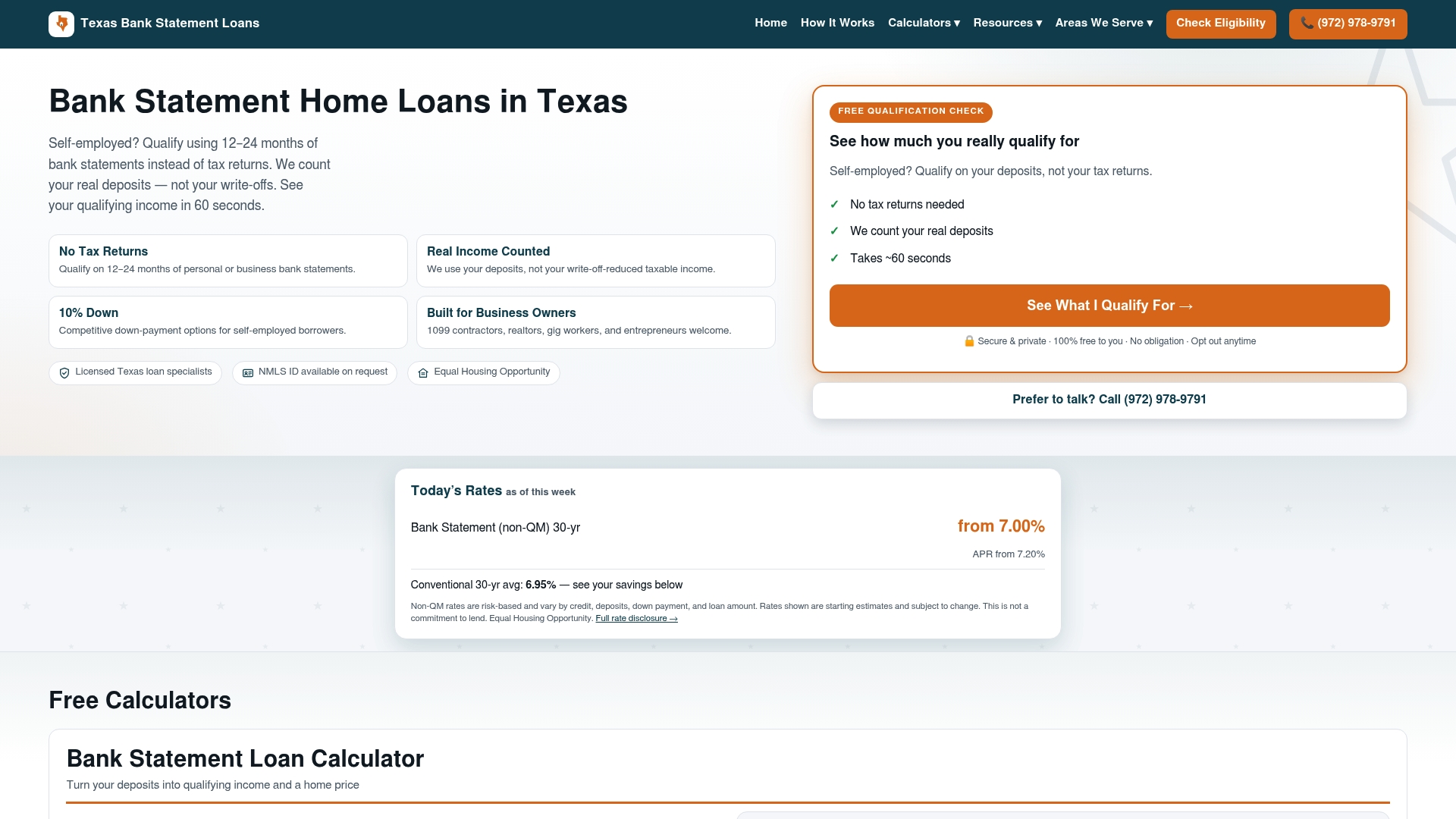
That matters just as much for closing-cost planning as it does for approval. Once you know your realistic loan amount, you can budget closing costs against an actual number instead of a guess.
- Run a free, no-obligation qualification check to see what you can realistically afford in about 60 seconds.
- Use our mortgage payment calculator to test how different closing-cost scenarios affect your monthly payment.
- Explore Bank Statement (non-QM) 30-yr financing, with rates from 7.00% per year, or review our DSCR loan options if you’re buying investment property.
Start with a bank statement home loan qualification check and get a clearer picture of your numbers before you make an offer.
This article is general information, not a substitute for advice from a qualified financial advisor. Consult a qualified financial professional about your own circumstances before acting on anything here.
FAQ
How much are closing costs on a $500,000 house in Texas?
Using the CFPB’s 2% to 5% guidance, closing costs on a $500,000 Texas home generally reflect a range from low to higher typical totals depending on loan type, lender fees, and any seller concessions or lender credits you negotiate.
Is $20,000 in closing costs a lot?
It depends on the purchase price. On a $400,000 to $500,000 Texas home, $20,000 falls within the normal 2% to 5% range that CFPB guidance describes, so it isn’t unusual, though you can often reduce it through negotiated credits.
How much are closing costs for a $400,000 house?
Applying the same 2% to 5% range, closing costs on a $400,000 Texas home typically fall between $8,000 and $20,000. Your actual total depends on which lender fees apply and how much of the non-premium title charges you’re able to shop down.
Is 2% closing cost good?
A 2% closing cost figure sits at the low end of the typical range for a full set of closing costs, so it’s a favorable outcome if you can achieve it. Reaching that end usually requires negotiated seller concessions, lender credits, or shopping non-premium title fees aggressively.
Does Texas have a transfer tax on real estate?
Texas does not impose a state transfer tax on real estate sales, which sets it apart from many other states. That absence is one reason Texas closing-cost totals can look different from national averages, since the broader 2% to 5% figure still applies but without a transfer tax line item added on top.
Sources
- Closing disclosure | Consumer Financial Protection Bureau
- Title insurance overview | Texas Department of Insurance
Recommended
See what you qualify for in 60 seconds, free and no credit check. Use the eligibility check at the top of this page.