
Yes, truck drivers can get a mortgage. Company drivers with steady W-2 pay usually qualify through conventional, FHA, or VA loans the same way any salaried buyer would. Owner-operators with lean tax returns often qualify faster through a bank-statement (non-QM) loan, which counts 12 to 24 months of deposits instead of taxable income. Either way, start by pulling your bank statements and talking to a knowledgeable lender familiar with trucking pay structures.
TL;DR:
- Owner-operators can qualify through bank-statement loans by averaging 12 to 24 months of deposits, bypassing misleading tax return net income calculations.
- Underwriters often flag industry-standard deposit timing and deductions, but proper documentation of truck payments and consistent deposits can support qualification.
- A two-year self-employment history or an exception of one year with proper proof significantly improves chances for conventional mortgage approval.
- Using a broker familiar with trucking income can streamline the process and prevent common issues like deposit verification and income misrepresentation.
- Preparing early by gathering bank statements, separating personal and business accounts, and consulting with a CPA can shorten the time to qualify from months to two years.
Table of Contents
- Why Truck Drivers Face Special Mortgage Challenges
- Loan Programs That Work for Truck Drivers and When to Use Each
- How Lenders Calculate Qualifying Income for Owner-Operators
- Preparation Checklist and Realistic Timeline
- Underwriting Rules and Quirks on Trucking Files
- W-2 Company Driver vs. 1099 Owner-Operator: Why It Matters
- Debt-to-Income Impacts and the Truck Loan Exclusion Rule
- How Seasonal Freight Swings Affect Mortgage Approval
- Common Underwriting Challenges and How to Solve Them
- Tips for Improving Your Credit Profile With Irregular Income
- Why a Broker Who Understands Trucking Income Matters
- Insurance Considerations When Applying for a Mortgage
- Tax Implications That Affect Your Mortgage Application
- A Practical Bridge: What Bank-Statement Underwriting Actually Solves
- How Texas Bank Statement Home Loans Can Help
- Sources
- FAQ
Why Truck Drivers Face Special Mortgage Challenges
Mortgage underwriters want two things: proof your income is real and proof it will keep coming. For a driver on a W-2, that’s simple. For an owner-operator, it’s a different conversation entirely.
The core problem isn’t that trucking income is unreliable. Most owner-operators bring in solid, consistent freight revenue. The problem is that the number on your tax return often looks nothing like the money hitting your bank account. A driver grossing $180,000 a year might show $38,000 in net profit on Schedule C after depreciation on the truck, fuel surcharges, maintenance write-offs, and per diem deductions. To an underwriter reading that return cold, it looks like a driver barely scraping by.
Add in how carriers and factoring companies actually pay drivers, and the documentation gets messier. Settlement statements from a carrier, factored invoice payments, and direct freight broker deposits can all land in the same account on different schedules, sometimes weekly, sometimes twice a month. An underwriter unfamiliar with trucking pay cycles may flag irregular deposit timing as a red flag rather than recognizing it as normal for the industry.
A few patterns show up again and again on trucking mortgage files:
- Net income on tax returns is often 60 to 80% lower than gross freight revenue due to legitimate business deductions.
- Two-year averaging is standard, so one strong year cannot offset one weak year in most conventional underwriting.
- Per diem, while it lowers a driver’s tax burden, frequently gets stripped out of qualifying income entirely.
- Deposit timing from factoring companies can look inconsistent even when total monthly revenue is stable.
- Owner-operators who recently switched from W-2 company driving to 1099 status face an immediate self-employment history clock that resets to zero.
None of this means a mortgage is out of reach. It means the file needs to be built differently than a typical W-2 application, and the loan program needs to match how your income actually shows up.
Loan Programs That Work for Truck Drivers and When to Use Each
Lenders don’t have a single “trucker mortgage.” They have several existing programs, and the trick is matching your pay structure to the one that reads your income correctly.
Conventional loans work best for W-2 company drivers and for owner-operators whose tax returns show strong net income. Fannie Mae and Freddie Mac guidelines generally require two years of tax returns for self-employed borrowers, though a documented one-year exception exists when a driver can show at least 12 months in the same line of work with a solid track record beforehand. Conventional financing offers the lowest rates and typically requires a credit score in the mid-600s or higher, with down payments starting around 3 to 5% for qualified buyers.
FHA loans give more room on both credit score and debt-to-income ratio. FHA guidelines allow scores as low as 580 with a 3.5% down payment, and the program tolerates higher DTI ratios when a borrower has compensating factors like cash reserves or a longer work history. FHA’s mortgagee letter updates also give underwriters more flexibility when calculating effective income for borrowers with employment gaps or nontraditional income patterns, which matters for drivers coming off a slow season or a carrier change.
VA loans are the strongest option for eligible veterans, offering $0 down and no mortgage insurance. Underwriting is still income-based, so a veteran driving as a 1099 owner-operator will face the same per diem and Schedule C questions as any other self-employed applicant, but the down payment advantage is hard to beat.
Bank-statement (non-QM) loans are built for owner-operators whose tax returns don’t reflect their real cash flow. Instead of net profit, the lender averages 12 to 24 months of business or personal deposits and applies an expense factor to estimate qualifying income. This is often the fastest realistic path for a driver who writes off heavily and doesn’t want to amend two years of returns to chase a bigger number. The trade-off: down payments typically start higher, often in the 10 to 20% range, and rates usually run above conventional pricing.
DSCR and asset-based loans apply to investment property, not the home you plan to live in. A DSCR loan qualifies based on a rental property’s cash flow rather than your personal income, which is useful if you’re building a portfolio, but it won’t help you buy your primary residence. Asset-depletion programs can help borrowers who hold significant savings or retirement funds but show little taxable income, though this is less common among working drivers than among retirees or high-net-worth buyers.
A rough comparison:
- Conventional: best rates, requires two years of solid tax returns, 3 to 5% down.
- FHA: more forgiving credit and DTI, 3.5% down, 580+ credit score.
- VA: $0 down for eligible veterans, income still fully documented.
- Bank-statement non-QM: uses deposits instead of tax returns, 10%+ down, higher rate.
- DSCR: investment properties only, not for owner-occupied purchases.
How Lenders Calculate Qualifying Income for Owner-Operators
This is the part most drivers get wrong, and it’s the part that decides whether you qualify at all.
For a self-employed borrower, underwriters start with Schedule C, line 31, net profit. They typically average that figure across two years (or annualize a partial year if the one-year exception applies). Then they add back certain non-cash or one-time expenses, because those don’t actually reduce the cash in your pocket. Depreciation is the big one. If your truck depreciation knocked $22,000 off your net profit, most conventional and FHA underwriters will add that back to your qualifying income. Other common add-backs include depletion, amortization, and business use of your home, though rules vary by program.
Per diem is trickier. Because per diem is a non-taxable reimbursement, it usually never appears as income on your tax return, which means it usually doesn’t show up in qualifying income either. Some lenders will gross up documented, consistent per diem using a multiplier, typically in the 1.15 to 1.25 range, but plenty of lenders won’t count it at all. Don’t assume it’s coming, and don’t build your budget around it until your loan officer confirms it in writing.
For bank-statement programs, the math is different and, honestly, more intuitive for most owner-operators:
- The lender pulls 12 to 24 months of bank statements, business or personal depending on the program.
- Total deposits are averaged into a monthly figure.
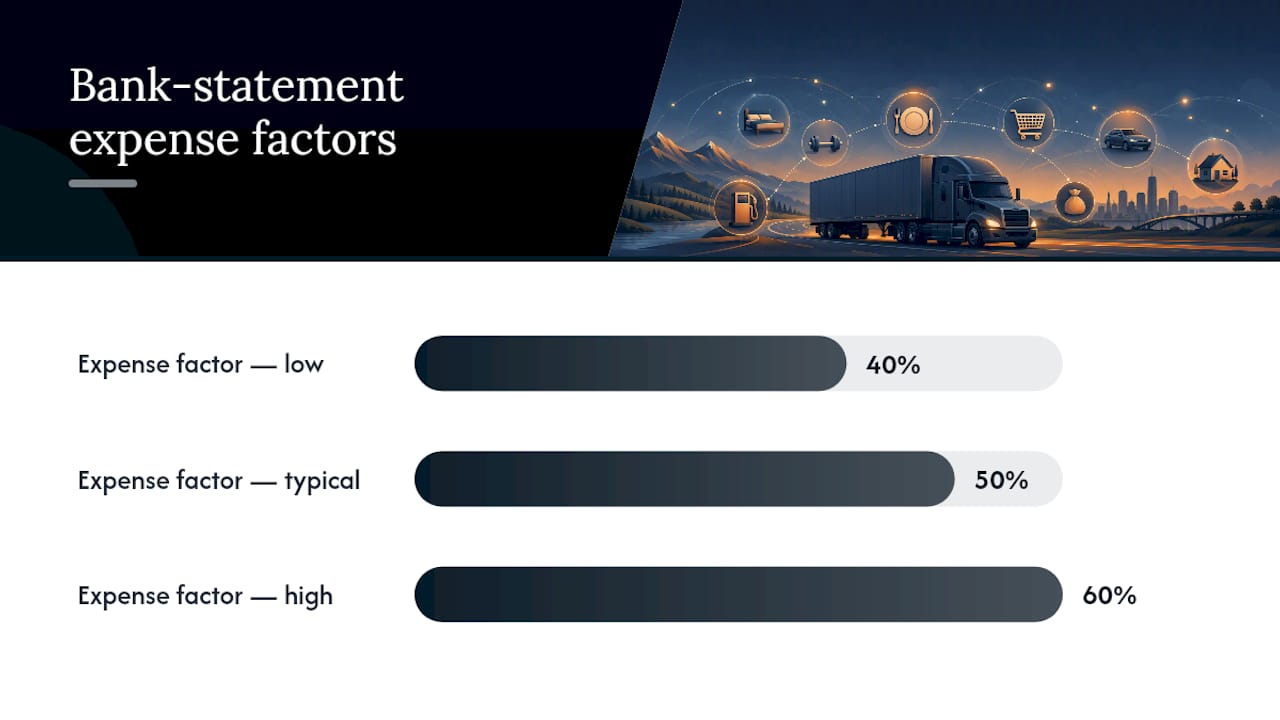
- An expense factor (often 40 to 60%, depending on the lender and program type) is applied to estimate what portion of those deposits covers business costs.
- What’s left after the expense factor becomes your qualifying monthly income.
- Lenders often ask for supporting documentation tying deposits to actual freight settlements or invoices, especially when deposit amounts vary month to month.
Pro Tip: Open a dedicated business checking account and route every settlement, factoring payment, and freight deposit through it, even if you’re currently a sole proprietor filing on Schedule C. A clean, single stream of deposits is far easier for a bank-statement underwriter to verify than a personal account mixed with groceries, kid’s soccer fees, and truck payments.
Talk to your CPA before tax season, not after. A conversation about which deductions you can dial back without creating a tax problem can meaningfully change your qualifying income on paper, and it costs nothing but a phone call.
Preparation Checklist and Realistic Timeline
How long should you expect to prepare? That depends on which loan route fits your income, but the honest answer for most owner-operators is somewhere between three months and two years.
Right now, start gathering:
- Twelve to 24 months of business and personal bank statements.
- Your two most recent years of tax returns, or one year plus prior employment history if you’re new to 1099 work.
- A year-to-date profit and loss statement, ideally prepared or reviewed by a CPA.
- CDL and employment history documentation, including any gaps.
- Settlement statements or 1099s showing per diem and freight payment breakdowns.
Over the next 90 to 180 days, separate your business and personal finances if you haven’t already, and let deposits flow consistently through one account. Pay down credit card balances to lower your utilization ratio, since that single number moves your credit score faster than almost anything else. Ask your CPA whether small, safe adjustments to this year’s deductions could raise your bankable income without triggering a bigger tax bill.
Over the next 12 to 24 months, focus on building a documented deposit history long enough to satisfy either a bank-statement lender now or a conventional lender later. If you’re financing your truck, understand how that payment shows up on your credit report, since it affects whether it can later be excluded from your debt-to-income ratio. Avoid switching from W-2 company driving to 1099 owner-operator status in the middle of a mortgage application. That single move resets your self-employment clock and can stall an otherwise strong file.
If you need to buy soon and your tax returns don’t reflect your real income, a bank-statement loan now, followed by a refinance into conventional pricing once you have two strong tax years, is often the more realistic path than waiting.
Underwriting Rules and Quirks on Trucking Files
A few specific rules decide more trucking mortgage outcomes than anything else in the file.
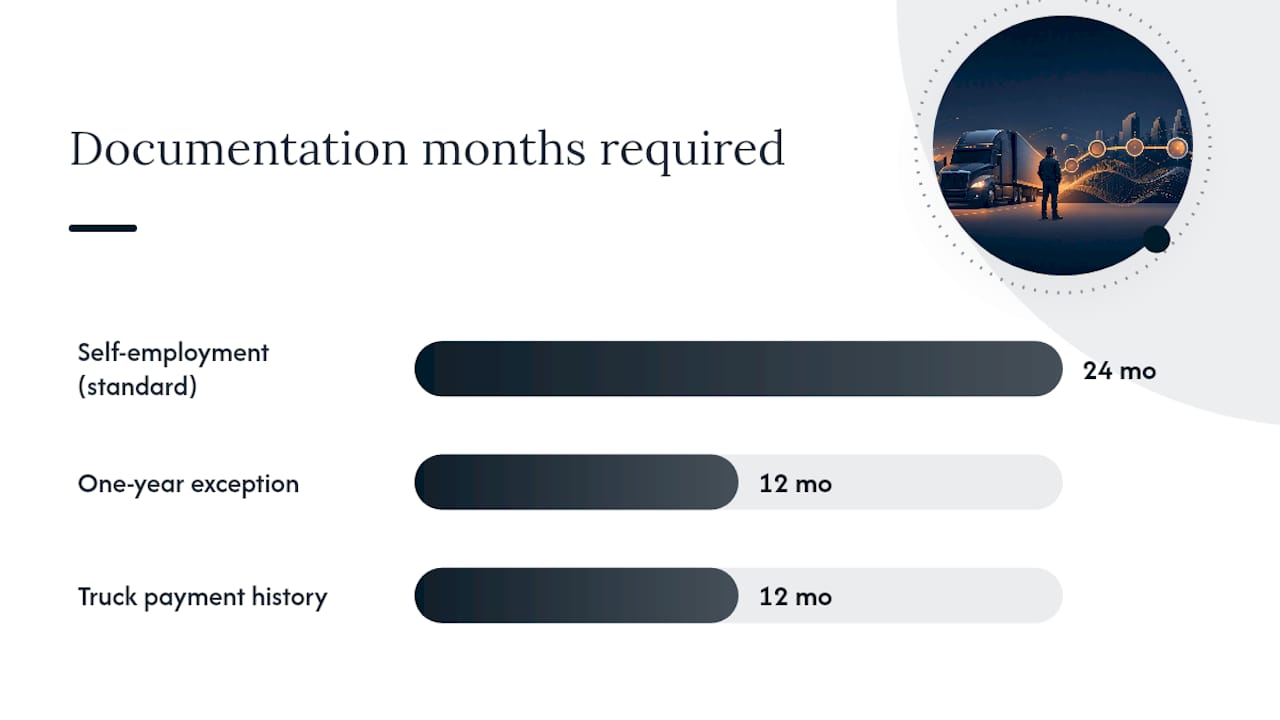
Fannie Mae’s self-employment guidelines call for a two-year earnings history, though a documented one-year exception applies when a borrower can show at least 12 months of self-employed income in the same field, paired with a prior history as a company driver or in a closely related trucking role. This exception matters a lot for drivers who recently went independent after years running as a W-2 employee.
HUD’s 2022 mortgagee letter gave FHA underwriters more flexibility in calculating effective income, including clearer allowances for analyzing self-employment income and handling gaps in employment history. That flexibility can matter for a driver coming off a slow freight season or a temporary carrier change.
Per diem gross-ups aren’t universal. When a lender does count per diem, the typical multiplier runs 1.15 to 1.25, applied to the documented per diem amount to approximate its pre-tax value. Ask upfront whether your target lender does this at all.
Truck payment exclusion is the rule most drivers don’t know exists. If you can show 12 months of documented truck payments made from business funds, backed by business bank statements, some lenders will exclude that note entirely from your personal debt-to-income calculation, treating it as a business expense rather than personal debt. That single adjustment can be the difference between a denial and an approval on a tight DTI file.
- Two-year self-employment history is standard; a one-year exception exists with the right documentation.
- Per diem gross-ups run roughly within the range of 1.15 to 1.25 when a lender allows them at all.
- A documented 12-month truck payment history from business accounts can support DTI exclusion.
- FHA guidance gives underwriters more room on effective income calculations for gaps and self-employment.
W-2 Company Driver vs. 1099 Owner-Operator: Why It Matters
Your employment classification changes almost everything about how a lender reads your file. A W-2 company driver hands over pay stubs and W-2 forms, and underwriting proceeds much like any salaried job. Overtime and bonus pay get averaged over two years if they’re not guaranteed, but there’s no Schedule C, no add-backs, no expense-factor math.
A 1099 owner-operator is treated as a small business owner, full stop. That means two years of tax returns (or the one-year exception), Schedule C analysis, depreciation add-backs, and often a request for a profit and loss statement covering the current year. It also means the lender will look closely at how long you’ve operated independently, since a driver six months into owner-operator status looks very different on paper than one three years in.
Some drivers sit in a hybrid position, leasing a truck through a carrier while technically working as a 1099 contractor, or running under a small LLC with one truck. Lenders will usually treat LLC income the same as sole proprietor income for underwriting purposes unless the business has retained earnings or multiple trucks generating separate documentation. If you’re unsure which category you fall into, ask your loan officer to confirm before you apply, not after you’ve locked a rate.
Debt-to-Income Impacts and the Truck Loan Exclusion Rule
Debt-to-income ratio, or DTI, compares your monthly debt payments to your qualifying income, and it’s often the single number that makes or breaks a trucking mortgage file. Conventional loans generally want DTI under 45 to 50%, FHA allows more room with compensating factors, and every dollar of truck note payment counts against you unless it’s excluded.
That’s where the exclusion rule matters most. Fannie Mae guidance allows lenders to exclude a business debt, including a truck note or lease, from personal DTI when the borrower can document that the payment has been made consistently from business funds for at least 12 months, verified through business bank statements. Miss that documentation window, and a $1,800 monthly truck payment gets counted fully against your personal income, often the difference between qualifying and not.
This is why the timing advice in the preparation checklist matters so much. If you financed your truck eight months ago and plan to apply for a mortgage in four months, you’ll hit the 12-month mark right around application time, assuming every payment came from a business account and you can prove it. Start pulling those statements together now rather than scrambling for them during underwriting, when a documentation delay can cost you a rate lock.
How Seasonal Freight Swings Affect Mortgage Approval
Freight volume moves with the seasons, and underwriters know it. Produce season, holiday retail freight, and winter weather disruptions all create predictable dips and spikes in a driver’s monthly revenue, which is exactly why lenders average income over 12 to 24 months rather than looking at any single month.
The risk isn’t that your income swings. The risk is applying right after your slowest stretch without documentation showing the bigger picture. A driver who had a rough January and February due to winter routes going quiet, but strong income the rest of the year, can still qualify comfortably. What sinks an application is a lender pulling only the most recent two or three months of statements and reading a seasonal dip as a permanent decline.
Ask your loan officer to review a full 12 to 24 month window upfront rather than letting the file default to whatever the most recent statements show. If you know a seasonal slowdown is coming, it’s often smarter to apply before it hits or wait until you’re a few months past it, so the averaging works in your favor rather than against it.
Common Underwriting Challenges and How to Solve Them
Most trucking mortgage denials trace back to a handful of recurring problems, and nearly all of them are fixable with enough lead time.
The most common issue is qualifying income that looks too low because of aggressive tax deductions. The fix is either a bank-statement loan that ignores the tax return entirely, or a conversation with your CPA about which write-offs to dial back for one filing year in exchange for stronger mortgage qualification.
The second most common problem is inconsistent or unverifiable deposits, usually from mixing personal and business finances in one account. Separating accounts and routing every settlement through a dedicated business account solves this within a few months of consistent use.
A third recurring issue is a thin self-employment history, typically a driver who went independent less than two years ago. The one-year exception can help here, but only with the right documentation of prior trucking experience. Without it, waiting until the two-year mark, or leaning on a bank-statement program in the meantime, becomes the practical answer.
Finally, undocumented truck payments create DTI problems that are entirely avoidable. Twelve months of business-funded truck payments, backed by statements, gets that note excluded from personal DTI. Start that documentation trail early, because there’s no shortcut once you’re mid-application.
Tips for Improving Your Credit Profile With Irregular Income
Credit scoring doesn’t know or care that your income is seasonal. It only sees whether you pay on time and how much of your available credit you’re using, and both of those are within a driver’s control regardless of freight volume.
Credit utilization is the fastest lever. Paying down credit card balances to under 30% of your limit, and ideally under 10%, can move your score meaningfully within a single billing cycle. If your income has seasonal peaks, use a strong month to knock down balances rather than letting them ride.
Payment history carries the most long-term weight, so automating minimum payments on every account removes the risk of a late payment during a slow freight month. A single 30-day late payment can knock 60 to 100 points off an otherwise strong score, and it stays on your report for years.
Avoid opening new credit accounts or financing anything major in the months leading up to a mortgage application. A new truck loan, a new credit card, even a new phone plan tied to a credit check, can all lower your score or raise your DTI right when you need both numbers at their best. If your score sits below what your target program requires, ask a loan officer which specific accounts to pay down first. Sometimes closing the gap by 20 points takes one focused payment rather than months of general cleanup.
Why a Broker Who Understands Trucking Income Matters
Not every loan officer knows the difference between a factoring deposit and a freight broker’s direct payment, and that gap in knowledge can cost you weeks or even a denial. A broker who regularly works with self-employed and gig-economy borrowers already knows which lenders offer bank-statement programs, which ones will gross up per diem, and which ones understand the truck payment exclusion rule without you having to explain it from scratch.
That specialization matters most at the underwriting stage, when a file gets flagged for something a generalist loan officer wouldn’t recognize as normal for trucking income. A broker familiar with owner-operator files can preempt those questions by including the right documentation upfront, sometimes shaving weeks off the approval timeline.
Before working with any broker or lender, confirm their licensing through NMLS Consumer Access, the government-backed lookup tool that shows whether a loan officer is properly licensed in your state. It takes two minutes and it’s the easiest way to avoid working with someone who isn’t authorized to originate loans where you’re buying.
Insurance Considerations When Applying for a Mortgage
Homeowners insurance is a standard closing requirement, but truck drivers sometimes hit a wrinkle most buyers never think about: where the truck parks. If you plan to store a commercial truck or trailer at the property you’re buying, check the homeowners association rules and local zoning before you write an offer, since some residential zones and HOAs restrict parking large commercial vehicles on-site.
Lenders will also want to see that your commercial auto or trucking liability insurance is active and in good standing, since a lapse in commercial coverage can raise questions about business continuity during underwriting. Keep your declarations page handy alongside your other financial documents; some underwriters ask for it as part of verifying that your business operations are stable.
If you’re self-employed, ask your insurance agent whether your homeowners policy needs to reflect any home-based business activity, like storing paperwork, running a small dispatch operation, or parking a personal vehicle used for business. Most policies handle this fine with a simple rider, but it’s worth confirming before closing rather than discovering a gap after you’ve moved in.
Tax Implications That Affect Your Mortgage Application
The deductions that lower your tax bill are often the same ones that lower your qualifying income, which puts every owner-operator in a genuine trade-off between paying less in taxes now and qualifying more easily for a mortgage later.
Depreciation on your truck is usually the biggest swing factor. It’s a real deduction that legitimately reduces your tax liability, and most conventional and FHA underwriters will add it back to your income during mortgage qualification. Per diem works differently: it’s already excluded from taxable income, which means it typically doesn’t need to be added back because it was never subtracted from qualifying income in the same way. Instead, the question is whether a lender will gross it up at all.
If you’re planning a home purchase within the next year or two, talk to your CPA before your next filing deadline, not after. Some deductions can be adjusted, deferred, or restructured with real tax consequences either way, so this isn’t a decision to make alone. A CPA who understands both trucking-specific write-offs and mortgage qualification math can help you find a filing strategy that doesn’t sacrifice one goal for the other unnecessarily.
A Practical Bridge: What Bank-Statement Underwriting Actually Solves
Bank-statement underwriting exists for exactly one reason: tax returns often lie about how much money an owner-operator actually makes. Qualifying on 12 to 24 months of deposits instead of Schedule C net profit reflects real cash flow, which is why it’s often the fastest path for drivers with heavy write-offs and strong bank balances.
The trade-off is real. Many drivers treat it as a bridge: buy now, then refinance into conventional pricing once two years of strong tax returns exist.
- Saad
How Texas Bank Statement Home Loans Can Help
If your tax returns undersell what you actually make, Texas Bank Statement Home Loans reads your bank deposits instead of your Schedule C, which means the write-offs that shrink your tax bill don’t also shrink your buying power.
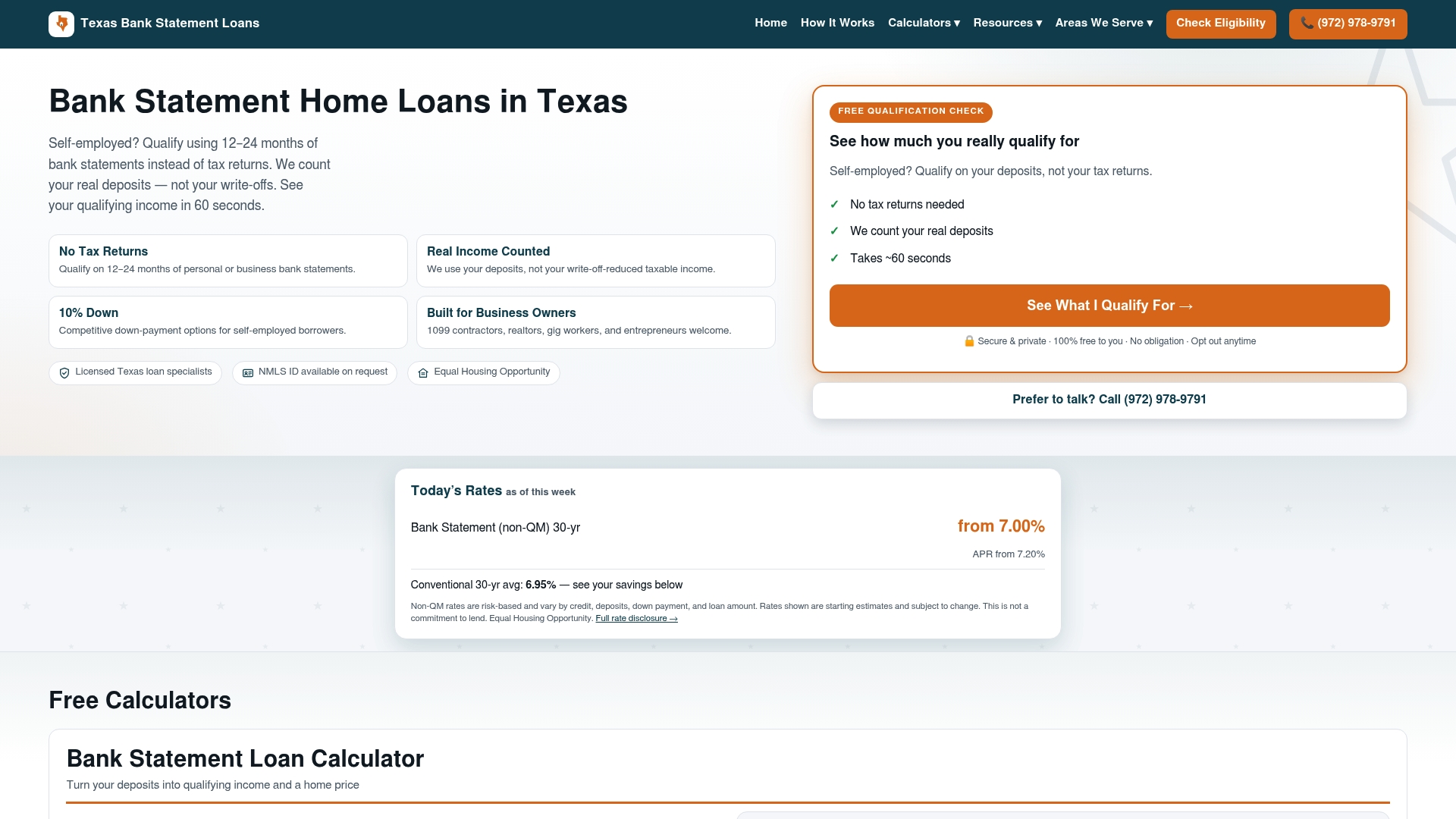
Start by gathering your last 12 to 24 months of statements, then run the self-employed affordability calculator to see where you land before you ever talk numbers with a lender. If you’re comparing program costs, check current bank-statement loan rates so you know what to expect going in. When you’re ready, request your qualification check and get matched with a loan officer familiar with trucking income.
This article is general information, not a substitute for advice from a qualified financial advisor. Consult a qualified financial professional about your own circumstances before acting on anything here.
Sources
- HUD Mortgagee Letter and FHA handbook updates (2022)
- Owner-Operator Mortgage in 2026: How a Trucker With 1099 or LLC Income Actually Buys a House
- NMLS Consumer Access
FAQ
Can Truck Drivers Get Approved for a Mortgage?
Yes. W-2 company drivers typically qualify through conventional, FHA, or VA programs the same way any salaried buyer does. Owner-operators often qualify through a bank-statement loan that counts deposits instead of tax return net income, especially when write-offs make taxable income look low.
Is There a $7,500 Tax Credit for Truck Drivers?
No broad federal tax credit exists specifically for truck drivers. Some proposed legislation and state-level incentive programs have floated credits tied to trucking, but nothing is a confirmed universal federal benefit, so check current IRS guidance or a CPA before assuming eligibility.
What Credit Score Do I Need for Truck Financing or a Mortgage as a Driver?
Bank-statement programs often set their own minimums, commonly in the mid-600s as well, though requirements vary by lender.
What Is Trump’s New CDL Law?
Federal policy discussions around commercial driver’s license rules have focused on English language proficiency enforcement and stricter licensing verification for CDL holders. These changes affect driving eligibility and carrier compliance, not mortgage qualification directly, though continuous, verifiable employment history still matters for underwriting.
How Long Does It Take to Prepare for a Mortgage as an Owner-Operator?
Most owner-operators need three to six months to clean up documentation for a bank-statement loan, or up to two years to build the tax return history conventional lenders prefer. Gathering 12 to 24 months of bank statements and separating business from personal accounts early shortens that timeline considerably.
See what you qualify for in 60 seconds, free and no credit check. Use the eligibility check at the top of this page.