
Your approved mortgage amount comes down to four levers: your credit score, your debt-to-income ratio (DTI), how you document income, and which lender you choose. Pull all four in the right direction and the ceiling moves significantly. Here are the highest-impact moves, ordered by how fast they work:
- Lower revolving credit utilization below 30% before your statement closes (30 days or less)
- Shop lenders within a 14-day window so multiple hard inquiries count as one credit event
- Get a written pre-approval, not just a pre-qualification, before you make an offer
- Pay down or eliminate installment debt to drop your back-end DTI (2-6 months)
- Build 6-12 months of reserves in a liquid account (3-6 months)
- Switch to bank-statement underwriting if tax-return income understates your actual deposits (varies)
Pro Tip: Industry guidance recommends shopping for mortgage pre-approval within a 14-day window so all mortgage credit inquiries are treated as a single event, minimizing the impact on your credit score while you compare lenders.
Table of Contents
- How lenders calculate the maximum mortgage they will approve
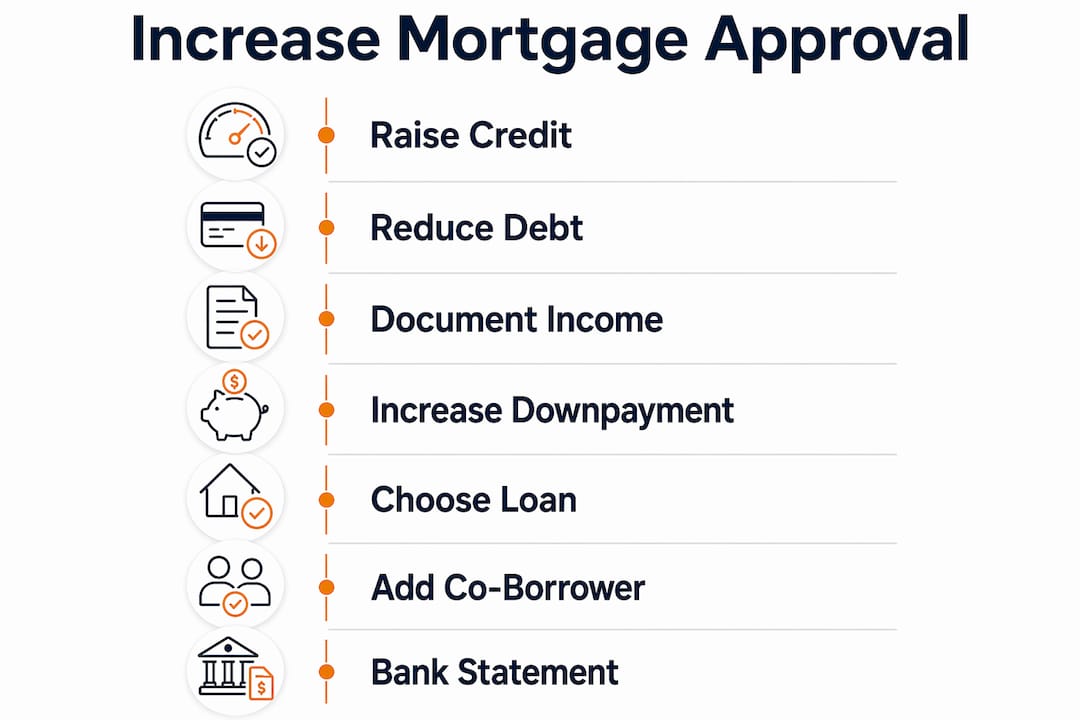
- 1. Raise your credit score before you apply
- 2. Cut your back-end DTI aggressively
- 3. Document your income the right way
- 4. Increase your down payment or reserves
- 5. Choose the right loan program and lender
- 6. Add a co-borrower strategically
- 7. Consider bank-statement underwriting if tax returns understate income
- How an interest-rate change affects your borrowing ceiling
- Options for self-employed borrowers: bank-statement loans and when they help
- How long each move takes and what it costs
- Questions to ask lenders and red flags to watch for
- How lenders treat bonuses, commissions, and rental income
- How employment history stability affects your approval amount
- How to use assets as reserves to increase your approval amount
- Key Takeaways
- What most self-employed borrowers get wrong
- Texasbankstatementloans: a direct path for self-employed borrowers
- Useful sources and further reading
How lenders calculate the maximum mortgage they will approve
Every lender runs the same core math, even if their overlays differ. Understanding the inputs tells you exactly where to push.
Front-end DTI covers housing costs only: principal, interest, property taxes, homeowner’s insurance, and HOA dues (the PITI bundle). Most conventional programs want this below 28%. Back-end DTI adds all monthly debt obligations, car loans, student loans, credit cards, child support, on top of PITI. The Qualified Mortgage standard centers on a 43% back-end DTI guideline, but Federal Reserve Bank of St. Louis research shows the functional underwriting boundary most lenders enforce is closer to 50%; denial rates jump sharply once an application crosses that mark.
Credit score affects two things simultaneously: the interest rate you receive and the DTI ceiling the lender will allow. A higher score unlocks lower rates, which directly increases how much loan a given monthly payment can support.
| Loan Program | Typical Max Back-End DTI | Baseline Loan Limit (2026) | Min Down Payment |
|---|---|---|---|
| Conventional | about 50% (AUS) | loan limits near conforming limits | 3% |
| FHA | roughly 50-57% (AUS) | Varies by county | - |
| VA | No hard cap (residual income test) | No conforming cap | - |
| Jumbo | approximately 43% (lender overlay) | Above conforming limit | 10-20% |
| Bank Statement (Non-QM) | 50% typical | Lender-set | 10%+ |
Key figure: PITI in high-property-tax states can consume several hundred dollars of your DTI allowance before a single dollar of principal is counted, a detail many borrowers miss until underwriting.
1. Raise your credit score before you apply
Moving from a 660 to a 760 score can lower your rate and raise your maximum purchase price significantly on the same income. That is not a marginal gain. The fastest legal moves: pay revolving balances down before the statement date (not just before the due date), dispute inaccurate items on your Experian, Equifax, and TransUnion reports, and avoid opening new accounts in the 90 days before application. Understanding how credit score affects wealth-building helps frame why this step deserves the most attention.

2. Cut your back-end DTI aggressively
Pay off or pay down installment loans, not just credit cards. A car loan with 10 months remaining still counts in your DTI. If you can eliminate it, do so. For self-employed borrowers, separating business and personal accounts is equally important: lenders look only at personal debt, so business expenses running through a personal card inflate your apparent obligations. Use your DTI calculator to model the impact before you pay anything off.
3. Document your income the right way
W-2 employees hand over two pay stubs. Self-employed borrowers hand over two years of personal and business tax returns, Schedule C or K-1s, a year-to-date profit and loss statement, and two months of bank statements. Underwriters average the two-year income figure; if year two is lower than year one, the trend works against you. Apply in a year when income is stable or rising. Fannie Mae’s Income Calculator is a free tool loan officers use to maximize qualifying income by incorporating all allowable add-backs like depreciation and depletion.
4. Increase your down payment or reserves
A larger down payment reduces the loan amount directly, which lowers DTI and often eliminates private mortgage insurance. Reserves matter separately: lenders generally want to see several months of PITI sitting in a liquid account after closing. Money market accounts are a practical place to park reserves because they stay liquid while earning a return. Asset-depletion programs go further: if you have substantial liquid assets, some lenders divide eligible assets by the loan term in months and count the result as qualifying income.
5. Choose the right loan program and lender
Program choice changes the ceiling. VA loans have no hard DTI cap and use a residual income test instead, which often allows higher loan amounts for veterans. FHA allows DTI up to 57% with automated underwriting approval. Conventional loans offer the widest rate competition. The Federal Reserve Bank of St. Louis research found that lender fixed effects explain more than 30% of approval outcomes, meaning where you apply is nearly as important as what you earn. A mortgage broker with experience in self-employed files can surface lender overlays that retail channels do not advertise.
6. Add a co-borrower strategically
A co-borrower’s income is added to yours for qualifying purposes, which can push the approval ceiling substantially. The tradeoff: the co-borrower typically takes an ownership stake. A co-signer (no ownership stake) helps with credit but not always with income, depending on the lender. Run the numbers both ways before committing.
7. Consider bank-statement underwriting if tax returns understate income
This is the path most traditional lenders will not mention. Bank-statement programs use 12-24 months of deposits to derive qualifying income instead of tax returns, which means the deductions that reduce your taxable income stop working against you. For a freelancer or business owner who writes off $40,000 in legitimate expenses, this can mean qualifying for a significantly larger loan than a tax-return-based program would allow.
How an interest-rate change affects your borrowing ceiling
Interest rates are the variable most borrowers cannot control, but they have the largest immediate effect on how much you can borrow. The math is direct: a fixed monthly payment supports a smaller loan at a higher rate.
| Monthly P&I Budget | Rate | Approximate Loan Amount |
|---|---|---|
| $2,000 | 5.- | - |
| $2,000 | 7.- | - |
Moving from 5% to 7% on the same monthly payment reduces borrowing power by roughly $144,000. That is not a rounding error. It is the difference between qualifying for a median-priced Texas home and falling short. Use the mortgage payment calculator to run your own scenario before locking a rate.
Callout: A 100-basis-point rate drop on a $2,000/month P&I budget adds roughly $30,000-$40,000 in borrowing capacity. Rate locks and float-down options are worth asking about.
Options for self-employed borrowers: bank-statement loans and when they help
Bank-statement underwriting converts your average monthly deposits over 12-24 months into qualifying income. The lender reviews business and personal bank statements, applies an expense factor (commonly 50% for business accounts), and arrives at a monthly income figure. If your deposits are strong but your tax returns show low net income after deductions, this approach can raise your qualifying income substantially.
Pros for freelancers and small-business owners:
- Qualifying income reflects actual cash flow, not taxable income
- Down payments start at 10% with programs like Texasbankstatementloans
- No tax-return requirement means faster documentation assembly
- Works for 1099 contractors, gig workers, and business owners
Cons to weigh:
- Rates are typically higher than conventional programs
- Reserves of 6-12 months PITI are commonly required
- Lender overlays vary; not every bank-statement lender uses the same expense factor
Documentation checklist:
- 12-24 months of business and/or personal bank statements
- A lender-ready profit and loss statement (CPA-prepared preferred)
- Business license or CPA letter confirming self-employment
- 2-3 months of personal bank statements showing reserves
Pro Tip: Keep business and personal deposits in separate accounts for at least 12 months before applying. Commingled accounts force underwriters to manually separate transactions, which slows approval and can reduce the qualifying income figure.
Texasbankstatementloans evaluates 12-24 months of deposits instead of tax returns, with down payments starting at 10%. Run a 60-second qualification check to see where you stand before gathering documents.
How long each move takes and what it costs
| Action | Time to Impact | Direct Cost | Tradeoff |
|---|---|---|---|
| Lower credit utilization | 30 days | None | Requires available cash |
| Dispute credit errors | 30-60 days | None | Outcome not guaranteed |
| Pay off installment debt | 30-90 days | Cash outlay | Reduces liquid reserves |
| Build 6-month reserves | 3-6 months | Opportunity cost | Cash tied up |
| Raise credit score 660→760 | 6-18 months | Credit monitoring fees | Time |
| Reduce tax deductions | 1-2 tax years | Higher tax bill | Increases taxable income |
| Switch to bank-statement program | 2-4 weeks | Higher rate (typically) | Rate premium vs conventional |
The fastest moves (utilization, error disputes, lender shopping) cost nothing but time. The slowest moves (credit repair, reserve-building) cost either money or opportunity. Paying more in taxes to show higher income on returns is a real tradeoff; for many self-employed borrowers, bank-statement underwriting sidesteps it entirely.
Questions to ask lenders and red flags to watch for
Before you commit to a lender, ask these directly:
- Does your AUS accept self-employment income, or will this go to manual underwriting?
- What overlays do you apply beyond agency guidelines for self-employed borrowers?
- How do you treat business deposits vs. personal deposits in bank-statement programs?
- What are your reserve requirements after closing?
- Will you accept gift funds for down payment or reserves?
- What is your rate-lock period, and do you offer a float-down option?
- Do you offer appraisal waivers on eligible properties?
Red flags:
- Vague answers about how income is calculated (“we’ll figure it out”)
- Promises to “boost” your qualifying income without documentation changes
- Unusual upfront fees before a loan estimate is issued
- Unwillingness to explain overlays in writing
- Pressure to skip the 14-day shopping window
Get at least two written pre-approval letters from different lender types. The difference in approval amounts can be substantial, and the credit impact is minimal when pulls are clustered.
How lenders treat bonuses, commissions, and rental income
Variable income gets a different treatment than base salary, and knowing the rules lets you maximize what counts.
Bonuses and commissions must have a two-year history to be included. Lenders average the two years; if the most recent year is lower, the average drops. A single large bonus in year one that does not repeat in year two may be excluded entirely. The fix: document consistency. If your commission structure changed, get a letter from your employer explaining the new structure and projected earnings.
Rental income from investment properties requires a two-year history on Schedule E. Lenders typically apply a 25% vacancy factor to gross rents, then net out mortgage, taxes, and insurance. If the property shows a loss on Schedule E, that loss is added to your monthly obligations. Properties with strong positive cash flow can meaningfully increase qualifying income; properties running at a tax loss work against you.
Part-time or side income needs a two-year history at the same source to count. Gig income (Uber, Airbnb, freelance platforms) documented on Schedule C follows the same self-employment rules: two years of returns, averaged, with add-backs for depreciation.
The practical move: pull your last two years of returns and calculate what each income stream contributes under standard lender rules before you apply. Surprises at underwriting cost time and sometimes the deal.
How employment history stability affects your approval amount
Lenders want a two-year employment history, but “stable” does not mean “same employer.” What they are actually checking is consistent income type and trajectory.
Switching from W-2 employment to self-employment resets the clock. Most lenders require two full years of self-employment tax returns before they will use that income for qualifying. If you went independent 18 months ago, you may need to wait, use a bank-statement program, or apply with a co-borrower who has W-2 income.
Gaps in employment are manageable with documentation. A gap of less than 30 days with a return to the same field is typically acceptable. Longer gaps require a written explanation and evidence of current employment. Lenders are looking for a pattern, not perfection.
Changing industries while staying employed is riskier than changing employers within the same field. An underwriter who sees a software engineer become a restaurant owner will ask more questions than one who sees a software engineer change companies.
The strongest employment file for a conventional loan: two or more years at the same employer or in the same field, with stable or rising income. For self-employed borrowers, two years of returns showing consistent or growing net income achieves the same result.
How to use assets as reserves to increase your approval amount
Reserves are not just a safety net. They are a compensating factor that can push a borderline file over the line, especially in manual underwriting where an estimated 15-20% of funded mortgages end up.
What counts as reserves:
- Checking and savings accounts (100% of balance)
- Money market accounts (100%)
- Vested 401(k) or IRA funds (typically 60-70% of balance after early-withdrawal penalty)
- Stocks and bonds in taxable accounts (typically 70% of current value)
- Gift funds (lender-specific; some programs allow)
What does not count: Funds needed for down payment and closing costs, borrowed funds, and cash that cannot be sourced and seasoned (typically 60 days in the account).
Asset-depletion underwriting takes this further. Lenders divide eligible assets by the remaining loan term in months to create a monthly income figure. A borrower with $500,000 in liquid assets and a 30-year loan term could generate roughly $1,388/month in qualifying income under this method, on top of any earned income. This approach is particularly useful for retirees, business owners with significant retained earnings, or anyone whose liquid wealth exceeds their documented income.
The practical step: move reserves into a single, clearly documented account at least 60 days before application. Underwriters need to trace the source; multiple small transfers from multiple accounts slow the process and raise questions.
Key Takeaways
Raising your approved mortgage amount is a sequenced process: fix the fastest items first, then work the longer-term levers while your application strengthens.
| Point | Details |
|---|---|
| DTI is the primary bottleneck | Denial rates jump sharply above 50% back-end DTI; pay down debt before applying. |
| Rate changes move the ceiling fast | Moving from a 5% to a 7% interest rate on the same monthly payment reduces borrowing power by roughly $144,000. |
| Credit score has a non-linear payoff | Moving from 660 to 760 can raise purchase power by 15-25% through lower rates and higher DTI allowances. |
| Employment and income history matter | Two years of consistent income in the same field is the baseline; gaps and industry changes require documentation. |
| Texasbankstatementloans for self-employed | Evaluates 12-24 months of deposits instead of tax returns, with down payments starting at 10%. |
What most self-employed borrowers get wrong
The most common mistake is applying in the wrong year. A business owner who had a strong year two years ago and a modest year last year will see the lender average the two, which pulls qualifying income down. The fix is to apply after a strong year closes, not during it.
The second mistake is commingled accounts. When business revenue flows through a personal checking account, underwriters cannot cleanly separate business income from transfers, reimbursements, and other deposits. The result: a lower qualifying income figure than the actual deposits support. Separate accounts, maintained for at least 12 months, solve this cleanly.
The third mistake is treating manual underwriting as a last resort. An estimated 15-20% of funded mortgages go through manual review. For a self-employed borrower with strong reserves, a clean payment history, and a well-organized file, manual underwriting can approve a loan that an automated system referred. The key is preparation: a narrative letter explaining income, organized exhibits, and a CPA-prepared P&L.
On the broker vs. direct lender question: use a broker when your income is non-traditional. Brokers access multiple lenders and know which overlays favor self-employed files. Direct lenders are faster when your file is clean and conventional. Adding a co-borrower makes sense when their income is stable W-2 income and your self-employment income alone falls short; it rarely makes sense when both borrowers have variable income.
Texasbankstatementloans: a direct path for self-employed borrowers
For self-employed borrowers whose tax returns understate their actual income, the conventional mortgage process is genuinely stacked against them. Texasbankstatementloans takes a different approach: it evaluates 12-24 months of bank deposits to determine qualifying income, which means your write-offs stop working against you.
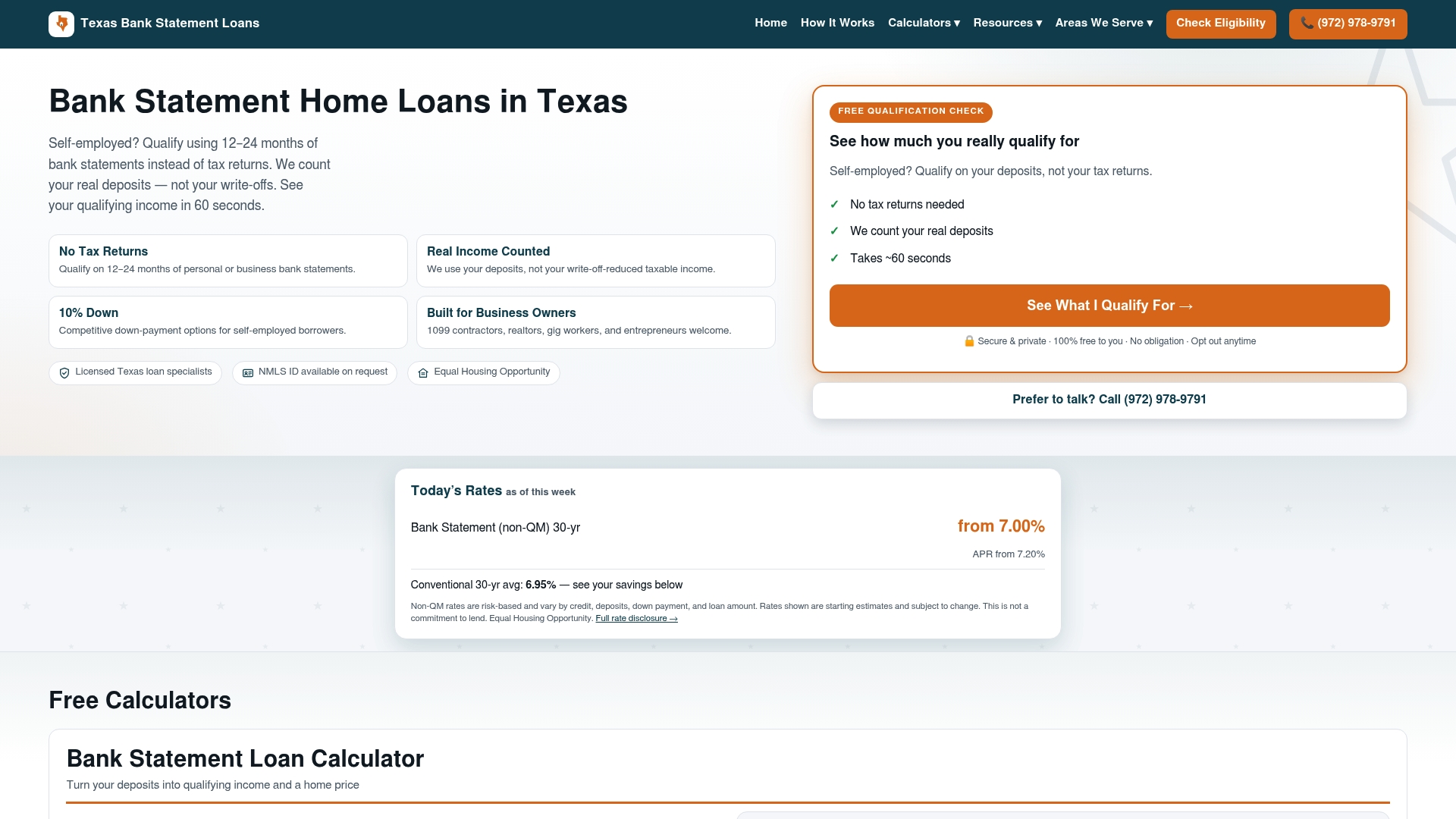
Down payments start at 10%, and the program is built specifically for business owners, 1099 contractors, and gig workers in Texas. Rates on bank-statement programs are typically higher than conventional loans, and reserves of 6-12 months PITI are commonly required, so go in with clear expectations. To get started, have 12-24 months of bank statements, a profit and loss statement, and your business license ready. Then run the bank-statement loan calculator to estimate your qualifying income, or check your eligibility with the self-employed affordability tool in about 60 seconds, no obligation required.
This article is general information, not financial or legal advice. Confirm current program requirements and loan limits with a licensed mortgage professional for your specific situation.
Useful sources and further reading
- The Determinants of Mortgage Denial, Federal Reserve Bank of St. Louis; backs the 50% DTI functional boundary and lender fixed-effects findings cited in this article.
- Maximum Mortgage Limits by Loan Type and Income, LegalClarity; source for the $144,000 borrowing-power example and rate-change impact.
- What Size Home Loan Can I Get?, LegalClarity; covers PITI, asset-depletion underwriting, and how taxes/insurance affect DTI.
- Self-Employed Mortgage Guide, Wealthvieu; source for the 14-day inquiry window guidance and bank-statement program mechanics.
- US Mortgage Pre-Qualification 2026, 3tej; source for the 660-to-760 credit score impact (15-25% purchase power increase) and conforming loan limits.
- How Mortgage Underwriting Works, The Score Guide; source for the 15-20% manual underwriting estimate and compensating factor guidance.
- Tips on Getting a Mortgage When Self-Employed, Chase; practical documentation checklist and the case for separating business and personal accounts.
- Fannie Mae Income Calculator, Fannie Mae; free tool for loan officers to maximize qualifying income from complex income sources.
See what you qualify for in 60 seconds, free and no credit check. Use the eligibility check at the top of this page.