
Yes, 1099 earners can qualify for a mortgage. Lenders typically look back 12-24 months of bank deposits for bank-statement programs, or 1-2 years of tax returns for conventional routes. From preapproval to closing, expect roughly four to five months overall, though a well-prepared 1099 borrower with clean documentation can move through underwriting in as little as 6-10 weeks on a bank-statement loan.
The 1099 homeownership timeline explained here covers every stage, from the paperwork you need to gather today to the refinance window you should plan for later. Here is where to start:
- Gather your last two years of personal tax returns, all 1099 forms (1099-NEC, 1099-MISC, 1099-K), and Schedule C if you file one.
- Pull 12-24 months of personal and business bank statements, all pages.
- Book a CPA consultation now if you are 12-24 months from applying. Tax decisions made this year directly affect how much income a lender will count next year.
- Get a preapproval letter before you start house hunting. It tells you your real budget and flags documentation gaps before they become closing delays.
Table of Contents
- What documents do lenders require from 1099 borrowers?
- How do underwriters calculate income from 1099 or bank data?
- Which loan type fits your situation as a 1099 borrower?
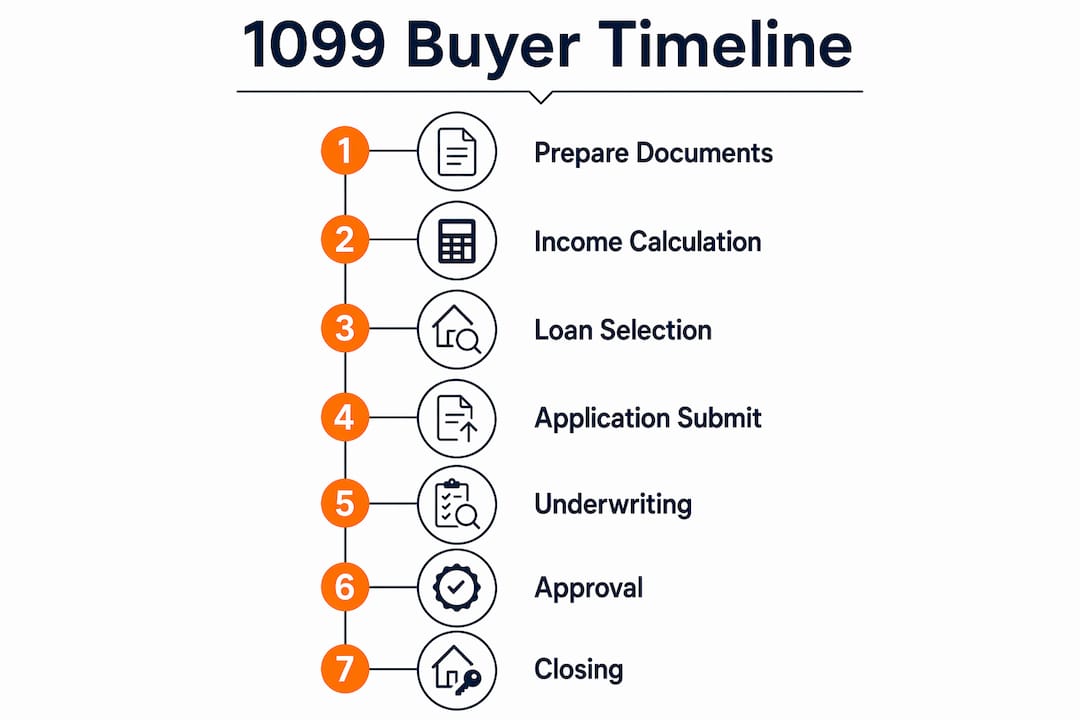
- What does the homebuying timeline actually look like for 1099 borrowers?
- How do you speed up approval and strengthen your application?
- When should you refinance out of a bank-statement loan?
- Key Takeaways
- What most 1099 borrowers get wrong about the mortgage process
- Texasbankstatementloans helps self-employed Texas buyers close faster
- Useful sources
What documents do lenders require from 1099 borrowers?
The paperwork list varies by loan program, but the core set is consistent. Standard documentation includes all 1099 forms, two years of personal tax returns with all schedules, bank statements, a profit and loss statement, and IRS transcripts requested via Form 4506-T.
| Document | Conventional | Bank-Statement / Non-QM |
|---|---|---|
| Personal tax returns (2 years) | Required | Often required for identity/history |
| All 1099 forms (NEC, MISC, K) | Required | Helpful but not primary |
| Schedule C (or business returns) | Required | Supplemental |
| 12-24 months of bank statements | Sometimes | Primary income proof |
| Profit & loss statement | Sometimes | Usually required |
| IRS transcript (4506-T) | Required | Required |
| Business license or DBA | Helpful | Often required |
| Current contracts or invoices | Helpful | Strongly recommended |
When lenders accept one year of self-employment: Freddie Mac guidance allows combined employment histories, meaning a borrower who spent years as a W-2 employee in the same trade before going independent may qualify with just one year of 1099 history. Supporting evidence that helps includes a prior W-2 in the same field, formal credentials, and documented recurring client relationships.
If you are an S-Corp owner or receive K-1 distributions, add two years of business returns (Form 1120S or 1065) and the K-1s themselves to your stack. Lenders will reconcile your personal income against the business returns to confirm the numbers align.
Pro Tip: Order your IRS transcripts early using Form 4506-C (the updated version of 4506-T). Processing can take 5-10 business days, and underwriters will not issue a clear-to-close without them. A transcript delay is one of the most common reasons closings slip by a week or two.
How do underwriters calculate income from 1099 or bank data?
Two methods dominate, and which one applies to you changes your qualifying income dramatically.
Method A: Tax-return-based underwriting. The underwriter adds your Schedule C net profit from the last two years and divides by 24 to get a monthly qualifying income figure. Non-cash expenses like depreciation are often added back because they reduce taxable income without reducing actual cash flow. Hard cash expenses, supplies, subcontractor payments, software subscriptions, are not added back.
Method B: Bank-statement underwriting. The underwriter averages total deposits across 12-24 months, then applies an expense ratio (often 50% for sole proprietors, lower for businesses with documented lower overhead) to arrive at qualifying income. No tax returns required as the primary proof.

A simple comparison: Suppose you deposit $12,000 per month consistently but write off $60,000 in business expenses annually. Your Schedule C net profit might be $84,000 ($7,000/month qualifying). Under bank-statement underwriting at a 50% expense factor, your qualifying income is $6,000/month. In this case, the tax-return route actually wins. But if your deductions are heavier, say $100,000 in write-offs on $144,000 in gross receipts, bank-statement underwriting at 50% yields $6,000/month versus a Schedule C net of roughly $3,700/month. That gap can mean the difference between qualifying and not.
The deduction trap is the single biggest surprise for 1099 borrowers. Every dollar you deduct from Schedule C reduces your qualifying income dollar-for-dollar on a conventional loan. A CPA who understands mortgage underwriting can help you balance tax savings against borrowing power before you apply, not after.
Underwriters also want to see that income will continue. Client contracts, recurring invoices, and a CPA letter confirming business health all support continuance. IRS transcripts verify the numbers match what you filed.
Which loan type fits your situation as a 1099 borrower?
| Loan Type | Documentation Required | Income History | Down Payment / Credit | Rate Tradeoff | Best For |
|---|---|---|---|---|---|
| Conventional | 2 years tax returns, Schedule C, 4506-T | 1-2 years | 5-20% down;, credit | Lowest rates | Steady net income on returns |
| FHA | 2 years tax returns, 1099s, bank statements | 2 years preferred | 3.5% down;, credit | Moderate; MIP required | Lower credit scores, higher DTI |
| VA | 2 years tax returns, 1099s, COE | 2 years preferred | - down (eligible veterans) | Competitive; no PMI | Eligible veterans and service members |
| Bank-Statement / Non-QM | 12-24 months of bank statements, P&L | 12-24 months deposits | 10%+ down;, credit for best pricing | 1.5%-2.5% higher | Heavy deductions, cash-flow-rich borrowers |
Conventional loans work well when your tax returns honestly reflect your income. The rate is the best available, and once you hit 20% equity, PMI drops off. The catch is that aggressive deductions can shrink your qualifying income to the point where you cannot hit the debt-to-income threshold.
FHA and VA programs still require stable income documentation. They are not a shortcut around the two-year history expectation, but they do allow lower credit scores and higher debt-to-income ratios, which helps some 1099 borrowers who are otherwise well-qualified.
Bank-statement loans are the practical solution when your cash flow is strong but your tax returns understate it. Bank-statement programs typically use 12-24 months of deposits, with 24 months producing smoother averages for seasonal businesses and often better pricing. The rate premium of roughly 1.5%-2.5% over conventional is real, but so is the ability to buy now rather than wait two years for your tax picture to improve.
Non-QM and stated income options serve borrowers who fall outside agency guidelines entirely, high-asset borrowers, ITIN holders, or those with very recent business formation. They carry the highest rates and are best treated as a bridge to conventional refinancing once your income history seasons.
What does the homebuying timeline actually look like for 1099 borrowers?
| Stage | Typical Duration | Key Documents Needed | Common Delay Causes |
|---|---|---|---|
| Pre-application prep | 2-12+ months | Tax returns, 1099s, bank statements | CPA coordination, account separation |
| Preapproval | 1-2 weeks | Full document package | Missing 1099s, co-mingled accounts |
| House hunting | Varies | Preapproval letter | Market conditions |
| Underwriting | 2-6+ weeks | 4506-T transcripts, P&L, CPA letter | High deductions, seasonal income, missing pages |
| Appraisal | 1-2 weeks | Purchase contract | Appraiser availability, property issues |
| Clear-to-close | 1-2 weeks | Final verification | Last-minute credit pulls, title issues |
The pre-application prep stage is where 1099 borrowers lose the most time, and it is entirely within your control. If your accounts are co-mingled, your deductions are heavy, or your IRS transcripts do not match your stated income, underwriting will stall while you explain discrepancies.
Preapproval itself moves quickly once your documents are organized, typically one to two weeks. The variable is underwriting. A straightforward W-2 file might clear in two weeks. A complex 1099 file with seasonal income, multiple income streams, or a recent business formation can take four to six weeks or longer.
Common delay causes specific to 1099 borrowers:
- Co-mingled personal and business accounts that require manual deposit-by-deposit review
- Missing pages from bank statements (lenders require every page, including blank ones)
- Seasonal income spikes that underwriters flag for continuance verification
- High deduction patterns that trigger requests for CPA letters or add-back documentation
- Amended tax returns that do not yet have IRS transcripts available
- 1099s from multiple clients that do not reconcile cleanly with bank deposits
Keeping business and personal accounts separate is not just good bookkeeping, it directly reduces the manual workload on the underwriter’s desk and shortens your timeline.

How do you speed up approval and strengthen your application?
12-24 months before applying:
- Open a dedicated business checking account and route all client payments through it. Personal expenses stay out.
- Meet with a CPA who understands mortgage underwriting. The goal is to align your tax strategy with your borrowing goals, not to maximize deductions at the cost of qualifying income.
- Document recurring client relationships with signed contracts or retainer agreements. These support income continuance.
- Avoid large one-off deductions in the 12 months before you apply, especially if they materially reduce your Schedule C net profit.
90 days before applying:
- Stop large transfers between personal and business accounts that could look like inflated deposits.
- Pay down revolving credit card balances to improve your debt-to-income ratio.
- Confirm your cash reserves are liquid and sitting in accounts the lender can verify. Retirement accounts count at a discount; cash in a brokerage account counts more cleanly.
- Order IRS transcripts now so they are ready when underwriting requests them.
30 days before applying:
- Do not open new credit accounts or make large purchases on existing ones.
- Ask your CPA to prepare a signed income letter that explains your business structure, income trend, and any unusual items on your returns.
- Ask your lender specifically which add-backs they allow. Depreciation is almost always acceptable; vehicle expenses and home-office deductions vary by lender.
Pro Tip: For gig or seasonal income, prepare a 12-month income summary showing monthly deposit totals alongside a brief explanation of your business cycle. Underwriters who see a clear pattern, high deposits in Q4, lower in Q1, are far less likely to flag it as instability than if they have to figure it out themselves.
When should you refinance out of a bank-statement loan?
Bank-statement and non-QM loans are built to be temporary for many borrowers. The bridge strategy works like this: buy now using bank-statement underwriting, then refinance into a conventional loan once your tax returns show two years of qualifying income at the level you need.
Typical refinance triggers:
- You have 12-24 months of tax returns showing the income level required for conventional qualification.
- Your property has appreciated enough to hit 20% equity, eliminating PMI on the new conventional loan.
- The rate differential between your current non-QM rate and available conventional rates makes the refi math work after closing costs.
What to watch for:
- Prepayment penalties on some non-QM products. Read your note carefully, some carry a 3-year penalty period.
- Qualifying rules may have changed by the time you refinance. Confirm current guidelines with your lender before assuming you will qualify.
- Calculate the break-even point. If refinancing saves you $300/month but costs $6,000 in closing costs, you need 20 months to break even. If you plan to sell before then, the refi may not pencil out.
Many borrowers who use a bank-statement loan as a bridge find that the two-year seasoning window passes faster than expected, especially if they are actively working with a CPA to present clean returns in year two.
Key Takeaways
1099 borrowers who separate accounts, coordinate with a CPA 12-24 months before applying, and choose the right loan program can close on a home in roughly the same timeframe as a W-2 borrower.
| Point | Details |
|---|---|
| Income history window | Lenders typically require 1-2 years of tax returns or 12-24 months of bank statements depending on the program. |
| The deduction trap | Business deductions reduce qualifying income dollar-for-dollar on conventional loans; plan with a CPA before applying. |
| Bank-statement loan fit | Best when tax deductions understate cash flow; expect a rate premium over conventional. |
| Timeline expectation | Overall homebuying averages roughly four to five months; complex 1099 underwriting can add 2-4 weeks to that. |
| Texasbankstatementloans | Evaluates 12-24 months of deposits for self-employed Texas borrowers, with down payment options starting at 10%. |
What most 1099 borrowers get wrong about the mortgage process
The conventional wisdom says the hardest part of buying a home as a 1099 earner is the paperwork. That is wrong. The paperwork is just the symptom. The real problem is that most self-employed borrowers make tax decisions in April with no thought to what those decisions will do to their mortgage application in October.
A CPA who has never worked alongside a mortgage underwriter will optimize your return for the lowest possible tax bill. That is their job. But the result is often a Schedule C that shows $40,000 in net profit on $180,000 in gross receipts, and a lender who will only count that $40,000 when calculating your debt-to-income ratio. You have the cash flow to carry the mortgage. The paper says you do not.
The fix is not to stop taking legitimate deductions. It is to understand which deductions are add-backable (depreciation, amortization, some one-time expenses) and which are not, and to make that calculation before you file, not after you are already in underwriting. A CPA who understands tax planning for self-employed borrowers is worth far more than their fee in this context.
The second thing borrowers underestimate is account separation. Underwriters reviewing co-mingled accounts have to manually identify which deposits are business income and which are personal transfers. That process takes time, generates questions, and sometimes results in deposits being excluded entirely. Opening a dedicated business account today costs nothing and can shave weeks off your underwriting timeline when you apply 18 months from now.
Bank-statement loans get a bad reputation for their rate premium, but for the right borrower, cash-flow-rich, tax-return-poor, they are not a consolation prize. They are the faster, cleaner path to ownership, with a clear refinance window built in. The borrowers who struggle are the ones who treat the bank-statement loan as a permanent solution and never plan the exit.
Texasbankstatementloans helps self-employed Texas buyers close faster
If your tax returns do not reflect what you actually earn, you do not have to wait two years for your returns to catch up with your cash flow. Texasbankstatementloans evaluates 12-24 months of bank deposits to qualify self-employed borrowers, 1099 contractors, gig workers, and realtors across Texas, no tax-return income required as the primary proof.
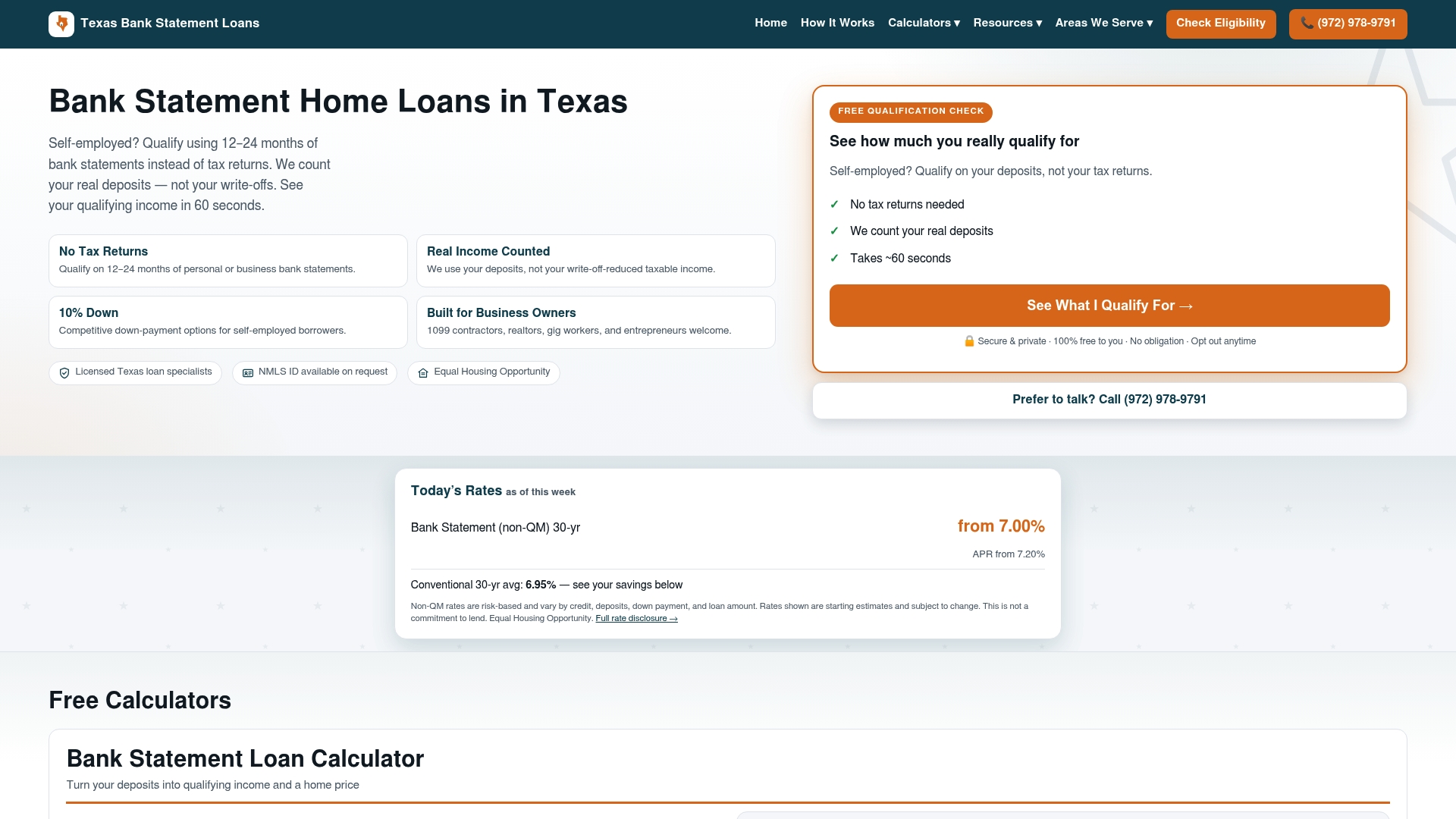
Down payment options start at 10% for primary residences, and the qualification check takes about 60 seconds. Whether you are buying in Houston, San Antonio, McKinney, or anywhere else in Texas, the process starts with a straightforward review of your deposit history rather than a dissection of your Schedule C. Use the self-employed affordability calculator to model your qualifying income before you talk to a loan officer, then reach out to start your prequalification.
This article is general information, not professional mortgage or tax advice. Confirm current program guidelines and eligibility requirements with a licensed mortgage professional and a qualified CPA for your specific situation.
Useful sources
- Consumer Financial Protection Bureau, Ability-to-Repay and Qualified Mortgage Rule
- Freddie Mac Bulletin 2024-10, Self-Employed Income Guidance (via Chestnut Mortgage)
- IRS Form 4506-C, Income Transcript Request Process
- Rocket Mortgage, Self-Employed Mortgage Requirements
- Zillow, How Long Does It Take to Buy a House?
- LegalClarity, 1099 Income for Mortgage: Documentation and Verification
- Amortio, Bank Statement Mortgage: Qualify Without Traditional Income Proof
- Wells Fargo, Mortgage Guidance for Self-Employed Borrowers
- SoFi, Bank Statement Mortgage Guide
- Truss Financial Group, How to Get a Mortgage as a 1099 Contractor
- The Mortgage Reports, Self-Employed Mortgage Loan Requirements
See what you qualify for in 60 seconds, free and no credit check. Use the eligibility check at the top of this page.