
These loans are non-QM products, meaning lenders set their own guidelines rather than following Fannie Mae or FHA rules. Expect a rate premium above conventional 30-year fixed mortgage rates, depending on your credit profile and down payment. The tradeoff is access: your tax returns stay out of the picture entirely.
Three qualifiers matter most up front:
- Credit score: 620 minimum to qualify; 700+ unlocks meaningfully better pricing
- DTI: most lenders cap at 45%-50%; 45% is a common working target
- Down payment: 10% for a primary residence; 20% typically required for investment properties
Use the bank-statement loan calculator to estimate your rate and monthly payment in about 60 seconds before you gather a single document.
Pro Tip: Run the calculator with both your personal and business account deposits separately. The qualifying income often differs significantly between the two, and knowing which account produces the stronger number before you apply can change your strategy entirely.
Key Takeaways
| Point | Details |
|---|---|
| Rate premium is real but manageable | Bank-statement loans typically price 0.5%-1.5% above conventional 30-year fixed rates due to non-QM classification. |
| Credit score drives pricing more than anything | Crossing 700 unlocks materially better rates; 620 qualifies but at higher cost. |
| Expense factor changes everything | Business deposits discounted at 50% can cut qualifying income in half; a CPA letter can reduce that factor significantly. |
| Sample affordability at 45% DTI | $6,875 monthly deposits minus $800 debt produces a maximum housing payment of about $2,295. |
| Texasbankstatementloans | Reviews 12-24 months of deposits, offers 10% down options, and provides a 60-second prequalification check for Texas borrowers. |
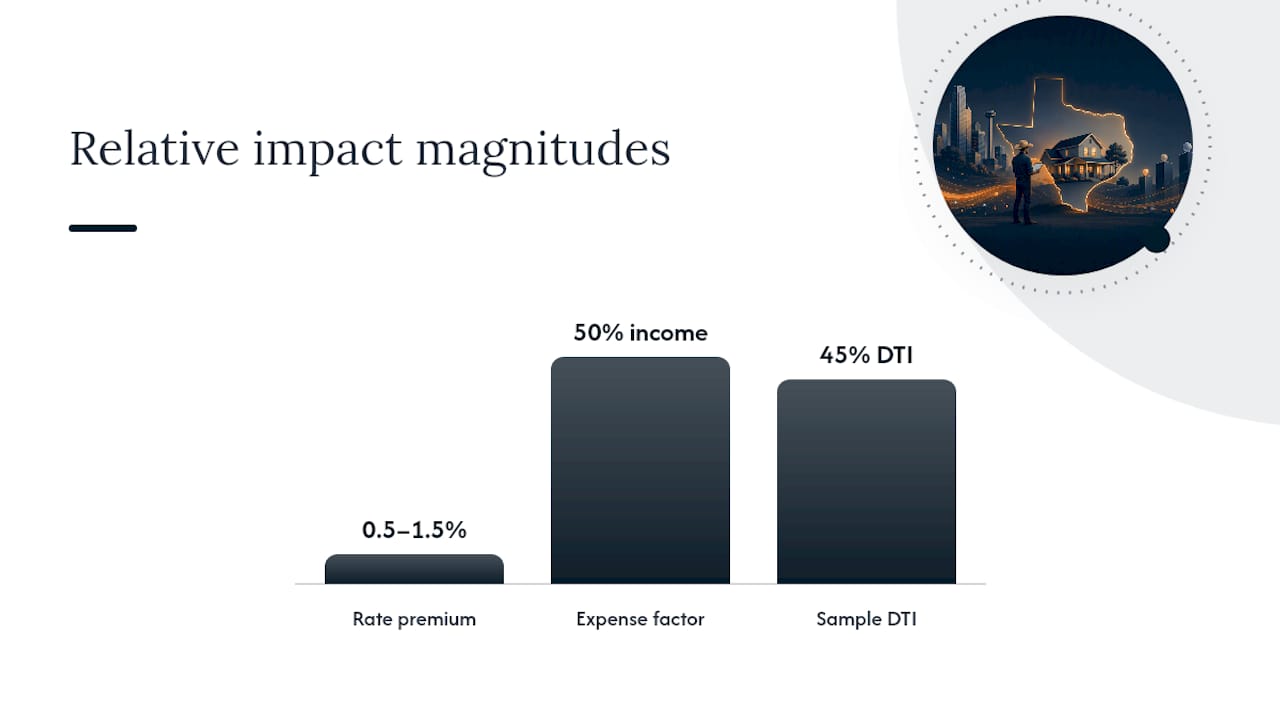
Table of Contents
- What sets your 30-year fixed bank-statement rate?
- Are you eligible? The qualification checklist
- How much house can you actually afford?
- How to lower your rate and strengthen your approval
- How to apply in Texas with Texasbankstatementloans
- What Texas borrowers should know about USDA loan limits and eligibility
- Current 30-year fixed rates and recent trends
- How bank-statement loan rates compare to FHA and VA loans
- USDA income limits and area eligibility in Texas
- How USDA loan guarantees affect rates and qualification
- From prequalification to closing: the typical timeline
- What self-employed borrowers often get wrong about bank-statement loans
- Texasbankstatementloans: your next step toward prequalification
- Sources
What sets your 30-year fixed bank-statement rate?
Bank-statement loans are non-QM products that often price higher than conventional loans, and can carry higher upfront fees. The rate you receive reflects several factors lenders weigh simultaneously:
- Credit score band: Moving from 640 to 700 can drop your rate by a meaningful margin. Scores of 720+ typically unlock the best pricing and highest loan-to-value options.
- Down payment and LTV: A 20% down payment versus 10% usually produces a noticeably lower rate because it reduces lender risk.
- Deposit type: Personal account deposits are counted at full value. Business deposits are discounted by an expense factor, often 50% by default, which cuts qualifying income in half before DTI is calculated.
- Expense factor and CPA letter: A CPA letter documenting actual business expenses can reduce that default 50% factor, sometimes to 30%-40%, which raises qualifying income and can improve your rate tier.
- Loan size: Jumbo loan amounts above conforming limits carry additional pricing adjustments.
- Cash reserves: Lenders want to see 6-12 months of mortgage payments sitting in reserve after closing. Thin reserves push rates up.
- Property type: Primary residence pricing is better than investment property pricing.
The single fastest lever most borrowers can pull is credit score. Crossing from the 660s into the 700s before you apply often saves more money over 30 years than any other preparation step.
Pro Tip: Ask your loan officer to run your file with both a 12-month and 24-month deposit window. If your income has grown recently, the 12-month average may be higher. If you had a slow quarter, the 24-month window smooths it out. The better number is the one you use.
Are you eligible? The qualification checklist
Lenders commonly use 12-24 months of bank statements and apply an expense factor to business deposits, with a CPA letter available to reduce that factor and increase qualifying income.
Documents to gather
- 12-24 months of personal and/or business bank statements (all pages, all accounts used)
- Profit and loss statement prepared or reviewed by a CPA
- Business license, LLC operating agreement, or K-1 as applicable
- Government-issued ID
- Proof of down payment source (seasoned funds, gift letter if applicable)
- Bank statements showing cash reserves after closing
- Written explanation for any large non-payroll deposits
Numeric minimums
| Factor | Minimum | Better Pricing Range |
|---|---|---|
| Credit score | 620 | 700+ |
| Down payment (primary) | 10% | 20%+ |
| DTI | Under 50% | Under 45% |
| Cash reserves | 3 months | 6-12 months |
Expense-ratio ranges on business deposits run 50%-85%, and a CPA letter documenting actual expenses can bring that ratio down, directly increasing the income a lender will count.
Key insight: A well-organized file closes faster and often prices better. Underwriters reward clarity. If every deposit in your statements ties back to your P&L, the review moves quickly. Unexplained transfers or irregular large deposits slow everything down and can trigger conditions that delay closing.
Pro Tip: Separate your business and personal accounts at least 12 months before applying if you haven’t already. Commingled funds force underwriters to make conservative assumptions about which deposits count as income.
How much house can you actually afford?
Here is the arithmetic a lender runs on a typical self-employed Texas borrower profile, drawn from Bankrate’s affordability guidance:
Borrower profile: $6,875 average monthly deposits, $800 monthly debt obligations

$6,875 × 0.45 = $3,094
Step 2, Subtract existing monthly debts: $3,094 − $800 = $2,294 maximum housing payment
That $2,294-$2,295 figure covers principal, interest, taxes, and insurance (PITI). The actual loan amount it supports depends on your rate.
What changes if you use business deposits?
- Qualifying income drops to $3,438 per month
- Maximum total debt at 45% DTI: $1,547
- Subtract $800 existing debt: $747 maximum housing payment
That is a dramatic difference. Use the DTI calculator to model your own numbers with different expense factors.
Pro Tip: If your business account deposits are your primary income source, getting a CPA letter before you apply is not optional. It can more than double your qualifying income in some scenarios.
How to lower your rate and strengthen your approval
Prioritized by impact:
- Raise your credit score first. Pay down revolving balances below 30% utilization. Dispute any errors on your Experian, Equifax, or TransUnion reports. Even a 20-point improvement from 680 to 700 can move you into a better pricing tier.
- Increase your down payment. Going from 10% to 15% or 20% reduces lender risk and typically produces a lower rate. Document the source of any additional funds at least 60 days before application.
- Build reserves. Lenders want to see 6-12 months of mortgage payments in liquid accounts after closing. Reserves above the minimum often allow underwriters to approve files they might otherwise condition heavily.
- Use the 24-month window strategically. If your income is seasonal or has grown, compare your 12-month and 24-month averages. Use whichever produces the higher qualifying income.
- Get a CPA letter. For business account deposits, this is the highest-leverage document you can produce. It can reduce your expense factor and materially raise the income a lender will count.
- Avoid large unexplained deposits in the 60-90 days before application. Transfers between your own accounts are fine if documented, but unexplained cash deposits trigger sourcing requirements that slow underwriting.
On timing: Ask your loan officer about rate lock options once you are under contract. Floating a rate in a volatile market carries real risk. A 30-day lock costs less than a 60-day lock, so having your documents ready before you go under contract can save money on the lock itself.
How to apply in Texas with Texasbankstatementloans
The application process for a bank-statement loan in Texas follows a clear sequence:
- Quick prequalification (~60 seconds): Use the self-employed affordability calculator or the online prequal form to get an initial read on your qualifying income and estimated payment.
- Document upload: Gather 12-24 months of bank statements, your P&L, business license, ID, and proof of reserves. Upload or submit to your loan officer.
- Underwriting review: The underwriter calculates your average monthly deposits, applies the appropriate expense factor, confirms DTI, and reviews the deposit history for consistency and sourcing.
- Conditional approval: Most conditions involve sourcing specific deposits, providing updated statements, or confirming reserves. Respond quickly to keep the timeline moving.
- Appraisal and closing: Texas bank-statement loan closings typically run 21-30 days for well-documented files.
Texasbankstatementloans reviews 12-24 months of deposits instead of tax returns, offers down payment options starting at 10% for qualified borrowers, and connects you with mortgage officers who specialize in self-employed Texas files. The Houston-area page covers regional timelines and local contacts if you are buying in the Houston market.
Pro Tip: Have your 12-24 months of bank statements and a CPA-prepared P&L ready before your first call. Loan officers can give you a much more accurate rate and payment estimate when they can see your actual deposit history rather than working from estimates.
What Texas borrowers should know about USDA loan limits and eligibility
The term “USDA rates 30-year fixed” appears frequently in mortgage searches, and it is worth clarifying the distinction. The USDA Single Family Housing Guaranteed Loan Program is a government-backed program administered by the U.S. Department of Agriculture for rural and some suburban areas. It is a separate product from the bank-statement loan described throughout this article.
USDA guaranteed loans in Texas do not set a hard loan limit the way FHA does. Instead, the maximum loan amount is determined by the borrower’s repayment ability and the area’s median income limits. For 2026, USDA income limits for the guaranteed program in most Texas counties sit around $112,450 for households of 1-4 people, though limits vary by county and household size. The USDA’s eligibility map defines which Texas properties qualify; many suburban areas around San Antonio, Lubbock, and East Texas communities fall within eligible zones, while major metro cores like downtown Dallas or Houston do not.
USDA loans require the property to be the borrower’s primary residence, and the borrower must meet income limits. They do not require a down payment, which is their primary appeal.
Current 30-year fixed rates and recent trends
Conventional 30-year fixed mortgage rates have moved in a range influenced by Federal Reserve policy, inflation data, and Treasury yields. Check current bank-statement loan rates directly, as rates shift with market conditions and individual file strength.
The rate environment in 2025-2026 has remained elevated compared to the historic lows of 2020-2021. The practical implication is that down payment size and credit score optimization matter more now than they did when rates were low enough to absorb pricing inefficiencies.
How bank-statement loan rates compare to FHA and VA loans
FHA and VA loans are government-backed QM products with standardized underwriting. Bank-statement loans are non-QM. The comparison matters because the rate premium on a bank-statement loan is the price of flexible income documentation.
If your tax returns show low net income due to business deductions, FHA qualification becomes difficult regardless of your actual cash flow.
VA loans offer the most competitive rates available for eligible veterans, with no down payment required and no mortgage insurance. They also require documented income, typically via tax returns.
Bank-statement loans sit above both in rate but below both in documentation requirements. For a self-employed borrower whose tax returns understate actual income, the rate premium is often the cost of getting approved at all.
USDA income limits and area eligibility in Texas
In practice, this means a household in a lower-cost Texas county may qualify with income up to $112,450 (1-4 person household) or higher for larger households, while high-cost suburban counties carry higher limits.
The USDA’s online eligibility map is the definitive tool for checking whether a specific Texas address qualifies. Properties in cities with populations above roughly 35,000 are generally ineligible, though boundary lines shift with each census update. Small towns, rural communities, and outer suburban rings around Texas metros frequently qualify.
USDA loans are not bank-statement loans. If you are self-employed and interested in a USDA-eligible property, you would still need to document income through tax returns under the standard USDA guaranteed program guidelines.
How USDA loan guarantees affect rates and qualification
That guarantee functions similarly to mortgage insurance: it reduces lender risk, which allows lenders to offer rates competitive with FHA and sometimes conventional loans, even with no down payment.
The annual fee is added to the monthly payment. Because the guarantee reduces lender exposure, USDA rates tend to be among the most competitive government-backed options available, often pricing below FHA on a comparable file.
For self-employed borrowers, the documentation requirements remain the sticking point. The USDA guaranteed program requires standard income verification, which means tax returns remain in play.
From prequalification to closing: the typical timeline
For a bank-statement loan in Texas, the process from first contact to closing typically runs 21-45 days depending on file complexity and how quickly the borrower provides documents.
- Days 1-3: Prequalification, initial document request, rate discussion
- Days 4-10: Document submission, initial underwriting review, appraisal order
- Days 11-20: Underwriting conditions issued and resolved, appraisal completed
- Days 21-30: Clear to close issued, closing disclosure sent, final walkthrough
- Days 30-45: Closing and funding (complex files or title issues extend this window)
Well-documented files close faster. The most common delay is sourcing large deposits or waiting on a CPA-prepared P&L. Having both ready before you start the process compresses the timeline significantly.
What self-employed borrowers often get wrong about bank-statement loans
The conventional wisdom says bank-statement loans are a last resort for borrowers who cannot qualify conventionally. That framing misses the point. For a business owner or 1099 contractor who legitimately earns $150,000 a year but shows $40,000 on a Schedule C after deductions, a conventional loan is not a near-miss. It is simply the wrong product.
The real question is not whether a bank-statement loan is “as good as” a conventional loan. It is whether it gets you into a home that matches your actual financial position. A modest rate premium over 30 years costs real money, but so does renting for another three years while you try to restructure your tax situation.
Where borrowers genuinely leave money on the table is in preparation. Most people apply with whatever documents they have rather than spending 60-90 days optimizing their credit score, building reserves, and getting a CPA letter. Those three steps alone can move a borrower from a higher-cost approval to a meaningfully better rate tier.
Texasbankstatementloans: your next step toward prequalification
Self-employed Texans who have been turned away by conventional lenders because their tax returns don’t reflect their real income have a direct path forward here. Texasbankstatementloans reviews 12-24 months of bank deposits in place of tax returns, with down payment options starting at 10% for qualified borrowers. The prequalification check takes about 60 seconds and carries no obligation.
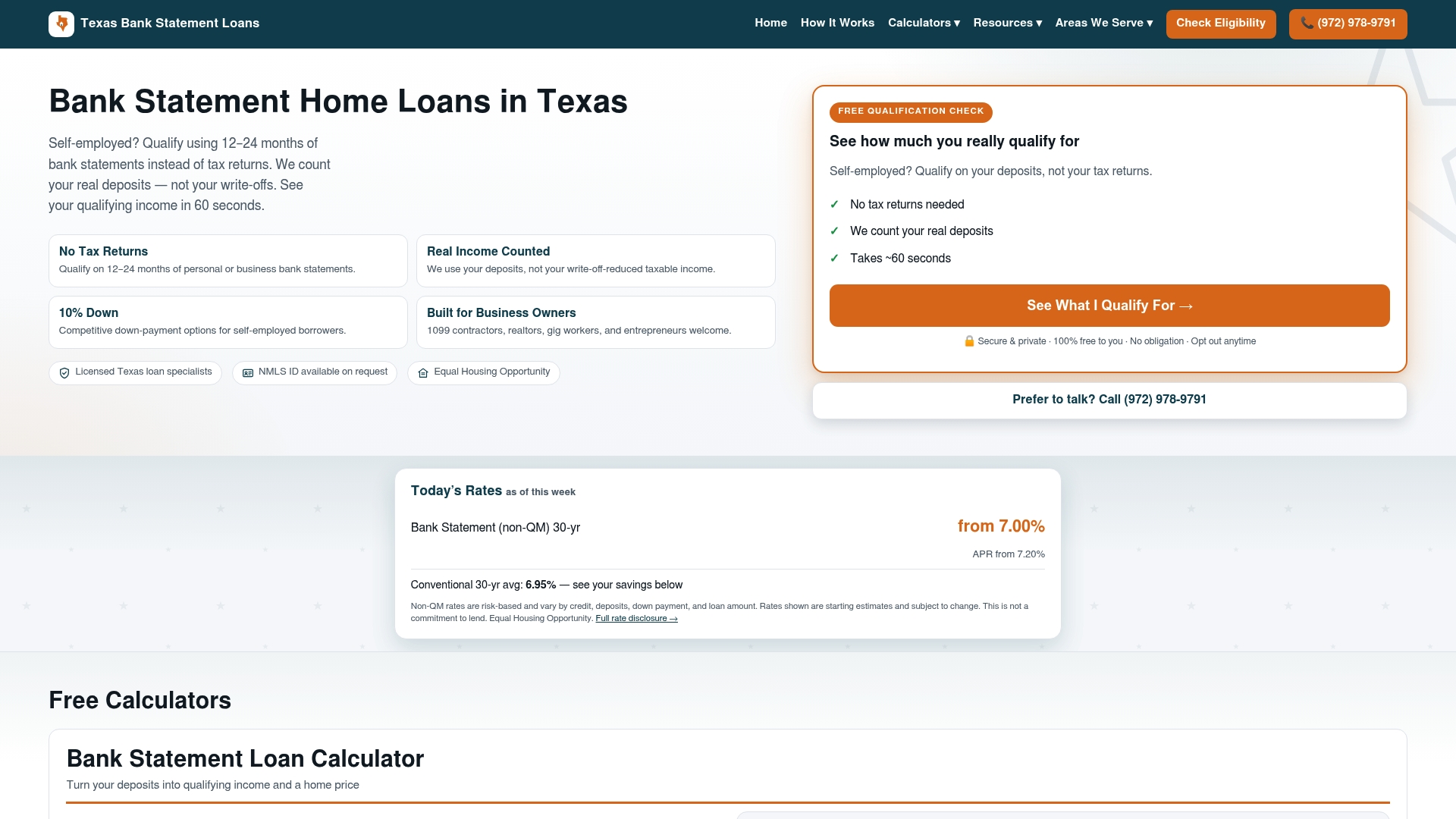
Loan officers at Texasbankstatementloans specialize in self-employed files across Texas, from Houston to Plano to Midland. They know how to structure a file using personal versus business deposits, when a CPA letter changes the qualifying income calculation, and how to move a well-documented application from prequal to closing in 21-30 days. Use the bank-statement loan calculator to run your numbers now, then start your no-obligation prequalification when you are ready to move forward.
Sources
Use these resources to verify the rules, run your own numbers, and start the prequalification process:
- Bank Statement Loan: What It Is And Who It’s For | Bankrate
- Bank Statement Loan: What It Is And Who It’s For | SoFi
This article is general information, not a substitute for advice from a qualified financial advisor. Consult a qualified financial professional about your own circumstances before acting on anything here.
Recommended
See what you qualify for in 60 seconds, free and no credit check. Use the eligibility check at the top of this page.