
Yes, self-employed first-time buyers in Texas can qualify for a mortgage, usually through one of three paths: tax-return-based conventional or FHA financing, bank-statement (Non-QM) loans, or a specialty program built around assets or business deposits. If your tax returns understate your real cash flow, bank-statement qualification often produces a higher approved income. The move right now: pull 12 to 24 months of bank statements and two years of tax returns, then get a Texas mortgage advisor to review the file.
TL;DR:
- Bank-statement loans often provide higher qualifying income for self-employed borrowers by averaging deposits over 12 to 24 months, especially when tax returns understate cash flow.
- While conventional and FHA loans require two years of tax returns with stable or growing income, bank-statement loans need only 12 to 24 months of deposits, making them suitable for those with inconsistent or minimized tax documents.
- Preparing a complete and organized file-including bank statements, tax returns, CPA letters, and reserves-significantly improves approval chances and shortens underwriting delays.
- Underwriters interpret income differently depending on whether they use tax-return averaging or deposit-based methods, which can lead to wide variances in qualifying amounts.
- Working with an experienced Texas mortgage advisor familiar with self-employed and bank-statement underwriting can reduce approval time and help identify the most suitable loan program.
Table of Contents
- How Texas Lenders Calculate Self-Employed Income
- Loan Program Guide for Self-Employed First-Time Buyers in Texas
- What Documents Do Lenders Want, and How Is Income Calculated?
- Credit, Down Payment, DTI, and Reserves: The Real Numbers
- Building an Approval-Ready File: Your Step-by-Step Plan
- Why Underwriting Takes Longer, and How to Avoid Delays
- How a Texas Mortgage Advisor Helps You Qualify Faster
- What Bank-Statement Lending Really Changes for Texas Buyers
- Get a Quick Qualification Check Before You Apply
- Where to Verify the Rules and Check a Lender’s License
- Sources
How Texas Lenders Calculate Self-Employed Income
Every underwriting decision starts with one question: what income can the lender actually count? For self-employed borrowers, that number rarely matches what shows on a bank balance, and it depends entirely on which method the lender uses.
Traditional underwriting averages your net income across two years of tax returns, then adds back certain non-cash deductions, like depreciation, depletion, and one-time business losses, to reconstruct a more realistic cash-flow figure. This is why an accountant who works hard to minimize your tax bill can accidentally sabotage your mortgage file; the same deductions that saved you money in April can shrink your qualifying income in July.
Bank-statement programs skip tax returns almost entirely. Lenders average your deposits over a recent stretch of months, then apply an expense factor to estimate what portion of those deposits counts as real income. Twelve-month reviews tend to fit newer or seasonal businesses; 24-month reviews usually produce steadier averages and can offset a slow quarter with a strong one, an approach several Texas mortgage guides describe in detail.
A few scenarios that change the math:
- Borrowers with less than two years of self-employment but a related W-2 history in the same field may still qualify under some conventional guidelines.
- Business owners with multiple bank accounts (personal and business) often need both reviewed together to capture the full income picture.
- Seasonal or gig-based earners sometimes get a stronger result from 24-month averaging than a single strong tax year would suggest.
Loan Program Guide for Self-Employed First-Time Buyers in Texas
Which program fits depends less on your income level and more on how well-documented that income is on paper.
Conventional and agency loans offer the best rates available to self-employed borrowers, but they demand two full years of tax returns and stable or growing income trends. If your returns are clean and your accountant hasn’t minimized your taxable income into the ground, this is usually the cheapest route.
FHA loans allow lower down payments and more flexible credit profiles, and they’re often more forgiving of thinner credit files or a shorter self-employment history. Documentation still leans on tax returns, though FHA underwriters have more room to consider compensating factors than conventional guidelines allow.
Bank-statement (Non-QM) loans, the specialty here at Texasbankstatementloans, qualify you off 12 to 24 months of deposits instead of tax returns. For a borrower whose tax returns don’t reflect true cash flow, the trade-off is usually worth it.
Other specialty options worth knowing: asset-depletion loans (qualify using savings or investments rather than income), DSCR loans (for investment property purchases, based on rental income rather than personal income), and ITIN loans (for borrowers without a Social Security number).
Pro Tip: Run the numbers both ways before you commit to a program. A quick side-by-side of tax-return income versus bank-statement income often reveals which path actually qualifies you for more house.
What Documents Do Lenders Want, and How Is Income Calculated?
Self-employed files live or die on paperwork. Before you contact a lender, assemble:
- Two years of personal and business tax returns
- Twelve to 24 months of personal and business bank statements
- Year-to-date profit and loss statement
- CPA or tax preparer letter confirming self-employment and business structure
- Business license or registration documents
- 1099s, if applicable
- Asset and investment account statements
- Government-issued ID
- Proof of reserves (typically two to six months of housing payments in liquid savings)
Here are two quick examples showing why the numbers can look so different depending on method.
Example 1, tax-return averaging: A freelance designer reports $95,000 in gross revenue but claims $40,000 in deductions, landing net taxable income around $55,000. Averaged over two years, that becomes the qualifying figure, roughly $4,583 a month before add-backs.
Example 2, bank-statement averaging: That same designer deposits an average of $8,000 a month into her business account. Applying a 50% expense factor, her qualifying income becomes $4,000 a month, close to the tax-return number in this case, but for borrowers with heavier write-offs, the gap runs much wider.

A CPA letter should be short: your name, business name, entity type, ownership percentage, and years in operation, on letterhead, signed and dated.
Credit, Down Payment, DTI, and Reserves: The Real Numbers
Numbers matter more than intentions here. Here’s what most Texas lenders are actually looking at:
- Credit score: FHA programs can open up around 580 to 620; conventional loans typically want 620 or higher; bank-statement programs often start near 600 to 640 depending on the lender.
- Down payment: Bank-statement loans commonly start at 10%; FHA can go as low as 3.5%; conventional loans often require 5% to 20% depending on credit and program.
- Debt-to-income ratio: Conventional and FHA guidelines usually cap DTI around 43% to 50%; Non-QM programs frequently accept higher ratios, sometimes into the mid-50s, because the underwriting model weighs cash flow differently.
- Reserves: Expect lenders to ask for two to six months of housing payments held in liquid, verifiable accounts. Self-employed files often draw the higher end of that range since income can look less predictable on paper.
Your credit report and score directly shape which of these programs is even on the table, so pull your reports and dispute any errors before you apply. Texas also has state and local first-time buyer assistance programs, such as those run through TSAHC and TDHCA, that can help with down payment costs, though eligibility rules vary by program and county, so confirm details before assuming you qualify.
Building an Approval-Ready File: Your Step-by-Step Plan
Approval odds come down to preparation more than luck. Here’s the order that actually works:
- Immediately: Pull your last 12 to 24 months of bank statements, gather two years of tax returns, draft a current P&L, and separate personal from business spending if you haven’t already.
- This week: Check your credit reports for errors and dispute anything inaccurate before applying.
- This month: Stabilize your deposit patterns. Avoid large, unexplained transfers between accounts; underwriters flag anything that looks like a borrowed down payment.
- Before applying: Request your CPA letter, confirm you have adequate reserves, and resolve any red flags, like recent late payments or a maxed-out business credit line.
- At application: Expect pre-approval within a few days once documents are complete, followed by underwriting.
Pro Tip: Open a dedicated business account if you haven’t already. Commingled personal and business deposits are one of the most common reasons bank-statement files get delayed for extra documentation.
Why Underwriting Takes Longer, and How to Avoid Delays
Self-employed underwriting almost always takes longer than a W-2 file, mainly because income requires interpretation rather than a simple pay stub check. Add-backs need justification. Deposits need explanation. A single large or unusual transaction can trigger a written explanation letter that adds days to the timeline.
The most common slowdowns:
- Bank statements that don’t match the account numbers or names on tax returns
- Missing months in a statement sequence
- Business and personal funds mixed in the same account
- Slow responses to underwriter follow-up requests
Keeping a folder of every document ready to send, and answering underwriter questions within 24 hours, keeps a file moving instead of stalling in a queue behind faster-responding borrowers.
How a Texas Mortgage Advisor Helps You Qualify Faster
A broker who works self-employed files daily knows which lenders favor 12-month averaging, which ones are lenient on DTI, and which underwriters actually understand a Schedule C. That matching alone often saves weeks.
Before you commit to anyone, verify their standing:
- Look up their license on NMLS Consumer Access, the same tool regulators use to confirm active status.
- Check public profiles like BBB business listings for complaint history.
- Ask directly how many self-employed or bank-statement files they’ve closed in the past year.
- Ask what their typical turnaround time looks like from application to closing.
Texasbankstatementloans reviews files against 12 to 24 months of bank deposits rather than tax-return averages, and its quick qualification check gives a realistic affordability estimate in about 60 seconds, before you commit to a full application.
What Bank-Statement Lending Really Changes for Texas Buyers
The biggest misconception in self-employed lending is that a low tax-return income means a low mortgage budget. It doesn’t. It means the tax return is the wrong document to judge affordability by. Bank-statement underwriting exists because deposits tell a more honest story about what a contractor, freelancer, or small business owner actually earns, and that gap between deposits and taxable income is often where first-time buyers get talked out of homeownership by lenders who only know one underwriting model.
What we see work best isn’t the borrower with the highest income. It’s the one who gets organized early, separates business and personal accounts months before applying, and treats the loan officer conversation as a strategy session rather than a formality. That preparation, more than credit score or income size, is usually what separates an approved file from a stalled one.
- Saad
Get a Quick Qualification Check Before You Apply
Texasbankstatementloans is built specifically for the borrower this article just described: someone whose tax returns don’t tell the full income story.
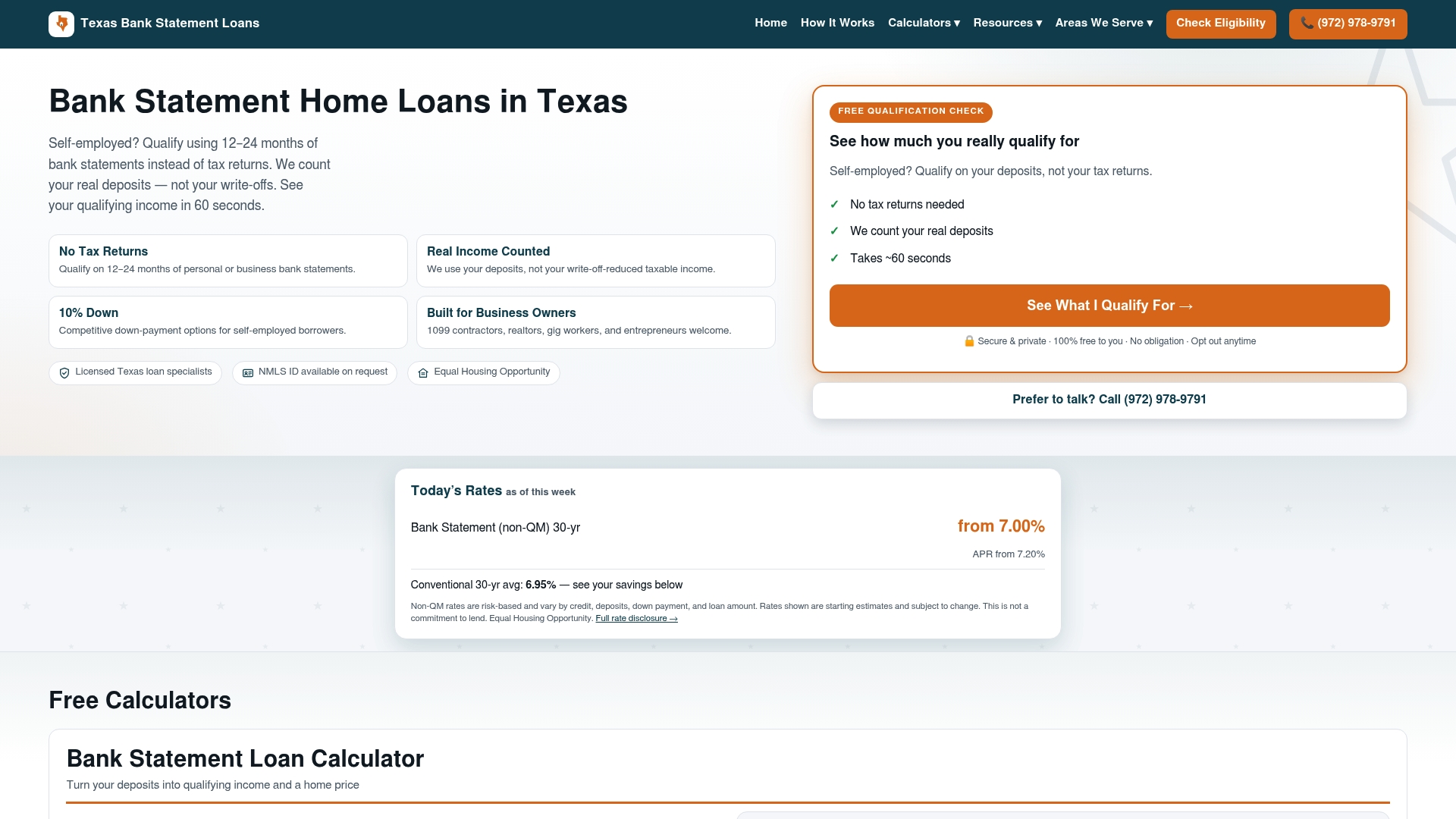
Have your last year of bank statements handy, and you can run the free, no-obligation qualification check in about 60 seconds to see a realistic price range before you talk to anyone. From there, use the mortgage calculators and tools to model different down payment and rate scenarios, or start directly on the bank statement loan program page to see what documents your file will need. Current rate ranges are published for reference before you apply.
Where to Verify the Rules and Check a Lender’s License
Confirm program details directly through the CFPB’s homebuying guidance, TREC’s consumer protection notice, and NMLS Consumer Access before signing anything.

This article is general information, not a substitute for advice from a qualified financial advisor. Consult a qualified financial professional about your own circumstances before acting on anything here.
Sources
- Consumer Financial Protection Bureau, Credit reports and scores
- Texas Real Estate Commission, Consumer protection notice
- NMLS Consumer Access
Recommended
- Bank Statement Loans for Self-Employed Buyers
- Bank Statement Loans in Austin, TX | Self-Employed Mortgage
- Bank Statement Loans in Tyler, TX | Self-Employed Mortgage
- Bank Statement Loans in Midland, TX | Self-Employed Mortgage
See what you qualify for in 60 seconds, free and no credit check. Use the eligibility check at the top of this page.