
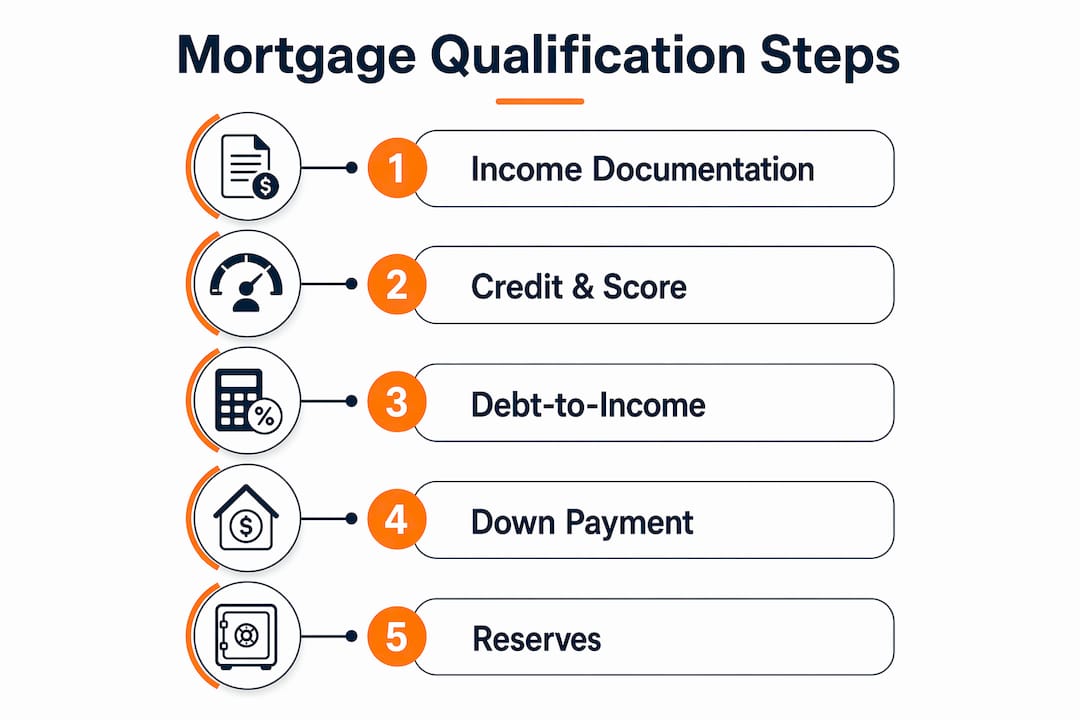
Mortgage qualification criteria are the documented standards lenders use to evaluate income, credit, debt load, and down payment before approving a home loan. For realtors and self-employed borrowers, these standards are the same as for any buyer, but the path to meeting them is harder. Four core areas drive every approval decision: credit history, income and employment history, debt-to-income ratio, and down payment with reserves. The realtor mortgage qualification criteria explained in this article follow the 2026 underwriting frameworks from Fannie Mae and FHA, so you get current, accurate guidance rather than outdated rules.
What income documentation do realtors and self-employed borrowers need?
Income documentation is the single biggest obstacle for realtors applying for a mortgage. Most realtors operate as independent contractors or sole proprietors, which puts them in the self-employed category under lender guidelines. That classification triggers a stricter documentation process than a W-2 employee faces.
FHA loans require at least two years of self-employment income documentation before a borrower qualifies. That two-year window exists because lenders need to see that your income is stable, not just a single good year. A conventional loan under Fannie Mae guidelines follows the same general principle.
What lenders actually analyze
The most common misconception among self-employed borrowers is that gross bank deposits equal qualifying income. Lenders do not use gross deposits. Underwriters focus on documented, stable, averaged income from tax returns over two years. If your Schedule C shows $120,000 in year one and $90,000 in year two, the lender averages those figures and may apply further adjustments for business expenses, depreciation, and depletion.
For realtors, this creates a specific problem. Commission income fluctuates by market cycle, transaction volume, and deal timing. A strong fourth quarter does not offset a slow first half in the lender’s calculation. The lender looks at the two-year average and applies it as your monthly qualifying income.
Traditional W-2 employees provide a pay stub and a W-2 form. Realtors typically need to provide:
- Two years of personal federal tax returns, including all schedules
- Two years of business tax returns if operating as an LLC or S-corp
- A year-to-date profit and loss statement, often prepared by a CPA
- Proof of active licensure and business existence for at least two years
- Bank statements showing consistent deposit patterns
Pro Tip: Organize your tax documents and profit and loss statements before you contact a lender. Gaps in paperwork are the leading cause of underwriting delays for self-employed borrowers.
How do credit scores and DTI ratios affect mortgage eligibility?
Credit score and debt-to-income ratio work together in every underwriting decision. A strong credit score does not override a high DTI, and a low DTI does not compensate for a poor credit history. Lenders review both simultaneously alongside collateral metrics like loan-to-value ratio.
Credit score thresholds
Conventional loans typically require a minimum credit score of around 620. Government-backed programs like FHA allow lower scores, but the trade-off is higher mortgage insurance costs. A score above 740 generally earns the best interest rates and eliminates the need for private mortgage insurance on conventional loans once you reach sufficient equity.
Credit score also affects your PMI rate directly. Borrowers with scores in the 620-659 range pay significantly more in PMI premiums than borrowers above 760. That difference compounds over the life of a loan and adds thousands of dollars in total cost.
Debt-to-income ratio limits
DTI is the percentage of your gross monthly income consumed by monthly debt payments. Lenders calculate it by adding your proposed mortgage payment, including principal, interest, taxes, and insurance (PITI), to all recurring monthly debts like car loans, student loans, and credit card minimums.
FHA sets a maximum DTI of 43% for most borrowers. That ceiling means your total monthly debt obligations cannot exceed 43% of your gross monthly income. Conventional loans under Fannie Mae guidelines can allow higher DTIs in some cases, but only when compensating factors like strong reserves or a high credit score are present.
Strategies to improve your DTI before applying include:
- Paying down revolving credit card balances to reduce minimum monthly payments
- Avoiding new auto loans or large credit purchases in the 12 months before applying
- Increasing documented income by reducing business deductions in the year before applying
- Using a DTI calculator to model different scenarios before you approach a lender
What LTV, down payment, and reserve requirements apply?
Loan-to-value ratio, or LTV, measures how much you are borrowing relative to the home’s appraised value. If you buy a $400,000 home with $40,000 down, your LTV is 90%. Lenders also calculate combined LTV (CLTV), which includes all liens on the property, and home equity combined LTV (HCLTV), which factors in home equity lines of credit.
Fannie Mae’s Eligibility Matrix specifies maximum LTV, CLTV, and HCLTV thresholds for every conventional loan scenario, tied directly to credit score and property type. Aligning your down payment with your credit score within those matrix thresholds is often the deciding factor in approval.
Down payment minimums by loan type
| Loan Program | Minimum Down Payment | Credit Score Requirement | Mortgage Insurance |
|---|---|---|---|
| FHA | 3.5% | 580+ | Required for loan life |
| FHA | 10% | 500-579 | Required for loan life |
| Conventional (Fannie Mae) | 3% | 620+ | Required until 20% equity |
| Conventional standard | 20% | 620+ | Not required |
FHA requires a 3.5% minimum down payment for borrowers with a credit score of 580 or above. Borrowers with scores between 500 and 579 must put down 10%. Conventional loans allow as little as 3% down, but PMI applies until the LTV drops to 80%.
Reserve requirements
Reserves are liquid assets you keep after closing. Fannie Mae requires reserves for many loan scenarios, particularly investment properties and second homes. For a primary residence conventional loan, reserves may not be required, but having two to six months of mortgage payments in savings strengthens your application significantly.
Pro Tip: Keep your down payment funds in a single, traceable account for at least 60 days before applying. Lenders require a paper trail, and large unexplained deposits trigger underwriting questions that slow approval.
How do lenders evaluate commission-based income for realtors?
Realtors face a specific underwriting challenge that salaried buyers do not. Commission income is inherently variable, and lenders treat variability as risk. The underwriting process for a realtor is not harder by design. It is harder because the income structure requires more documentation to prove stability.

Established realtors with consistent transaction volume over two years have an easier path to qualification because their commission history demonstrates reliable earnings. A realtor who closed $2,000,000 in transactions across both years presents a cleaner income picture than one with a single breakout year.
Lenders commonly request the following from realtors beyond standard self-employment documentation:
- Commission statements or 1099 forms from brokerages for the past two years
- A letter from the employing broker confirming active status and typical earnings
- Executed purchase contracts or closing disclosures to verify transaction history
- Business bank statements showing regular commission deposits
Fluctuating income creates a specific DTI problem. If your income averaged $8,000 per month over two years but you earned $14,000 last month, the lender uses the $8,000 figure. That lower number shrinks your qualifying loan amount. The solution is to document income consistently over time, not to rely on recent strong months.
Mortgage eligibility criteria are updated regularly, and the 2026 Fannie Mae guidelines reflect current underwriting standards. Reviewing the current eligibility matrix before you apply prevents surprises during underwriting. Use a self-employed affordability calculator to estimate your qualifying range before you start the formal process.
Key Takeaways
Self-employed realtors qualify for mortgages by meeting documented income, credit, DTI, and down payment standards set by Fannie Mae and FHA, with income verification being the most complex hurdle.
| Point | Details |
|---|---|
| Income documentation | FHA and Fannie Mae require two years of documented, averaged self-employment income. |
| Credit score baseline | Conventional loans require 620+; higher scores reduce PMI costs and improve rates. |
| DTI ceiling | FHA caps total monthly debt obligations at 43% of gross monthly income. |
| Down payment and LTV | FHA allows 3.5% down at 580+ credit score; conventional allows 3% with PMI. |
| Reserve funds | Holding two to six months of payments in savings strengthens any loan application. |
What I’ve learned about qualifying self-employed realtors for mortgages
The biggest mistake I see self-employed realtors make is treating the mortgage process like a transaction they can close on charm and a strong recent quarter. Lenders do not care about your best month. They care about your documented average over 24 months.
The second mistake is assuming that a high credit score solves everything. Credit score alone does not determine approval. Lenders enforce DTI and LTV constraints regardless of your score. I have seen borrowers with 780 credit scores get denied because their DTI was too high after factoring in business debt.
The most underrated preparation step is working with a CPA who understands mortgage qualification, not just tax minimization. A CPA who aggressively reduces your taxable income saves you money on taxes but may cost you far more in mortgage purchasing power. Those two goals are in direct conflict, and most self-employed borrowers do not realize it until they are sitting in underwriting.
My advice is to start the mortgage process 12 to 18 months before you plan to buy. Use that window to review your two-year income average, reduce unnecessary debts, and keep your bank accounts clean. The borrowers who qualify smoothly are the ones who treated qualification as a process, not a single event.
- Saad
How Texasbankstatementloans helps self-employed realtors qualify
Self-employed realtors in Texas often cannot qualify through traditional channels because their tax returns understate their real income. Texasbankstatementloans was built specifically for that situation.
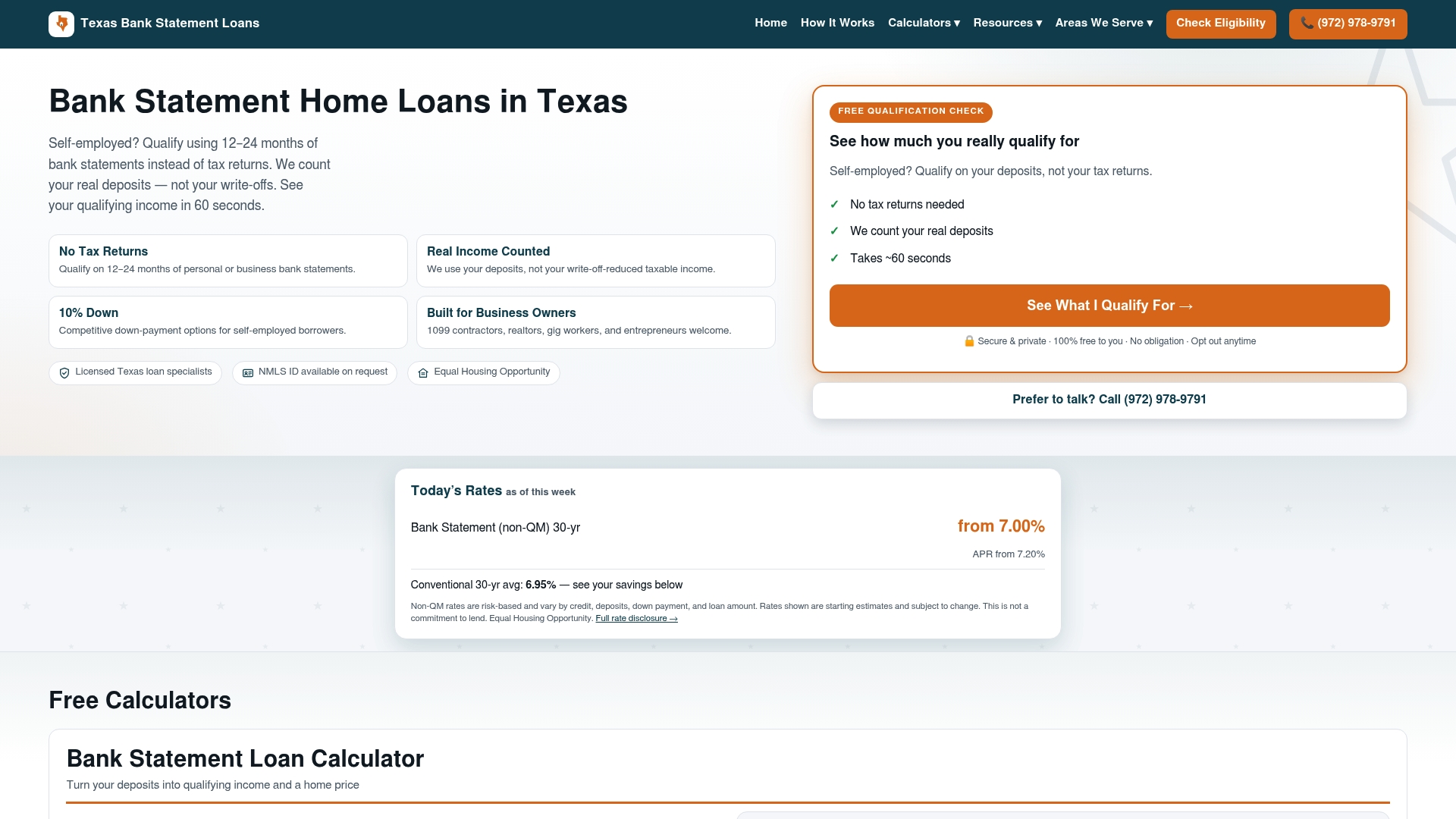
Instead of tax returns, Texasbankstatementloans evaluates 12-24 months of bank deposits to determine qualifying income. That means your actual cash flow counts, not the reduced figure your CPA reported. Down payment options start at 10%, and a no-obligation qualification check takes 60 seconds. Whether you are buying in Houston or San Antonio, Texasbankstatementloans offers a direct path to approval for borrowers with non-traditional income. Visit Texasbankstatementloans to see what you qualify for today.
FAQ
What is the minimum credit score to qualify for a mortgage as a realtor?
Conventional loans generally require a minimum credit score of 620. FHA loans allow scores as low as 500, though borrowers below 580 must put down at least 10%.
How many years of income do self-employed realtors need to show?
FHA and Fannie Mae both require at least two years of documented self-employment income. Lenders average those two years to calculate your monthly qualifying income.
What DTI ratio do lenders allow for mortgage qualification?
FHA sets a maximum DTI of 43%, including your mortgage PITI and all recurring monthly debts. Conventional loans may allow higher DTIs with strong compensating factors like reserves or a high credit score.
Can a realtor qualify for a mortgage using bank statements instead of tax returns?
Yes. Bank statement loan programs, like those offered by Texasbankstatementloans, use 12-24 months of bank deposits to verify income instead of tax returns. This approach works well for realtors whose tax returns underreport actual earnings.
What counts as reserves in a mortgage application?
Reserves are liquid assets remaining after your down payment and closing costs. Lenders typically want to see two to six months of mortgage payments in a verifiable account, and strong reserves can offset a higher DTI or lower credit score in some loan programs.
Recommended
See what you qualify for in 60 seconds, free and no credit check. Use the eligibility check at the top of this page.