
Yes. You can qualify for a residential mortgage using bank deposits instead of tax returns, provided you have 12 to 24 months of consistent statements to show it. Start by gathering those statements, requesting Loan Estimates from a few lenders, and preparing a reconciled profit and loss statement. Underwriters will study your deposit trends closely, so stability matters more than any single number.
TL;DR:
- Lenders typically require 12 to 24 months of bank statements and a reconciled profit and loss statement before qualifying for a bank-statement mortgage.
- Underwriters assess deposit stability and consistency, emphasizing regular trends over size, and they scrutinize large, irregular, or mixed funds deposits.
- Higher interest rates and potentially larger down payments are common for bank-statement loans compared to conventional mortgages, with pricing varying significantly between lenders.
- Comparing multiple loan estimates is essential, focusing on fees and lender credits, as the interest rate alone can be misleading and lead to substantial savings.
- Maintaining organized, separate accounts and providing clear deposit explanations significantly improves approval speed and reduces underwriting questions.
Table of Contents
- What a bank-statement mortgage is and how it differs from tax-return underwriting
- Who typically qualifies and common red flags
- Documents lenders will ask for
- How lenders turn deposits into qualifying income
- How to prepare your file and apply
- Timeline and what it costs to get to closing
- What to focus on when comparing Loan Estimates
- A one-page checklist before you apply
- How your credit score and history factor in
- How to improve your approval odds
- Risks and drawbacks worth weighing
- Interest rates and terms compared with conventional loans
- What loan officers see go wrong, and what goes right
- How Texas Bank Statement Home Loans can help
- FAQ
- Sources
What a bank-statement mortgage is and how it differs from tax-return underwriting
A bank-statement mortgage, sometimes called a cash-only business mortgage, qualifies you using deposits into your bank account rather than the net income shown on your tax returns. This matters if you write off a lot of business expenses: tax returns often understate what you actually bring in, while bank deposits show the real cash flow.
These loans fall under the non-QM (non-qualified mortgage) category, meaning they don’t meet the standard underwriting boxes that Fannie Mae and Freddie Mac loans do, though many non-QM lenders still borrow concepts from their guidance. One well-known version is Texas Bank Statement Home Loans, built specifically for self-employed borrowers using deposit history.
One clarification before you go further: this is about buying or refinancing the home you live in. It’s not about commercial property loans or business-purpose financing for investment real estate, which follow entirely different underwriting rules.
Who typically qualifies and common red flags
Sole proprietors, 1099 contractors, gig workers, and owners of cash-heavy businesses (contractors, salons, restaurants, trucking) tend to fit this program best, especially when their deposits show a steady or growing pattern month over month.
Underwriters get nervous about a few things: deposits that trend downward over the review period, personal and business funds mixed into one account, and large, unexplained lump sums that don’t match your regular income pattern. None of these automatically disqualify you, but each one adds a documentation step.
What underwriters want to see is consistency: similar deposit amounts landing on a similar schedule, with dips or spikes you can explain. A business account that’s been open for at least two years, with steady activity, tells a cleaner story than a brand-new account with erratic deposits.
Documents lenders will ask for
Before you apply, put together a file that answers questions before they’re asked. Lenders process bank-statement files faster when the paperwork arrives complete the first time.
- 12 to 24 months of personal or business bank statements, depending on the program and how your income flows.
- A signed, year-to-date profit and loss statement that a lender can reconcile against your actual deposits, consistent with Fannie Mae’s guidance on analyzing P&L statements.
- Government-issued ID and proof of funds for your down payment and reserves.
- Written explanations, invoices, or contracts for any large or irregular deposits.
Lenders are entitled to ask for more documentation after you submit your application, particularly around the source of large deposits or non-employment income, according to CFPB guidance on lender document requests. Having these answers ready before you’re asked shortens your underwriting timeline considerably.
How lenders turn deposits into qualifying income
Underwriters don’t just add up your deposits and call it income. They look for revenue trends over the statement period, since Fannie Mae’s self-employment guidance directs underwriters toward stability and continuity rather than a single high month.
When net or non-taxable income is used to qualify, some guidelines allow lenders to gross up that figure, multiplying it by 1.25 to estimate a gross equivalent, under rules like those in Freddie Mac’s servicing guidance, business expenses may be deducted from gross deposits before this calculation, depending on the lender’s methodology.

This is where your P&L earns its keep. A reconciled P&L that lines up with your bank deposits resolves most underwriter questions on the spot. A P&L that doesn’t match your statements triggers more questions, more document requests, and a slower path to closing.
How to prepare your file and apply
- Open or confirm a dedicated business checking account and route your income through it consistently.
- Reconcile the last 12 to 24 months of statements against a signed, year-to-date profit and loss statement.
- Flag and document any deposit that looks unusual: a client payment, an asset sale, a one-time transfer.
- Request Loan Estimates from several lenders, telling each one upfront that you’re qualifying through bank-statement income so the estimate reflects that program.
- Compare the Loan Estimates side by side before choosing a lender.
Pro Tip: Write a one-line explanation for every deposit over a few thousand dollars while the details are fresh. It’s faster than reconstructing the story months later when an underwriter asks.
Timeline and what it costs to get to closing
Your timeline depends mostly on how fast you can produce a clean document file. Gathering statements and a reconciled P&L takes a few days if your records are already organized; underwriting review and appraisal scheduling typically add the bulk of the wait.
Down payment requirements on bank-statement programs vary by lender, and some programs allow relatively low down payments. Comparing multiple Loan Estimates before locking in a lender can mean real savings over the life of the loan, since fees and rates both vary by lender even on the same program.
What to focus on when comparing Loan Estimates
Don’t compare lenders on interest rate alone. Look at origination charges, lender credits, and the total of lender-controlled fees on each Loan Estimate, since those are the numbers you can actually negotiate.
By law, a lender can only charge a small credit report fee before issuing a Loan Estimate; any other fee charged before that point isn’t permitted, according to CFPB rules on Loan Estimates. Getting Loan Estimates from multiple lenders has been shown to save homebuyers $600 to $1,200 a year, and showing one lender a competing offer often prompts them to match or beat it.
A one-page checklist before you apply
Keep this list next to your statements as you build your file:
- Bank statements covering the full 12 to 24 month window your lender requires.
- A signed, year-to-date P&L statement no older than 60 days.
- Proof of down payment funds and reserve assets.
- Written explanations for any deposit that stands out from your normal pattern.
The IRS recommends keeping a dedicated business checking account and reconciling it monthly, depositing receipts before paying expenses out of the same account. That habit, built before you ever apply for a mortgage, makes your deposits easy for an underwriter to read.
A service evaluates 12 to 24 months of bank deposits instead of tax returns and offers a free, no-obligation qualification check that takes about 60 seconds to complete.
How your credit score and history factor in
Your credit score still carries real weight in a bank-statement mortgage, even though your income is proven differently than on a conventional loan. Lenders use it to judge how you’ve handled debt historically, separate from how you earn.
A higher score typically opens access to better pricing and more lender options, while a lower score narrows your choices and can push your rate higher. Late payments, high credit card balances relative to your limits, and collections all weigh against you the same way they would on any mortgage application.
Because bank-statement programs already carry more income-verification flexibility than a conventional loan, many lenders lean more heavily on credit history to offset that. If your deposits are strong but your credit history is thin or recently blemished, expect a lender to ask more questions or adjust your terms. Paying down revolving balances and correcting any errors on your credit report before you apply are worth doing well ahead of submitting a file, since credit changes take time to show up and settle.
How to improve your approval odds
The borrowers who move through underwriting fastest are the ones who look organized from the first document they submit. A clean, reconciled file signals to a lender that the rest of the process will go smoothly too.
A few habits make the biggest difference. Keep your business and personal spending in separate accounts well before you apply, since mixed accounts are one of the most common sources of underwriter questions. Build a deposit pattern that’s consistent, even if it isn’t large, rather than letting income arrive in sporadic lump sums. Write down an explanation for any unusual deposit the same week it happens, while the paper trail (invoices, contracts, transfer receipts) is easy to produce.

Finally, shop more than one lender and tell each one clearly that you intend to qualify through bank statements. A lender experienced with this program will ask for the right documents upfront instead of discovering gaps halfway through underwriting, which keeps your timeline from stalling.
Risks and drawbacks worth weighing
Bank-statement mortgages solve a real problem for self-employed borrowers, but they come with trade-offs worth knowing before you commit. Rates on these programs tend to run higher than on a conventional, tax-return-based loan, since lenders are pricing in the extra flexibility they’re offering on income documentation.
Down payment requirements can also be higher than what a conventional buyer puts down, and the underwriting process itself leans heavily on your ability to explain every irregular deposit. A business with genuinely volatile income, where deposits swing widely from month to month, may find that swings work against them during underwriting even if the yearly total looks healthy. And because these are non-QM products, not every lender offers them, which narrows your shopping pool compared to a conventional purchase.
None of this makes the program a poor choice for the borrowers it’s built for. It does mean you should go in expecting a rate premium and a documentation-heavy process, not a shortcut around either.
Interest rates and terms compared with conventional loans
Bank-statement loans generally carry higher interest rates than conventional, tax-return-based mortgages, reflecting the added income-verification flexibility lenders extend. As one example of current program pricing, Texas Bank Statement Home Loans lists its Bank Statement (non-QM) 30-year product starting from 7.00% per year.
Loan terms on bank-statement products often mirror conventional structures, including 30-year fixed options, though the specific terms, points, and fees available depend on the lender and the strength of your file. Because these loans sit outside the standard Fannie Mae and Freddie Mac boxes, pricing varies more between lenders than it does on a conventional loan, which is exactly why comparing several Loan Estimates matters more here, not less.
What loan officers see go wrong, and what goes right
The borrowers who stumble usually mix personal and business spending in one account, or wait until an underwriter asks before explaining a large deposit. Both habits turn a one-week review into a month-long back and forth.
The ones who move fastest show up with reconciled statements and a signed P&L already in hand. Underwriters notice that immediately, and it buys goodwill for the rest of the file. If you’re not sure where you stand, a quick qualification check costs you nothing and tells you fast.
- Saad
How Texas Bank Statement Home Loans can help
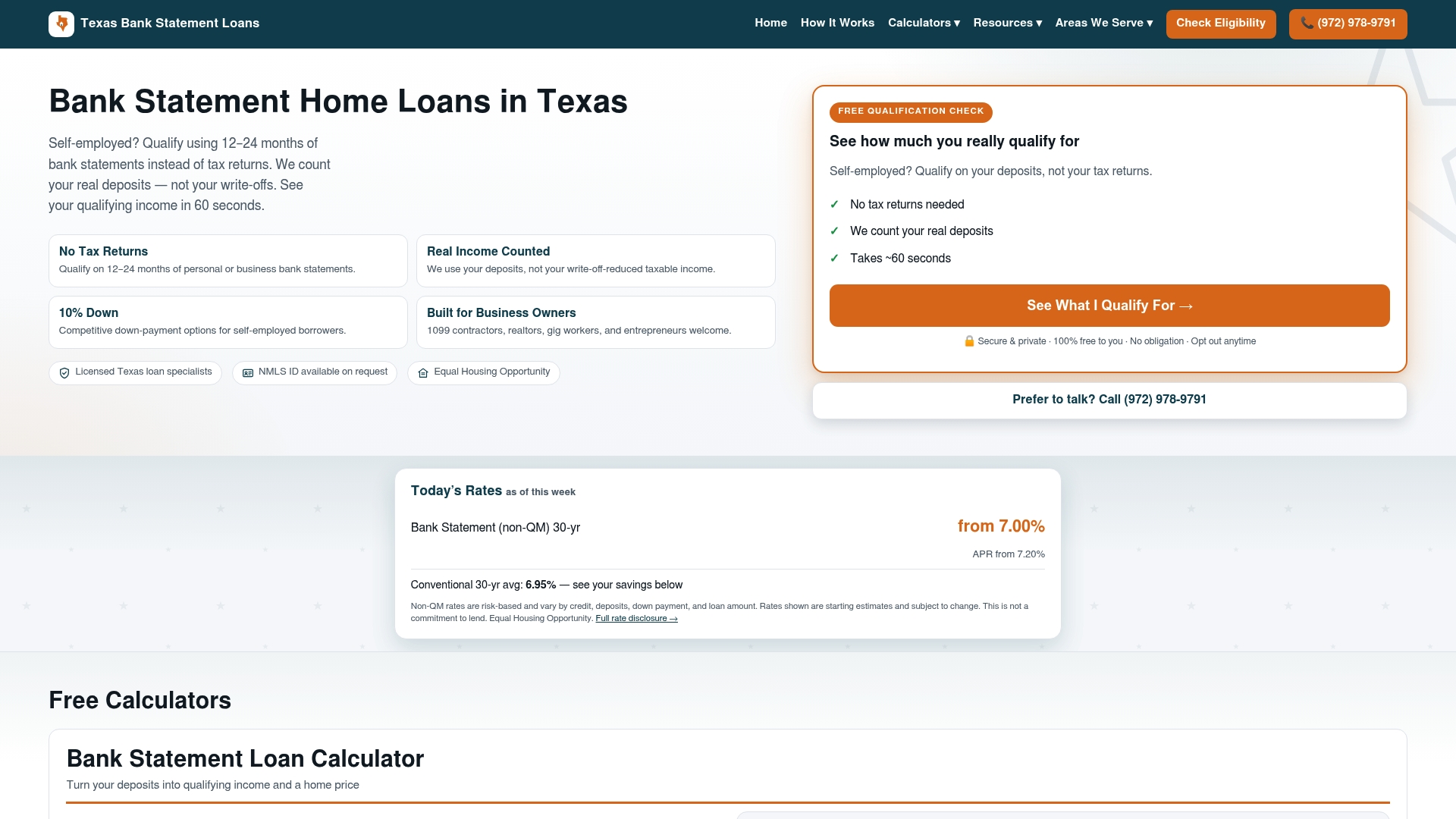
If you’re ready to move past research and see real numbers, Texas Bank Statement Home Loans evaluates 12 to 24 months of your bank deposits instead of tax returns, built specifically for self-employed borrowers, 1099 contractors, and gig workers whose income doesn’t fit a conventional file.
Check your Bank Statement Home Loans options, run the numbers on the bank statement loan calculator, or see current pricing on the Bank Statement (non-QM) 30-year program before you request your first Loan Estimate.
This article is general information, not a substitute for advice from a qualified financial advisor. Consult a qualified financial professional about your own circumstances before acting on anything here.
FAQ
What counts as a cash-only business mortgage?
It’s a residential mortgage that qualifies you using bank deposits, typically 12 to 24 months of statements, instead of tax returns. It’s aimed at self-employed borrowers, 1099 contractors, and business owners whose tax returns understate their actual cash flow.
How many months of bank statements do lenders need?
Most bank-statement programs ask for 12 to 24 months of statements, with the exact window set by the lender and loan product. A signed, year-to-date profit and loss statement is usually required alongside them, per Fannie Mae’s P&L guidance.
Do bank-statement mortgages require a bigger down payment?
Expect the exact requirement to depend on your credit, deposit consistency, and the specific loan product.
Why do lenders gross up net deposits?
When net or non-taxable income is used to qualify, some guidelines permit lenders to multiply that net figure by 1.25 to estimate an equivalent gross income, under rules like those in Freddie Mac’s servicing guidance. This accounts for the fact that net income typically understates true earning capacity compared with gross wages.
How many Loan Estimates should I get before choosing a lender?
Requesting Loan Estimates from several lenders lets you compare lender-controlled fees and rates side by side, and the CFPB notes this comparison can save homebuyers $600 to $1,200 a year. There’s no fixed number, but three is a common target that gives you enough to negotiate from.
Sources
- Publication 583: Starting a Business and Keeping Records (IRS)
- Freddie Mac servicing guidance (gross-up rules and bank-statement income guidance)
See what you qualify for in 60 seconds, free and no credit check. Use the eligibility check at the top of this page.