
Gig income qualifies for a mortgage when it is consistent, documented, and verifiable over at least two years. Lenders treat 1099 and freelance earnings as self-employed income, which means the qualification process differs from a standard W-2 application but is not harder to pass. The mortgage industry now recognizes that the gig economy accounts for 36% of the U.S. workforce, and lenders have responded by adopting alternative income verification methods. Understanding how gig income qualifies for a mortgage starts with knowing exactly what documents lenders need and which loan programs fit your income profile.
How gig income qualifies mortgage approval: the core rules
Gig income is classified as self-employed income under standard mortgage underwriting guidelines. That classification triggers a specific set of documentation rules that differ from salaried borrowers. The core requirement is two years of consistent, verifiable earnings.
Two years of federal tax returns, including Schedule C, form the foundation of most applications. Lenders use Schedule C to calculate your net income after business expenses. That net figure, not your gross deposits, is what counts toward your debt-to-income ratio on a conventional loan.

1099 forms from gig platforms serve as supporting proof of income sources. Platforms like rideshare services, delivery networks, and freelance marketplaces issue 1099-NEC or 1099-K forms annually. Lenders cross-reference these against your tax returns to confirm consistency.
Supplemental gig income counts toward qualifying income even if you also hold a W-2 job, provided it has been consistent for at least two years. Lenders will exclude any gig income that is less than two years old from the qualifying calculation entirely. That two-year rule is the single most important threshold for gig workers to understand.
What documentation do gig workers need to qualify?
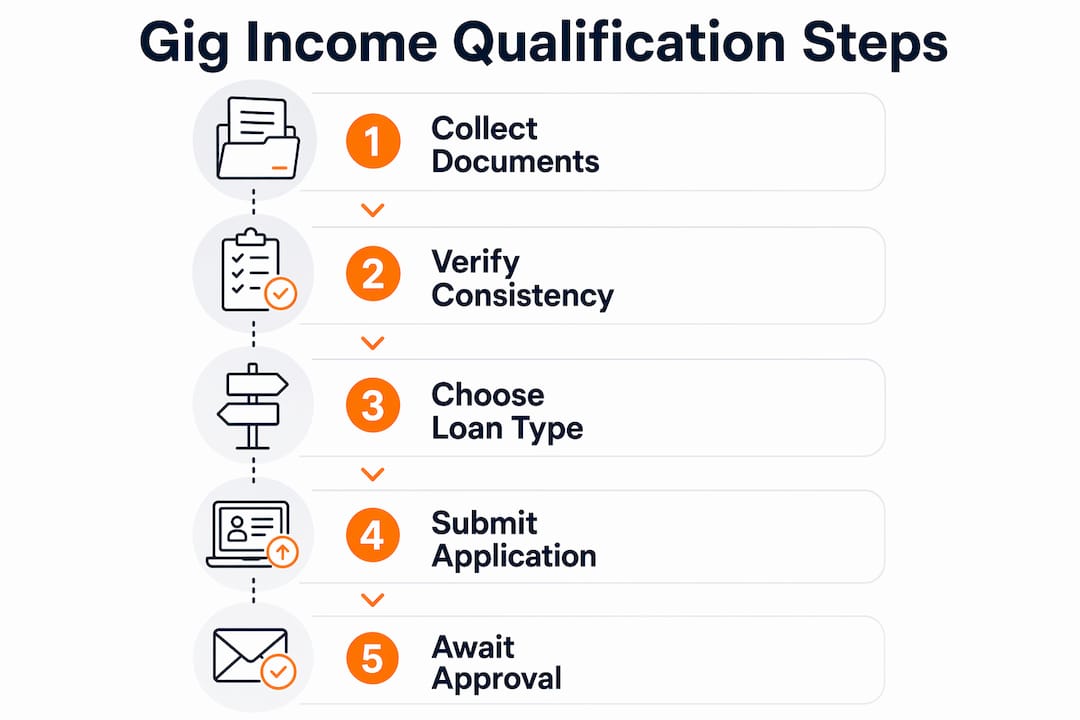
The document list for a gig worker mortgage application is longer than a salaried borrower’s list, but each item serves a clear purpose. Gathering these before you apply prevents delays and strengthens your file.
- Two years of federal tax returns (personal and business, including all schedules)
- 1099 forms from every platform or client for both years
- Profit and loss statement for the current year, prepared by a CPA
- 12-24 months of bank statements showing consistent deposits
- Business license or client contracts to confirm active operations
- Mileage logs and expense records if you claim vehicle deductions
Separating your personal and business bank accounts is critical before you apply. Lenders reviewing bank statements need to see clean, traceable deposits. Mixing personal and business transactions creates confusion and can lower your qualifying income figure.
Pro Tip: Ask your CPA to prepare a year-to-date profit and loss statement no more than 60 days before your application date. Lenders treat outdated P&L statements as a red flag.
The bank statement loan is an alternative path worth knowing. Bank statement loans analyze deposits rather than tax returns, applying a standard expense factor of 10-25% to estimate qualifying income. This approach benefits gig workers whose taxable net income looks low on paper but whose actual cash flow is strong. Texasbankstatementloans evaluates 12-24 months of bank deposits to calculate qualifying income, which gives gig workers a direct way to present what they actually earn.
Which loan types work best for gig workers?
Four main loan categories are available to gig workers, and each has different thresholds for credit scores, down payments, and income documentation.
| Loan Type | Min. Credit Score | Down Payment | Income Method | DTI Limit |
|---|---|---|---|---|
| Conventional | 620+ | 3-20% | 2 years tax returns | ~45% |
| FHA | 580+ | 3.5% | 2 years tax returns | Up to 57% |
| VA | 580-620 | 0% | 2 years tax returns | Varies |
| Non-QM / Bank Statement | 660+ | 10-20% | 12-24 months bank statements | Flexible |
Conventional loans require two years of consistent documented income and carry stricter debt-to-income limits. They work well for gig workers with strong net income on their tax returns and a credit score above 620.
FHA loans offer a 3.5% minimum down payment and allow debt-to-income ratios up to 57%, which gives gig workers with variable monthly income more room to qualify. The 580 minimum credit score also makes FHA accessible after a rough financial year. FHA still requires two years of self-employment history, so this is not a shortcut around the documentation requirement.
Non-QM loans are the most flexible option for high-earning gig workers whose tax deductions reduce their reported net income significantly. Non-QM loans allow qualification based on actual bank deposits rather than taxable income, which is a major advantage when your Schedule C shows heavy write-offs. These loans typically require a credit score of 660 or higher and a down payment of 10-20%, with rates slightly above conventional loan rates.
Pro Tip: If your gross deposits are strong but your net income after deductions looks weak, ask specifically about Non-QM bank statement programs before assuming you cannot qualify.
How do lenders assess income stability for gig workers?
Lenders do not just look at how much you earned. They look at whether your income is likely to continue at a similar level. That distinction matters for gig workers whose income can shift from month to month.
- Two-year average calculation. Lenders add your net income from year one and year two, then divide by 24 months to get a monthly qualifying figure. A spike in one year does not help if the other year was low.
- Trend analysis. If your income is rising year over year, lenders typically use the two-year average. If income is declining, some lenders use only the most recent year’s lower figure.
- Continuity of income test. Lenders look for steady, supportable income that appears reliable and likely to continue. A consistent client base or active platform history strengthens this argument.
- Length of self-employment exception. Borrowers with over five years of self-employment may qualify with only one year of tax returns at some lenders. This exception recognizes that long-term gig workers have proven income sustainability.
- Seasonal income handling. Lenders average seasonal earnings across the full year rather than annualizing a single strong quarter. Document your off-season activity to show the business remains active year-round.
The key takeaway from this process is that consistency beats volume. A gig worker earning $60,000 steadily over two years qualifies more easily than one who earned $40,000 one year and $80,000 the next.
What steps can gig workers take to improve mortgage qualification?
Preparation before you apply makes a measurable difference in what you qualify for. The following steps address the most common reasons gig workers get denied or receive lower loan amounts than expected.
- Reduce tax write-offs for two years before applying. Minimizing deductions for two years before applying raises your reported net income and directly increases your qualifying loan amount. This is a deliberate trade-off: pay slightly more in taxes now to buy a home sooner.
- Open a dedicated business checking account. Clean separation between business and personal deposits makes your bank statements easier to underwrite and reduces lender questions.
- Build your down payment and cash reserves. Most loan programs want to see two to six months of mortgage payments in reserve after closing. Gig workers with reserves signal financial stability to underwriters.
- Check your credit score at least six months before applying. Dispute errors, pay down revolving balances, and avoid opening new credit lines. A score above 700 opens the widest range of loan programs.
- Work with a lender experienced in gig economy loans. A lender unfamiliar with 1099 income will often misread your file. Texasbankstatementloans specializes in self-employed mortgage qualification and understands how to present gig income correctly to underwriters.
Use the self-employed affordability calculator to estimate your qualifying range before you start the formal application process. Knowing your realistic price range prevents wasted time on homes outside your budget.
Pro Tip: Ask your lender to run a “desktop underwrite” on your file before you make an offer on a home. This pre-check catches income calculation issues early, when they are still fixable.
Key Takeaways
Gig income qualifies for a mortgage through consistent documentation, the right loan program, and deliberate financial preparation over at least two years before applying.
| Point | Details |
|---|---|
| Two-year income rule | Lenders require two years of consistent gig income to count it toward qualification. |
| Document every source | Tax returns, 1099 forms, bank statements, and a current P&L are all required. |
| Non-QM loans fill the gap | Bank statement loans qualify gig workers on actual deposits, not taxable net income. |
| Reduce deductions early | Lowering write-offs for two years before applying raises your qualifying income figure. |
| Lender selection matters | Choose a lender with direct experience in 1099 and gig income underwriting. |
What I have learned helping gig workers get approved
The biggest mistake I see gig workers make is waiting until they find a house to start thinking about their mortgage. By that point, the tax returns are already filed, the deductions are locked in, and the income picture is set. Preparation has to start at least two years out.
The second pattern I notice is that gig workers underestimate how much loan program selection matters. A conventional lender who has never underwritten a 1099 file will often decline an application that a Non-QM lender would approve the same week. The income is identical. The lender’s experience with it is not.
The 2026 mortgage market is genuinely more accessible for gig workers than it was five years ago. Lenders now assess cash flow via bank statements rather than relying solely on tax returns, which reflects a real shift in how the industry thinks about non-traditional income. That shift benefits you if you know how to use it.
My honest advice: treat your mortgage application like a business pitch. Organize your financials, tell a clear income story, and work with professionals who already know the audience. Gig income does not disqualify you. Disorganized documentation does.
- Saad
Bank statement loans built for gig workers in Texas
Gig workers in Texas have a direct path to homeownership through Texasbankstatementloans, which evaluates 12-24 months of actual bank deposits instead of relying on tax returns.
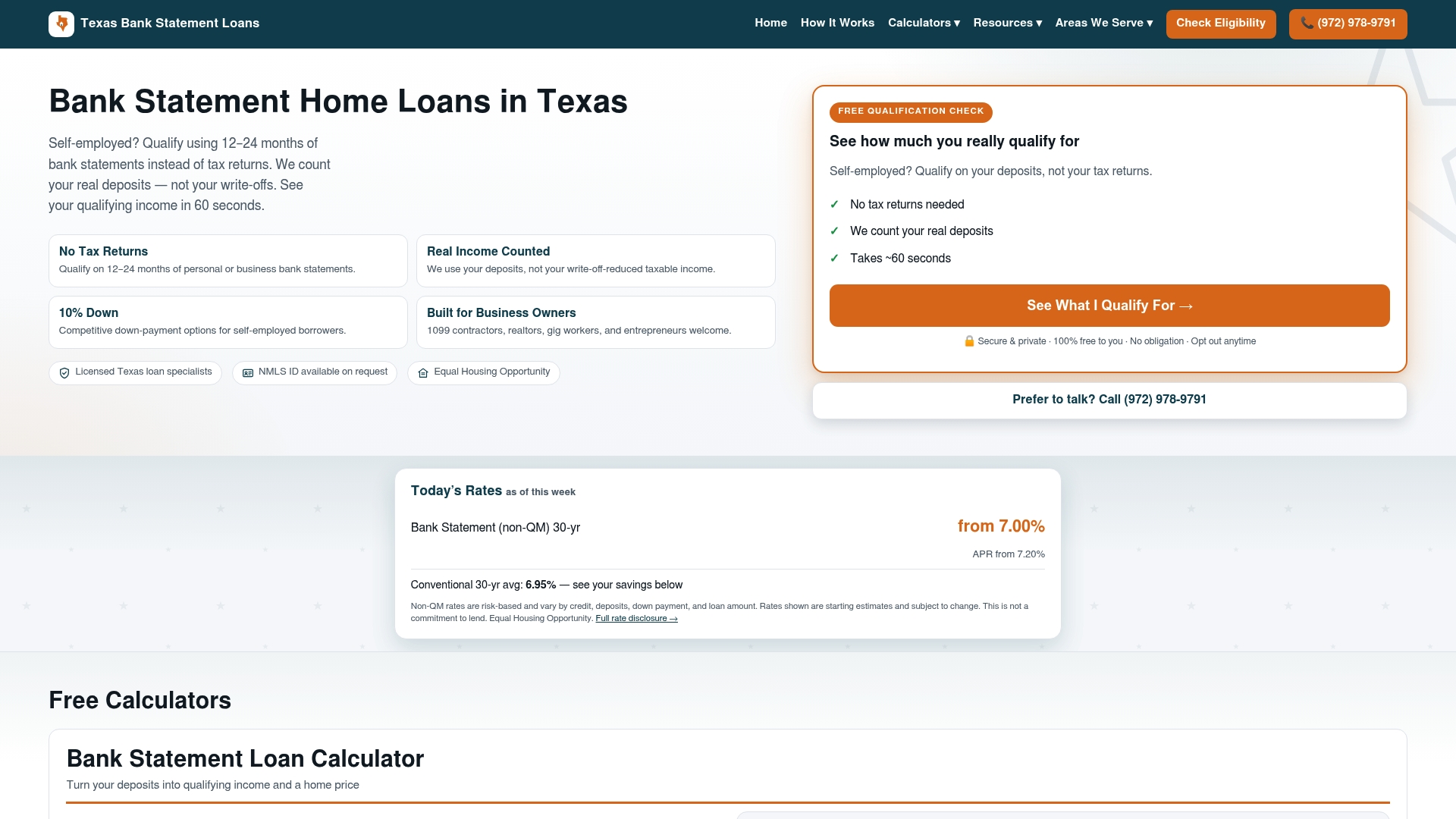
Texasbankstatementloans offers bank statement loan options with down payments starting at 10%, designed specifically for 1099 contractors and self-employed buyers whose net income on paper does not reflect their real earning power. Whether you are buying in Houston, Plano, or Round Rock, the qualification process uses your actual deposits to determine what you can afford. A no-obligation qualification check takes 60 seconds and shows your realistic price range before you start shopping.
FAQ
How long does gig income need to be consistent to qualify?
Most lenders require two full years of consistent gig income documented through tax returns. Income less than two years old is typically excluded from the qualifying calculation.
Can I use a bank statement loan if I have low net income after deductions?
Yes. Bank statement loans calculate qualifying income from actual deposits, applying a standard expense factor rather than your tax deductions. This makes them well suited for gig workers with strong cash flow but low taxable income.
What credit score do I need for a gig worker mortgage?
FHA loans accept scores as low as 580, conventional loans typically require 620 or higher, and Non-QM bank statement loans generally require 660 or above. A higher score expands your loan options and lowers your rate.
Does supplemental gig income count if I also have a W-2 job?
Supplemental gig income counts toward qualification if it has been consistent and verifiable for at least two years. Lenders will add it to your W-2 income to increase your qualifying amount.
What is the minimum down payment for a gig worker mortgage?
FHA loans require 3.5% down, conventional loans can go as low as 3%, and Non-QM bank statement loans typically require 10-20% down. Texasbankstatementloans offers options starting at 10% for qualified borrowers.
Recommended
- Self-Employed Affordability Calculator | Texas Bank Statement Loans
- Free Mortgage Calculators & Tools | Texas Bank Statement Loans
See what you qualify for in 60 seconds, free and no credit check. Use the eligibility check at the top of this page.