
A business owner mortgage is a loan product that uses alternative income verification to match the real financial profile of self-employed borrowers, unlike conventional loans that rely on tax returns and W-2s. Understanding how business owner mortgage differs from conventional lending is the single most important step you can take before applying. Conventional loans follow Fannie Mae guidelines, which calculate income from Schedule C or K-1 net profits. That method routinely understates actual cash flow for business owners who use aggressive tax deductions. The result is a borrowing power gap that leaves qualified buyers on the sidelines.
How do lenders verify income for business owners versus conventional borrowers?
Conventional lenders verify income through tax returns, W-2s, and a stable two-year employment history. The process is straightforward for salaried workers but creates a structural problem for business owners. Fannie Mae guidelines require lenders to use Schedule C or K-1 net profits, not the actual deposits flowing through a business account. A business owner who earns $200,000 in gross revenue but deducts $120,000 in legitimate business expenses shows only $80,000 in taxable income. That $80,000 is what the conventional lender uses to calculate how much house you can afford.
Business owner mortgages, also called non-QM or bank statement loans, replace tax returns with 12-24 months of bank deposits. Lenders review personal or business bank statements and build a picture of actual cash flow. They also accept profit and loss statements prepared by a CPA as supporting documentation.

The critical catch is the “expense factor.” Lenders discount gross deposits by 30-50% to account for estimated operating expenses. That means $20,000 in monthly deposits may qualify as only $10,000-$14,000 in income. This surprises many business owners who assume every dollar deposited counts toward qualification.
Documentation required for each loan type:
- Conventional loan: Two years of federal tax returns, W-2s or 1099s, two months of bank statements, employer verification letter
- Business owner mortgage: 12-24 months of personal or business bank statements, CPA-prepared profit and loss statement, business license or CPA letter confirming self-employment, two years of tax returns (some lenders waive this)
Pro Tip: Keep personal and business bank accounts completely separate for at least 24 months before applying. Mixed accounts force underwriters to manually sort deposits, which slows approval and can reduce your qualifying income.
What are the key qualification differences between business owner and conventional loans?
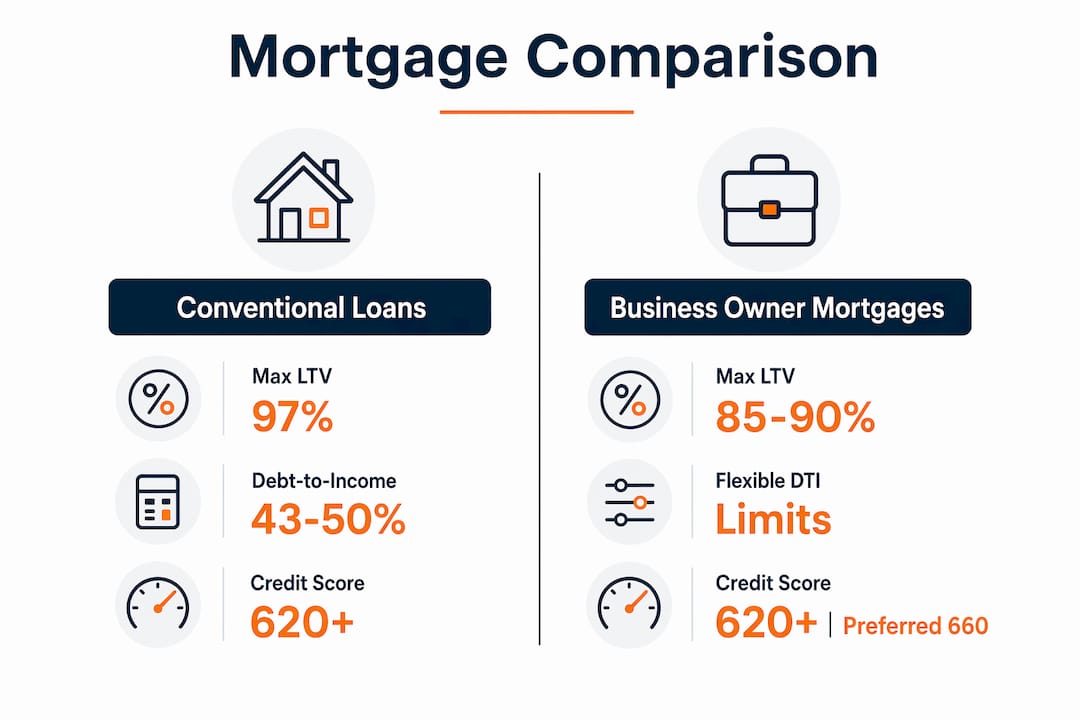
The qualification standards for each loan type differ across four main categories: loan-to-value ratio, debt-to-income ratio, credit score, and down payment.
Conventional mortgages allow LTV ratios up to 97%, meaning a buyer can put down as little as 3%. Business owner mortgages typically cap LTV at 85-90%, which translates to a minimum 10-15% down payment. That higher down payment requirement reflects the added risk lenders take on when income documentation is non-traditional.
| Qualification Factor | Conventional Loan | Business Owner Mortgage |
|---|---|---|
| Max LTV | Up to 97% | 85-90% |
| Min down payment | 3% | 10-15% |
| DTI limit | 43-50% | Up to 50%+ with compensating factors |
| Min credit score | 620 | 620-660+ depending on lender |
| Income documentation | Tax returns, W-2s | Bank statements, P&L |
| Loan type | QM (agency-backed) | Non-QM |
Debt-to-income limits for conventional loans sit at 43-50%, while non-QM bank statement loans allow more flexibility, sometimes exceeding 50% when a borrower has strong compensating factors like significant cash reserves or a high credit score. That flexibility is meaningful for business owners whose income fluctuates month to month.
Credit score minimums are similar on paper. Both loan types generally start at 620, but many non-QM lenders prefer 660 or higher to offset the documentation flexibility they extend. A stronger credit score also helps you access better interest rates on a bank statement loan, which typically carries a slightly higher rate than a conventional mortgage.
Pro Tip: Run a bank statement loan calculator before you meet with any lender. Knowing your estimated qualifying income under the expense factor model prevents surprises during underwriting.
Why do conventional guidelines underestimate business owner income?
The gap between actual cash flow and reported taxable income is the defining challenge for self-employed borrowers. Tax planning strategies that save money at tax time directly reduce the income figure conventional lenders use to approve loans. This is not a flaw in the system. It is a structural conflict between two legitimate financial goals.
Business owners who write off home offices, vehicles, depreciation, retirement contributions, and health insurance premiums reduce their taxable income significantly. Conventional lenders use this reduced net income from Schedule C or K-1 distributions, not the gross revenue or actual deposits the business generates. Retained earnings reinvested into the business also do not count as personal income under conventional guidelines.
The practical result looks like this:
- A business owner deposits $15,000 per month into a business account.
- After deductions, the tax return shows $6,000 per month in net income.
- A conventional lender qualifies the borrower on $6,000, not $15,000.
- The borrower qualifies for a significantly smaller loan than their actual cash flow supports.
This gap is why non-QM loans exist as legitimate, regulated products specifically designed for self-employed borrowers. They carry slightly higher interest rates than conventional loans, but they provide access to financing that conventional guidelines structurally deny.
What steps should business owners take to prepare for mortgage approval?
Preparation for a business owner mortgage works best when it starts 12-24 months before you plan to buy. The documentation requirements are more demanding than a conventional loan, and lenders reward borrowers who arrive organized.
- Separate your finances. Open dedicated personal and business bank accounts if you have not already. Underwriters need clean, traceable deposit histories. Mixed accounts create delays and can reduce your qualifying income.
- Talk to your CPA early. Business owners need thorough documentation including bank statements, profit and loss statements, and tax schedules reviewed by a CPA. Ask your CPA to prepare a mortgage-ready P&L that clearly shows gross revenue, expenses, and net income.
- Balance tax strategy with borrowing goals. Aggressive deductions lower your tax bill but also lower your qualifying income. Work with your CPA to find a balance that serves both goals in the year before you apply.
- Document unusual items. If your tax return shows a large one-time deduction or a business loss in one year, prepare a written explanation. Lenders want to understand anomalies, not guess at them.
- Choose the right loan type for your income profile. If your tax return income is strong enough to qualify conventionally, a conventional loan offers lower rates and a smaller down payment. If your actual deposits are far higher than your taxable income, a bank statement loan through a lender like Texasbankstatementloans gives you a more accurate picture of what you can afford.
Pro Tip: Use the self-employed affordability calculator at Texasbankstatementloans to estimate your qualifying range under bank statement loan guidelines before you start shopping for homes.
How do business owner mortgages compare to commercial real estate loans?
Business owners sometimes confuse residential business owner mortgages with commercial real estate loans. They serve different purposes and carry very different terms.
A residential business owner mortgage finances the home you live in. A commercial real estate loan finances a property your business uses, such as an office, warehouse, or retail space. The underwriting for each loan type focuses on different factors.
| Loan Feature | Residential Business Owner Mortgage | Commercial Real Estate Loan |
|---|---|---|
| Property use | Primary residence | Business-occupied property |
| Down payment | 10-15% | 20-35% |
| Loan terms | 15-30 year fixed | Shorter fixed periods, balloon payments |
| Income focus | Borrower personal income | Property cash flow and business financials |
| SBA option | No | Yes, for owner-occupied commercial |
Commercial loans typically require 20-35% down payments and often include balloon payment structures with shorter fixed-rate periods. They also require a property cash flow analysis, which residential loans do not. Conventional commercial loans close faster than SBA-backed options but demand stronger credit profiles and higher down payments.
SBA loans offer a lower down payment path for business owners purchasing owner-occupied commercial property, but the documentation requirements are heavier than either residential or conventional commercial options. If you are buying a home to live in, a residential bank statement loan is the right category. If you are buying property for your business, commercial financing applies.
Key Takeaways
A business owner mortgage uses bank deposits instead of tax returns to qualify self-employed borrowers, which closes the gap between actual cash flow and reported taxable income that conventional loans cannot bridge.
| Point | Details |
|---|---|
| Income verification method | Business owner mortgages use 12-24 months of bank statements; conventional loans use tax returns and W-2s. |
| Down payment requirement | Conventional loans allow as little as 3% down; business owner mortgages typically require 10-15%. |
| Expense factor impact | Lenders discount gross deposits by 30-50%, so qualifying income is lower than total deposits. |
| Tax strategy tradeoff | Aggressive deductions reduce taxable income and conventional loan qualification simultaneously. |
| Preparation timeline | Start separating finances and coordinating with your CPA at least 12-24 months before applying. |
What I have learned about self-employed mortgages after years in this space
The most common mistake I see business owners make is assuming their mortgage situation is hopeless because a conventional lender turned them down. That rejection almost never reflects their actual financial strength. It reflects a documentation mismatch.
The second mistake is waiting until they find a home to think about financing. A business owner mortgage requires preparation that a salaried borrower simply does not need. If your bank statements are mixed with business deposits, if your CPA has not prepared a mortgage-ready P&L, or if your tax returns show two years of heavy losses from startup costs, you are not ready to apply. That does not mean you cannot get there. It means you need a plan.
Non-QM loans, including bank statement loans, are not a last resort. They are a professional financial tool designed for a specific borrower profile. The interest rate is slightly higher than a conventional loan, but for a business owner whose taxable income is $60,000 and whose actual deposits are $180,000, the conventional loan is not a better deal. It is simply unavailable.
The most productive conversation you can have right now is with your CPA and a lender who specializes in self-employed borrowers. Bring 24 months of bank statements, your last two tax returns, and a list of your monthly business expenses. That conversation will tell you exactly where you stand and what you need to change.
- Saad
Bank statement loans built for business owners in Texas
Self-employed borrowers in Texas have a direct path to homeownership that does not require fitting into a conventional income box.
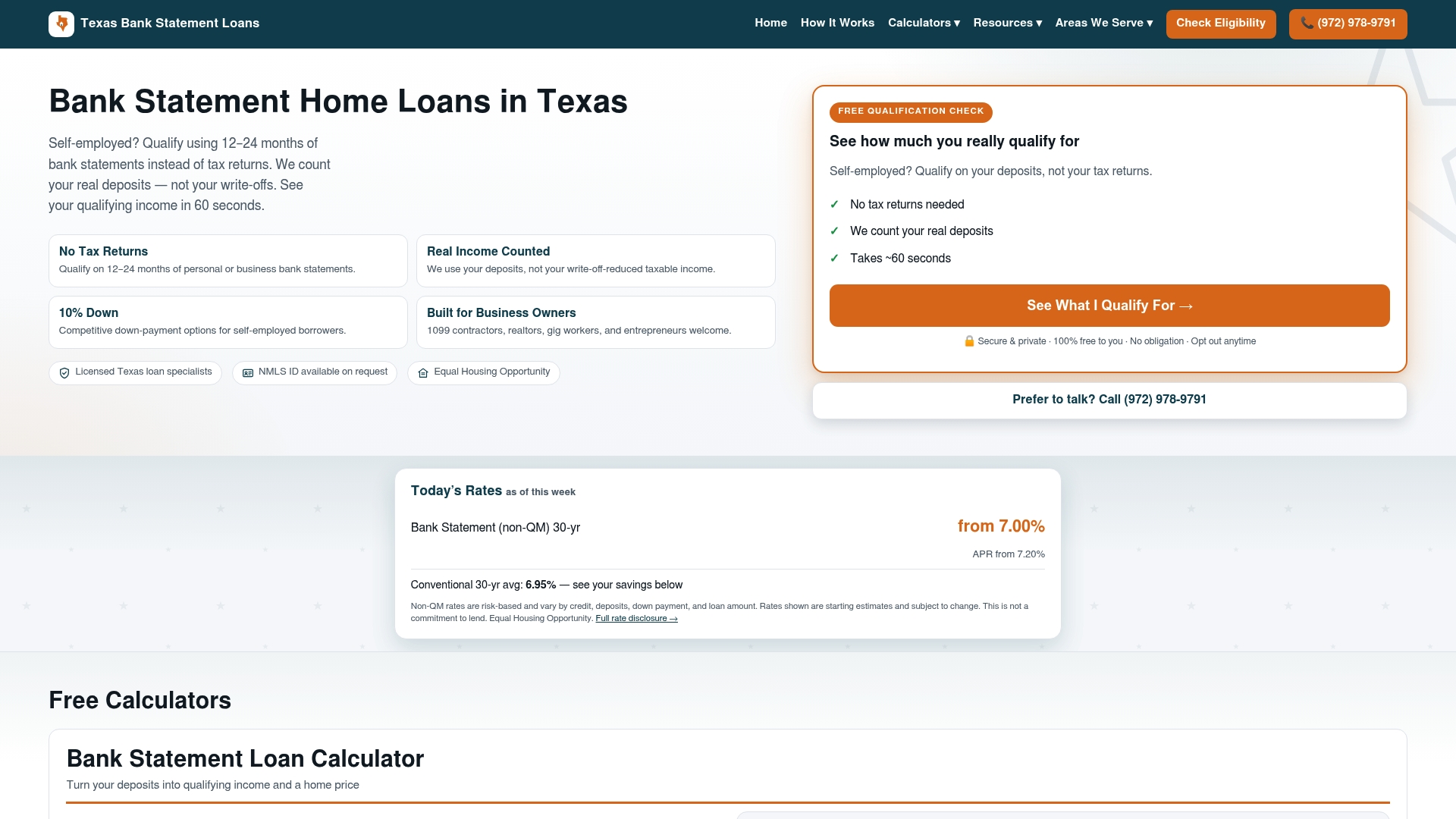
Texasbankstatementloans evaluates 12-24 months of bank deposits instead of tax returns, giving business owners, 1099 contractors, and gig workers a qualification method that reflects actual income. Down payments start at 10%, and you can check your estimated qualification in 60 seconds with no obligation. Whether you are buying in Houston, Plano, or Midland, Texasbankstatementloans offers bank statement loan options built specifically for the self-employed. Check current loan rates to see what today’s terms look like for your income profile.
FAQ
What is a business owner mortgage?
A business owner mortgage is a non-QM loan that uses bank statements or profit and loss statements instead of tax returns to verify income, designed for self-employed borrowers whose taxable income understates actual cash flow.
How does the expense factor affect my qualifying income?
Lenders discount gross deposits by 30-50% to estimate operating expenses, so $20,000 in monthly deposits may qualify as only $10,000-$14,000 in income depending on the lender’s expense factor.
Can I get a business owner mortgage with a 620 credit score?
Most bank statement loan programs start at a 620 credit score, though many lenders prefer 660 or higher. A stronger score improves your rate and increases lender flexibility on other qualification factors.
Why did a conventional lender deny me if my business earns well?
Conventional lenders use Schedule C or K-1 net profits from your tax return, not gross revenue or deposits. Heavy deductions that reduce your tax bill also reduce the income figure the lender uses to approve your loan.
How far in advance should I prepare for a business owner mortgage?
Start preparing 12-24 months before you plan to buy. Separate personal and business bank accounts, coordinate with your CPA on documentation, and avoid large unexplained deposits or withdrawals during that window.
Recommended
- Bank Statement Loan Rates Today | Texas Bank Statement Loans
- Bank Statement Loans in San Antonio, TX | Self-Employed Mortgage
See what you qualify for in 60 seconds, free and no credit check. Use the eligibility check at the top of this page.