
App-based income qualifies as self-employment income for mortgage purposes, and lenders across the country accept it when you document it correctly. Gig workers earning through platforms like DoorDash, Uber, Instacart, or Airbnb can use app-based income for mortgage approval by following the same verification standards applied to any self-employed borrower. The industry term for this process is “self-employment income documentation,” and it follows guidelines set by Fannie Mae and FHA. The catch is that most lenders require at least two years of verifiable history, consistent cash flow, and the right paperwork before they will count a single dollar of your gig earnings toward qualifying income.
What documentation do you need to verify app-based income?
Most conventional lenders require two years of self-employment or gig work history, verified through tax returns and profit and loss statements. That two-year window is not arbitrary. It gives lenders enough data to average your income and spot trends, whether your earnings are growing, shrinking, or bouncing around unpredictably.
The core documents you will need include:
- Form 1040 with Schedule C: This is the IRS form where sole proprietors and 1099 contractors report net profit. Lenders read Schedule C closely because it shows both your gross revenue and your deductions.
- Year-to-date profit and loss statement: Many lenders require a P&L prepared or reviewed by a licensed CPA, especially if you are applying mid-year.
- 12-24 months of bank statements: Both personal and business accounts. Lenders use these to confirm that deposits match what you reported on your taxes.
- 1099 forms: If you receive 1099s from app platforms, include all of them. They corroborate your reported income.
- Business license or proof of ongoing activity: A screenshot of your active driver or delivery account, a business registration, or client contracts all work here.
Bank statements used for income calculation must be complete, consecutive, and clearly show your name and account number. Missing even one page can stall underwriting for days.
Pro Tip: Open a dedicated business checking account at least 12 months before you apply. Mixing personal and gig deposits in one account forces underwriters to manually sort your income, which slows approval and raises red flags.
How do lenders calculate qualifying income from gig work?
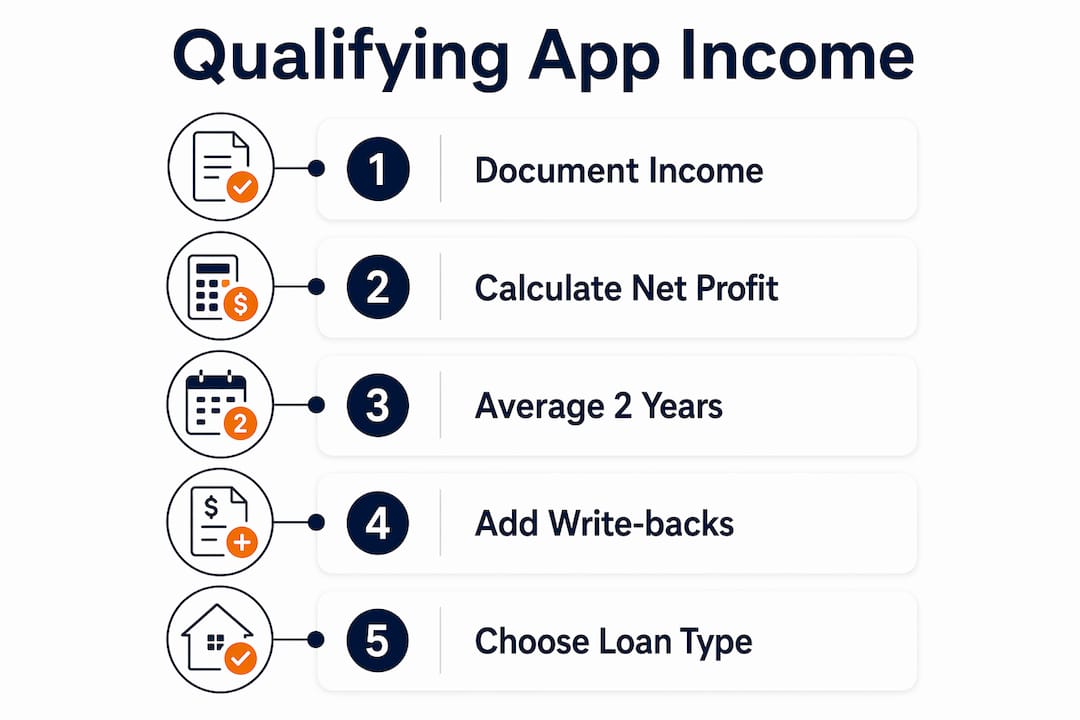
The math lenders use surprises most gig workers. Lenders focus on net income, not gross revenue, when qualifying self-employed borrowers. Every deduction you claim on Schedule C reduces the income number a lender will use to approve your loan. If you earned $90,000 driving for a rideshare platform but wrote off $40,000 in vehicle expenses, the lender qualifies you on roughly $50,000, not $90,000.
Lenders also average your income across two years. If you earned $40,000 in year one and $60,000 in year two, your qualifying income is $50,000 per year. Rising income actually helps here. If your earnings went up year over year, some lenders will use the most recent year’s figure rather than the average.
For gig workers with heavy write-offs, non-QM bank statement loans offer a different calculation method. Non-Qualified Mortgage bank statement loans allow income verification using 12-24 months of bank deposits, typically applying a 50% expense ratio to calculate qualifying income. That means if your deposits total $100,000 over 12 months, the lender counts $50,000 as qualifying income, regardless of what your tax return shows.
| Income method | How income is calculated | Best for |
|---|---|---|
| Tax return method | Net profit averaged over 2 years | Gig workers with low write-offs |
| Bank statement method | Total deposits × 50% expense ratio | Gig workers with high deductions |
| 1099 loan method | Gross 1099 income with minimal deductions | Single-platform contractors |
| Mixed W-2 + gig income | Each stream documented separately, then combined | Part-time gig workers with a day job |
Mixing W-2 and self-employed income is allowed. If you drive for a rideshare platform on weekends and hold a salaried job during the week, both income streams count as long as each meets its documentation requirements.
Pro Tip: Ask your CPA to add back depreciation and depletion to your Schedule C before you apply. Lenders can add these non-cash deductions back to your net income, which raises your qualifying number without changing your tax bill.

How to prepare your app-based income for a mortgage application
Preparation starts long before you talk to a lender. The steps below give you the cleanest possible income picture when underwriting begins.
-
Open a dedicated business account now. Separating business and personal finances at least 12-24 months before applying simplifies income verification and reduces underwriting friction. Every deposit from your app platforms should land in this account.
-
Balance your write-offs against your qualifying income. Claiming every possible deduction is smart for taxes but damaging for mortgage approval. Work with a CPA to find the right balance between tax savings and the income number you need to qualify.
-
Keep receipts and mileage logs. Detailed records protect your deductions if the IRS asks questions and give your CPA accurate data to build a clean P&L statement.
-
Get a CPA-prepared P&L statement. Many lenders require this for bank statement loans and non-QM programs. A CPA-signed P&L carries more weight than a spreadsheet you built yourself.
-
Build cash reserves. Lenders want to see two to six months of mortgage payments sitting in your account after closing. Reserves signal financial stability and offset the risk of irregular income.
-
Time your tax filing and mortgage application strategically. Strategically timing tax deductions and mortgage applications can maximize qualifying income by balancing tax savings and loan approval requirements. Filing taxes with fewer deductions in the year before you apply raises your qualifying income on paper.
-
Get an income analysis before you house hunt. A mortgage specialist who works with gig borrowers can run your numbers before you fall in love with a property. Knowing your real qualifying income saves you from making offers you cannot back up.
Pro Tip: Use the self-employed affordability calculator at Texasbankstatementloans to estimate your qualifying income before you meet with a lender. It takes about 60 seconds and gives you a realistic price range.
What challenges come up when using app income for a mortgage?
App income and home loans do not always mix smoothly. Knowing the common obstacles in advance puts you in a much stronger position.
- Income inconsistency: Lenders value income consistency for gig work and will discount or exclude extreme fluctuations. A month where you earned $2,000 followed by a month where you earned $8,000 raises questions. Document the reason for any large swings with a written explanation letter.
- Less than two years of history: Transitioning from W-2 to gig work can allow lenders to accept one year of self-employment history if you have prior industry experience. A former restaurant worker who now delivers food full-time may qualify with just 12 months of gig income.
- High business write-offs: The more you deduct, the lower your qualifying income. If your tax return makes you look unprofitable, a bank statement loan or 1099 loan program sidesteps this problem entirely.
- Choosing the wrong loan program: FHA loans allow self-employed borrowers to qualify with two years of tax returns and accept credit scores as low as 580 for a 3.5% down payment. Conventional loans require higher credit scores but offer better rates. Non-QM bank statement loans require no tax returns but carry slightly higher rates.
- Debt-to-income ratio problems: Your total monthly debt payments, including the new mortgage, must stay within the lender’s DTI limit. Paying down credit cards and auto loans before applying directly improves this ratio.
“Consistency of income over time is often more important than high but volatile earnings for gig economy workers. A borrower who earns $4,000 per month reliably for two years qualifies more easily than one who earns $8,000 some months and $1,000 in others.”
Qualifying mortgage with app income becomes much more predictable once you understand that lenders are not judging your hustle. They are measuring your risk. Consistent deposits, clean records, and the right loan program answer every concern an underwriter has.
Key Takeaways
App-based income qualifies for a mortgage when you document it consistently, choose the right loan program, and balance your tax deductions against your qualifying income needs.
| Point | Details |
|---|---|
| Two-year history matters | Most lenders require two years of gig income verified through tax returns or bank statements. |
| Net income drives approval | Lenders use net taxable income, not gross revenue, so heavy write-offs reduce your qualifying number. |
| Bank statement loans offer flexibility | Non-QM programs use 12-24 months of deposits with a 50% expense ratio instead of tax returns. |
| Separate your accounts early | Dedicated business banking at least 12 months before applying speeds up underwriting significantly. |
| Consistency beats high earnings | Steady monthly deposits qualify you more reliably than large but irregular income spikes. |
What I’ve learned from watching gig workers navigate mortgage approvals
The biggest mistake I see gig workers make is waiting until they find a house to figure out their income situation. By then, it is too late to fix two years of mixed bank accounts or a tax return that shows $18,000 in net income on $75,000 in deposits.
The second mistake is assuming that high write-offs are always a problem. They are only a problem if you are using the wrong loan program. A bank statement loan exists precisely for borrowers whose tax returns understate their real cash flow. The lender looks at your deposits, applies a standard expense ratio, and qualifies you on that number. Your Schedule C becomes almost irrelevant.
What actually works is treating your mortgage application like a business project you start 18 months early. Open the right accounts, keep your records clean, and have a CPA run your numbers annually with an eye toward both tax efficiency and mortgage qualification. These two goals are not always in conflict. With the right planning, you can minimize your tax bill and still show enough qualifying income to buy the home you want.
The mortgage world is also catching up to gig work faster than most people realize. Non-QM lenders have built entire product lines around 1099 contractors and app-based earners. The options available in 2026 are genuinely better than they were five years ago. You just need to know where to look and how to present your income correctly.
- Saad
App income earners have real mortgage options in Texas
Gig workers and self-employed borrowers in Texas have access to loan programs built specifically for how they earn. Texasbankstatementloans works with app-based income earners across Houston, San Antonio, Midland, and beyond, using 12-24 months of bank deposits instead of tax returns to calculate qualifying income.
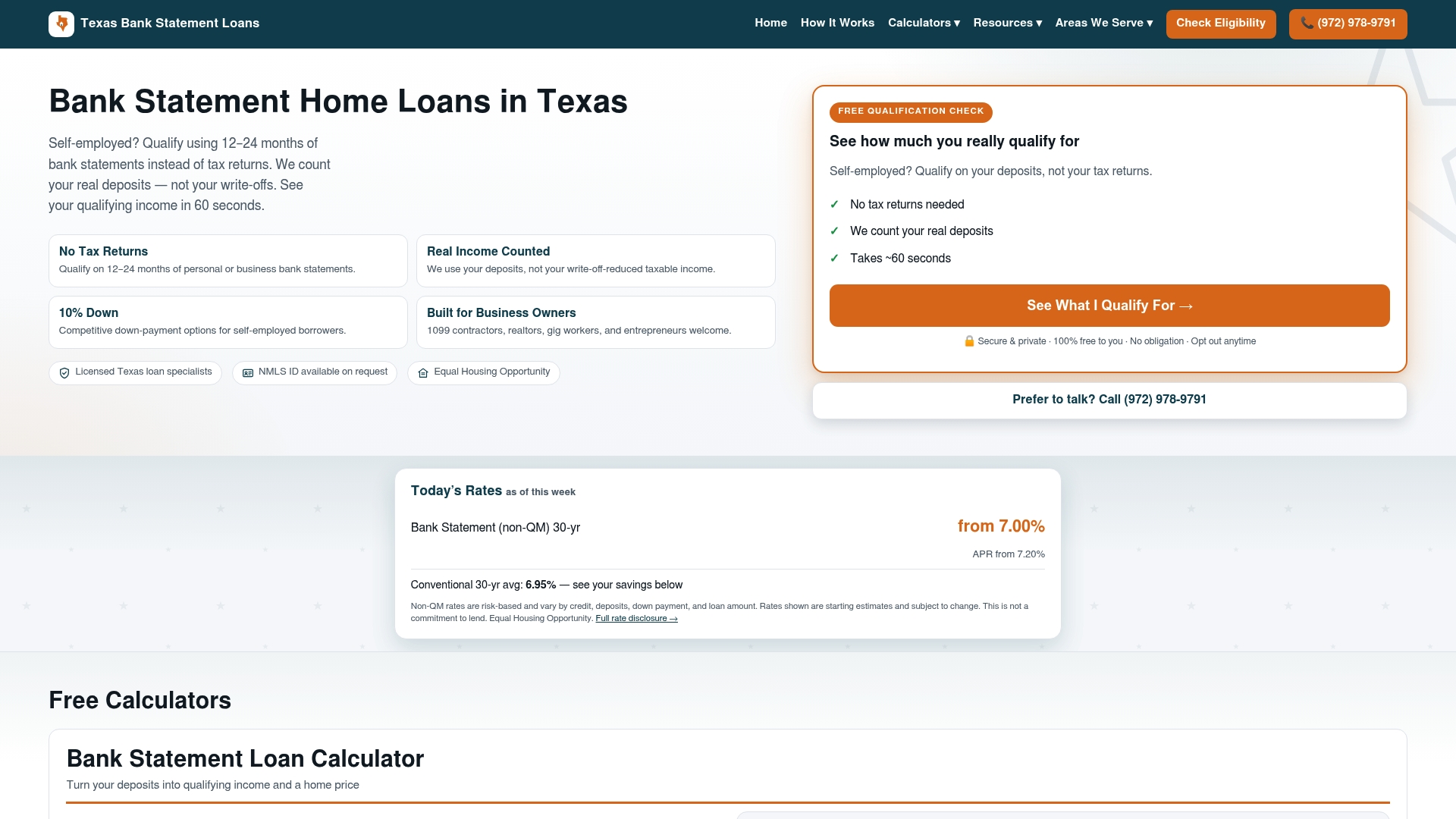
Down payments start at 10%, and a no-obligation qualification check takes about 60 seconds. Whether you drive, deliver, rent, or freelance, Texasbankstatementloans has a program that fits your income structure. Check bank statement loans in Houston or San Antonio mortgage options to see what you qualify for today. You can also use the bank statement loan calculator to run your numbers before speaking with anyone.
FAQ
Can app-based income be used for a mortgage?
Yes. App-based income counts as self-employment income for mortgage purposes. Lenders accept it when you document it through tax returns, bank statements, or 1099 forms over a consistent period.
How many years of app income do lenders require?
Most lenders require two years of verifiable gig or self-employment income. Some programs accept one year if you have prior experience in the same field.
What is a bank statement loan and how does it help gig workers?
A bank statement loan is a non-QM mortgage that uses 12-24 months of bank deposits instead of tax returns to verify income. It helps gig workers whose tax returns show low net income due to business deductions.
Do write-offs hurt my chances of getting a mortgage?
Write-offs reduce the net income lenders use to qualify you on conventional and FHA loans. A bank statement loan or 1099 loan program bypasses this issue by using gross deposits instead of taxable income.
What credit score do I need to qualify with app-based income?
FHA loans accept credit scores as low as 580 with a 3.5% down payment. Conventional loans typically require a score of 620 or higher. Non-QM bank statement loans vary by lender but generally require a score of 620 or above.
See what you qualify for in 60 seconds, free and no credit check. Use the eligibility check at the top of this page.