
Yes, lenders can use several months to a couple of years of deposits from multiple bank accounts to qualify you for a bank statement mortgage, but they require careful reconciliation and documentation. You will need to provide statements for every account, explain large deposits, and flag transfers so they are not counted twice. If business accounts are part of the picture, expect a cash flow review too. Start by gathering your statements and proof of where your money comes from.
TL;DR:
- Gather statements for each personal and business account, then match transfers by date and amount so lenders do not count the same funds twice.
- Document any single deposit exceeding half your monthly qualifying income; lenders may exclude its unsourced portion, so keep invoices, contracts, or payment records.
- Using business funds can prompt a cash flow review; provide a profit and loss statement or balance sheet showing withdrawals will not impair operations.
- If your statements are more than 45 days old, lenders may request supplements; accounts opened within 90 days of applying can draw extra scrutiny.
- Lenders subtract internal transfers, loan proceeds, and undocumented large deposits before dividing eligible deposits by the statement period’s months to calculate monthly income.
Table of Contents
- How bank statement underwriting treats deposits from multiple accounts
- Step-by-step documentation and reconciliation checklist for multiple accounts
- Common red flags with multiple-account bank statement qualification
- How lenders calculate qualifying income from aggregated deposits
- When a bank statement loan with multiple accounts is the right choice
- A practitioner’s take on managing multiple accounts for underwriting
- Get qualified using your multiple bank accounts
- FAQ
- Sources
How bank statement underwriting treats deposits from multiple accounts
Underwriters are not simply adding up every number that hits your accounts. They are looking at whether your income is stable, how often it arrives, and whether it is trending up, flat, or down over several months to a couple of years of statements. A single strong month surrounded by weak ones tells a different story than steady, recurring deposits, even if the raw totals match.
Money moving from your savings account to your checking account is not new income. It is the same dollar showing up twice unless you can prove otherwise, and lenders will ask you to document transfers between your own accounts so they are not mistaken for earnings.
When business accounts enter the equation, the review gets more detailed. Lenders want to confirm that pulling funds out for a down payment or for qualifying income will not leave the business without enough cash to operate.
Underwriters typically evaluate:
- Deposit consistency across the full statement period, not just the most recent months
- The source and payor for recurring deposits, especially client payments or contract income
- Internal transfers between your own personal or business accounts
- Business liquidity remaining after any withdrawal used toward the loan
This is the core trade-off of bank statement qualification: it rewards real, recurring income, but it demands more paperwork than a straightforward tax-return file.
Step-by-step documentation and reconciliation checklist for multiple accounts
Assembling a clean file before you apply saves weeks of back-and-forth. Lenders will eventually ask for most of this anyway, so gathering it up front puts you in control of the timeline.
- Pull several months to a couple of years of statements for every account you want counted toward income, personal and business alike.
- Go through each statement and mark internal transfers, noting the matching date and amount on both the sending and receiving account.
- If you are including business accounts, prepare a profit and loss statement or balance sheet that lenders can cross-reference against deposit activity.
- Collect source-of-funds documentation, invoices, contracts, or payment records, for any deposit that looks unusually large.
- Be ready to authorize a Verification of Deposits request or automated account verification if your lender asks for one, since Fannie Mae’s verification standards allow lenders to request supplemental statements when the most recent ones are more than 45 days old.
A mortgage document checklist can help you track which paperwork you still need across several accounts, which matters more the more accounts you are reconciling.
Pro Tip: Label every transfer the same day it happens, with a short note like “transfer to checking 3/14,” so you are not reconstructing the trail months later.
Common red flags with multiple-account bank statement qualification
Most delays trace back to a handful of recurring issues, and nearly all of them are preventable if you know what underwriters are checking for.
- An undocumented large deposit gets flagged, and the unsourced portion is typically excluded from usable assets rather than counted as income.
- Circular transfers between your own accounts, if left unlabeled, create the appearance of double-counted income and invite scrutiny.
- A newly opened account or a balance that jumps well above your historical average tends to trigger extra verification requests.
- Using business funds for a down payment usually means a closer look at whether the business can absorb that withdrawal without hurting operations.
A large deposit is generally defined as any single deposit exceeding half of your monthly qualifying income, and Fannie Mae guidance treats the unsourced portion as excluded from usable assets. That single rule explains more qualification shortfalls than any other documentation issue.
Accounts opened within 90 days of application often draw the same extra scrutiny as an unusually high balance, so timing matters as much as the paper trail itself.
How lenders calculate qualifying income from aggregated deposits
The math behind a bank statement loan is more straightforward than it looks once you separate real income from noise.
- Add up total deposits across every account being used for the application over the full statement period.
- Subtract anything that is a transfer between your own accounts or proceeds from a loan, since neither counts as income.
- Remove the unsourced portion of any large deposit that you cannot document, per the large deposit standards lenders apply.
- Divide the remaining figure by the number of months in the statement period to reach a monthly qualifying income figure.
Say two accounts show combined deposits of $180,000 over 12 months, including one undocumented $20,000 deposit. After removing that unsourced amount, qualifying deposits drop to $160,000, or about $13,333 a month. That monthly figure, not the original $180,000, is what feeds into your debt-to-income calculation.
Even a strong monthly number still has to clear the lender’s debt-to-income and reserve requirements under ATR/QM rules before it translates into an approval.

When a bank statement loan with multiple accounts is the right choice
This approach fits best when your deposits genuinely reflect what you earn and you can show where the money comes from.
- A good fit looks like recurring client payments, contract income, or gig earnings that show up predictably across months, with payors you can document.
- A weaker fit involves deposits that are mostly loans, gifts, or one-time windfalls, since underwriting guidance tends to discount income that is not recurring.
- Your down payment size, credit score, and whether pulling from business accounts would strain operations all factor into whether this path makes sense right now.
If your deposit history is messy or inconsistent, it may be worth waiting a few months to build a cleaner pattern before applying.
A practitioner’s take on managing multiple accounts for underwriting
The borrowers who move through underwriting fastest are not the ones with the highest deposits. They are the ones who treat their bank statements like a story they are telling an underwriter, not just a record they are handing over.
Label transfers the moment they happen. Keep a simple profit and loss snapshot updated monthly if you run a business, even an informal one, rather than scrambling to build it at application time. And when a large deposit lands, write down where it came from immediately, while the invoice or contract is still easy to find.
Bank statement programs built around several months to a couple of years of deposits, like the ones we evaluate, exist specifically because tax returns often understate what self-employed borrowers actually earn.
- Saad
Get qualified using your multiple bank accounts
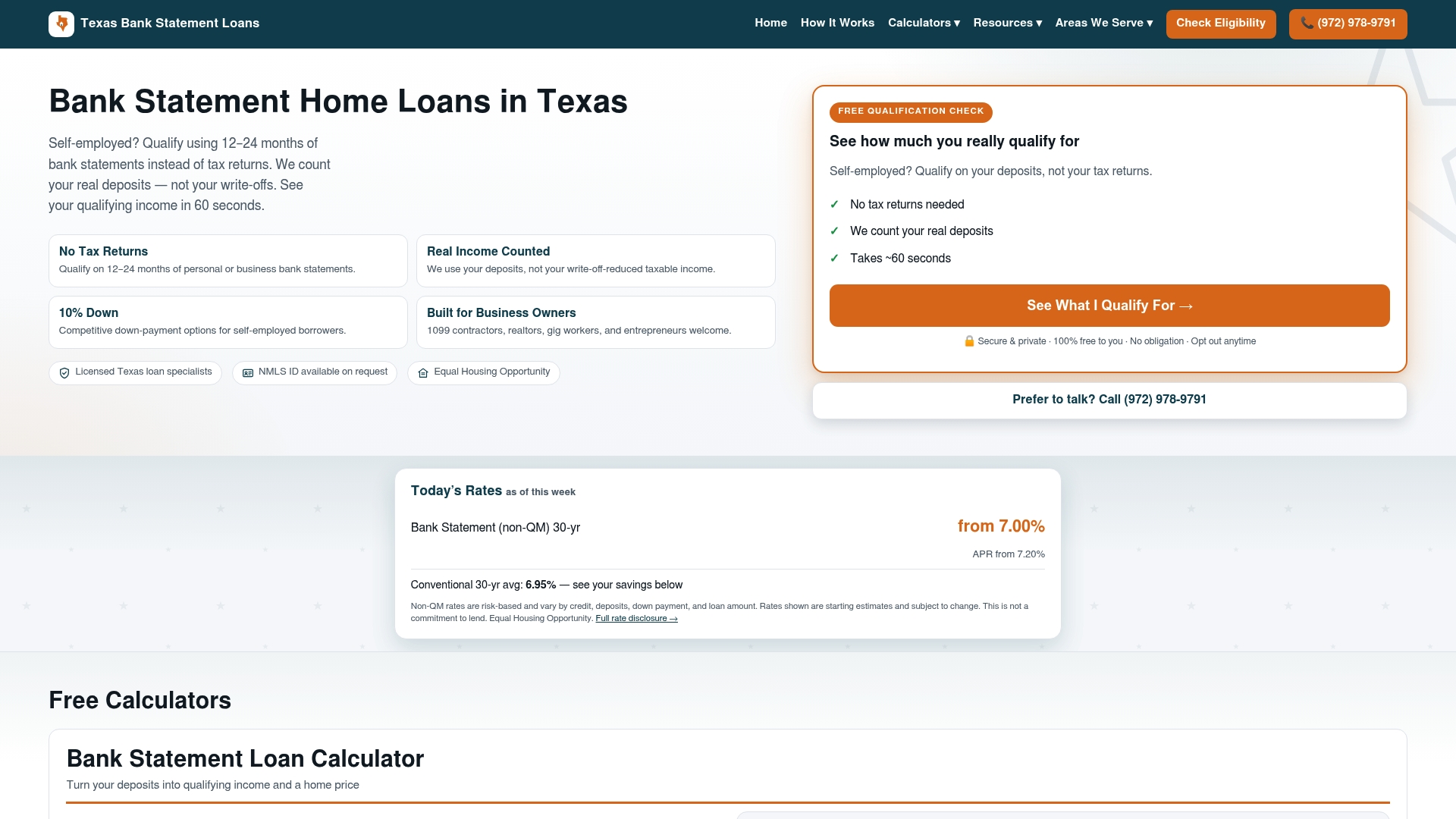
We built our bank statement programs for exactly the situation this article describes: borrowers whose income lives across more than one account and whose tax returns do not tell the full story. We evaluate several months to a couple of years of deposits instead of tax returns, and our Bank Statement (non-QM) 30-yr loans start at rates from 7.00% per year with down payments as low as 10%.
If rental or investment property income is part of your picture, our DSCR loan calculator can help you see how that property’s cash flow factors into qualification. Whichever path fits, you can run a free, no-obligation qualification check in about 60 seconds and see what you can realistically afford before you apply.
- Check your qualifying income with our bank statement loan calculator
- Compare rates and terms on our Bank Statement (non-QM) 30-yr page
- Explore all our mortgage calculators and tools before you apply
This article is general information, not a substitute for advice from a qualified financial advisor. Consult a qualified financial professional about your own circumstances before acting on anything here.
FAQ
Can you use two different bank accounts to qualify for a mortgage?
Yes, lenders can combine deposits from more than one personal or business account when calculating qualifying income for a bank statement loan. You will need statements for each account covering the same 12 to 24 month period, along with documentation showing that transfers between accounts are not being counted as new income.
How many months of bank statements do lenders require?
Most bank statement mortgage programs require several months to a couple of years of statements so underwriters can evaluate deposit stability, frequency, and trend rather than a single month’s snapshot. The exact length depends on the specific program and lender.
What counts as a large deposit on a bank statement?
A large deposit is generally any single deposit exceeding 50% of your monthly qualifying income, and the portion you cannot document as a legitimate income source may be excluded from your usable assets. Keeping invoices, contracts, or payment records on hand for unusually large deposits helps avoid that reduction.
Do transfers between my own accounts count as income?
No, transfers between your own personal or business accounts are not treated as new income, since they represent the same money moving rather than money earned. Lenders ask borrowers to label these transfers and match the withdrawal and deposit dates so the deposits are not double-counted.
Does using business account funds affect my mortgage approval?
Using business account funds can trigger a closer look at your company’s cash flow to confirm the withdrawal will not hurt its ability to operate. Lenders may request a profit and loss statement or balance sheet as part of that review.
Sources
The rules behind bank statement qualification come from federal consumer protection guidance and investor underwriting standards, not from any single lender’s internal policy. We recommend reviewing the sources below and confirming any lender-specific requirements directly with your loan officer before applying.
- Underwriting factors and documentation for a self-employed borrower | Fannie Mae
- Ability-to-Repay/Qualified mortgage (ATR/QM) small entity compliance guide | CFPB
See what you qualify for in 60 seconds, free and no credit check. Use the eligibility check at the top of this page.