
Yes, 1099 contractors can qualify for a mortgage, and the right path depends on whether your tax returns actually reflect your cash flow. Most contractors should start by asking a lender to run a Form 1084 income analysis against two years of Schedule C returns. If deductions have hollowed out your reported income, a bank statement or 1099 income program usually recovers more borrowing power. The next move is simple: pull 12 to 24 months of bank statements and two years of returns, then get pre-qualified.
TL;DR:
- Using two years of Schedule C or 1099 income, lenders apply specific calculations like averaging profits or gross income minus expenses to determine mortgage eligibility.
- Bank statement loans derive income from deposits over 12 to 24 months, often with a 50% expense ratio, suitable for contractors whose returns understate true cash flow.
- Proper documentation, including bank statements, tax transcripts, and a detailed profit and loss statement, can significantly reduce underwriting delays and improve approval chances.
- Non-QM and bank statement loans typically require higher down payments and interest rates, making conventional options preferable if Schedule C net income supports the needed loan amount.
- Maintaining consistent records, avoiding large deposit surprises, and cleaning credit reports beforehand are key steps to strengthen self-employed mortgage applications.
Table of Contents
- Loan Program Options for 1099 Contractors
- How Lenders Calculate Self-Employed Income
- Step-by-Step Checklist Before You Apply
- Rate and Down Payment Trade-Offs Worth Knowing
- How Bank Statement Loans Work in Practice
- Managing Income Swings So Lenders See Stability
- Underwriting Challenges Contractors Run Into
- Why Year-Round Record Keeping Determines Your Approval
- Comparing Lenders Who Work With Self-Employed Borrowers
- DTI Ratios and How Contractors Can Optimize Theirs
- Building Stronger Credit Before You Apply
- A Loan Officer’s Take: Three Quick Wins Before You Apply
- How Texas Bank Statement Home Loans Can Help
- Where to Verify the Rules Yourself
- Sources
Loan Program Options for 1099 Contractors
The mortgage industry built several parallel tracks for people who don’t get a W2, and picking the wrong one can cost you thousands over the life of the loan. Each program pulls income from a different source and treats risk differently, which is why your paperwork determines your rate almost as much as your credit score does.
- Conventional with Form 1084: Uses two years of tax returns and a standardized worksheet to calculate net qualifying income. This is the cheapest option when your Schedule C profit, after add backs like depreciation, actually supports the loan amount you need.
- 1099 income programs: Some lenders qualify borrowers off gross 1099 earnings rather than net Schedule C profit, which helps contractors who write off heavily but still bring home solid cash. These sit closer to conventional pricing than full bank statement loans.
- Bank statement loans: Income is derived from 12 to 24 months of deposits rather than tax returns, a structure classified as a Non-QM loan since it steps outside standard Qualified Mortgage rules. Best for contractors whose returns understate real income.
- P&L / CPA letter programs: A CPA-prepared profit and loss statement substitutes for tax documentation, sometimes paired with a few months of bank statements for verification.
- DSCR and asset-based programs: Built for investment property purchases or high-net-worth borrowers whose income doesn’t fit a standard employment box.
Down payment minimums climb as you move away from conventional financing, and FICO thresholds tend to run higher for bank statement and DSCR products since they lack government-sponsored enterprise backing.
How Lenders Calculate Self-Employed Income
Underwriters don’t just glance at your bank balance. They run specific math depending on which program you’re in, and knowing the mechanics ahead of time lets you catch problems before an underwriter does.
- Schedule C averaging: Lenders add your net profit from the last two years’ Schedule C forms, then divide by 24 to get a monthly qualifying figure. A contractor who netted $70,000 one year and $90,000 the next qualifies off $6,667 a month, not the more recent, higher figure.
- 1099 gross treatment: Some programs count gross 1099 income and apply a fixed expense ratio instead of relying on your actual deductions, which can help contractors who claim large write-offs but still generate strong cash flow.
- Bank statement math: Lenders total qualifying deposits over 12 to 24 months, then apply an expense factor, typically 50%, before dividing by the number of months reviewed.
- K-1 and S-corp draws: Owner distributions get scrutinized separately from W2 wages the same business might pay you, and underwriters need documentation proving the draw is compensation rather than a loan repayment or one-time event.
Statistic to know: Bank statement lenders commonly apply that same 50% expense ratio across deposit totals to estimate real income, according to Stacking Capital’s underwriting overview. A contractor depositing a substantial amount over 24 months might qualify for a considerably lower monthly income estimate after applying the expense factor, even though the raw deposits suggest more.
Commingled personal and business accounts create the biggest headache here. Underwriters need to isolate compensation from revenue, and a mixed account often gets downgraded to harsher business-revenue treatment rather than clean personal income.
Step-by-Step Checklist Before You Apply
Most underwriting delays trace back to missing or inconsistent paperwork, not credit problems. Fixing your file before you submit an application saves weeks.
- Pull 12 to 24 months of bank statements for every account tied to your income, personal and business.
- Gather two years of 1040s with Schedule C, or two years of 1099s if you’re not filing a Schedule C at all.
- Request IRS transcripts through the IRS Self-Employed Individuals Tax Center so your lender can verify what you filed matches what you’re claiming.
- Separate business and personal funds if you haven’t already, and start documenting owner draws with clear transfer memos.
- Build a simple income summary or P&L covering the most recent 12 months, even if your CPA hasn’t formalized one yet.
- Ask your lender to run a Form 1084 analysis first, before assuming you need a bank statement program at all.
- Check your reserves. Most self-employed programs want two to six months of mortgage payments sitting in accessible accounts.
- Pull your own credit report and dispute anything inaccurate before a lender pulls it formally.
Pro Tip: Ask your CPA to prepare a one-page P&L letter even before a lender requests one. Having it ready shaves days off the process and shows underwriters you’re organized, which matters more than people expect.
Rate and Down Payment Trade-Offs Worth Knowing
Non-QM and bank statement loans cost more, and it’s worth knowing exactly why before you commit to one.
- Bank statement and Non-QM loans typically carry higher down payment requirements and higher interest rates than conventional financing, since they lack Freddie Mac or Fannie Mae backing.
- The rate premium is worth paying when your Schedule C deductions have crushed your reported income to the point where conventional qualifying would shrink your borrowing power dramatically.
- Reserve requirements tend to run higher on Non-QM files, and appraisal or processing timelines can stretch longer since fewer investors buy these loans on the secondary market.
Numbers that matter: if a Form 1084 analysis shows your Schedule C net income supports the loan amount you need, conventional financing almost always beats a bank statement rate. The premium only makes sense once conventional math falls short.
How Bank Statement Loans Work in Practice
Some lenders evaluate 12 to 24 months of personal or business bank deposits instead of tax returns, giving contractors a way to show what they actually earn rather than what their Schedule C reports after deductions.
- Some services offer a quick, no-obligation qualification check that estimates what you can afford in about 60 seconds.
- Down payments generally start higher than for conventional loans; specific minimums vary depending on lender and borrower qualifications.
- These loan options fit gig workers, business owners, and 1099 contractors whose deposits tell a stronger income story than their tax returns do.
- Rates may run higher than conventional financing, so it’s worth running a Form 1084 conventional comparison first if your returns are close to supporting the loan.
Managing Income Swings So Lenders See Stability
Freddie Mac’s own guidance to lenders emphasizes looking for stable or increasing self-employment income over the two years reviewed, which means a volatile income history needs framing, not hiding.
If your best year was recent and your worst year was two years ago, document why. A new client contract, an expanded service line, or a shift from part-time to full-time contracting all explain an upward trend that averaging alone won’t capture. Write a one-paragraph letter of explanation and attach supporting contracts or invoices.
Diversifying your client base also helps. A contractor earning 90% of their income from one client looks riskier to an underwriter than one spread across six clients, even at identical income levels, because losing that single client would gut their earning ability. If you’re concentrated with one client, start documenting additional income streams now, even small ones, before you apply.
Avoid major swings in deduction strategy the year before you apply. Freddie Mac notes that tax-saving deductions directly reduce the income lenders can count, so a sudden spike in write offs to lower your tax bill can backfire against your mortgage application the same year. Talk to your CPA about timing large purchases or elections around your homebuying plans, not just around tax savings.

Underwriting Challenges Contractors Run Into
The most common problem underwriters flag is a mismatch between what your 1099s report and what your Schedule C shows, according to analysis of 1099 income documentation. If a client issued you a 1099 for $45,000 but your Schedule C shows $38,000 in gross receipts from that relationship, expect a request for an explanation.
Unexplained large deposits are the second biggest snag. A $12,000 deposit that doesn’t match your usual client payment pattern will get flagged, and you’ll need a paper trail showing where it came from, whether that’s a loan repayment, a gift, or a delayed invoice payment.
Commingled accounts cause the third major issue. When personal and business funds mix in one account, underwriters can’t cleanly separate compensation from revenue, and bank statement lenders will often apply harsher expense ratios to the whole account rather than parsing it transaction by transaction.
The fix for all three problems is the same: open a dedicated business account if you haven’t, keep a folder of contracts and invoices tied to every large deposit, and reconcile your 1099s against your Schedule C before a lender does it for you. Catching a mismatch yourself and explaining it upfront reads very differently than an underwriter discovering it mid-file.

Why Year-Round Record Keeping Determines Your Approval
Mortgage qualification isn’t something you prepare for in the 60 days before applying. It’s built or broken by how you keep records all year.
Contractors who reconcile bank accounts monthly, save every invoice, and track owner draws as they happen walk into a mortgage application with a file that’s basically ready. Contractors who wait until tax season to sort receipts, and then wait until they need a mortgage to think about documentation, end up scrambling for transcripts and explanations under a closing deadline.
The IRS Self-Employed Individuals Tax Center is worth bookmarking now, not when you apply. It outlines exactly which forms and transcripts you’ll eventually need, and requesting transcripts early avoids the multi-week processing delays that catch people off guard during underwriting.
Talk to your CPA in the fall, not in March, if you’re planning to buy within the next 12 to 24 months. Deduction decisions made purely for tax savings can quietly shrink your qualifying income, and a CPA who knows you’re mortgage shopping can help you time write offs so they don’t work against you the year it matters most.
Comparing Lenders Who Work With Self-Employed Borrowers
Not every loan officer runs self-employed files often enough to know the shortcuts. When you’re shopping lenders, ask directly how many 1099 or bank statement files they closed in the past year. A lender who processes a handful annually will move slower and ask more redundant questions than one who handles them weekly.
Ask each lender to run both a conventional Form 1084 estimate and a bank statement estimate side by side. Freddie Mac’s own analysis tools have been refined specifically to give self-employed borrowers a fairer shot at conventional pricing, so a lender who skips that step and jumps straight to a Non-QM quote may be leaving cheaper financing on the table.
Compare rate, down payment, reserve requirements, and closing timeline across at least two or three lenders before committing. Loan officers using modern income-analysis tools, including platforms built for independent originators like Loanofficer, can often turn around a Form 1084 versus bank statement comparison faster than one relying on manual spreadsheets, which matters if you’re on a tight closing timeline.
DTI Ratios and How Contractors Can Optimize Theirs
Debt-to-income ratio works the same way for contractors as it does for W2 borrowers mathematically, but the income side of the equation is where contractors lose ground. If averaging pulls your qualifying income down to $5,500 a month instead of your actual $7,000 in take-home cash, your DTI calculation looks worse than your real financial life.
Two moves help immediately. First, pay down revolving debt before applying, since even a modest drop in credit card balances can shift your DTI meaningfully when your qualifying income is already conservative. Second, get a Form 1084 analysis run specifically to check whether add backs like depreciation or amortization are inflating your apparent DTI by understating your true income.
Avoid opening new credit lines, auto loans, or large purchases on credit in the months before applying. Every new monthly obligation counts against you at the exact moment your income is already being averaged conservatively. If you’re self-employed and carry irregular income, lenders also tend to want lower DTI ratios than they’d accept from a salaried borrower with the identical debt load, simply because irregular income carries more perceived risk.
Building Stronger Credit Before You Apply
Credit requirements for 1099 workers often run a notch higher than for salaried borrowers on the same program, since lenders are pricing in income-verification risk on top of standard credit risk. That makes cleanup work here pay off more than it might for a W2 applicant.
Start by pulling your own report and disputing any errors, since inaccurate collections or outdated balances are more common than most people expect. Pay down revolving balances below 30% of your available limit, ideally lower, since utilization moves your score faster than almost any other factor. Avoid closing old credit cards even if you don’t use them, since that shortens your average account age and can shrink your available credit at the same time.
If you’ve had any late payments in the past 24 months, get current and stay current before applying. Underwriters reviewing self-employed files already have more variables to reconcile, and a clean, boring credit report gives them one less thing to question. Contractors sitting near a credit tier threshold, like the jump from 680 to 700, sometimes find a 20 point improvement meaningfully changes their rate offer on a bank statement program specifically, since pricing tiers on Non-QM products tend to be steeper than on conventional loans.
A Loan Officer’s Take: Three Quick Wins Before You Apply
The single fastest way to raise your qualifying income is cleaning up your bank accounts. Separate business from personal deposits, label recurring client payments clearly, and get a CPA-prepared P&L covering the trailing 12 months. These three moves alone resolve most of the underwriting questions that stall self-employed files.
On your first call with a loan officer, ask three things: Will you run a Form 1084 analysis before quoting me a bank statement rate? How many self-employed files have you closed this year? What exact documents do you need to give me a real quote, not an estimate?
If your records are messy, spend 30 days fixing them before applying. If they’re already clean, apply now. Waiting rarely improves a file that’s already organized.
- Saad
How Texas Bank Statement Home Loans Can Help
Certain lenders exist to serve borrowers whose tax returns tell a smaller story than their bank account does. Instead of forcing your Schedule C deductions to work against you, the qualification process reviews 12 to 24 months of actual deposits and builds a loan around real cash flow.
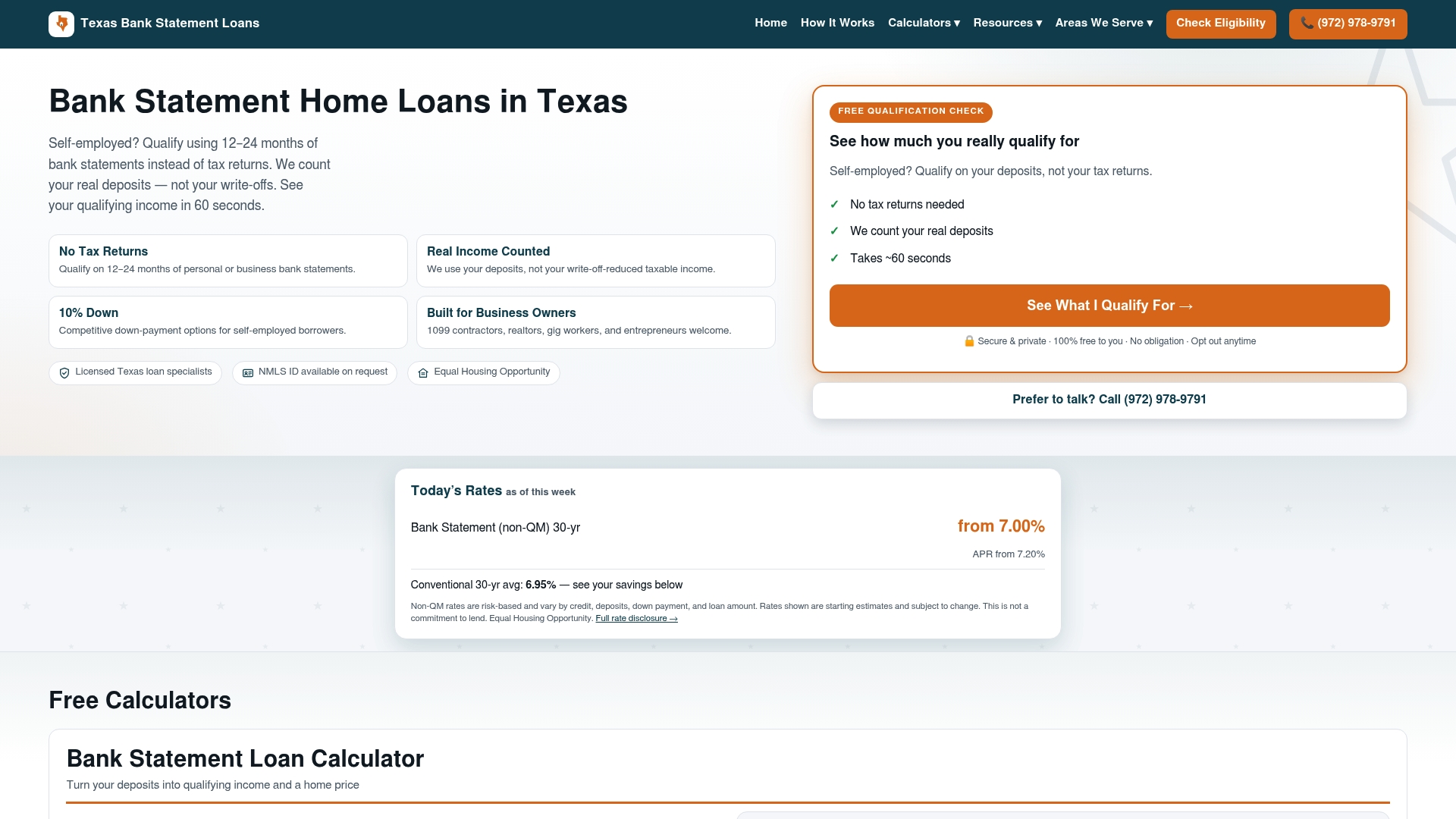
Down payments start at 10% for qualifying borrowers, and the quick qualification check takes about 60 seconds to give you a realistic sense of what you can afford, no obligation attached. Business owners, gig workers, and 1099 contractors across Texas markets, including Houston and Plano, use this path when conventional underwriting undercounts their income.
After a quick check, expect a request for bank statements, basic identification, and a short conversation about your business structure before formal pre-qualification. Start with the affordability calculator or visit the main bank statement loan page to see what your deposits could qualify you for today.
Where to Verify the Rules Yourself
- Freddie Mac’s guidance for self-employed borrowers explains how lenders assess stability and qualifying income.
- The CFPB’s guide on mortgage denials covers your options and defines Qualified Mortgages.
- The IRS Self-Employed Individuals Tax Center lists the forms and transcripts lenders request.
- NMLS Consumer Access lets you verify any loan officer’s or lender’s registration before you share financial documents.
This article is general information, not a substitute for advice from a qualified financial advisor. Consult a qualified financial professional about your own circumstances before acting on anything here.
Sources
- Non‑QM loans guide - HousingWire
- Self‑Employed Individuals Tax Center - IRS
- Bank statement loans: The self‑employed mortgage alternative (Stacking Capital)
See what you qualify for in 60 seconds, free and no credit check. Use the eligibility check at the top of this page.