
A low down payment self-employed mortgage lets you buy a home with as little as 3% down by using specific loan programs and documentation methods designed for borrowers without traditional W-2 income. Self-employed individuals and 1099 contractors face a real challenge: lenders want predictable income, but your tax returns often show less than you actually earn after deductions. The good news is that multiple loan programs, including conventional, FHA, VA, USDA, and Non-QM bank statement loans, exist specifically to address this gap. Understanding which program fits your situation is the first step toward closing on a home in 2026.
What low down payment mortgage programs are available for self-employed borrowers?
Self-employed borrowers have more loan options than most realize. The right program depends on your credit score, income documentation, military status, and property location.
-
Conventional loans (Fannie Mae HomeReady): HomeReady requires as little as 3% down for qualifying borrowers. Private mortgage insurance (PMI) applies when your down payment falls below 20%, but PMI cancels once equity reaches 20%. This makes conventional loans a strong starting point for self-employed borrowers with solid credit and two years of tax returns.
-
FHA loans: The Federal Housing Administration backs loans with a minimum 3.5% down payment and accepts credit scores as low as 580. FHA loans carry mortgage insurance premiums for the life of the loan in most cases, which raises your monthly cost. They work well for self-employed borrowers who have lower credit scores but consistent bank deposit history.
-
VA loans: Eligible veterans and active-duty service members can access 0% down with no monthly PMI. A one-time funding fee applies, but the absence of monthly mortgage insurance significantly reduces carrying costs. Self-employed veterans who qualify here have the strongest low down payment option available.
-
USDA loans: The U.S. Department of Agriculture offers $0 down for rural properties that meet location and income eligibility requirements. A guarantee fee and annual mortgage insurance apply. Self-employed borrowers in qualifying Texas counties can use this program with standard income documentation.
-
Non-QM bank statement loans: These loans accept 12-24 months of bank deposits instead of tax returns. Down payments typically run 10-20%, which is higher than government-backed options. Texasbankstatementloans specializes in this program for self-employed borrowers whose tax returns understate their real income.
How do lenders verify income for self-employed borrowers?
Income verification is the single biggest obstacle for self-employed mortgage applicants. Lenders cannot simply look at your pay stubs, so they require a broader set of documents to build a picture of your earning stability.
Standard documentation for conventional, FHA, VA, and USDA loans includes:
- Two years of personal and business tax returns with all relevant schedules, including Schedule C, Schedule E, and K-1 forms where applicable
- A year-to-date profit and loss statement prepared by a CPA or licensed accountant
- Two years of business bank statements to confirm active cash flow
- Business licenses or letters from a CPA confirming two or more years of self-employment
- 1099 forms for contractors who receive them from clients
The core problem is the add-back calculation. Lenders take your net income from your tax return and add back certain non-cash deductions like depreciation. The resulting number is often lower than what you actually deposit each month. A freelance graphic designer earning $120,000 in gross revenue might show $60,000 in net income after deductions. That lower figure is what most lenders use to calculate your qualifying income.
Non-QM bank statement loans solve this by analyzing your actual deposits. Lenders using bank statement programs review 12-24 months of deposits and apply an expense ratio to estimate net income. This approach captures your real cash flow rather than your tax-optimized income.

Pro Tip: Keep your personal and business bank accounts completely separate. Lenders reviewing bank statements flag mixed accounts as a documentation problem, which slows approval and can reduce your qualifying income.
Being organized matters as much as the numbers themselves. Responding quickly and accurately to documentation requests is one of the most direct ways to keep your application moving. Delays in submitting paperwork give underwriters reason to question your reliability as a borrower.
How to prepare for a low down payment mortgage as a self-employed borrower
Preparation done 12-24 months before you apply makes a measurable difference in your approval odds and the rate you receive.
-
Build your credit score to 740 or above. Rates improve significantly at this threshold. Pay down revolving balances, avoid new credit inquiries, and dispute any errors on your credit report well before you apply.
-
Save cash reserves beyond your down payment. Most lenders want to see two to six months of mortgage payments in reserve after closing. Reserves signal that you can cover payments during a slow business month.
-
Reduce discretionary write-offs in the tax year before you apply. Every dollar you deduct lowers your qualifying income. A business owner who writes off $30,000 in meals, travel, and equipment the year before applying may disqualify themselves from programs they would otherwise fit. Talk to your CPA about this trade-off early.
-
Organize your financial records now. Create a dedicated folder with two years of tax returns, 12-24 months of bank statements, your profit and loss statement, and your business license. Lenders will ask for all of it.
-
Use a self-employed affordability calculator. Tools like the affordability calculator at Texasbankstatementloans let you estimate how much home you can realistically qualify for before you start shopping.
-
Ask about gift funds and down payment assistance programs. Texas offers several state and local down payment assistance programs for qualifying buyers. Gift funds from family members are also acceptable under FHA and conventional guidelines with proper documentation.
-
Compare multiple loan programs before committing. A borrower who qualifies for both an FHA loan and a Non-QM bank statement loan needs to compare total costs, not just down payment size. The FHA loan may require less upfront but carry higher long-term insurance costs.
Pro Tip: If your income has grown significantly in year two compared to year one, ask your lender whether they can use a 12-month average instead of a 24-month average. Some programs allow this when income trends upward.
What alternative mortgage paths exist for self-employed borrowers?
Non-QM bank statement loans are the most practical alternative for self-employed borrowers whose tax returns do not reflect their actual income. These loans sit outside the Fannie Mae and Freddie Mac guidelines, which means lenders set their own qualification standards.
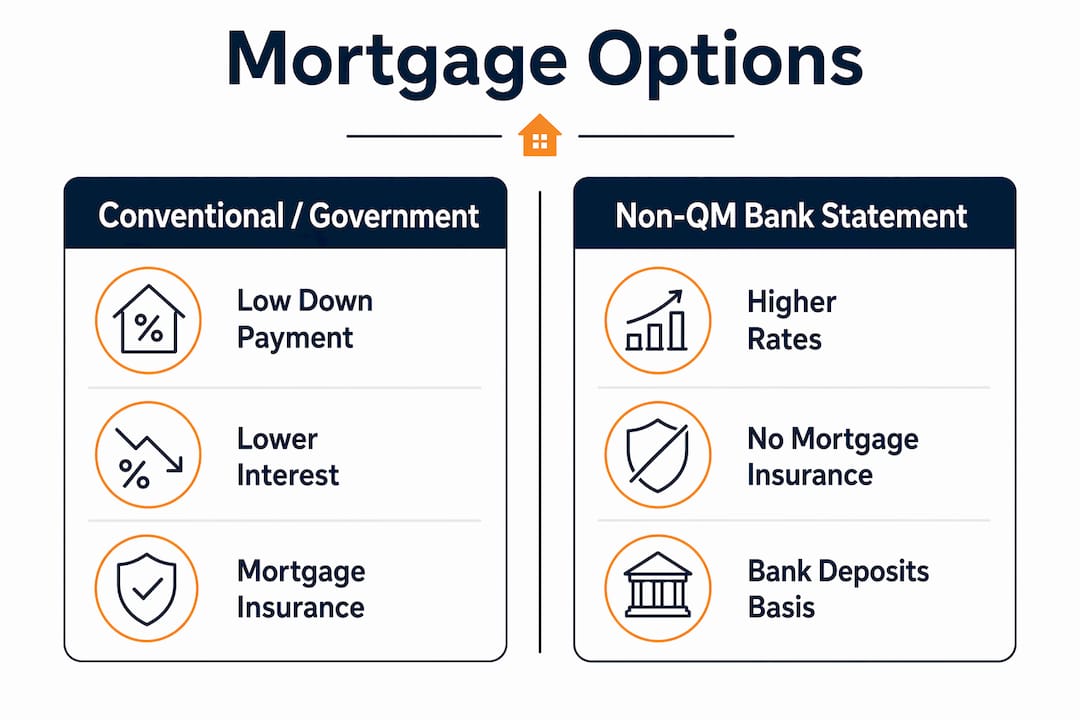
The key trade-off is cost versus access. Non-QM loans carry interest rates 0.5%-1.5% above conventional mortgages because lenders take on more risk by stepping outside standard guidelines. That premium is real, but for a borrower who cannot qualify any other way, it is the price of homeownership.
| Feature | Conventional / Government loans | Non-QM bank statement loans |
|---|---|---|
| Down payment | 0%-5% (program dependent) | 10%-20% |
| Income verification | Tax returns, W-2s, pay stubs | 12-24 months of bank deposits |
| Credit score minimum | 580-620 (FHA); 620+ (conventional) | Typically 660 or higher |
| Mortgage insurance | Required under 20% down (most programs) | Generally not required |
| Interest rate | Market rate | 0.5%-1.5% above conventional |
| Best for | Borrowers with clean tax return income | Borrowers with high deposits but low reported income |
No mortgage insurance on Non-QM loans is a meaningful offset to the higher rate. A borrower putting 10% down on a conventional loan pays PMI monthly until they reach 20% equity. A Non-QM borrower at 10% down avoids that cost entirely, which narrows the real payment gap between the two options.
State and local down payment assistance programs can also apply to Non-QM loans in some cases. Texas programs like the Texas State Affordable Housing Corporation (TSAHC) offer grants and second-lien loans that reduce upfront costs for qualifying buyers.
What are common pitfalls when applying for a low down payment mortgage as self-employed?
Most self-employed mortgage applications that stall or get denied share the same set of problems. Knowing them in advance puts you ahead of the majority of applicants.
-
Inconsistent income documentation. If your tax return shows one income figure and your bank statements show another, underwriters flag the discrepancy. Every document you submit needs to tell the same story.
-
Ignoring lender requests for additional paperwork. Documentation requests are standard underwriting requirements, not red flags. Treating them as optional or responding slowly is one of the fastest ways to lose a rate lock or miss a closing date.
-
Overestimating income after write-offs. Many self-employed borrowers assume their gross revenue is what lenders see. Lenders use net income after deductions for most programs. Running your numbers through a mortgage calculator before applying prevents this surprise.
-
Insufficient reserves. Saving exactly enough for the down payment and closing costs leaves no buffer. Lenders want to see cash remaining after closing, and thin reserves can trigger a denial even when income qualifies.
-
Skipping Non-QM options because of the higher rate. Some borrowers rule out bank statement loans based on the rate alone without calculating total cost. A slightly higher rate with no PMI can cost less per month than a lower rate with PMI.
Pro Tip: Ask your loan officer to run a side-by-side comparison of your total monthly payment under each program you qualify for, including PMI, mortgage insurance premiums, and the rate. The lowest rate is not always the lowest payment.
Key Takeaways
Self-employed borrowers can access low down payment mortgages by matching their documentation type to the right loan program, with options ranging from 0% down for veterans to 10% down for bank statement loans.
| Point | Details |
|---|---|
| Multiple programs available | Conventional, FHA, VA, USDA, and Non-QM loans each offer distinct down payment minimums for self-employed borrowers. |
| Income verification is the core challenge | Lenders use net income from tax returns, which is often lower than actual deposits due to business deductions. |
| Bank statement loans fill the gap | Non-QM programs use 12-24 months of deposits to qualify borrowers whose tax returns understate income. |
| Preparation improves approval odds | Saving reserves, building credit above 740, and organizing documents 12-24 months early strengthens any application. |
| Total cost matters more than rate | Comparing PMI, mortgage insurance, and rate together reveals which program is actually cheaper month to month. |
What I have learned about self-employed mortgages that most articles skip
The conventional wisdom says self-employed borrowers just need to “get organized.” That is true but incomplete. What I have seen repeatedly is that the borrowers who get approved quickly are not necessarily the ones with the highest income. They are the ones who understand how lenders read their documents.
A lender does not see your business the way you do. They see a spreadsheet of income and expenses, and they apply formulas to it. A self-employed borrower who earns $150,000 but writes off $90,000 looks like a $60,000 earner to a conventional underwriter. That same borrower, applying through a bank statement loan program, might qualify on $130,000 of actual deposits. The program you choose changes the income number the lender works with.
The other thing most articles miss is the timing of write-offs. I have talked with borrowers who aggressively deducted expenses in the year before applying and then could not qualify for the home they wanted. The tax savings were real, but the mortgage cost was higher. Working with a CPA who understands mortgage qualification, not just tax minimization, is genuinely worth the extra conversation.
My honest take is that the self-employed mortgage process is harder than it should be, but it is not as hard as most borrowers fear. The path exists. You just need to know which door to walk through.
- Saad
Texasbankstatementloans: built for self-employed borrowers in Texas
Self-employed buyers in Texas do not have to fit into a W-2 box to buy a home. Texasbankstatementloans evaluates 12-24 months of bank deposits instead of tax returns, which means your actual income drives your qualification, not your deductions.
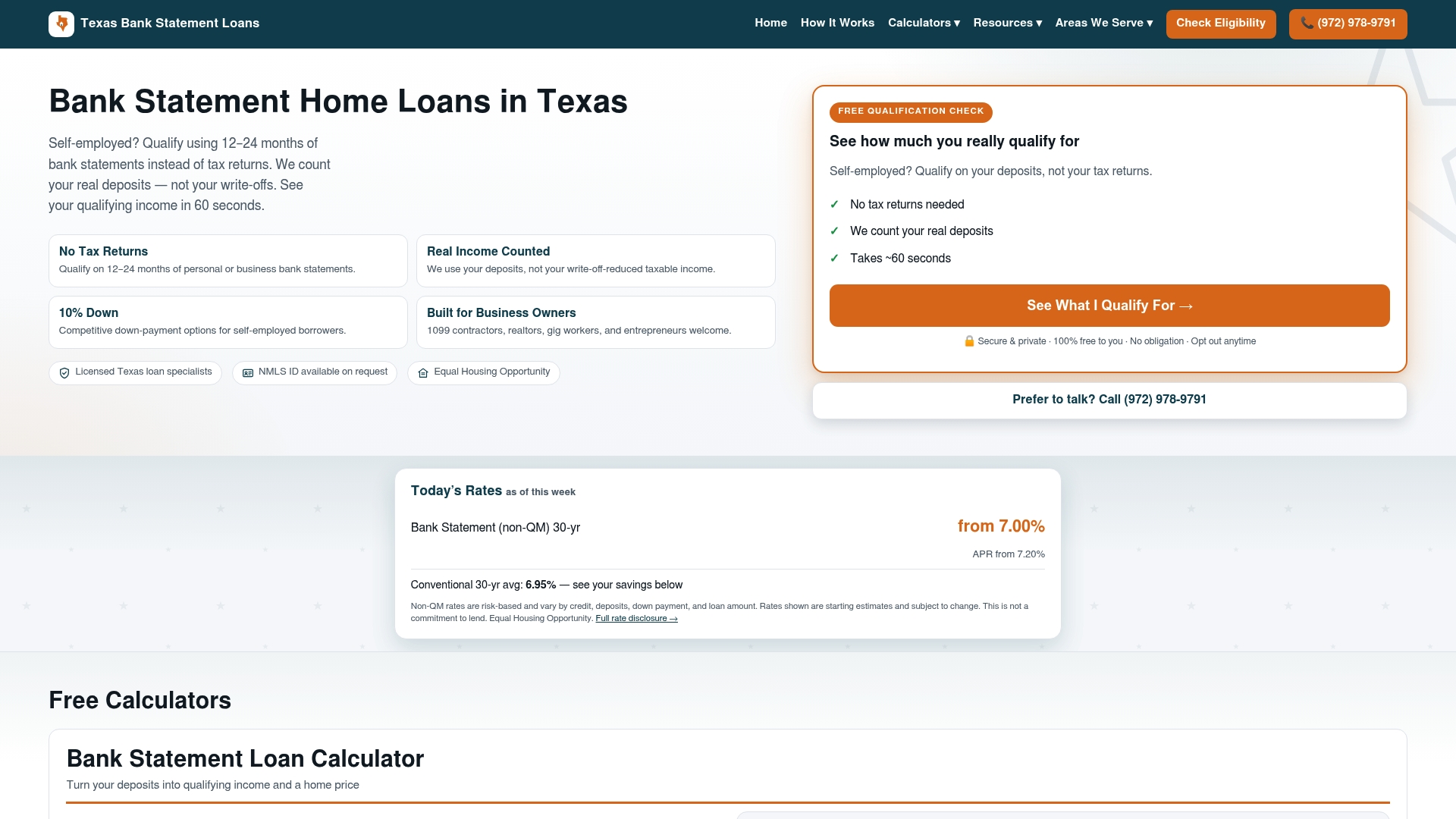
Down payments start at 10% for eligible borrowers, and the program covers major Texas markets including Houston, San Antonio, and Midland. You can check today’s current loan rates and run a 60-second qualification check to see what you realistically qualify for. The process is straightforward, and the guidance is specific to self-employed borrowers, not generic mortgage advice.
FAQ
What is the minimum down payment for a self-employed mortgage?
The minimum depends on the loan program. FHA loans require 3.5% down, conventional loans start at 3%, VA and USDA loans offer 0% down for eligible borrowers, and Non-QM bank statement loans typically require 10%-20% down.
Can I get a mortgage using bank statements instead of tax returns?
Yes. Non-QM bank statement loans use 12-24 months of bank deposits to verify income instead of tax returns. These programs are designed for self-employed borrowers whose tax returns show lower income due to business deductions.
Why do self-employed borrowers often need a larger down payment?
Lenders calculate qualifying income from net income on tax returns, which is reduced by business deductions. Lower reported income raises the lender’s risk, which is why Non-QM programs require 10%-20% down compared to 3%-5% for conventional loans.
What credit score do I need for a low down payment self-employed mortgage?
FHA loans accept scores as low as 580. Conventional loans generally require 620 or higher. Non-QM bank statement loans typically require 660 or above, and a score of 740 or higher gets you the best available rates across all programs.
Does being self-employed hurt my mortgage application?
It adds documentation complexity, but it does not automatically disqualify you. Lenders have clear processes for self-employed income verification, and programs like bank statement loans exist specifically to serve borrowers with non-traditional income documentation.
Recommended
See what you qualify for in 60 seconds, free and no credit check. Use the eligibility check at the top of this page.