
There is no blanket income-based phase-out that wipes out the mortgage interest deduction entirely. What actually limits the deduction are debt caps, a PMI-specific AGI phase-out, and indirect restrictions like the Alternative Minimum Tax (AMT). For mortgages originated after December 15, 2017, the qualified acquisition debt cap is $750,000, while older loans are subject to a higher $1,000,000 cap. The One Big Beautiful Bill Act (OBBBA) made the $750,000 cap permanent and restored PMI deductibility starting in tax year 2026, subject to an AGI-based phase-out. No single income threshold strips the deduction away, but high earners face real indirect limits.
Key facts at a glance:
- Debt cap: The debt cap differs for loans based on their origination date, with lower and higher caps for newer and older loans respectively.
- MFS halving: The caps are halved for married taxpayers filing separately.
- PMI: Deductible again starting tax year 2026 under OBBBA, with an AGI phase-out that reduces and eventually eliminates the benefit for higher earners.
- No income floor to claim: There is no AGI threshold that by itself removes the right to deduct qualified mortgage interest.
- Itemizing required: The deduction only produces a tax benefit when your Schedule A total exceeds the standard deduction.
- Immediate action: Check your Form 1098 for reported interest, confirm your loan origination date, and compare your Schedule A total against the standard deduction before assuming you benefit.
Table of Contents
- How the mortgage interest deduction actually works
- Current limits and how to calculate your deductible interest
- Home equity loans and HELOCs: when interest is deductible
- Points, PMI, and other related items: current status and effective dates
- How to claim the deduction and what records you need
- Recent legislative changes: OBBBA, effective dates, and what to watch
- Tax-planning scenarios and practical strategies
- Documenting mortgage interest for self-employed and nontraditional-income borrowers
- Key Takeaways
- The rules are stable, but the planning still takes work
- Authoritative sources and further reading
How the mortgage interest deduction actually works
The deduction covers interest paid on a loan secured by a qualified residence and used to buy, build, or substantially improve that residence. That last phrase matters more than most taxpayers realize. If the loan proceeds are used for other purposes, such as paying off credit cards, the interest does not qualify as deductible acquisition debt, even if the home is collateral.
A qualified residence is your main home plus one second home. You choose which second home qualifies each year, and you can change that choice annually. If you rent out a second home, you must use it personally for more than 14 days or 10% of the rental days, whichever is greater, for it to count as a qualified residence.
Why itemizing is the gate. The deduction lives on Schedule A (Form 1040), which means you only benefit if your total itemized deductions exceed the standard deduction for your filing status. For many taxpayers with smaller mortgages or lower interest rates, the standard deduction wins, and the mortgage interest deduction produces zero additional tax benefit. Run the comparison every year, especially after a refinance changes your interest-to-principal ratio.
Form 1098 is your starting point. Your lender sends Form 1098 (Mortgage Interest Statement) each January, reporting the interest you paid in box 1, any mortgage insurance premiums in box 5, and deductible points in box 6. That figure goes directly onto Schedule A, but it is not always the final number. If your loan balance exceeds the applicable cap, you must prorate.
- Mixed-use homes:, If part of your home is a dedicated business space, allocate the interest. The business-use portion goes on Schedule C (or Schedule E for rental), not Schedule A. Self-employed borrowers who deduct a home office need to be precise here because double-counting is a common audit trigger.
Pro Tip: If you own two second homes, calculate which one produces more deductible interest under the cap and designate that one as your qualified second residence for the year. You can switch the designation annually.
Current limits and how to calculate your deductible interest
The limits hinge on one date: December 15, 2017. IRS Publication 936 is the authoritative source for the worksheet (Table 1) that walks you through the proration calculation line by line.
Loan limits by origination date
| Loan category | Filing jointly cap | Married filing separately cap |
|---|---|---|
| Grandfathered debt (pre-Oct. 14, 1987) | Unlimited (subject to fair market value) | Unlimited (subject to fair market value) |
| Acquisition debt, Dec. 16, 2017 or earlier | $1,000,000 | $500,000 |
| Acquisition debt, after Dec. 15, 2017 | $750,000 | $375,000 |
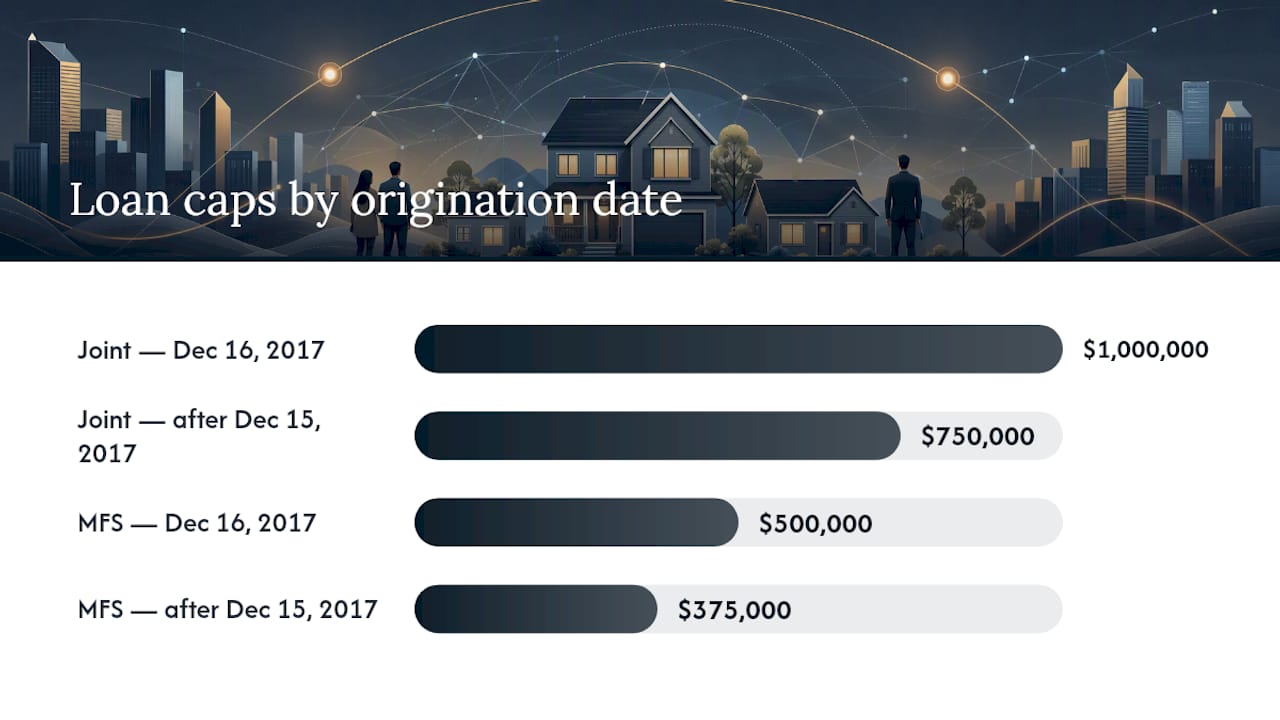
Grandfathered debt (pre-October 14, 1987) does not reduce the newer caps, but it does count against the overall fair-market-value limit of the home. Post-1987 acquisition debt from the two categories above is combined when you hold both types simultaneously, and the applicable cap is $1,000,000 for loans originated on or before December 15, 2017, and $750,000 for loans originated after that date.
How the proration works
When your average loan balance exceeds the cap, only a fraction of your interest is deductible. The formula is straightforward:
Deductible interest = Total interest paid × (Applicable cap ÷ Average loan balance)
This proration limits deductible interest when loan balances exceed applicable caps, causing some interest to be nondeductible. The nondeductible portion increases as loan balances or interest rates rise. The Publication 936 web page links directly to the Table 1 worksheet so you can work through your specific numbers.
- Multiple loans:, Add the average balances of all qualified loans on your main home and second home before comparing to the cap.
Pro Tip: Your loan origination date is on the closing disclosure or HUD-1 settlement statement. County recorder records are a backup if you cannot locate original loan documents. Get the exact date before preparing Schedule A, because a single day can determine which cap applies.
Home equity loans and HELOCs: when interest is deductible
The rule here is conditional, and the condition is strict. Interest on a home equity loan or HELOC is deductible only when the proceeds are used to buy, build, or substantially improve the home that secures the loan. Using a HELOC to pay tuition, consolidate debt, or buy a car produces nondeductible interest, full stop, regardless of what the loan documents call it.
- Deductible uses:, Kitchen remodel, bathroom addition, roof replacement, new HVAC system, structural repairs. The work must be on the home that secures the loan.
Refinances and acquisition debt status. When you refinance, the new loan retains acquisition-debt character only up to the balance of the old mortgage immediately before closing. If you refinance a $400,000 mortgage into a $500,000 loan and pocket $100,000 in cash, that $100,000 is home equity debt. Its interest is deductible only if you use those funds to substantially improve the home.
Documentation is everything here. Keep contractor invoices, permits, and bank records showing the HELOC draws went directly to the contractor or home-improvement account. The IRS requires you to trace proceeds, and “I used it for the house” without receipts will not hold up in an audit.
Points, PMI, and other related items: current status and effective dates
Points
Points paid to obtain a mortgage are generally deductible in the year paid if they meet IRS requirements: the loan is secured by your main home, paying points is an established practice in your area, and the points do not exceed what is customary. Points on a refinance are typically amortized over the life of the loan rather than deducted upfront. Both scenarios are subject to the same qualified loan limits that apply to mortgage interest.
PMI: restored for 2026
Private Mortgage Insurance premiums were deductible for several years, expired, and have now been restored by the OBBBA starting in tax year 2026. This is one of the more consequential changes for first-time buyers and lower-down-payment borrowers. The deduction phases out based on adjusted gross income (AGI), reducing benefits for higher earners and affecting the decision to itemize versus taking the standard deduction for borrowers who pay PMI.
- Form 1098, Box 5, reports mortgage insurance premiums. Verify this figure matches your annual PMI statements.
- Lender errors:, If the Form 1098 figure differs from your records, do not simply use the wrong number. Attach a statement to your return explaining the discrepancy. The IRS instructions for Schedule A describe exactly how to handle this.
How to claim the deduction and what records you need
- Gather your Form 1098(s). Collect one from each lender. If you have a main home and a second home with separate loans, you need both.
- Determine qualified interest. Compare your average loan balance to the applicable cap. If you are over the cap, apply the proration formula from Publication 936’s Table 1 worksheet.
- Complete Schedule A, Line 8a. Enter deductible home mortgage interest reported on Form 1098. Use Line 8b for interest not reported on Form 1098 (seller financing, for example), and attach the required statement.
- Add points (Line 8c) and PMI (Line 8d for 2026 returns). Verify each figure against your Form 1098 and closing disclosure.
- Compare to the standard deduction. If your Schedule A total does not exceed the standard deduction for your filing status, the standard deduction wins and you get no additional benefit from mortgage interest.
- File Schedule A with Form 1040. The total from Schedule A flows to Line 12 of Form 1040.
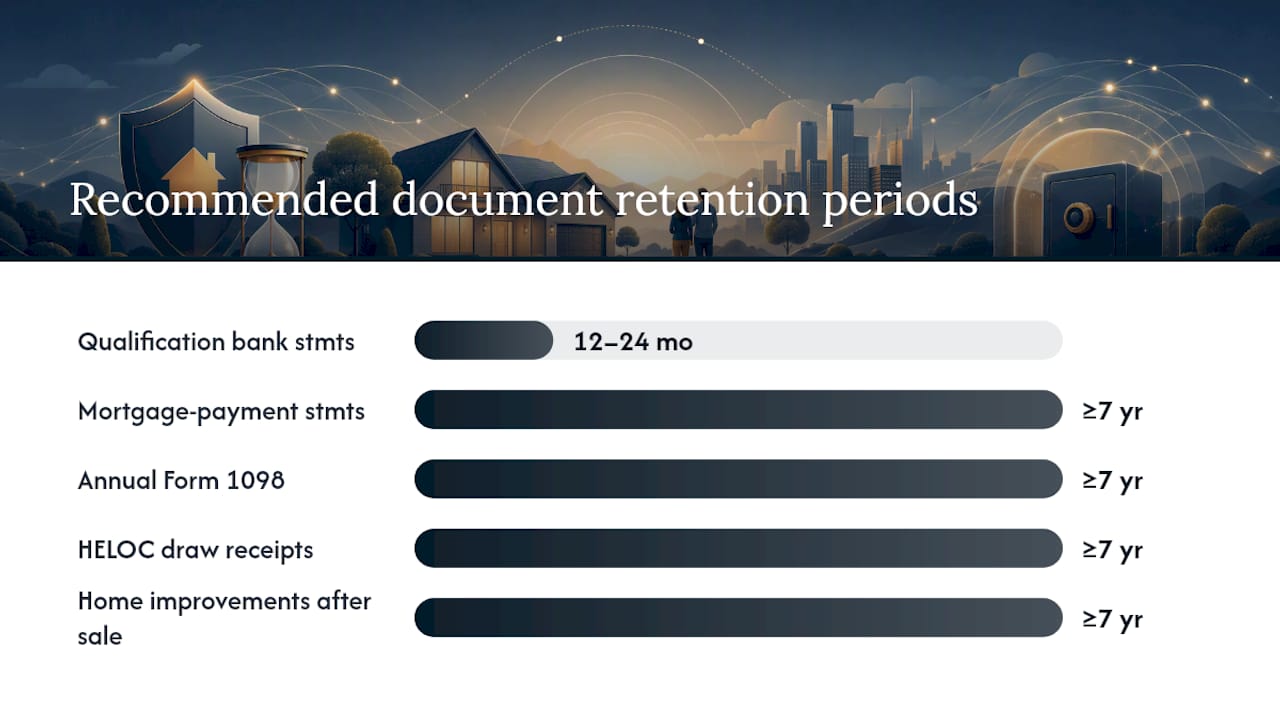
Records to keep and for how long. The IRS generally has three years to audit a return, but six years if income is underreported by more than 25%. Keep these documents for at least seven years:
- Closing disclosure or HUD-1 settlement statement (shows origination date and loan amount)
- Annual Form 1098 from each lender
- Loan statements showing monthly balances
- Cancelled checks or bank statements confirming payments
- Contractor invoices and receipts for any home improvements funded by a HELOC
- Documentation of HELOC draw purposes (bank transfers, receipts, permits)
Pro Tip: Create a dedicated folder (physical or digital) for each property you own. Label it with the address and origination date. Auditors ask for origination dates immediately, and having the closing disclosure on hand saves hours of scrambling.
Tax software like TurboTax or H&R Block will walk you through the Schedule A questions and flag whether itemizing beats the standard deduction. What the software cannot do automatically is verify your loan origination date or catch a proration error when you have mixed-vintage loans. A tax professional who reviews origination dates, checks for binding-contract exceptions, and confirms HELOC tracing is worth the fee for anyone with a complex mortgage situation.
Recent legislative changes: OBBBA, effective dates, and what to watch
The most significant recent change to mortgage interest rules came from the One Big Beautiful Bill Act (OBBBA). Here is what changed and when it takes effect.
- $750,000 cap made permanent: Under the Tax Cuts and Jobs Act (TCJA) of 2017, the $750,000 acquisition-debt limit was set to expire after 2025, reverting to $1,000,000. OBBBA §70108 permanently extended the $750,000 cap, so post-December 15, 2017 loans will not see the limit change after 2025. The JCT’s 2024 analysis provides the fiscal and technical background on this provision.
- PMI deductibility restored: PMI premiums are deductible again starting in tax year 2026. The deduction phases out for higher-AGI filers.
- Grandfathered loans unchanged: Loans originated on or before December 15, 2017 retain the $1,000,000 cap. OBBBA did not alter that.
- SALT cap: The OBBBA also addressed the state and local tax (SALT) deduction cap, which interacts with mortgage interest because both live on Schedule A. Changes to the SALT cap affect whether itemizing makes sense at all for taxpayers in high-tax states.
Key dates
| Event | Date / Tax year |
|---|---|
| TCJA $750,000 cap effective | Loans after Dec. 15, 2017 |
| TCJA scheduled to expire | After tax year 2025 |
| OBBBA signed into law | 2025 |
| $750,000 cap made permanent | Tax year 2026 and forward |
| PMI deductibility restored | Tax year 2026 |
The Congressional Research Service report on the mortgage interest deduction provides historical context and policy analysis for anyone tracking how these rules evolved and where future reform discussions may go.
Where to monitor ongoing changes:
- Congress.gov for bill text and status
- IRS.gov for updated Publication 936 and guidance
- Joint Committee on Taxation (jct.gov) for technical analyses
Tax-planning scenarios and practical strategies
-
Refinancing across a cap boundary. If you refinance a pre-2018 loan, the new loan takes the origination date of the refinance, not the original loan. That means a $900,000 balance refinanced in 2022 is now subject to the $750,000 cap, not the $1,000,000 cap. The deductible interest drops accordingly. Before refinancing a large pre-2018 mortgage, calculate the after-tax cost of the new rate against the lost deductibility on the excess balance.
-
Buying before vs. after a cap-change date. With the $750,000 cap now permanent under OBBBA, the urgency to close before a sunset date is gone for post-2017 loans. However, if you are purchasing with a loan above $750,000, you will always be prorating. Use a mortgage payment calculator to estimate year-one interest and then apply the proration formula to see your actual deductible amount.
-
Married filing separately. Filing separately halves both caps. A couple with a $750,000 joint mortgage filing separately can each deduct interest on only $375,000 of debt. In most cases, filing jointly produces a better combined result. Run both scenarios before choosing.
-
Combining two mortgages with mixed origination dates. If you have a 2016 loan at $600,000 and a 2021 HELOC at $200,000 used for home improvements, the combined balance is $800,000. The 2016 loan is subject to the $1,000,000 cap; the 2021 HELOC is subject to the $750,000 cap. A tax professional using the Publication 936 worksheet will calculate the blended deductible amount. Do not guess at this.
Worked refinance example. You had a $850,000 mortgage from 2016 (cap: $1,000,000). You refinanced in 2023 into a new $850,000 loan. The new loan’s origination date is 2023, so the $750,000 cap applies. You paid $46,750 in interest. Deductible interest = $46,750 × ($750,000 ÷ $850,000) = $41,250. The $5,500 difference is nondeductible.
Practical strategies:
- Time HELOC draws carefully. Draw funds and pay contractors in the same tax year when possible. Contemporaneous documentation is far easier to reconstruct than records from three years ago.
- PMI and moderate-AGI borrowers. If your AGI is below the phase-out threshold, the restored PMI deduction for 2026 may tip the balance toward itemizing. Calculate your Schedule A total including PMI before defaulting to the standard deduction.
- Document HELOC purpose at the time of the draw. A note in your records stating “Draw #3, $15,000 to ABC Roofing, invoice #1042” takes 30 seconds and is worth its weight in an audit.
Common mistakes that erode the deduction:
- Assuming all HELOC interest is deductible regardless of how the money was used.
- Failing to track which loan originated when after a refinance.
- Allocating 100% of mortgage interest to Schedule A when part of the home is a dedicated business space.
- Ignoring the proration requirement when combined loan balances exceed the cap.
Documenting mortgage interest for self-employed and nontraditional-income borrowers
Self-employed borrowers face a documentation challenge that W-2 employees do not: the same bank deposits used to qualify for a bank-statement mortgage may also be the source of mortgage payments, and the IRS expects clean records showing where the money came from and where it went.
Core document checklist:
- Loan closing disclosure or HUD-1 (confirms origination date, loan amount, and initial balance)
- Form 1098 from each lender for each tax year
- 12-24 months of bank statements (the same statements used for mortgage qualification)
- Cancelled checks or ACH records confirming each mortgage payment
- Contractor invoices, permits, and lien waivers for any substantial improvements funded by a HELOC
- HELOC draw history and receipts showing the purpose of each draw
- Business bank statements if business funds were used to make mortgage payments
Allocating interest between Schedule A and Schedule C. If you claim a home office deduction, the business-use percentage of your home’s square footage determines how much mortgage interest goes on Schedule C (or Form 8829) versus Schedule A. The two amounts must add up to your total interest paid. Claiming the same interest on both forms is a clear audit trigger. For self-employed borrowers in Texas using bank-statement underwriting, this allocation is especially important because the income documentation overlaps with the records the IRS would examine.
Pro Tip: If you used business distributions or company account transfers to make personal mortgage payments, keep a contemporaneous memo or transaction note linking each transfer to the business receipt it came from. This prevents the appearance of double-counting interest as both a business expense and a personal Schedule A deduction.
Record retention timeline:
| Document type | Recommended retention |
|---|---|
| Closing disclosure / HUD-1 | Permanently |
| Annual Form 1098 | At least 7 years |
| Bank statements (mortgage payments) | At least 7 years |
| HELOC draw receipts and invoices | At least 7 years from the year of the draw |
| Home improvement records | At least 7 years after sale of the property |
Organize records by property address and tax year. A simple folder structure, whether physical or in cloud storage, makes a potential audit manageable rather than catastrophic.
Key Takeaways
The mortgage interest deduction has no single income-based phase-out, but debt caps, the PMI AGI phase-out, and AMT can all reduce the benefit depending on your loan characteristics and income level.
| Point | Details |
|---|---|
| No income-based elimination | No AGI threshold removes the right to deduct qualified mortgage interest outright. |
| Debt caps by origination date | Loans originated before and after a key date have different acquisition debt caps, with the newer loans subject to a lower cap. |
| PMI restored for 2026 | PMI deductibility was reinstated starting tax year 2026, subject to an AGI-based phase-out. |
| HELOC interest is conditional | Interest is deductible only when proceeds are used to buy, build, or substantially improve the secured home. |
| Itemizing is required | The deduction only produces a benefit when Schedule A total exceeds the standard deduction. |
The rules are stable, but the planning still takes work
The OBBBA’s permanent extension of the $750,000 cap removes one source of uncertainty that had been hanging over post-2017 borrowers for years. That is genuinely useful. Taxpayers who bought after December 2017 no longer need to plan around a potential reversion to $1,000,000 limits that would have changed their proration math. The rules are now stable enough to build a multi-year tax plan around.
What I find underappreciated, though, is how much the practical complexity has increased even as the statutory picture clarified. The interaction between the debt caps, the restored PMI phase-out, the SALT cap changes, and the AMT means that two taxpayers with identical mortgage balances can have very different effective deductions depending on their AGI, filing status, and how their HELOC proceeds were used. The worksheet in Publication 936 handles the math, but the inputs to that worksheet require documentation that many borrowers simply do not keep.
Self-employed borrowers have an additional layer. The bank statements that qualify you for a bank-statement mortgage are the same records the IRS would examine if your Schedule A deduction were questioned. Keeping those records organized is not just good tax hygiene; it is the connective tissue between your mortgage qualification and your tax position. Use a self-employed affordability calculator to model different loan sizes and their interest costs before committing to a purchase price, and then carry that same discipline into your tax recordkeeping.
The taxpayers who get this wrong are not the ones with complicated situations. They are the ones who assumed their HELOC interest was automatically deductible, or who refinanced without checking the origination-date implications, or who never compared their Schedule A total to the standard deduction. The rules reward attention to detail more than they reward any particular income level or loan size.
This article is general information, not tax or legal advice. Consult a qualified tax professional for guidance specific to your situation.
Authoritative sources and further reading
The sources below are the primary references for the rules covered in this article. Each one is worth bookmarking for ongoing monitoring.
- Publication 936 (2025), Home Mortgage Interest Deduction
- About Form 1098, Mortgage Interest Statement
- About Schedule A (Form 1040)
- JCT 2024 report (JCX-48-24)
- The Mortgage Interest Deduction, CRS (IF12789)
Calculators and tools for self-employed borrowers:
- Mortgage payment calculator: Estimate year-one interest for different loan sizes to model your potential Schedule A deduction before you close.
- Free mortgage calculators and tools: Full suite including bank-statement qualification and affordability tools for self-employed borrowers in Texas.
State conformity note. Texas has no state income tax, so state conformity to federal mortgage interest rules is not a concern for most Texas borrowers. If you own property in another state, check that state’s conformity to federal itemized deduction rules, since some states cap or disallow the federal mortgage interest deduction on state returns.
Self-employed in Texas and shopping for a mortgage? Texasbankstatementloans qualifies borrowers using 12-24 months of bank deposits rather than tax returns, with down payments starting at 10%. See what you qualify for in 60 seconds, no obligation required.
See what you qualify for in 60 seconds, free and no credit check. Use the eligibility check at the top of this page.