Yes. For most residential DSCR loans, HOA dues get folded into PITIA, the monthly obligation lenders divide your rent by, and every dollar of dues lowers your DSCR dollar-for-dollar. A $300 monthly HOA fee doesn’t just eat into your cash flow. It can pull a 1.15 DSCR down below a lender’s 1.0 floor and kill the deal outright. Check HOA fees before you write an offer, not after.
TL;DR:
- HOA dues directly lower your DSCR value because they are included in PITIA, the monthly payment used for qualification, often pushing ratios toward or below the critical 1.0 threshold.
- Lenders typically set DSCR floors between 1.0 and 1.25, making high HOA fees especially risky if they exceed 20% of gross rent, potentially disqualifying a loan.
- Including HOA dues in the rent-to-PITIA calculation can reduce your DSCR from comfortable levels like 1.33 to marginal or unacceptable levels such as 1.08 or lower, risking loan denial.
- Borrowers should request HOA documents early, and consider increasing down payment, supporting higher rent figures, or building reserves to improve DSCR when HOA fees are high.
- Running precise DSCR calculations before making an offer can prevent surprises during underwriting, especially with HOA fees that could otherwise cause a deal to fall apart.
Table of Contents
- How Do Lenders Calculate DSCR With HOA Dues?
- How Much Do HOA Dues Lower Your DSCR?
- Worked Example: DSCR With and Without HOA Dues
- What Documents Do Lenders Want for HOA Properties?
- How Can You Improve DSCR When HOA Dues Are High?
- Where Can You Run the Numbers Before Making an Offer?
- What Do Investors Get Wrong About HOA Dues and DSCR?
- Get a DSCR-Ready Pre-Qualification
- Sources
- FAQ
How Do Lenders Calculate DSCR With HOA Dues?
Commercial lenders typically calculate debt service coverage as net operating income divided by annual debt service. Residential DSCR lenders use a different, simpler convention: gross monthly rent divided by monthly PITIA. That acronym is where HOA dues quietly enter the picture.
PITIA stands for:
- Principal, the portion of your payment that reduces the loan balance
- Interest, the cost of borrowing the money
- Taxes, property tax escrowed monthly
- Insurance, hazard insurance on the property
- Association dues, your HOA or condo fee
Most residential DSCR calculations use gross monthly rent divided by PITIA, and PITIA bakes in HOA dues at the full billed amount. Before you get attached to a listing, ask the lender two questions: which formula are they using, and which rent figure feeds it? Some pull from the appraiser’s Form 1007 rent schedule, others from your signed lease. That distinction alone can move your DSCR by several points.
How Much Do HOA Dues Lower Your DSCR?
The math is unforgiving because HOA dues sit in the denominator alongside your mortgage payment. Add $100 to monthly HOA fees and your PITIA rises by $100, which drags DSCR down by exactly the same proportion a $100 tax increase would. There’s no separate “HOA discount” in the formula. It’s treated the same as principal and interest.
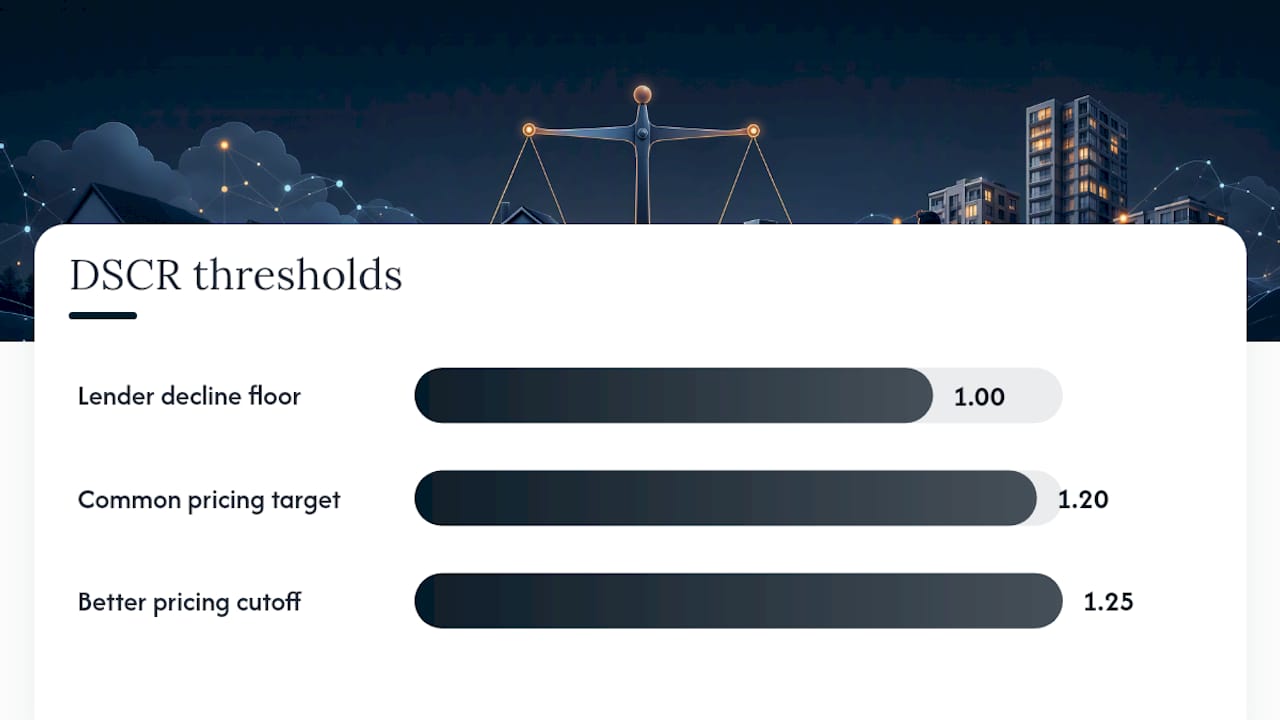
Lenders typically set DSCR floors between 1.0 and 1.25 for residential investment properties, and pricing usually improves once you clear 1.20 to 1.25. Fall below 1.0 and most lenders either decline the loan or demand a larger down payment and a higher rate to offset the risk.
HOA dues are the single expense most likely to tank an otherwise solid condo deal. When HOA fees run above roughly 20% of gross rent, hitting a 1.20+ target gets genuinely hard, even with a decent purchase price.
Some practical considerations include that HOA fees can represent a significant portion of gross rent, and these fees often increase annually, which should be factored into DSCR calculations.
- Special assessments (roof replacements, elevator repairs) can spike a monthly obligation overnight, and lenders know it.
Worked Example: DSCR With and Without HOA Dues
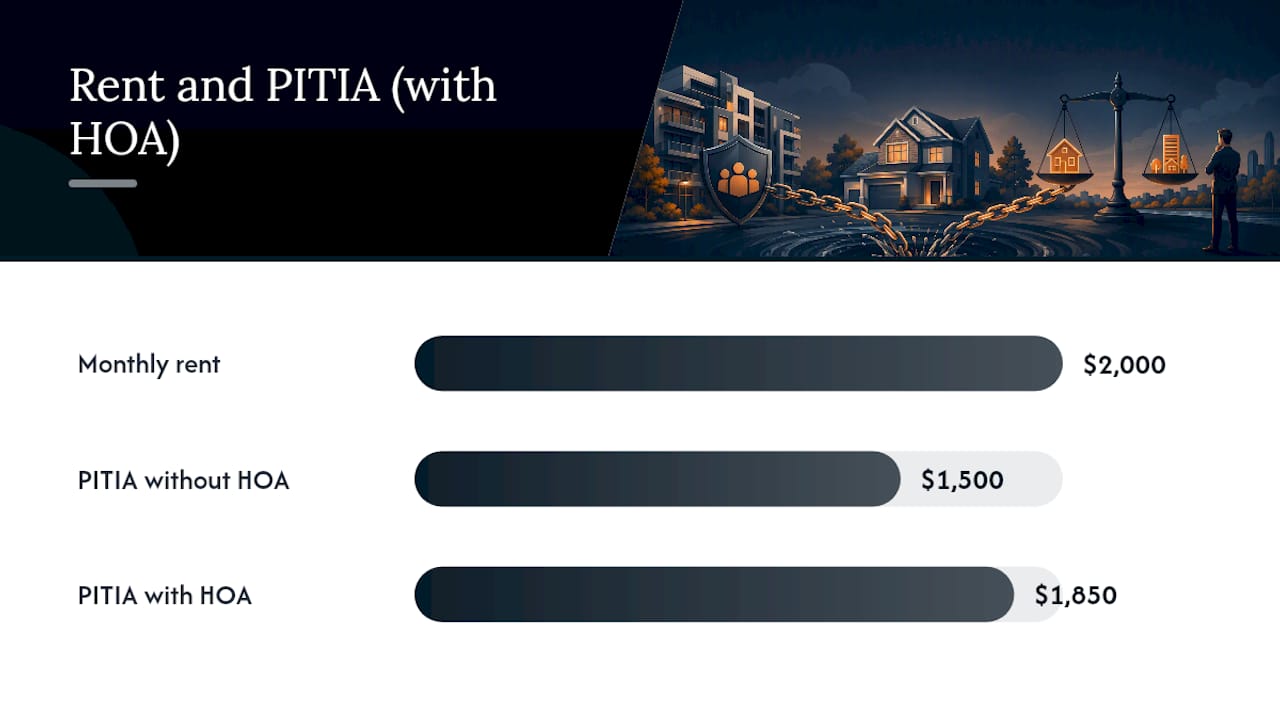
Take a condo renting for $2,000 a month. Principal and interest run $1,150, property taxes are $250, insurance is $100, and the HOA charges $350 a month.
- Without HOA in the math: PITIA would be $1,500 ($1,150 + $250 + $100). DSCR = $2,000 ÷ $1,500 = 1.33.
- With HOA included, as lenders actually calculate it: PITIA becomes $1,850 ($1,150 + $250 + $100 + $350). DSCR = $2,000 ÷ $1,850 = 1.08.
That $350 HOA fee dropped the DSCR from a comfortable 1.33 to a marginal 1.08, right at the edge of most lenders’ comfort zone. A slightly higher HOA, say $500, would push DSCR under 1.0 entirely.
One more wrinkle: lenders often use the lower of the appraiser’s Form 1007 market rent or your actual lease amount when qualifying rent. If your tenant pays $2,000 but the appraiser’s comparable rents suggest $1,800, your DSCR gets calculated on the lower number, HOA and all.
What Documents Do Lenders Want for HOA Properties?
HOA-managed properties trigger a documentation trail beyond a standard single-family purchase. Underwriters processing DSCR loans on condos or association-governed homes typically request:
- Current HOA budget and financial statements
- CC&Rs (covenants, conditions, and restrictions)
- Recent board meeting minutes
- Reserve study showing funding levels for major repairs
- Condo questionnaire completed by the HOA management company
- Special assessment history for the past several years
Rental caps and tenant approval processes matter just as much as the dollar amount of the fee, since an HOA that restricts how many units can be rented shrinks the pool of comparable rents an appraiser can use. A thinly funded reserve account can trigger a lender request for extra cash reserves or a bigger down payment, since a poorly capitalized HOA is more likely to hit owners with a surprise assessment.
Pro Tip: Request HOA documents the day you go under contract, not the week before closing. Also confirm whether the master policy covers your unit’s interior or whether you need a separate HO6 policy, since gaps in coverage can stall underwriting fast.
Foundation and structural issues discovered during the HOA’s own reserve planning can also surface at appraisal time. It’s worth understanding how appraisers flag structural concerns before those findings show up as a lending surprise.
How Can You Improve DSCR When HOA Dues Are High?
A high HOA fee doesn’t automatically kill a deal. It just means you need a lever to pull.
- Increase your down payment. Less financed means lower principal and interest, which drops PITIA and lifts DSCR even with the HOA fee unchanged.
- Document market rent aggressively. If comparable rentals support a higher figure than your current lease, get that reflected on the appraiser’s Form 1007 before the loan is priced.
- Shop lenders and programs. Some DSCR lenders, including bank-statement and specialty investment-property programs, accept lower floors or weigh compensating factors like reserves and credit differently.
- Build a reserve cushion. Showing six to twelve months of PITIA in reserves can offset a marginal DSCR in a lender’s eyes, especially on HOA properties with assessment risk.
- Negotiate the price, not just the rent. A lower purchase price reduces the loan amount and, with it, the principal and interest that make up most of PITIA.
Where Can You Run the Numbers Before Making an Offer?
Guessing at DSCR before you make an offer is how deals fall apart at underwriting. Running the actual formula, with HOA dues included, takes a few minutes and saves you from a rejected file two weeks into escrow.
- Use a DSCR calculator built to model PITIA including HOA dues so you can test different rent and fee scenarios before you’re under contract.
- Pull together HOA budgets, your rent roll or lease, and a rough tax and insurance estimate before calling a lender.
- Ask about a pre-qualification process that evaluates the property’s cash flow rather than your personal tax returns, which is the whole point of DSCR lending in the first place.
The broader collection of mortgage calculators is worth bookmarking if you’re comparing several properties at once.
What Do Investors Get Wrong About HOA Dues and DSCR?
The HOA surprise is the most common DSCR failure I see. Investors run the numbers on rent versus mortgage payment, feel good about the deal, then discover during underwriting that a $400 HOA fee just pulled their ratio under the lender’s floor.
Here’s the fix, in order: run a DSCR calculator that includes HOA dues before you offer, request the HOA budget and recent meeting minutes immediately after acceptance, verify which rent figure the lender is actually using, and line up either a bigger down payment or a reserve cushion if the math comes in tight. Skip any of these steps and you’re negotiating blind.
- Saad
Get a DSCR-Ready Pre-Qualification
Texas Bank Statement Home Loans qualifies investment properties on rental cash flow, not your tax returns, which matters most when an HOA fee is squeezing your ratio and a traditional lender won’t budge on documentation. If self-employment income or 1099 work has made conventional underwriting a headache on top of an HOA-heavy deal, bank statement DSCR financing gives you a path that doesn’t hinge on either problem.
Run your numbers through the DSCR calculator before you make an offer, factoring in the HOA fee at its full monthly amount so there are no surprises at underwriting. Down payments are available, and a no-obligation pre-qualification takes about sixty seconds to see what you can realistically finance.
Sources
Confirm any lender’s licensing directly through NMLS Consumer Access before sharing financial documents. For HOA-specific underwriting standards, cross-reference guidance on HOA documentation requirements and DSCR floor conventions, then model your own scenario using a DSCR calculator that accounts for association dues.
This article is general information, not a substitute for advice from a qualified financial advisor. Consult a qualified financial professional about your own circumstances before acting on anything here.
- DSCR loans for HOA properties: Rental restrictions & approval - Trulo Mortgage
- DSCR Loan Calculator (2026): Lender-Accurate Math + 10-Lender Qualification Map | CrowdfundedWealth
FAQ
Is a DSCR of 1.7 good?
Yes. A 1.7 DSCR means the property generates 70% more income than its debt obligations require, well above the typical 1.0 to 1.25 lender floor, which usually qualifies for a lender’s best available pricing.
Are HOA fees included in the debt-to-income ratio?
For personal debt-to-income calculations, HOA fees are typically included as a housing expense. For DSCR loans specifically, HOA dues are folded into PITIA rather than a personal DTI figure, since DSCR loans qualify the property’s cash flow instead of the borrower’s income.
What is the downside to a DSCR loan?
DSCR loans often carry higher interest rates and larger down payment requirements than owner-occupied mortgages, and a property with thin cash flow, especially one burdened by high HOA dues, can fail to qualify even when the borrower’s personal finances are strong.
What is the DSCR rate today?
DSCR loan rates shift with the broader mortgage market and vary by lender, credit profile, and the property’s own DSCR ratio, so check current bank statement loan rates for an up-to-date figure rather than relying on a fixed number.
Recommended
See what you qualify for in 60 seconds, free and no credit check. Use the eligibility check at the top of this page.