
You need three document categories: 12 to 24 months of complete bank statements, business proof (a profit and loss statement, business license, or CPA letter), and standard identity and asset paperwork. Whether you’re buying or refinancing changes the recency window and reserve requirements, but the core package stays the same.
- Statement window: most lenders want 12 to 24 consecutive months from the same account, dated within 45 days of application for a purchase.
- Non-bank files: government ID, a signed credit authorization, a profit and loss statement, and proof your business is active (license, EIN letter, or a CPA letter).
Your first move: pull consecutive statements straight from your bank’s online portal and ask your bookkeeper or CPA for a typed profit and loss statement covering the same period. Everything else in the file builds on those two items.
Key Takeaways
Bank statement loans succeed or fail based on document completeness: 12 to 24 months of unbroken, bank-branded statements plus a matching profit and loss statement determine whether you qualify.
| Point | Details |
|---|---|
| Gather full statement history first | Pull 12 to 24 consecutive months directly from your bank’s portal before contacting a lender. |
| Match P&L to your statements | Ask a CPA for a typed profit and loss statement covering the exact same period as your deposits. |
| Watch the 45-day window | Purchase transactions need statements dated within 45 days of application or a supplemental balance letter. |
| Document every large deposit | Attach invoices, gift letters, or bills of sale to any deposit that looks out of pattern. |
| Check your numbers with Texas Bank Statement Home Loans | Their calculator estimates qualifying income from deposits before you submit a full application. |
Where to Verify Bank Statement Loan Rules Yourself
For the exact underwriting standards behind statement completeness and recency, Fannie Mae’s selling guide and its consumer-facing document list are the primary sources. For closing timelines and borrower protections, the CFPB’s guidance on qualified mortgages covers disclosure rules that apply late in the process. Bankrate’s program overview is a solid plain-language starting point for comparing lender expectations.
Table of Contents
- What Is a Bank Statement Loan and Who Qualifies?
- Bank Statement Loan Documents Checklist
- What Do Underwriters Actually Check on Bank Statements?
- Business Documentation and When You Need a CPA Letter
- ID, Credit, and Asset Documents You’ll Need
- How the Verification and Underwriting Process Works
- What Red Flags Get Bank Statement Loans Denied?
- Best Practices That Prevent Document Re-Requests
- Get Your Bank Statement Loan Documents Reviewed by Texas Bank Statement Home Loans
- Frequently Asked Questions About Bank Statement Loan Documents
- Sources
What Is a Bank Statement Loan and Who Qualifies?
A bank statement loan verifies your income through actual deposits instead of tax returns, pay stubs, or W-2s. It falls under what the mortgage industry calls “non-QM” or alternative-documentation lending, and it exists for one reason: tax returns lie about how much money self-employed people actually make. Write-offs that shrink your taxable income also shrink the number a traditional underwriter sees on your Schedule C.
This product serves a specific group. Self-employed business owners, 1099 contractors, gig workers, real estate agents, and investors whose bank balances tell a very different story than their tax filings all fit the mold. If your CPA has ever told you “your tax return doesn’t reflect your real income,” you’re the target borrower.
The tradeoff is real, and you should know it going in:
- Down payments typically start higher than conventional loans, often around 10% or more.
- Interest rates tend to run above conventional rates because the loan carries more risk for the lender.
- Underwriting is manual and document-heavy rather than automated, so file quality matters more than it does with a W-2 borrower.
Bank Statement Loan Documents Checklist
Here’s what to gather before you contact a lender, organized by category so nothing slips through the cracks.
Bank statements:
- 12 to 24 consecutive months, the same account or accounts, no gaps.
- For a purchase, statements typically need to be dated within 45 days of application; refinances often accept a single recent month, per Fannie Mae’s verification standards.
- Every page included, even ones that look like they contain nothing but disclosures or ads.
Identity and business documents:
- Government-issued photo ID and Social Security card or ITIN.
- Signed credit authorization form.
- Profit and loss statement, business license, articles of organization, or 1099s, depending on your entity type.
Assets and reserves:
- Checking and savings statements showing reserve funds.
- Source-of-funds documentation for any large or unusual deposits.
- Gift letters if part of your down payment is coming from a relative, plus retirement or brokerage statements if you’re using those as reserves.
What Do Underwriters Actually Check on Bank Statements?
Underwriters aren’t skimming your statements for a rough balance. They’re checking specific details, and missing even one triggers a re-request that can delay your closing by a week or more.
Every statement needs the bank’s name clearly visible, your name as account holder (or a clear joint-account relationship), the statement period, the ending balance, and at least the last four digits of the account number, according to Fannie Mae’s selling guide. Miss a page, even a blank one or an ad insert, and the file gets kicked back. Homebuyer puts it plainly: incomplete statements are one of the most common reasons lenders ask for resubmission.
Recency matters just as much as completeness. For a purchase, lenders want your latest statement dated within 45 days of application. If it’s older than that, you’ll need a supplemental bank-generated balance confirmation to close the gap. Refinances are more forgiving, sometimes accepting a single recent statement.
How lenders calculate your qualifying income:
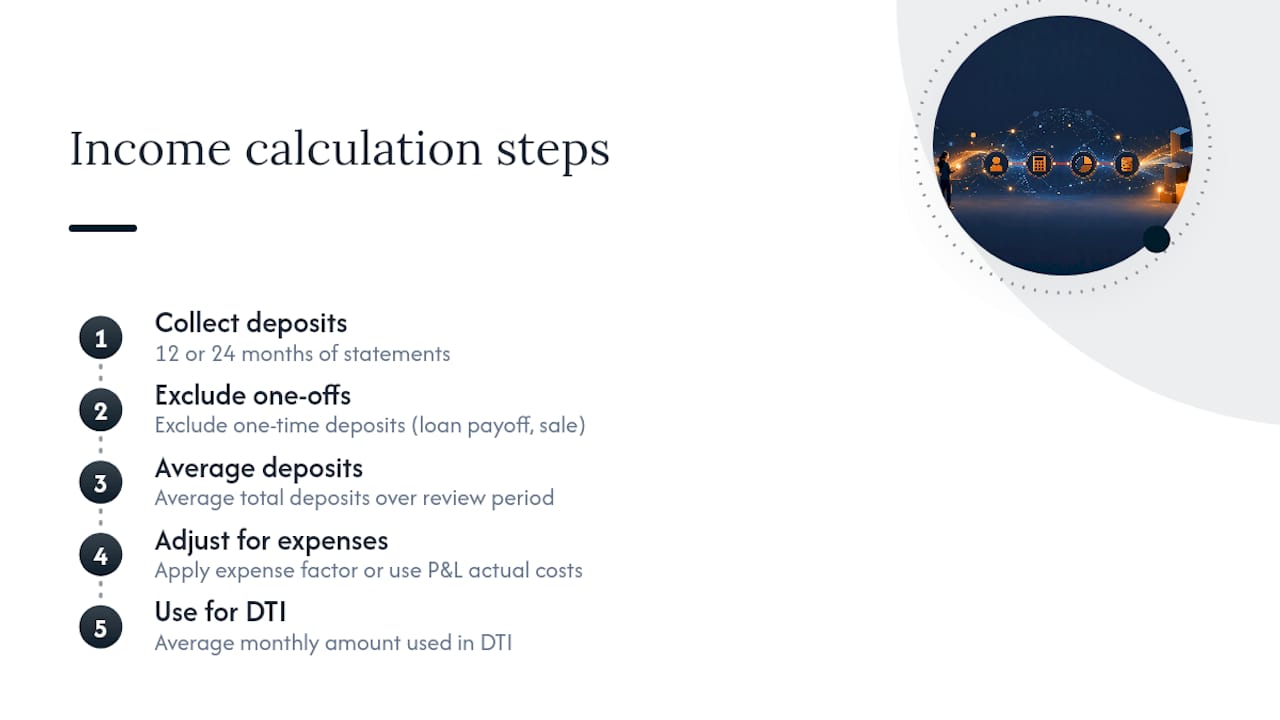
The math isn’t “add up every deposit.” Underwriters average your total deposits over the review period, typically 12 or 24 months, then apply an expense factor (often a flat percentage, unless your P&L specifies actual costs) to account for the fact that not every dollar deposited is profit. They also strip out non-recurring deposits, like a one-time loan payoff or the sale of a vehicle, because those don’t reflect ongoing income.
A sample calculation:
Say you’re a 1099 contractor with $180,000 in total deposits across 24 months, or $7,500 a month average. That’s the number your debt-to-income ratio gets calculated against, not your gross deposits and not your tax-return net income.
Acceptable formats matter too. Bank-generated PDFs downloaded directly from your bank’s portal, or paper statements mailed to you, both work as long as the bank’s name and branding appear on every page. A screenshot cropped from your phone or an edited PDF where you’ve blacked out unrelated transactions raises red flags immediately, since underwriters can’t verify what’s been altered.
Pro Tip: If your income is seasonal, ask your lender whether they’ll average over a full 24 months instead of 12. A contractor who does most of their work in spring and summer can look weaker on a 12 month snapshot than they actually are.
Business Documentation and When You Need a CPA Letter
Your bank statements only tell half the story. Lenders also want proof your business is real, active, and generating the deposits they see.
A self-prepared profit and loss statement works for many programs, but some lenders require one prepared or signed off by a CPA, especially when your expense ratio looks unusual or your deposits don’t obviously match your stated business type. If your lender pushes back on a self-prepared P&L, expect them to ask for supporting records like invoices, receipts, or merchant processing statements to back it up.
Standard business verification documents:
- Business license or DBA registration.
- Articles of organization or incorporation, if you operate as an LLC or corporation.
- EIN confirmation letter from the IRS.
- Evidence of ongoing activity, such as a business bank account with regular transactions.
A CPA letter becomes necessary in specific situations: when you’re adjusting your expense factor away from the lender’s default assumption, when your business structure is complex (multiple entities, partnerships), or when you want to validate owner compensation that doesn’t clearly show up as a deposit. Self-employed borrowers sometimes rely on the Schedule C form to reconcile deductions against actual cash flow, and a CPA letter can bridge whatever gap remains between the two.
ID, Credit, and Asset Documents You’ll Need
Beyond your bank statements and business paperwork, every bank statement loan file needs standard identity, credit, and asset documentation.
Identity and credit:
- Government-issued photo ID (driver’s license or passport).
- Social Security card or ITIN, depending on your status.
- Signed credit authorization and consent forms allowing the lender to pull your credit report.
Asset statements:
- Checking, savings, and CD statements for reserve funds.
- Brokerage and retirement account statements, if you’re using them as reserves. Keep in mind that pulling from a retirement account for your down payment can trigger tax consequences, so talk to your CPA before you do it.
- Business account statements if your down payment is coming from business funds rather than personal.
Source-of-funds paperwork:
Any large or unusual deposit needs a paper trail. If you’re getting a gift for part of your down payment, you’ll need a signed gift letter from the donor. If you’re transferring funds between your own accounts, a lender may still ask for statements from both sides to confirm the money isn’t coming from an undisclosed source. Joint accounts add a wrinkle too: if you’re not the sole owner, expect the lender to ask the co-owner to sign a statement confirming you have full access to the funds.
How the Verification and Underwriting Process Works
Once your documents are in, lenders don’t just take your word for what’s on the page. They confirm it through one of several verification paths.
- Form 1006 (Verification of Deposit). The lender sends this form directly to your bank, which confirms account balances and history without you handing over a printed statement. Homebuyer.com notes that this method eliminates any question about whether a file has been edited.
- Third-party asset verification vendors. Some lenders use digital tools that pull your account data directly with your authorization, a faster alternative to manually collecting PDFs.
- Direct bank-generated confirmations. If your latest statement is stale, a supplemental balance letter from your bank fills the gap without requiring a whole new statement cycle.
Timelines vary by transaction type. Purchases move faster when your file is complete on day one, since underwriters often re-request supplemental documents for anything that looks incomplete or outdated. Refinances tend to have more flexibility on statement recency but still require the same completeness standard.
The fastest path through underwriting: organize every file by month before you submit, and proactively include source-of-funds documentation for any deposit that looks out of pattern. Waiting for the underwriter to ask adds days to your timeline every time.
What Red Flags Get Bank Statement Loans Denied?
Most denials or delayed conditions trace back to a handful of repeat offenders on the bank statement side.
- Incomplete pages. Missing even one page, including blank disclosure pages, is treated as an incomplete file.
- Unexplained large deposits. A $15,000 deposit with no clear source looks like undisclosed debt or an unverifiable gift.
- Frequent overdrafts. Multiple overdrafts in a short window signal cash flow instability that undercuts your stated income.
- Edited or cropped PDFs. Screenshots and altered files raise fraud concerns that a bank-generated document avoids entirely.
- Mismatched account ownership. A statement in a name that doesn’t match the loan application, without an explanation, stalls the file immediately.
Fixes are specific to the problem. Unexplained deposits need a paper trail, an invoice, a signed gift letter, a bill of sale. Edited files get replaced with a bank-generated confirmation. Overdrafts sometimes need a written letter of explanation tied to a one-time event rather than an ongoing pattern.
Pro Tip: If you run a cash-intensive business or share a joint account, get ahead of it: a short letter from you (and your co-owner, if applicable) explaining deposit patterns and confirming your access to the funds often resolves the issue before an underwriter even asks.
Best Practices That Prevent Document Re-Requests
A few habits separate borrowers who close on schedule from borrowers stuck in a re-request loop.
- Include every single page of every statement, even the ones that look irrelevant, as LegalClarity’s mortgage document guide points out is one of the most common oversights.
- Confirm the bank’s name and logo appear on every page, especially for statements downloaded from an online portal.
- Keep the last four digits of your account number visible on every page rather than redacting them entirely.
- If your latest statement is more than 45 days old by the time you apply, get a bank-generated balance confirmation letter rather than waiting for a new statement cycle.
Pro Tip: Download statements as bank-generated PDFs, not screenshots. If you’re emailing files to a loan officer, keep a copy of what you sent and when. It’s a small habit that saves you from disputes over what version of a document was actually submitted.
A Specialist’s View on Getting Bank Statement Loans Approved Faster
The borrowers who close fastest aren’t the ones with the highest income. They’re the ones who show up with a clean 24-month deposit summary and a typed P&L already in hand. The single biggest mistake I see is borrowers submitting statements piecemeal, one month at a time, instead of the full window up front.
Get Your Bank Statement Loan Documents Reviewed by Texas Bank Statement Home Loans
Once you’ve pulled your statements and P&L, the next question is whether they’ll actually qualify you, and for how much. Texas Bank Statement Home Loans reviews 12 to 24 months of personal or business deposits directly, with down payments starting at 10% for self-employed borrowers, 1099 contractors, and gig workers across Texas.
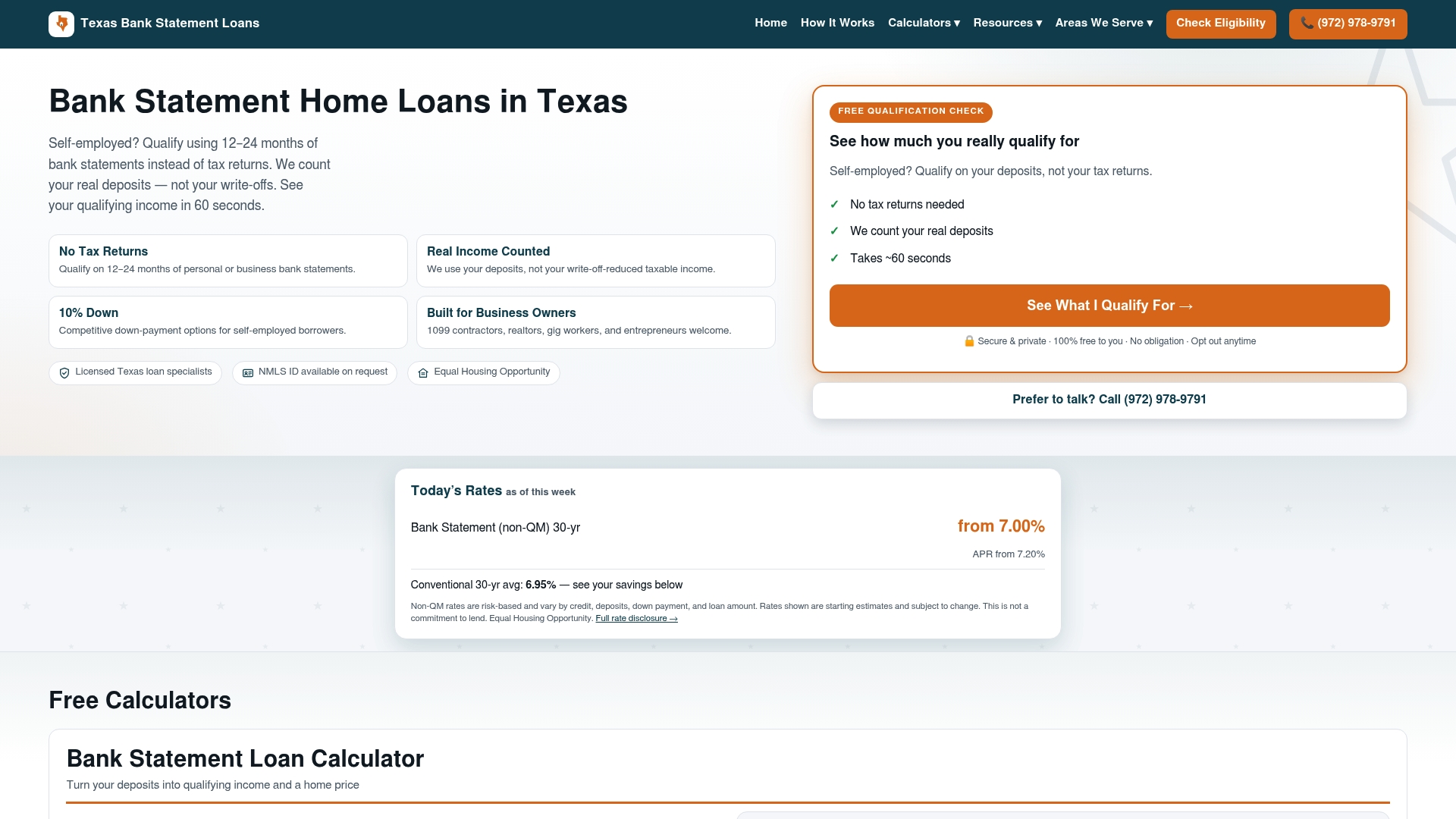
You don’t need a finished application to find out where you stand. The bank statement loan calculator turns your average monthly deposits into an estimated qualifying income in about 60 seconds, using the same averaging approach underwriters apply. If you’re closer to applying, local loan pages for Dallas and Tyler walk through region-specific underwriting notes and connect you directly with a loan officer who works these files daily. Run your numbers through the calculator before you gather a single extra document. It tells you whether the paperwork chase is even worth starting.
Frequently Asked Questions About Bank Statement Loan Documents
How many months of bank statements do I need for a bank statement loan? Most programs require 12 to 24 months of statements. Some lenders offer 12-month programs at a higher rate, while 24-month programs often come with better pricing since they show a longer income history.
Can I use personal bank statements instead of business statements? Yes, many programs accept either personal or business bank statements, or a blend of both, depending on how you run your business finances. Sole proprietors who deposit client payments into a personal account often qualify using personal statements alone.
Do bank statement loans require tax returns at all? Typically no. That’s the entire point of the product: your qualifying income comes from deposits and a P&L, not your Schedule C or 1040. Some lenders may still request a business tax return for verification purposes on complex files.
What happens if my bank statements have overdrafts? Occasional overdrafts usually don’t disqualify you, but frequent overdrafts within the review period raise concerns about cash flow stability. A written explanation for isolated incidents can resolve the issue.
Are electronic bank statements accepted, or do I need paper copies? Electronic, bank-generated PDFs downloaded from your bank’s online portal are accepted as long as the bank’s name and branding appear on every page. Screenshots or manually edited files are not.
Can I combine statements from multiple banks if I use more than one account? Yes, but each account needs its own complete statement history meeting the same completeness and recency standards. Deposits across accounts get combined for the income calculation, provided you can show ownership of all accounts.
Do biweekly statements affect how income gets calculated? Most banks issue monthly statements regardless of how often you’re paid, so this rarely comes up. If your bank does issue statements on a different cycle, lenders will typically request enough of them to cover the same 12 to 24 month window.
This article is general information, not a substitute for advice from a qualified financial advisor. Consult a qualified financial professional about your own circumstances before acting on anything here.
Sources
- Verification of deposits and assets | Fannie Mae Selling Guide
- Homebuyer
- Bank Statement Loan | Bankrate
- What is a qualified mortgage? | CFPB
See what you qualify for in 60 seconds, free and no credit check. Use the eligibility check at the top of this page.