
Borrowers who want to “set it and forget it” and reduce the risk of missing a tax bill do best with escrow; borrowers with strong credit, real equity, and the discipline to save monthly on their own can sometimes come out ahead without it. That is the whole decision in one sentence, but the details determine whether waiving escrow is actually available to you and whether it is worth the hassle.
Loan type decides eligibility before anything else. FHA and USDA loans almost always require escrow for the life of the loan, no exceptions for good credit or low balances.
The risks of going without escrow are real and specific, not theoretical; similar to why waiving an inspection contingency is risky, removing built-in safeguards exposes you to significant hazards:
- A missed property tax payment can trigger penalties, interest, and eventually a tax lien.
- Letting homeowners insurance lapse can lead the servicer to buy force-placed coverage on your behalf, at a price that is often steep for narrower protection.
- Some lenders charge a one-time waiver fee, commonly around 0.25% of your loan balance, plus a small permanent rate bump on your interest rate, which may vary by lender.
Key Takeaways
Escrow suits borrowers who value automatic payments and lower risk, while waiving escrow rewards disciplined borrowers with real equity and a clear savings plan.
| Point | Details |
|---|---|
| Loan type decides eligibility | FHA and USDA loans require escrow for the full loan term; conventional loans may allow a waiver near 80% loan-to-value. |
| Waivers cost money upfront | Expect a one-time fee near 0.25% of your loan balance plus a possible small permanent rate increase. |
| No-escrow risk is real | Missed tax payments can lead to liens, and lapsed insurance can trigger costly force-placed coverage. |
| Run the break-even math first | Compare the waiver fee and rate bump against realistic interest earned on self-managed tax and insurance funds. |
| Self-employed borrowers need reserves | Texasbankstatementloans underwrites using 12 to 24 months of bank deposits, so document your escrow-related reserves early with your loan officer. |
Table of Contents
- Escrow vs No Escrow: What an Escrow Account Actually Does
- Pros and Cons of Escrow vs Managing Payments Yourself
- Who Can Waive Escrow on a Mortgage?
- How Do You Request an Escrow Waiver or Removal?
- Does Waiving Escrow Actually Save You Money?
- What Self-Employed Borrowers Should Know Before Choosing
- Explore Bank-Statement Loans If You’re Self-Employed
- Where to Verify These Rules Yourself
- Sources
Escrow vs No Escrow: What an Escrow Account Actually Does
An escrow account is a fund your loan servicer manages on your behalf to pay property taxes, homeowners insurance, and, in flood zones, flood insurance, as those bills come due. You do not write the check to the county tax office or your insurance carrier. Your servicer does, using money you have already paid in through your monthly mortgage payment.
Here is how the mechanics typically work:
- Initial deposit. At closing, you fund the escrow account with a lump sum, usually enough to cover two to three months of taxes and insurance plus a cushion.
- Monthly contribution. Your mortgage payment gets split into principal, interest, taxes, and insurance, often shown as PITI on your statement, with the tax and insurance portion going straight into escrow.
- The cushion. Federal rules allow servicers to hold a reserve, usually capped at two months of payments, to absorb increases in tax or insurance bills without running short.
- Annual escrow analysis. Once a year, your servicer recalculates what you owe based on actual tax and insurance costs. If you paid in too much, you get a refund. If you paid in too little, you face a shortage that gets spread across the next year’s payments.
Escrow shortages and surpluses are not left to a servicer’s discretion. Under Regulation X, surpluses of $50 or more must be refunded within 30 days of the analysis, and you are entitled to an annual escrow statement showing exactly where your money went. Federal law also caps how aggressively a lender can require escrow in the first place, and it mandates disclosures whenever an escrow or impound account gets attached to your loan.
Pros and Cons of Escrow vs Managing Payments Yourself
Escrow removes a decision from your plate every month. That is the entire appeal, and for a lot of homeowners, it is enough on its own.
What escrow does well:
- Your tax and insurance bills get paid automatically, so there is no calendar reminder to set or check to mail.
- Your servicer is watching your coverage and tax status, which catches problems before they become liens or lapses.
- Budgeting is simpler because one payment covers everything, rather than a mortgage payment plus two separate large annual or semiannual bills.
What no-escrow offers instead:
- Your monthly mortgage payment is lower, since only principal and interest get collected.
- You keep the float on your own tax and insurance money and can earn interest on it if you’re disciplined about setting it aside.
- You control timing. Paying property taxes early sometimes earns a small discount in certain counties, and you decide when to shop for a better insurance rate.
Pro Tip: If you’re considering no-escrow, open a separate high-yield savings account just for tax and insurance money and automate a transfer the day your mortgage payment posts. Treat it like a bill, not a bonus.
The failure modes cut both ways. Escrow can produce shortages that spike your payment with little warning, and servicing errors do happen. No-escrow shifts that risk onto you entirely: miss one tax deadline and you’re looking at penalties and interest, and let your homeowners policy lapse and your servicer can force-place coverage that is often far more expensive with narrower protection than what you’d buy yourself.
Who Can Waive Escrow on a Mortgage?
Not every borrower gets to choose. Loan program rules decide this before your credit score or your bank balance ever enters the conversation.
Government-backed loans are the strictest. FHA and USDA loans generally do not permit escrow waivers at any point in the loan term, regardless of how much equity you build or how long you’ve paid on time. VA loans occasionally allow waivers, but it is uncommon and depends heavily on the individual lender.
Conventional loans are where waivers become realistic, and even then, only under specific conditions:
- Your unpaid principal balance typically needs to sit at or below 80% of the home’s original value, matching the threshold Fannie Mae uses in its servicing guidance.
- You need a clean payment history, meaning no recent late payments on the mortgage itself.
- Your property taxes and insurance need to be current, with no lapses in the recent past.
- Your servicer needs a written escrow-waiver policy in place; waivers are never handed out ad hoc.
Federal rules override all of this in certain cases. Higher-priced mortgage loans require escrow for a minimum of five years by law, no exceptions for equity or credit. Homes in designated flood zones face a separate mandate: flood insurance must be escrowed regardless of your loan type or standing. And even after a waiver is granted, your servicer can reinstate escrow if your taxes go delinquent or your insurance lapses, since Fannie Mae’s guidance preserves that right for the life of the loan.
How Do You Request an Escrow Waiver or Removal?
Getting rid of escrow is a paperwork process, not a phone call. Here is the realistic sequence:
- Call your servicer and ask for their escrow-waiver policy in writing. Requirements vary by lender, and some won’t consider a request until you’ve made twelve consecutive on-time payments.
- Confirm your loan-to-value ratio. If you’re near the 80% threshold, ask whether a new appraisal would help you qualify sooner. Some servicers accept your original purchase price appreciation; others require a fresh valuation.
- Gather documentation. You’ll typically need proof that property taxes are current and a copy of your homeowners insurance declarations page showing active coverage.
- Submit the written waiver request. Servicers commonly take 30 to 45 days to process the request, verifying your equity position, payment history, and tax status before approving anything.
- Expect a fee, and possibly a rate adjustment. Many lenders charge a one-time waiver fee near 0.25% of your loan balance and may tack on a small permanent rate increase to offset the added risk they’re taking on.
If your request is denied, ask specifically why. Sometimes it’s a technical issue, like taxes paid a few days late two years ago, that’s easy to explain or wait out. If your account is approved for closure and you had a surplus balance, that money is refunded on the same statutory timeline that governs any escrow surplus.
Does Waiving Escrow Actually Save You Money?
Run the math before you assume no-escrow is the better deal. It usually saves less than people expect once fees and rate adjustments enter the picture.

Start with the true cost of waiving: the one-time fee (commonly around 0.25% of your loan balance) plus the present value of any permanent rate bump, often in the 0.125% to 0.25% range, over the life of the loan. Weigh that against what you’d actually earn holding your own tax and insurance money in a savings account until it’s due.
A 0.125% rate bump on that balance adds roughly $31 a month, or $375 a year, for as long as you hold the loan. Over most holding periods, the rate bump eats the savings.
A few things shift that math. Some states legally require escrow accounts to pay interest on the balance held, which narrows the gap further, though federally chartered banks are sometimes exempt from those state rules. And the math only works if you actually save the money instead of spending it, which is the part most people underestimate about their own discipline.
What Self-Employed Borrowers Should Know Before Choosing

Escrow decisions land differently for self-employed borrowers because your income already gets more scrutiny during underwriting. Lenders reviewing 12 to 24 months of bank statements instead of tax returns are already asking harder questions about reserves and payment stability, and a request to waive escrow adds one more data point they’ll weigh.
If your income fluctuates month to month, a servicer is going to look closely at whether you can reliably self-fund tax and insurance bills that arrive as one large sum rather than a smoothed monthly payment. That’s not a reason to avoid asking for a waiver, but it is a reason to build the case with real numbers, not optimism. Keep a dedicated reserve account, document your tax and insurance payment history, and ask your loan officer about waiver policy early, before you’re deep into underwriting and it becomes one more variable to explain.
- Saad
Explore Bank-Statement Loans If You’re Self-Employed
If you’re self-employed, a 1099 contractor, or running your own business, the escrow decision might not even be your first hurdle. Traditional lenders often undercount your real income because they lean on tax returns that show deductions, not deposits. Texasbankstatementloans evaluates 12 to 24 months of actual bank deposits instead, which gives self-employed borrowers in Texas a mortgage path that reflects what they actually earn.
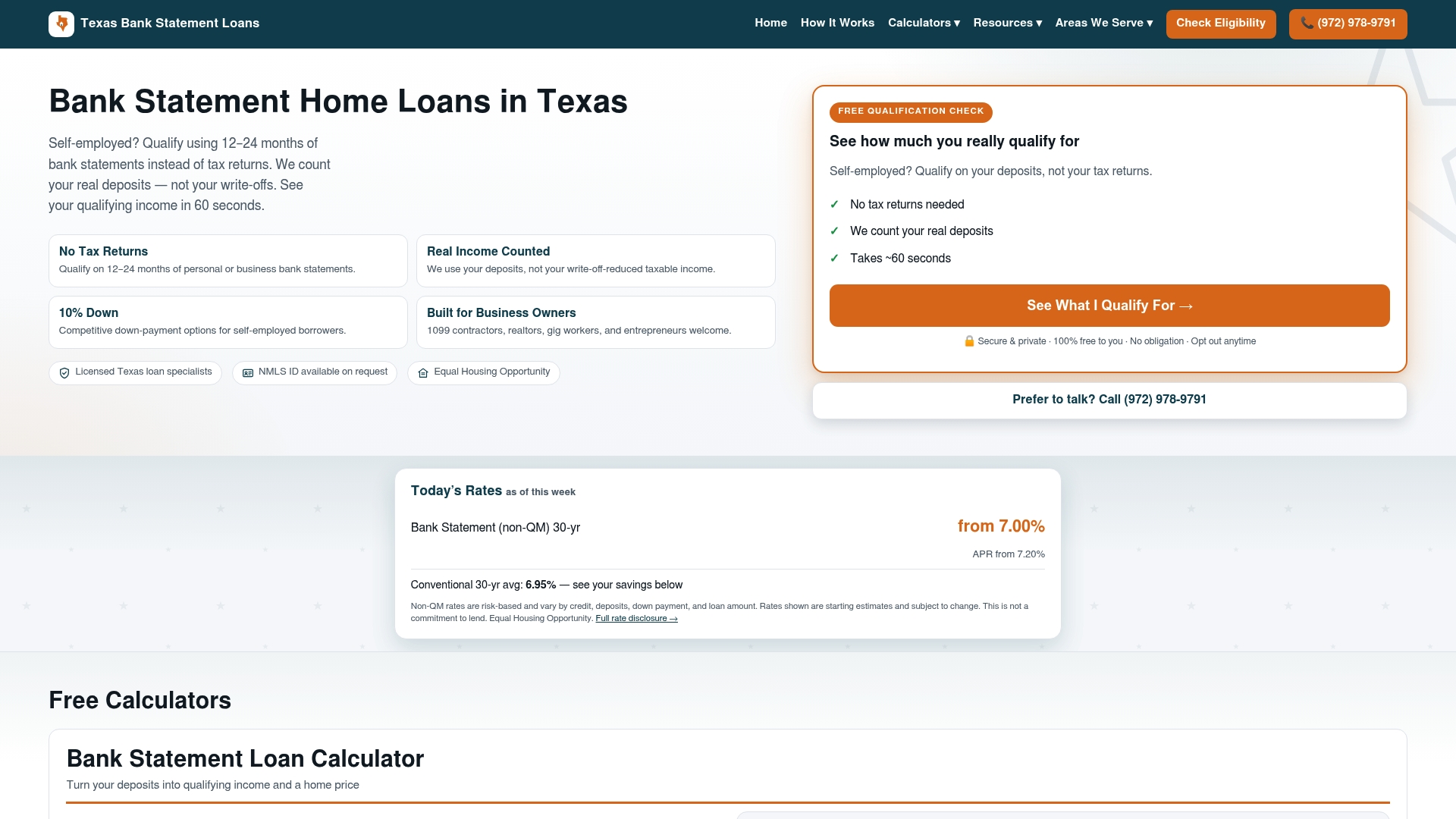
This is an editorial mention, not the only option out there, but if bank statements represent your income better than a tax return does, it’s worth checking what you’d qualify for. Run your numbers through the self-employed affordability calculator to see where you stand before you talk to a loan officer about escrow policy or anything else.
Where to Verify These Rules Yourself
Check your servicer’s disclosures against the primary sources behind these rules:
- The federal statute on escrow accounts sets the legal limits on when escrow can be required.
- Fannie Mae’s servicing guide explains conventional-loan waiver eligibility.
Your own loan documents and annual escrow statement will always override general guidance, so read those first.
This article is general information, not a substitute for advice from a qualified financial advisor. Consult a qualified financial professional about your own circumstances before acting on anything here.
Sources
- §1639d. Escrow or impound accounts relating to certain consumer credit transactions
- Escrow Accounts | Fannie Mae
- What is an escrow waiver and how does it work? - LegalClarity
See what you qualify for in 60 seconds, free and no credit check. Use the eligibility check at the top of this page.