
Yes, you can get a mortgage shortly after becoming self-employed, through two realistic paths: a conventional loan backed by strong documentation and exceptions to the standard history rule, or a bank-statement and non-QM loan that skips tax returns entirely. What underwriters care about most is whether your income is stable and verifiable, not your job title. Your fastest move is to gather your paperwork or run a quick pre-qualification check this week.
TL;DR:
- Self-employed borrowers can qualify using either conventional loans with strong documentation or alternative options like bank-statement or non-QM loans that do not require tax returns.
- Lenders mainly focus on verifying income stability and likelihood of continuation, often requiring two years of self-employment history unless strong compensating factors are present.
- Alternative underwriting paths, such as bank-statement or DSCR loans, benefit those with high write-offs or volatile income, often allowing higher qualifying amounts than tax returns suggest.
- A well-organized application, accurate documentation, and proactive preparation of key paperwork can improve approval chances and reduce delays.
- Lender overlays, such as higher credit score requirements or stricter reserves, vary significantly between lenders, affecting eligibility for newly self-employed applicants.
Table of Contents
- What lenders look for when you’re newly self-employed
- Exact documents lenders commonly require: a step-by-step checklist
- Alternative qualification paths: bank-statement, non-QM, and DSCR loans
- How to prepare your application to improve approval odds
- Common pitfalls and red flags underwriters flag
- How bank-statement underwriting works in practice
- How newly self-employed status affects your rate and loan terms
- Building creditworthiness quickly as a newly self-employed borrower
- How business type and income volatility affect approval
- Lender overlays that specifically target newly self-employed applicants
- When a bank-statement loan beats waiting it out
- How Texas Bank Statement Home Loans helps newly self-employed borrowers
- FAQ
- Sources
What lenders look for when you’re newly self-employed
Lenders do not reject you for being self-employed. They are legally required to verify your ability to repay before approving any mortgage, a rule known as the Ability-to-Repay (ATR) standard, which requires creditors to confirm income, employment status, and monthly obligations before qualifying you. Self-employment income counts under this rule, but it has to be documented and traced to you personally rather than to loans or transfers passing through your accounts.

Most lenders still default to wanting two years of self-employment history, since that pattern makes the income easier to trust. Exceptions exist when you worked in a related field as a W-2 employee before going independent, when your year-to-date profit and loss statement shows rising earnings, or when other compensating factors are strong, according to HUD/FHA guidance on self-employment income analysis.
To evaluate your income, lenders typically review:
- Usually two years of federal tax returns, with possible exceptions for one year if there is a long business history
- Year-to-date profit and loss statements and balance sheets
- Bank deposits over 12 to 24 months when using alternative underwriting
- Fannie Mae cash-flow analysis forms that adjust your reported income for write-offs
Lenders primarily want to confirm your income is stable and likely to continue, according to Freddie Mac’s guidance for self-employed borrowers, which means building a coherent income story matters more than hitting a single number.
Exact documents lenders commonly require: a step-by-step checklist
Formal underwriting requires real paperwork, even though a Loan Estimate itself only needs basic application data like your name, income, Social Security number, and the property address. Once you move past that early quote stage, gather these in order:
- Two years of signed federal tax returns or IRS transcripts, personal and business if applicable
- Year-to-date profit and loss statement and balance sheet covering the current year
- Client contracts or invoices showing ongoing work and projected income
- Twelve to 24 months of personal and business bank statements if pursuing alternative underwriting
- IRS Form 4506-C authorizations, filed separately for personal and each business return
- Source-of-funds documentation for your down payment and any reserve accounts
- Proof the business is active and legitimate: a website, state licenses, or a CPA letter
Fannie Mae’s documentation standards note that personal and business tax authorizations are typically separate forms, so missing one can stall your file by days.
Pro Tip: Request your 4506-C transcripts and CPA letter before you start shopping for homes. Both can take a week or more to process, and underwriters will not finalize your file without them.
Alternative qualification paths: bank-statement, non-QM, and DSCR loans
When tax returns understate your real income because of legitimate write-offs, alternative underwriting products exist specifically for that gap.
- Bank-statement loans average your deposits over 12 to 24 months to calculate qualifying income, which often produces a materially higher number than your adjusted gross income on a tax return.
- Non-QM loans sit outside standard Qualified Mortgage rules, trading a somewhat higher interest rate and larger reserve requirement for flexible documentation.
- DSCR loans qualify investment property buyers using the property’s rental income rather than personal income, which helps self-employed investors whose personal tax returns show thin profit.
- Hybrid products blend partial tax-return review with bank statements, useful when your write-offs are moderate rather than extreme.
Each path fits a different borrower. Heavy write-offs point toward bank statements, rental-focused buyers point toward DSCR, and borrowers close to conventional qualification sometimes only need a one-year exception rather than a full alternative product.
How to prepare your application to improve approval odds
A clean, well-organized file moves faster through underwriting and reduces the chance of a denial over a documentation gap. Work through these in order before you apply:
- Build a clear year-to-date profit and loss statement and reconcile it against your bank deposits
- Ask your CPA for a letter confirming your business type, time in operation, and income trend
- Separate business and personal bank accounts if you have not already
- Document the source of any large deposits, gifts, or one-time transfers before they appear on a statement
- Pay down revolving debt and raise your credit score where possible
- Save beyond the minimum down payment to build two to three months of reserves
- Run a pre-qualification check with a lender experienced in bank-statement underwriting
Pro Tip: Open a dedicated business checking account at least two or three months before applying. Commingled deposits are one of the most common reasons underwriters ask for extra explanation letters.
Common pitfalls and red flags underwriters flag
A few recurring issues slow down or sink self-employed applications, and most are fixable if you catch them early.
- Unexplained large deposits raise questions about whether income is truly yours; document the source or move the funds into your account well before applying.
- Heavy tax write-offs that legitimately lower your taxable income also lower your qualifying income on a standard loan; a CPA letter or bank-statement loan can offset this.
- Changing business structure right before applying, such as switching from sole proprietor to an S-corp, can break the continuity lenders expect, and industry guidance generally advises keeping your filing status steady for at least 12 months if a mortgage application is on the horizon.
How bank-statement underwriting works in practice
Bank-statement programs look at your actual deposit history, typically 12 to 24 months of statements, and calculate an average monthly income from that cash flow instead of your tax return’s bottom line. This approach tends to benefit freelancers, gig workers, and small-business owners whose write-offs make their taxable income look smaller than their real cash flow.
- Freelancers and 1099 contractors with inconsistent monthly income often see a more accurate picture under bank-statement review
- Gig workers without traditional pay stubs can qualify using deposit history alone
- Small-business owners with significant deductions frequently qualify for a higher loan amount than tax returns alone would support
Down payment requirements on these programs often start near 10%, and a qualification check can typically be completed in a few minutes before you move to full underwriting.
How newly self-employed status affects your rate and loan terms
Being newly self-employed does not automatically mean a higher interest rate, but the loan product you qualify for does. A conventional loan underwritten with full tax-return documentation and a solid two-year history generally carries the lowest available rate, because it meets standard Qualified Mortgage guidelines. Step outside that into bank-statement or non-QM territory, and you typically trade a slightly higher rate for flexible income verification.
The gap is not usually dramatic, but non-QM pricing reflects the extra risk a lender takes on when it cannot rely on tax-return history. Bank-statement loans priced under non-QM guidelines, for example, are quoted with their own rate sheets rather than conventional rate sheets. Loan terms can also shift: some bank-statement and non-QM products require larger reserve accounts, higher minimum credit scores, or a larger down payment to offset the documentation flexibility.
The trade-off generally narrows over time. Once you have two full years of tax returns showing stable or rising income, you become eligible for conventional pricing again, which means a newly self-employed rate premium is often temporary rather than permanent. If your income is strong and well-documented even in year one, ask your lender whether you qualify for an exception to standard conventional pricing rather than assuming you need a non-QM product by default. The underwriting path matters more to your rate than your self-employment status alone.
Building creditworthiness quickly as a newly self-employed borrower
Your credit profile carries extra weight when your income documentation is thinner than a typical W-2 file, so it is worth attacking early rather than treating it as an afterthought.
Start by paying down revolving balances, since your credit utilization ratio has an outsized effect on your score in a short time frame. Keep every account current, even small recurring bills, because a single late payment stands out more when your file is already being scrutinized for stability. Avoid opening new credit accounts or financing a vehicle in the months before you apply, since new inquiries and added debt both work against your debt-to-income ratio right when underwriters are evaluating it.
If your credit history is thin because you recently left a W-2 job, keep older accounts open rather than closing them, since length of credit history matters more than people expect. Consider becoming an authorized user on a well-managed account if you have a trusted family member willing to add you, which can lift your score without requiring new debt in your own name.
None of this replaces documented income, but a stronger credit score can offset some of the perceived risk of a shorter self-employment history, sometimes opening up better pricing or a lower required down payment on the same loan product.
How business type and income volatility affect approval
Not all self-employment looks the same to an underwriter, and your business structure shapes how your income gets evaluated. Sole proprietors and single-member LLCs have their income flow directly onto a personal tax return, which keeps the analysis relatively simple. S-corps and partnerships add a layer of complexity, since underwriters have to separate your personal draw from the business’s overall profit and loss, often requiring the business return in addition to your personal one.
Income volatility is its own factor, separate from business type. A business with steady month-to-month revenue is easier to qualify than one with large seasonal swings, even if both produce the same annual total. Underwriters often average income over 24 months specifically to smooth out volatility, but a business that shows a sharp decline in its most recent year can still trigger extra scrutiny even if the two-year average looks fine.
Service-based businesses with recurring clients or contracts tend to qualify more smoothly than project-based or seasonal businesses, simply because the income story is easier to document. If your business is naturally volatile, such as agricultural work, event-based services, or commission-heavy sales, a bank-statement approach that captures real cash flow over time can represent your income more fairly than a tax return reflecting one unusually slow year.
Lender overlays that specifically target newly self-employed applicants
An overlay is an extra requirement a lender adds on top of the baseline rules set by Fannie Mae, Freddie Mac, or FHA. Many lenders apply overlays specifically aimed at self-employed and newly self-employed borrowers, even when the underlying program would technically allow more flexibility.
Common overlays include requiring two full years of self-employment history even in cases where federal guidance would allow an exception, requiring a higher minimum credit score for self-employed applicants than for W-2 borrowers on the same loan program, or capping the loan-to-value ratio lower for self-employed files. Some lenders also require additional reserve funds specifically for self-employed borrowers, reasoning that irregular income carries more risk even when it is well-documented.

These overlays vary significantly from one lender to another, which is why two lenders can look at the identical file and reach different conclusions. If one lender’s overlays rule you out, that does not mean you are unqualified everywhere. It often means you need a lender whose internal policies, rather than the baseline federal guidelines, are built around self-employed and recently self-employed borrowers.
When a bank-statement loan beats waiting it out
If you need to buy soon, your income trend is rising, and you have healthy reserves, a bank-statement loan usually makes sense now despite the modest rate premium. If your income is still unpredictable or your down payment is thin, building a documented two-year history may serve you better. Either way, talk to a mortgage advisor before committing.
- Saad
How Texas Bank Statement Home Loans helps newly self-employed borrowers
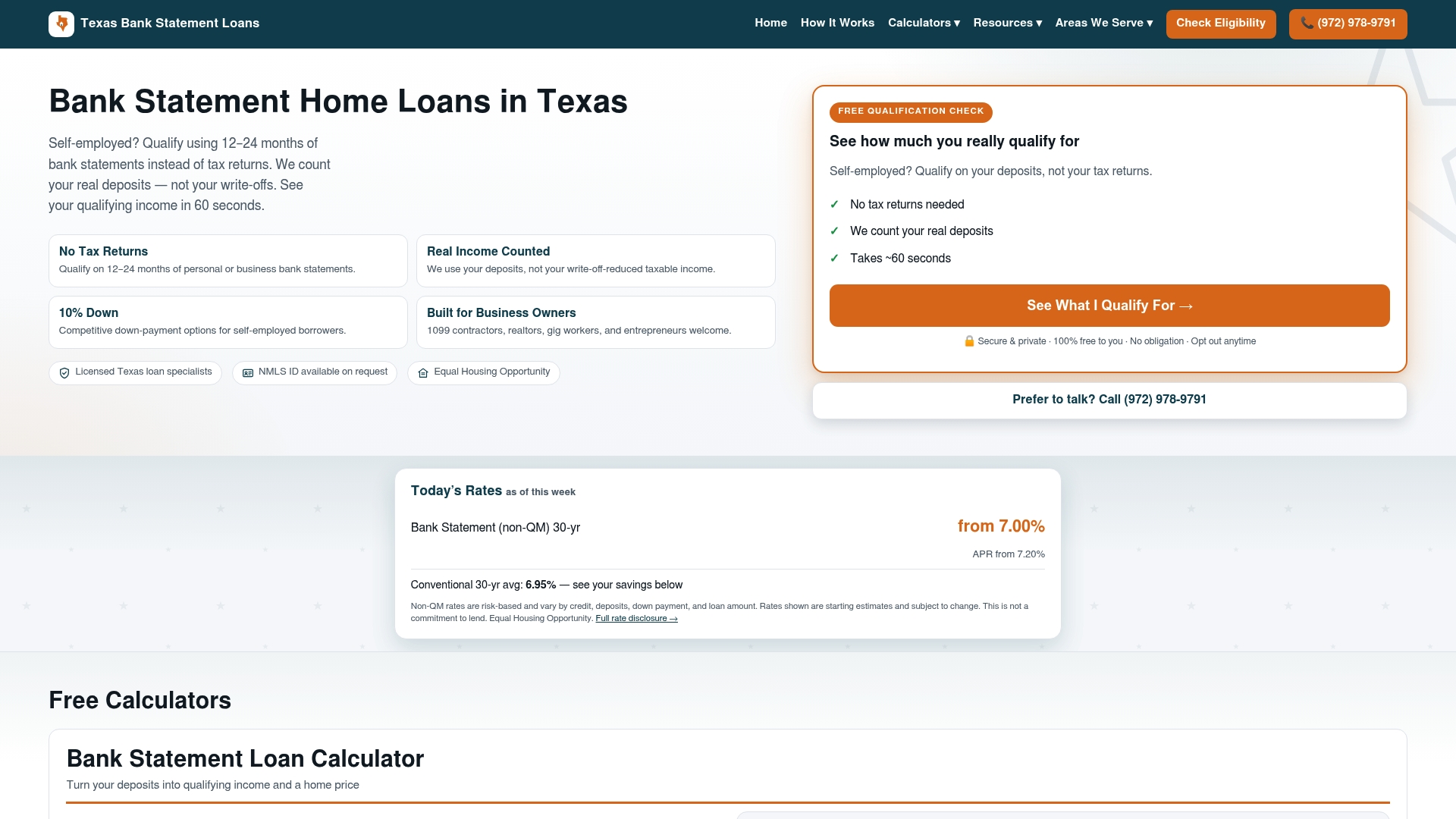
We built our process around one problem: tax returns rarely show what self-employed people actually earn. Instead of starting with your 1040, we evaluate 12 to 24 months of your bank deposits, so write-offs and irregular 1099 income do not shrink your qualifying number.
- We work with freelancers, gig workers, 1099 contractors, and small-business owners
- We offer down payment options starting at low percentages, and our qualification check takes about a minute
- We also offer DSCR loans for investment property buyers relying on rental income
Check your bank statement loan rates or run the numbers on our self-employed affordability calculator to see what you can realistically afford right now.
This article is general information, not a substitute for advice from a qualified financial advisor. Consult a qualified financial professional about your own circumstances before acting on anything here.
FAQ
How hard is it to get a mortgage when you are self-employed?
It is harder than a standard W-2 application mainly because of documentation, not because lenders view self-employment unfavorably. Lenders must verify your ability to repay through tax returns, bank statements, or profit and loss records, which takes more paperwork than a pay stub.
Can I get a mortgage if I’m self-employed?
Yes, self-employment income is fully acceptable under mortgage underwriting rules as long as it is verifiable and likely to continue. You can qualify through a conventional loan with strong documentation or through a bank-statement and non-QM loan that uses deposit history instead of tax returns.
Can I get a mortgage as a self-employed person with one year of accounts?
Sometimes, though it depends on your situation. Fannie Mae guidelines allow one year of tax returns in limited cases, often when you have a long business history or strong compensating factors, and alternative lenders may waive the two-year rule entirely if you have prior related W-2 experience.
Which mortgage lender is best for self-employed individuals?
There is no single best lender for every self-employed borrower, since overlays and documentation preferences vary widely between institutions. Borrowers with heavy write-offs or irregular 1099 income often do best with a lender that specializes in bank-statement underwriting rather than a standard retail bank.
See what you qualify for in 60 seconds, free and no credit check. Use the eligibility check at the top of this page.