
Your business structure is the single biggest factor lenders use to evaluate your income as a self-employed borrower. How business type affects mortgage eligibility comes down to three things: how your income is reported, how liability flows between you and the business, and how stable lenders judge that income to be. Fannie Mae and Freddie Mac define a self-employed borrower as anyone owning 25% or more of a business, regardless of structure. That threshold applies equally to sole proprietors, LLC members, and corporate shareholders. Knowing which rules apply to your structure before you apply can save months of delays.
How does business type affect mortgage eligibility?
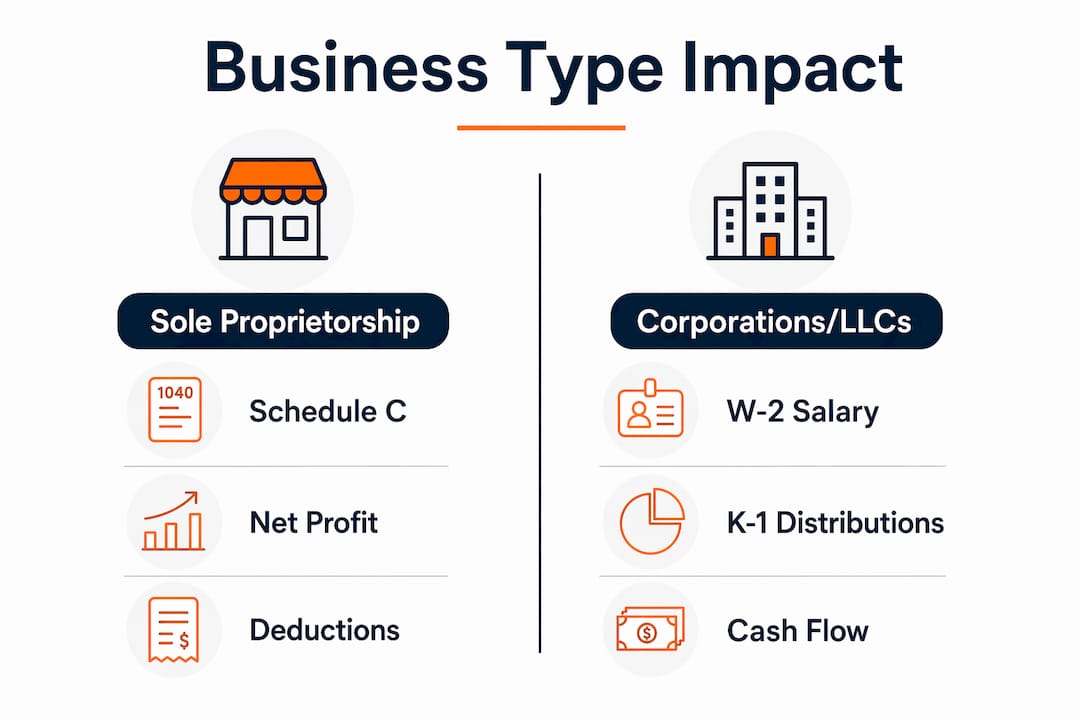
The impact of business structure on mortgage approval is direct and measurable. Lenders do not look at your gross revenue. They look at how income flows from your business to you personally, and whether that flow is stable enough to support a mortgage payment for years to come. Income qualification differs by entity type: net profit on Schedule C for sole proprietors, W-2 wages plus K-1 distributions for S-corporations. Each structure produces different tax documents, different income figures, and a different risk picture for the underwriter.
Business deductions make this even more complex. High gross revenue does not increase your qualifying income if your net profit is low after deductions. A freelance consultant earning $200,000 a year but writing off $120,000 in expenses qualifies on $80,000. That gap surprises many business owners who assume their revenue is what lenders see.
How do sole proprietorships affect mortgage eligibility?
Sole proprietors face the most straightforward documentation process, but also the most aggressive income reduction. Your business income and personal income are the same legal entity, reported together on your personal tax return.
Lenders require the following from sole proprietors:
- Two years of personal federal tax returns, including Schedule C
- A completed IRS Form 4506-C so lenders can verify returns against IRS transcripts
- Profit and loss statements for the current year if returns are more than a few months old
- Documentation of any non-recurring expenses that inflated deductions
The core problem is that Schedule C income is net profit after all deductions. If you write off a home office, vehicle, equipment, and travel, your taxable income drops significantly. That lower number is exactly what lenders use to calculate your qualifying income. Unlimited personal liability also increases lender risk perception, since your personal assets are directly exposed to business debts.
Pro Tip: Document consistent monthly withdrawals from your business account to your personal account. Lenders want to see that cash actually moves from the business to you on a regular basis, not just that profit exists on paper.

What unique challenges do partnerships and LLCs present for mortgage approval?
Partnerships and LLCs introduce a layer of complexity that catches many borrowers off guard. The business files its own tax return (Form 1065 for partnerships, Form 1120S for S-corps that elected LLC status), and your share of income appears on a K-1 schedule attached to that return.
Here is where the confusion starts. The K-1 shows your allocated share of business profit. That number is not necessarily what you actually received in cash. A partnership might show $150,000 in profit on your K-1, but you only took $60,000 in distributions. Lenders verify actual cash received, not paper profits. The distinction matters enormously for qualification.
The four most common documentation challenges for LLC and partnership borrowers are:
- K-1 income vs. cash distributions. Lenders want proof of what you actually withdrew, not just what was allocated.
- Recent entity changes. Changes in business structure within 6-12 months before application can reset your income history and complicate approval.
- Personal guarantees on business debt. Guaranteed business loans count as personal debt for underwriting purposes, raising your debt-to-income ratio.
- Multiple ownership stakes. Owning shares in more than one LLC means lenders review each entity separately.
Limited liability status does change the lender’s risk picture slightly. Because your personal assets are shielded from business debts, lenders focus more on the business’s cash flow and less on your personal exposure. That is a small advantage, but it does not eliminate the income documentation burden.
Pro Tip: Keep a clear paper trail of every distribution you take from the LLC or partnership. Bank records showing regular transfers from the business account to your personal account are the strongest evidence of actual income.
How does corporate business structure affect mortgage income evaluation?
Corporations create the most complex income picture of any business structure. The key distinction is between S-corporations and C-corporations, because each produces different income documents and different qualifying income calculations.
| Structure | Tax Form | Income Sources Lenders Review |
|---|---|---|
| S-corporation | Form 1120S + K-1 | W-2 wages plus K-1 distributions |
| C-corporation | Form 1120 | Dividends, salary, and retained earnings |
| Partnership | Form 1065 + K-1 | Distributive share of income |
S-corp shareholders typically receive both a W-2 salary and K-1 distributions. Lenders add these together, then apply adjustments for depreciation and other non-cash deductions. C-corp owners face a harder path. Dividends paid to shareholders are taxable at the corporate level first, and retained earnings inside the corporation do not count as personal income unless actually distributed.
Corporate liquidity is the factor most corporate borrowers overlook. A lender will assess whether the business has enough liquid assets to continue operating after you withdraw funds for a mortgage payment. High reported profit tied up in equipment, inventory, or receivables does not satisfy this test. Lenders require that personal withdrawals from corporate businesses not compromise operational liquidity or existing debt obligations.
Pro Tip: If you own an S-corp, pay yourself a reasonable W-2 salary before applying. A documented salary history is far easier for lenders to qualify than irregular distributions alone.
What are the general lender requirements for self-employed borrowers?
Regardless of business structure, all self-employed borrowers face a common set of documentation and stability requirements. These are not optional guidelines. They are federal underwriting standards applied by Fannie Mae and Freddie Mac.
The core requirements are:
- Two years of complete federal tax returns with all schedules, verified using IRS Form 4506-C against IRS transcripts
- Income stability over the prior two years, with no significant year-over-year decline
- Likelihood of continuance for at least three years after loan closing
- Business viability documentation if the business is less than two years old
The continuance rule is where many self-employed borrowers stumble. Lenders prioritize income stability and require that qualifying income is likely to continue for at least three years after closing. A one-time consulting contract, a single large project, or income that has declined two years in a row will not satisfy this standard.
“Income must be recurring and likely to continue at least three years. One-time projects or unstable ventures do not qualify, even if current profitability looks strong.”
There is one meaningful exception. Self-employed borrowers with five or more years of consecutive ownership at 25% or more may qualify using just one year of tax returns, provided the business meets continuous operation criteria. This exception rewards longevity and consistency.
How can self-employed borrowers improve their mortgage eligibility?
The strategies that improve mortgage eligibility apply across every business structure. The common thread is documentation and consistency.
- Separate personal and business finances completely. Commingled accounts make it nearly impossible for lenders to trace income accurately.
- Avoid restructuring your business entity before applying. Recent entity changes reset your income history and raise red flags.
- Prepare current profit and loss statements. These supplement tax returns and show lenders your current trajectory.
- Consider a bank statement loan if tax returns understate your cash flow. Bank statement loans use 12-24 months of bank deposits instead of tax returns to qualify income. They carry higher rates, but they reflect actual cash flow rather than taxable income.
- Get pre-approved with full documentation, not just pre-qualified. Pre-qualification is an estimate. Pre-approval with a complete file tells you exactly where you stand.
Pro Tip: Work with a lender who specializes in self-employed borrowers. A generalist loan officer may not know how to add back depreciation, calculate K-1 income correctly, or structure your file for the best outcome. Use the self-employed affordability calculator at Texasbankstatementloans to get a realistic number before you walk into any lender’s office.
Key Takeaways
Your business structure determines which tax documents lenders require, how they calculate your qualifying income, and whether your cash flow meets federal stability standards.
| Point | Details |
|---|---|
| Structure drives income calculation | Sole proprietors use Schedule C net profit; S-corp owners use W-2 wages plus K-1 distributions. |
| Two years of returns are standard | Lenders verify all returns against IRS transcripts using Form 4506-C, with no exceptions. |
| Five-year exception exists | Borrowers with 5+ years of continuous ownership may qualify with just one year of tax returns. |
| Corporate liquidity matters | High profit tied up in illiquid assets does not count as available income for mortgage qualification. |
| Bank statement loans fill the gap | Borrowers whose tax returns understate real cash flow can qualify using 12-24 months of deposits. |
What I’ve learned about self-employed mortgage approvals
The biggest misconception I see is that business owners think their revenue tells the story. It does not. Lenders read your tax return, and your tax return reflects every deduction your accountant could find. That is smart tax planning. It is also the reason your qualifying income looks smaller than your actual cash flow.
The second mistake is waiting until you find a home to organize your documents. By then, you have no time to fix two years of commingled accounts or explain a business restructuring from eight months ago. The borrowers who close successfully are the ones who prepared their financial picture 12 to 18 months before applying.
Transparency with your lender is not optional. If your income declined last year, explain why and show evidence it has recovered. If you took a large distribution, document it. Lenders are not trying to disqualify you. They are trying to build a file that survives underwriting review. Give them the tools to do that.
The self-employed mortgage process is more complex than a W-2 borrower’s process. It is not harder to succeed at. It just requires more preparation and a lender who knows what they are doing.
- Saad
How Texasbankstatementloans helps self-employed borrowers qualify
Self-employed borrowers with strong cash flow but low taxable income have a real path to homeownership through bank statement loans.
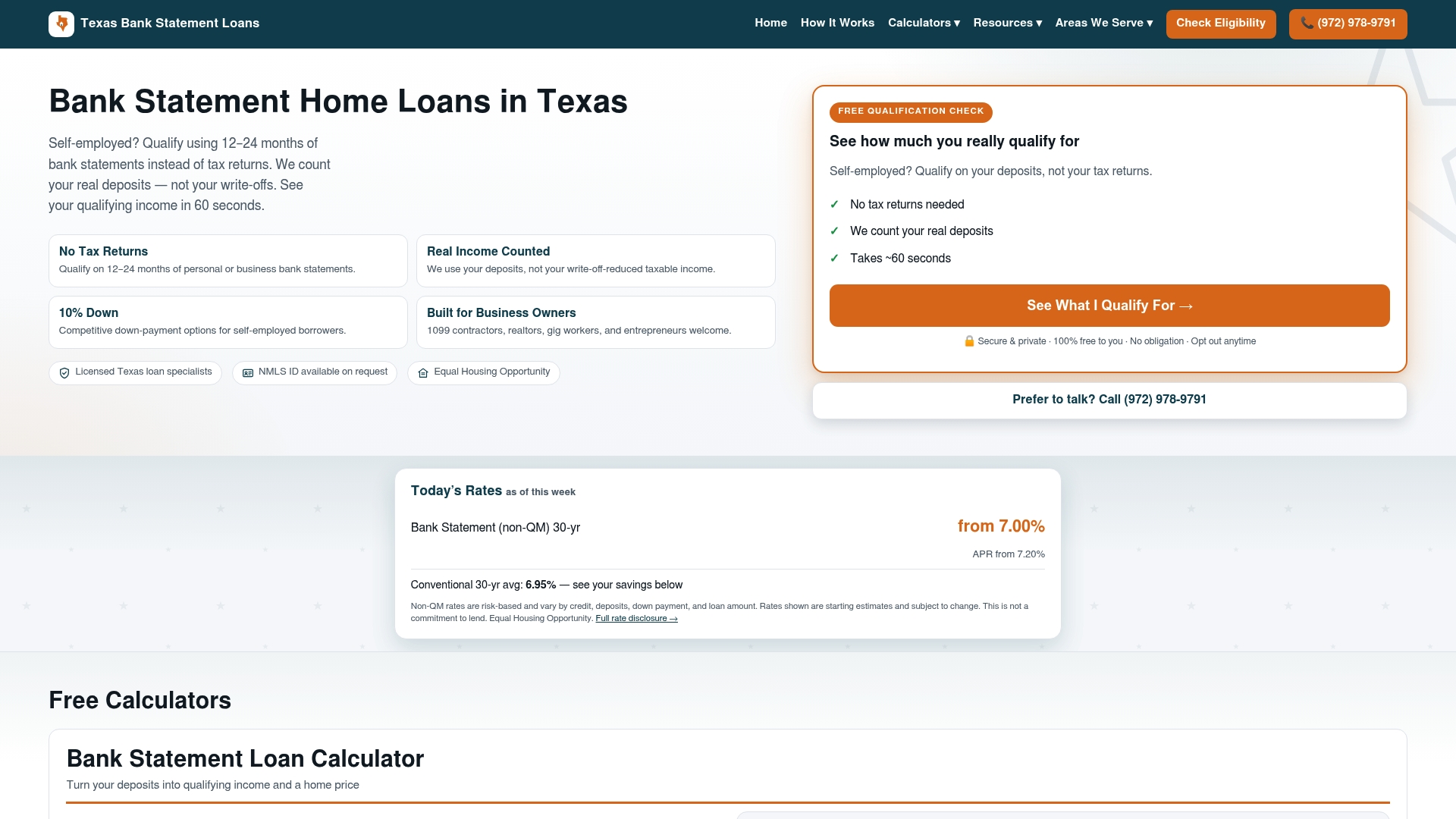
Texasbankstatementloans evaluates 12-24 months of bank deposits instead of tax returns, so your actual income drives the approval, not your Schedule C net profit. Down payments start at 10%, and the qualification check takes 60 seconds with no obligation. Whether you own an LLC, an S-corp, or operate as a sole proprietor, the bank statement loan program at Texasbankstatementloans is built for borrowers whose real cash flow exceeds what their tax returns show. Check current loan rates and connect with an advisor who works exclusively with self-employed borrowers across Texas.
FAQ
Who counts as self-employed for mortgage purposes?
Fannie Mae and Freddie Mac classify any borrower who owns 25% or more of a business as self-employed, regardless of whether the structure is a sole proprietorship, LLC, partnership, or corporation.
What documents do self-employed borrowers need for a mortgage?
Lenders require two years of complete federal tax returns with all schedules, verified against IRS transcripts using Form 4506-C, plus current profit and loss statements.
How does an LLC affect mortgage approval?
LLC members qualify based on actual cash distributions received, not the profit allocated on their K-1. Lenders also count any personally guaranteed business debt against your debt-to-income ratio.
Can self-employed borrowers qualify with one year of tax returns?
Yes. Borrowers with five or more consecutive years of 25%+ business ownership may qualify using just one year of returns, provided the business meets continuous operation criteria.
What is a bank statement loan and who should use it?
A bank statement loan uses 12-24 months of bank deposits to calculate qualifying income instead of tax returns. It is the best option for self-employed borrowers whose deductions significantly reduce their taxable income below their actual cash flow.
See what you qualify for in 60 seconds, free and no credit check. Use the eligibility check at the top of this page.