
If you’re self-employed, run a side business, or earn through gig platforms, you can still qualify for a mortgage. You just won’t be using a W-2 to do it. Bank-statement loans, asset-depletion programs, DSCR loans, and 1099-based non-QM products are the primary income verification alternatives for mortgages available to nontraditional earners in the U.S. today.
The one-line verdict: Your actual cash flow, your assets, or your rental income can replace tax returns and pay stubs, but each path comes with its own credit, reserve, and down payment requirements; non-QM down payments commonly start at 10%.
Quick TL;DR:
- Bank-statement loans use a period of deposits spanning approximately one to two years to calculate income. Lenders typically apply a portion of average deposits to account for business expenses as qualifying income.
- Asset-depletion loans divide your liquid assets by the loan term. A borrower with substantial eligible assets can qualify for a monthly income figure by dividing those assets by the loan term.
- DSCR loans use rental property cash flow, not personal income at all. Ideal for real estate investors.
- 1099/stated-income programs accept contractor income records without requiring full tax return analysis.
- Trade-offs are real: non-QM loans typically run 1-3 percentage points above conventional rates, and down payments commonly start at 10%.
- Credit score matters more here than in conventional lending. Most programs require a minimum credit score generally above 600, and better pricing starts above 700.
Texasbankstatementloans is one example of a lender that evaluates 12-24 months of bank deposits for self-employed borrowers in Texas, with down payment options starting at 10%.
Table of Contents
- What are the main income verification alternatives for mortgages?
- Which alternative fits your borrower profile?
- What do lenders actually check on alternative income applications?
- What documents do you need to gather?
- What do these loans actually cost?
- How do you prepare and submit a strong application?
- Can you refinance without traditional income verification?
- How Texasbankstatementloans evaluates borrowers using bank statements
- Key Takeaways
- The real cost of waiting for a “perfect” conventional profile
- Texasbankstatementloans: qualify with your actual income, not your tax return
- Useful sources and further reading
What are the main income verification alternatives for mortgages?
These programs go by several industry names, bank-statement loans, alternative documentation loans, stated-income loans, non-QM products, but they all solve the same problem: replacing W-2s and tax returns with something that better reflects how nontraditional earners actually make money.
| Loan Type | Income Docs Accepted | Best For | Typical Down Payment | Credit Score Guideline |
|---|---|---|---|---|
| Bank-statement loan | 12-24 months of personal or business bank statements | Self-employed, freelancers, business owners with high deductions | 10%+ | 620+ |
| Asset-depletion loan | Brokerage, savings, retirement account statements | High-net-worth borrowers with low taxable income | 20-30% | 680+ |
| DSCR / investor cash-flow loan | Lease agreements, rental income history | Real estate investors | 20-25% | 640+ |
| 1099 / stated-income program | 1099 forms, contractor letters, signed affidavits | Gig workers, 1099 contractors | 10%+ | 620+ |
| Stated-asset / no-doc variant | Asset verification only, minimal income docs | Borrowers with substantial liquid assets | 30%+ | 700+ |
Bank-statement loans
Lenders average your monthly deposits over 12-24 months, then apply an expense factor, typically 50-75% of that average, to arrive at qualifying income. A business owner depositing $15,000/month on average might qualify on $7,500-$11,250 of monthly income. These are almost always offered by portfolio lenders or non-QM specialists, not conventional banks.

Asset-depletion loans
No income at all? If you have substantial liquid assets, some lenders will divide them by the total number of months over the loan term typically used for long-term mortgages to generate a monthly income figure. The OCC has published guidance on prudent asset-depletion underwriting, including conservative assumptions about rates of return. Lenders often discount retirement accounts or illiquid holdings.
DSCR loans
Debt-service coverage ratio loans skip personal income entirely. The lender looks at whether the rental property’s income covers the mortgage payment. A property generating $2,000/month in rent against a $1,600 mortgage payment has a DSCR of 1.25, which most lenders accept.
1099 and stated-income programs
These accept 1099 forms, signed affidavits, deposit records, and accountant-prepared P&L statements as proof of income. They’re common for gig workers and independent contractors whose income is documented but not through a traditional employer.
Which alternative fits your borrower profile?
Not every program fits every situation. The right match depends on where your income actually lives: in your bank account, your assets, or your rental properties.
Self-employed business owner with heavy deductions Your tax return probably shows far less income than you actually earn. A bank-statement loan is almost always the right starting point. The lender ignores your Schedule C write-offs and focuses on what actually hit your account.
Gig worker or 1099 contractor You have documented income, just not through an employer. A 1099-based program or bank-statement loan both work here. If you’ve been contracting for at least two years and have consistent deposit history, you’re in a strong position.
High-net-worth borrower with low taxable income Asset depletion is built for you. If you’ve sold a business, inherited wealth, or hold significant investment accounts, dividing those assets by the loan term can generate enough qualifying income to close a substantial loan.

Real estate investor DSCR is the cleanest path. You don’t have to document personal income at all. The property’s cash flow does the qualifying work.
| Borrower Profile | Recommended Program | Primary Signal | Minimum Threshold (Typical) |
|---|---|---|---|
| Self-employed, high deductions | Bank-statement loan | Monthly deposit average | 12-24 months statements, 620+ credit |
| Gig / 1099 contractor | 1099 program or bank-statement | 1099 history + deposits | 2 years 1099s, 620+ credit |
| High-net-worth, low taxable income | Asset-depletion | Liquid asset total | 680+ credit, 20-30% down |
| Real estate investor | DSCR loan | Property DSCR ratio | DSCR 1.0-1.25+, 640+ credit |
| Minimal income, strong assets | Stated-asset / no-doc | Asset verification | 700+ credit, 30%+ down |
One important caveat: non-QM programs are not federally standardized. The thresholds above reflect industry norms, but individual lenders set their own rules. A lender who requires 680 for a bank-statement loan might approve a 640 with stronger reserves.
What do lenders actually check on alternative income applications?
The underwriting process for non-QM loans is manual, which means a human reviews your file rather than running it through an automated system. That’s both an opportunity and a risk.
The core checks:
- Credit score, Most programs start at 620, but pricing improves significantly above 700. A 680 borrower and a 740 borrower may see meaningfully different rates on the same bank-statement program.
- Cash reserves, Lenders commonly expect 6-12 months of mortgage payments in liquid reserves after closing. This is non-negotiable for most non-QM products.
- Time in business, Two years of self-employment is the standard benchmark. Some lenders accept 12 months with strong compensating factors.
- Deposit consistency, Erratic deposits raise flags. A borrower with steady monthly deposits is far easier to approve than one with three large irregular transfers.
- Debt-to-income ratio, Even without a W-2, lenders calculate a DTI. They use the qualifying income derived from your statements or assets, then measure it against your total monthly obligations.
How bank-statement income is calculated
Say you deposit an average of $12,000/month across 24 months of business statements. The lender applies a 50% expense factor (common for business accounts), arriving at $6,000/month qualifying income. On a 30-year loan at a 7.5% rate, that supports roughly a $850,000 loan at a 43% DTI. Some lenders use personal statements instead, which often carry a higher percentage (closer to 75%) since personal deposits are assumed to be post-expense.
Trust callout: The OCC’s 2019 bulletin on asset-depletion underwriting specifically addresses how lenders should apply conservative return assumptions to avoid overstating qualifying income for high-net-worth applicants. If a lender quotes you an asset-depletion figure that seems unusually high, ask how they’re calculating it.
Pro Tip: Keep business and personal bank accounts completely separate before you apply. Co-mingled accounts force underwriters to manually back out personal expenses from business deposits, which slows the process and can reduce your qualifying income.
What documents do you need to gather?
The specific documents depend on which program you’re pursuing. Here’s what to collect before you contact a lender.
Bank-statement loan checklist
- All pages of 12-24 months of personal and/or business bank statements (PDF, not screenshots)
- Business license or formation documents (LLC, S-corp, sole proprietor registration)
- Accountant-signed profit and loss statement covering the same period
- CPA letter confirming you’ve been self-employed for at least two years
- Explanation letters for any large or irregular deposits
Asset-depletion checklist
- Most recent 2-3 months of brokerage, savings, and investment account statements
- Retirement account statements (lenders may discount these by 30-40%)
- Documentation of asset ownership (joint accounts require clarification)
- Letter of explanation if assets were recently liquidated or transferred
1099 / stated-income checklist
- Two years of 1099 forms from all clients or platforms
- Signed contracts or client engagement letters
- Deposit records and signed affidavits confirming income source
- Business bank statements to corroborate 1099 totals
DSCR loan checklist
- Signed lease agreement for the subject property
- Current rent roll if purchasing a multi-unit property
- Property insurance quote
- Appraisal (ordered by lender)
Pro Tip: When submitting bank statements, annotate any deposit over $5,000 that isn’t regular business income. A brief cover note explaining a client payment, asset sale, or family transfer prevents the underwriter from flagging it as an undisclosed liability or gift.
Third-party verification adds credibility. A CPA-signed P&L carries more weight than a self-prepared spreadsheet. For 1099 income, a letter from a long-term client on company letterhead confirming your working relationship can be the difference between an approval and a request for more documentation.
What do these loans actually cost?
The honest answer: more than a conventional loan, and how much more depends on your credit, your down payment, and the lender.
- Interest rate premium: Non-QM bank-statement loans typically run 1-3 percentage points above conventional rates. On a $500,000 loan, that’s a meaningful monthly difference.
- Down payment: Most programs start at 10%, but better pricing and easier approval come at 20-25%. Asset-depletion and no-doc variants often require 30%.
- Reserves: Expect to show 6-12 months of payments in liquid accounts after closing. This isn’t a soft suggestion; many lenders won’t approve without it.
- Origination fees: Non-QM loans often carry higher origination costs than conventional products. Ask for a full loan estimate and compare the APR, not just the rate.
- Processing time: Manual underwriting takes longer. Budget 30-45 days minimum, sometimes more if documentation is incomplete.
Your credit score is the biggest lever on pricing. A borrower at 740 might land a rate 0.75-1.0 points lower than a 640 borrower on the same bank-statement program. Running a self-credit check before applying lets you fix errors and time your application when your score is strongest.
Pricing note: Non-QM underwriting rules and pricing vary significantly by lender. The ranges above reflect industry consensus, not a guarantee. Always get multiple loan estimates before committing.
How do you prepare and submit a strong application?
A well-organized file moves faster and gets fewer conditions. Here’s the sequence that works.
- Separate your accounts. If you haven’t already, open a dedicated business checking account and stop running personal expenses through it. Give it at least 3-6 months of clean history before applying.
- Run your own credit check. Pull your report from AnnualCreditReport.com and dispute any errors. Pay down revolving balances to below 30% utilization.
- Calculate your target down payment and reserves. Use a bank statement loan calculator to estimate what loan amount your deposit history supports, then work backward to the down payment you’ll need.
- Get a CPA-prepared P&L. This should cover the most recent 12-24 months and be signed by your accountant. Self-prepared statements are accepted by some lenders but carry less weight.
- Compile your statement package. All pages, in PDF, no gaps in months. A missing statement from month 14 of a 24-month package will pause your file.
- Write explanation letters. For any large or irregular deposit, write a brief, factual explanation. Keep it one paragraph. Attach supporting documentation where you have it.
- Contact specialized lenders or brokers. A mortgage broker who works with non-QM lenders regularly will know which programs fit your profile and which lenders are pricing competitively right now.
Questions to ask any lender:
- How do you calculate qualifying income from bank statements? What expense factor do you apply?
- What reserve requirement applies to this program?
- Do you accept personal statements, business statements, or both?
- What’s your minimum credit score for this product?
- What fees are included in the APR?
Red flags to fix before you apply:
- Co-mingled personal and business accounts
- Large unexplained deposits in the last 12 months
- Thin credit file (fewer than 3 open tradelines)
- Less than 12 months of self-employment history
Can you refinance without traditional income verification?
Yes, and it works similarly to a purchase loan, with a few differences worth knowing.
- Rate/term refinance: If you have equity and your deposit history supports the new payment, most non-QM lenders will refinance using bank statements or asset depletion. The documentation requirements are nearly identical to a purchase.
- Cash-out refinance: Also available through non-QM programs, but lenders typically cap loan-to-value more conservatively, often at 75-80%. Strong reserves matter even more here.
- Government-backed streamlines: FHA Streamline and VA IRRRL programs are designed to reduce documentation, but they still require the original loan to have been government-backed. They don’t eliminate income verification entirely for borrowers who didn’t start with those programs.
- Timing: Refinancing too soon after purchase can be a problem. Some non-QM lenders require 12 months of seasoning before they’ll refinance a bank-statement loan.
When refinancing makes sense for nontraditional earners:
- Your deposit history has improved significantly since your original loan
- Rates have dropped enough to offset the higher non-QM premium
- You need cash-out for business investment or debt consolidation and have sufficient equity
When it probably doesn’t:
- You’re within 12 months of your original closing
- Your reserves are thin after the purchase
- You’re hoping to switch to a conventional loan without improving your documentation profile first
How Texasbankstatementloans evaluates borrowers using bank statements
Texasbankstatementloans is built specifically for self-employed borrowers in Texas whose tax returns underreport cash flow due to business deductions. Here’s how their process works in practice.
The process flow:
- Prequalification (60 seconds): A no-obligation check that gives you a realistic sense of how much you can borrow based on your deposit history. No hard credit pull at this stage.
- Statement submission: 12-24 months of personal or business bank statements, all pages in PDF format.
- Income calculation: Deposits are averaged and an expense factor is applied to arrive at qualifying income. The specific percentage depends on your account type and business structure.
- Supporting documents: Accountant-signed P&L, business license, and CPA letter confirming self-employment duration.
- Credit and reserve review: Standard non-QM thresholds apply. Down payment options start at 10%.
- Underwriting and approval: Manual review by a specialist familiar with self-employed income patterns.
Pro Tip: Before you submit, use the self-employed affordability calculator to estimate your qualifying income from deposits. It takes two minutes and gives you a realistic target before you talk to a loan officer.
Underwriting criteria vary by borrower and program. The process above reflects Texasbankstatementloans’s general approach; specific thresholds and documentation requirements depend on your individual file. This article is general information, not financial advice. Confirm current program details directly with a qualified loan officer before making any application decisions.
Key Takeaways
Bank-statement loans, asset-depletion programs, DSCR loans, and 1099-based non-QM products are the primary income verification alternatives for mortgages, each requiring different documentation and carrying higher costs than conventional loans.
| Point | Details |
|---|---|
| Four main alternatives | Bank-statement, asset-depletion, DSCR, and 1099 programs each replace W-2s with different qualifying evidence. |
| Rate and down payment premium | Non-QM loans typically run 1-3 points above conventional rates; down payments commonly start at 10%. |
| Credit and reserves matter most | Most programs require 620+ credit and 6-12 months of reserves; higher scores unlock better pricing. |
| Documentation quality drives speed | CPA-signed P&Ls, annotated statements, and clean separate accounts reduce conditions and processing time. |
| Texasbankstatementloans | Evaluates a period of deposits spanning approximately one to two years for Texas self-employed borrowers, with down payment options starting at 10%. |
The real cost of waiting for a “perfect” conventional profile
Most articles on this topic treat non-QM loans as a last resort. That framing misses something. For a business owner who writes off $80,000 in legitimate expenses and shows $40,000 in taxable income, a conventional loan isn’t just harder to get. It’s often impossible, regardless of how much cash is actually moving through the business.
The smarter frame is strategic: exhaust conventional options first if your documentation genuinely supports them. But if your tax strategy is working exactly as intended and your actual cash flow is strong, a bank-statement loan isn’t a consolation prize. It’s the product designed for your situation.
The mistake I see most often is borrowers who spend 12-18 months trying to force a conventional approval by adjusting their tax strategy, only to reduce the deductions that made their business efficient in the first place. That’s a bad trade. A slightly higher mortgage rate is almost always cheaper than years of overpaying taxes.
The other common error: applying to a non-QM lender without shopping. These programs vary more than conventional loans. Two lenders can quote the same borrower rates that differ by a full percentage point on the same bank-statement product. Use a broker who works with multiple non-QM lenders, not one who has a single in-house product.
Transparent documentation is the single biggest factor in approval speed. Annotate your statements. Get the CPA letter. Write the explanation letters before the underwriter asks. Borrowers who submit a clean, well-organized file close faster and with fewer conditions than borrowers who submit raw statements and wait for questions.
Texasbankstatementloans: qualify with your actual income, not your tax return
Self-employed borrowers in Texas often earn far more than their tax returns show. Texasbankstatementloans was built around that reality. Instead of penalizing you for legitimate business deductions, the program evaluates 12-24 months of bank deposits to reflect what you actually earn.
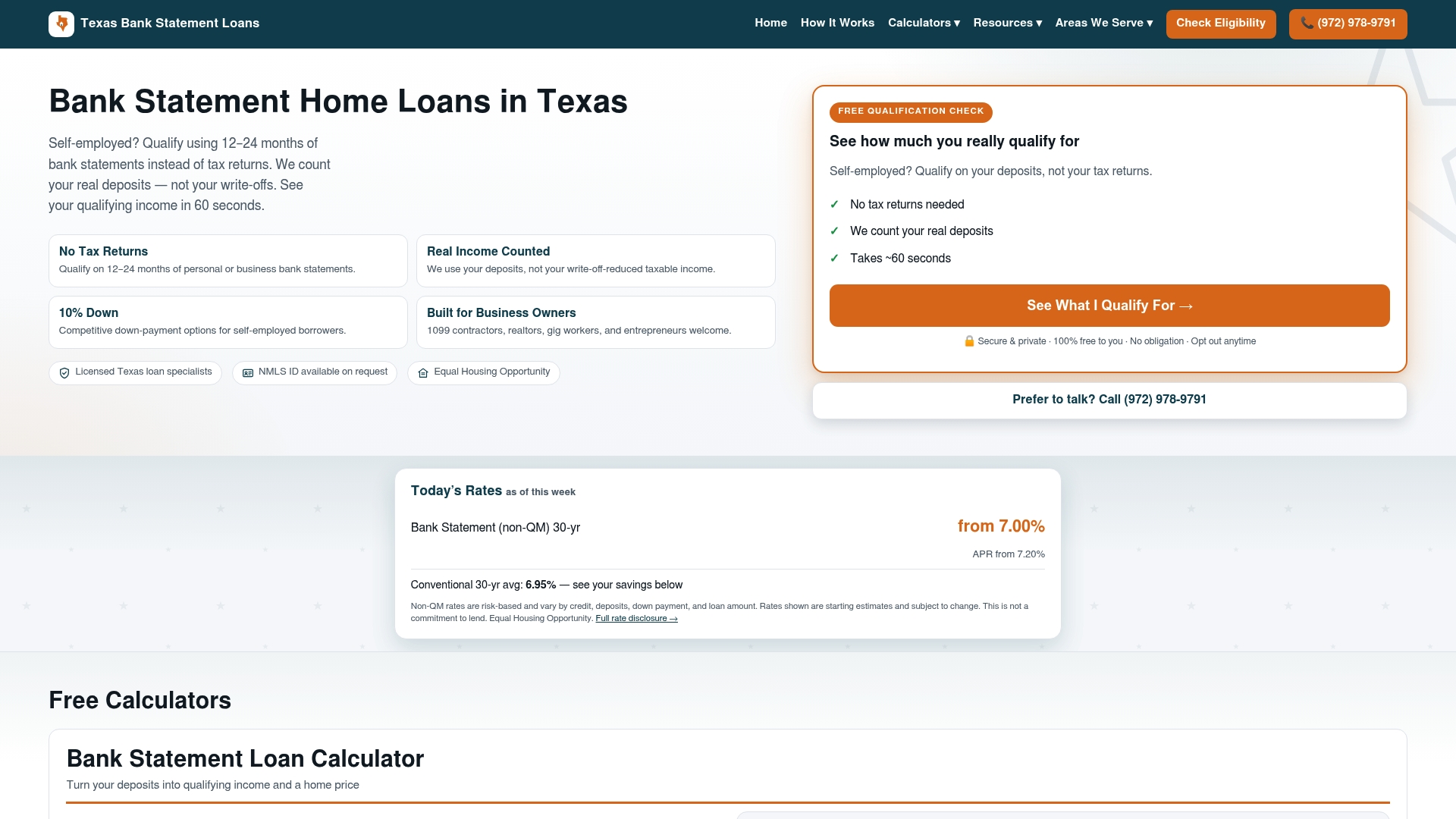
Down payment options start at 10%, and the prequalification check takes about 60 seconds with no obligation and no hard credit pull. Whether you’re in Houston, Austin, Midland, or anywhere else in Texas, the program is designed for business owners, 1099 contractors, and gig workers who need a lender that understands how nontraditional income actually works.
Check today’s bank-statement loan rates or run your numbers through the bank statement loan calculator to see what your deposit history supports. When you’re ready, start your prequalification at Texasbankstatementloans. Underwriting criteria vary by borrower and program; confirm current requirements with a loan officer.
Useful sources and further reading
These are the primary sources used for claims throughout this guide.
- OCC Bulletin 2019-36: Asset-Depletion Underwriting, The Office of the Comptroller of the Currency’s guidance on prudent assumptions for asset-depletion mortgage underwriting. Essential reading if you’re evaluating a high-net-worth borrower or being quoted an unusually high asset-depletion income figure.
- CFPB Ability-to-Repay and Qualified Mortgage Rule Compliance Guide, The Consumer Financial Protection Bureau’s compliance guide explaining the QM rule framework, which defines what non-QM loans are by exclusion. Useful for understanding why non-QM underwriting is lender-specific.
- NMLS Consumer Access, The official registry for verifying that a mortgage lender or broker is licensed in your state. Always confirm licensure before submitting documents or paying fees.
- SML Texas: State Licensing and Regulation, The Texas State Securities Board and Office of Consumer Credit Commissioner regulate mortgage lenders in Texas. Use this to verify state-level licensing for any Texas-based lender.
- Non-QM Loan Guide (Aditya Choksi / 21st Century Lending), A detailed practitioner breakdown of bank-statement income calculations, expense factors, and non-QM program structures.
- Asset-Depletion Mortgage Explained (Quicken Loans), Clear explanation of asset-depletion formulas, reserve expectations, and credit thresholds for high-net-worth borrowers.
- Bank-Statement Mortgage Guide (SoFi), Covers the trade-offs between bank-statement and conventional loans, with advice on when to pursue each.
- Proof of Income: Accepted Documents (Ondato), Comprehensive list of income documentation alternatives accepted across lending and verification contexts, including 1099s, affidavits, and P&L statements.
Recommended
See what you qualify for in 60 seconds, free and no credit check. Use the eligibility check at the top of this page.