
A bank statement is a formal record of all deposits, withdrawals, and balances in a single account during a set period. The distinction between personal vs business bank statements is not cosmetic. Lenders treat these documents as fundamentally different instruments, each triggering a separate underwriting model. For self-employed borrowers, contractors, and business owners applying for a mortgage in Texas, choosing the wrong statement type can reduce your qualifying income or delay your closing. Getting this right starts with understanding what each document contains and how lenders read it.
What are personal bank statements and how are they used?
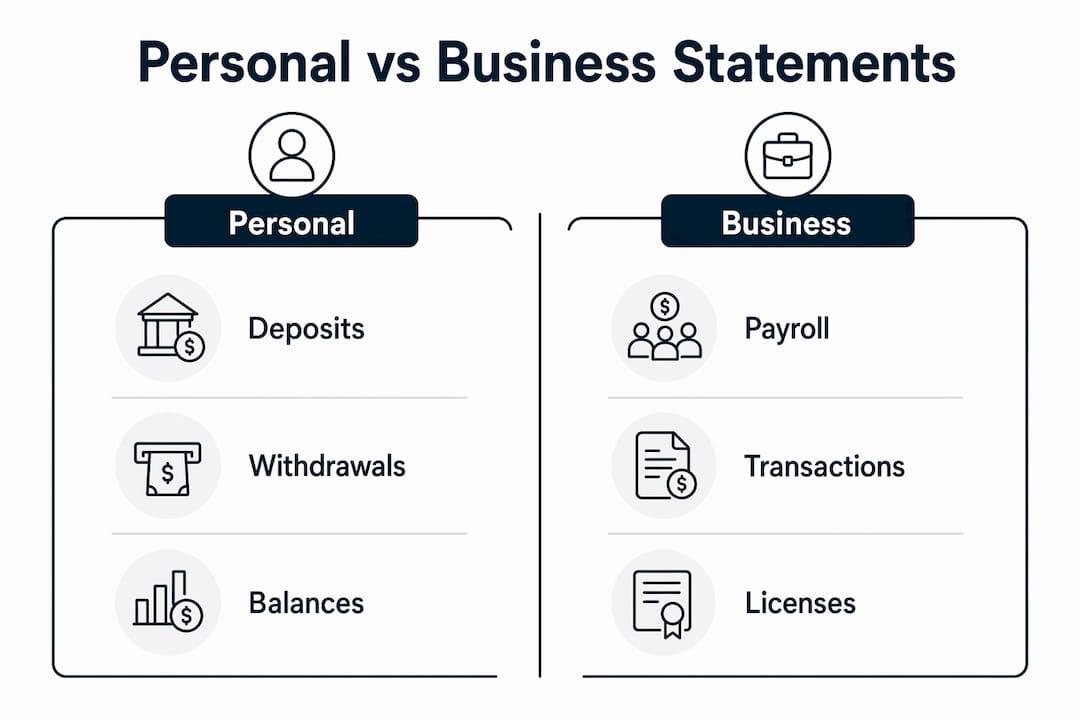
Personal bank statements show deposits, withdrawals, and balances for individual checking or savings accounts, reflecting actual spendable income. Lenders use them to verify that income flows in consistently and that the account holder can sustain mortgage payments. For freelancers, 1099 contractors, and sole proprietors who deposit client payments directly into a personal account, this document is often the clearest picture of real income.
Lenders reviewing personal statements look for three things: deposit consistency, average monthly balance, and the absence of large unexplained transfers. A deposit pattern that spikes one month and disappears the next raises flags. Regular, recurring deposits from identifiable sources carry the most weight.

Personal statements work best when business expenses are paid separately. If you run a landscaping business but pay for fuel, equipment, and supplies through your personal account, a lender sees those outflows as personal spending. That reduces your apparent net income and complicates the underwriting review.
Common mistakes borrowers make with personal statements:
- Depositing business revenue and personal income into the same account. This creates a commingled record that lenders cannot cleanly interpret.
- Making large cash deposits without documentation. Lenders require a paper trail for any deposit that looks irregular.
- Transferring money between accounts repeatedly. Transfers between your own accounts can appear as double income if not clearly labeled.
- Submitting incomplete statement sets. Missing pages or months create gaps that trigger underwriting delays.
- Ignoring overdrafts or returned items. Even one returned payment signals cash flow instability to a lender.
Pro Tip: Before submitting personal statements for a loan, review 12 months of transactions yourself. Flag any deposit you cannot explain with a simple document. Lenders will ask, and having the answer ready cuts weeks off your processing time.
What is a business bank statement and why does it matter for lending?
A business bank statement is a formal record of a company’s account activity, including payroll runs, ACH transfers, merchant deposits, vendor payments, and operating fees. Business statements include special transaction codes for payroll, ACH, and merchant deposits, reflecting operational cash flow and costs. They are typically multi-page documents with higher transaction volume than personal accounts, and lenders review them with a different set of questions in mind.
The core question a lender asks when reviewing a business statement is not “how much came in?” but “how much is left after the business pays its bills?” This is where the expense factor comes in. Lenders apply an industry-specific expense ratio to total deposits to estimate the owner’s actual take-home income. A restaurant owner and a software consultant will face different expense factors because their cost structures differ.
What lenders look for in business statements
- Consistent monthly deposit volume across the review period (typically 12-24 months)
- Stable or growing account balances that suggest the business is not burning through reserves
- Absence of large, unexplained transfers to personal accounts that could indicate income shifting
- Clear separation between operating expenses and owner distributions
- No significant NSF (non-sufficient funds) events that signal cash flow problems
Business statements also require supporting documentation. Lenders require business licenses, articles of incorporation, and CPA letters to verify business operations and support expense deductions. This documentation package is more extensive than what personal statement loans require, and missing even one item can stall your application.
| Document type | Personal statements | Business statements |
|---|---|---|
| Statement length | 12-24 months | 12-24 months |
| Supporting docs | Minimal | Business license, CPA letter, articles of incorporation |
| Expense factor applied | Generally none | Yes, varies by industry |
| Transaction complexity | Low to moderate | High |
| Underwriting time | Faster | Longer |
Pro Tip: If you submit business bank statements, attach a CPA-prepared profit and loss statement for the same period. Lenders who see consistent numbers across both documents process applications faster and with fewer conditions.
How do lenders evaluate personal vs business bank statements for mortgages?
Lenders treat personal statements as household cash flow measures and business statements as indicators of company operational profitability and cash management. That fundamental difference drives two separate risk models. Personal statements feed a household stability analysis. Business statements feed an operational health analysis.
With personal statements, lenders typically count the full eligible deposit amount as qualifying income, minus any obvious business expenses that appear in the same account. With business statements, lenders apply expense factors to business deposits rather than counting the full deposit total. The expense factor reduces gross deposits to an estimated net income figure. That figure is what the lender uses to calculate your debt-to-income ratio.
Choosing the wrong statement type does not just affect paperwork. It directly changes the income number a lender uses to approve or deny your loan. A business owner depositing $20,000 per month may qualify for a larger loan using personal statements than business statements, depending on the expense factor applied. The math matters more than the label.
Commingling funds creates the most common underwriting problem. When personal and business transactions appear in the same account, mixing accounts triggers lender scrutiny and more complicated income verification. Underwriters must manually separate business from personal transactions, which takes time and often results in a conservative income estimate that hurts the borrower.
Bank statement loans require 12-24 months of statements plus self-employment verification, regardless of which statement type you use. Business statements generally require more supporting documents than personal statements. That added documentation burden is the main reason some self-employed borrowers prefer to use personal statements when their income structure allows it.
You can use the loan income calculator at Texasbankstatementloans to see how deposit amounts translate into qualifying income under both statement types before you apply.
How to choose between personal and business bank statements for your loan
Choosing the right statement type is less about what looks better on paper and more about how your income actually flows and how clearly a lender can verify it. The right choice depends on income flow and verifiability, not on which document shows a higher number.
Use this decision process:
- Identify where your income lands. If client payments deposit directly into your personal account, personal statements are the cleaner choice. If revenue flows into a business account first, use business statements.
- Check your account separation. If you have kept personal and business transactions in separate accounts for at least 12 months, either statement type will produce a clean record. If accounts are mixed, separate them now and wait before applying.
- Understand your business structure. Sole proprietors and single-member LLCs often qualify using personal statements. S-corps and multi-member LLCs typically require business statements because income distribution is more complex.
- Ask your lender directly. Different lenders apply different expense factors and have different preferences. A lender who specializes in self-employed borrowers, like Texasbankstatementloans, will tell you upfront which statement type produces the better qualifying income for your specific situation.
- Organize your statements before submitting. Print or download complete statement sets with no missing pages. Label each month clearly. Attach a simple deposit summary that matches the statement totals. This one step prevents the most common processing delays.
A hybrid approach works in specific cases. Some borrowers use personal statements for the primary income calculation and submit business statements as supplemental documentation to show business stability. This works when the lender accepts it and when both accounts show consistent, clean activity. Confirm this option with your lender before assembling your package.
Pro Tip: Reconcile your bank statements against your accounting records before submitting them. Any discrepancy between your bookkeeping and your bank record will surface during underwriting. Catching it yourself first prevents a last-minute condition that delays closing.
Key Takeaways
Personal and business bank statements serve distinct roles in mortgage underwriting, and choosing the right type directly determines your qualifying income.
| Point | Details |
|---|---|
| Personal statements count full deposits | Lenders use the full eligible deposit amount without applying an expense factor to personal accounts. |
| Business statements require an expense factor | Lenders reduce business deposits by an industry-specific ratio to estimate net income. |
| Account separation prevents delays | Commingled personal and business funds trigger manual review and conservative income estimates. |
| Supporting docs differ by type | Business statements require licenses, CPA letters, and articles of incorporation; personal statements do not. |
| Statement choice affects qualifying income | The right statement type depends on where income flows, not which document shows a higher gross number. |
What I’ve learned from watching borrowers choose the wrong statement type
Most borrowers I’ve seen run into trouble not because their income is too low, but because their documentation tells a confusing story. A contractor earning $15,000 a month can fail to qualify simply because their personal and business transactions share one account. The lender cannot cleanly separate the income from the expenses, so they apply a conservative estimate that cuts the qualifying figure in half.
The mistake I see most often is waiting too long to separate accounts. Borrowers decide to apply for a mortgage and then realize their last 12 months of statements are a mixed record. At that point, the only option is to wait another 12 months with clean accounts or accept a lower qualifying income. Neither is a good outcome when you have found the right property.
The second mistake is assuming that more gross deposits always means a better application. Business statements with $30,000 in monthly deposits may produce a lower qualifying income than personal statements with $20,000, once the expense factor is applied. I’ve watched borrowers insist on using business statements because the number looks bigger, only to qualify for less than they expected.
My advice is to talk to a lender who works exclusively with self-employed borrowers before you start organizing your documents. They will tell you exactly which statement type produces the best result for your income structure. That conversation takes 15 minutes and can save you months of preparation time.
- Saad
Texasbankstatementloans: qualifying with the right bank statements
Self-employed borrowers in Texas have a direct path to mortgage approval without tax returns or W-2s.
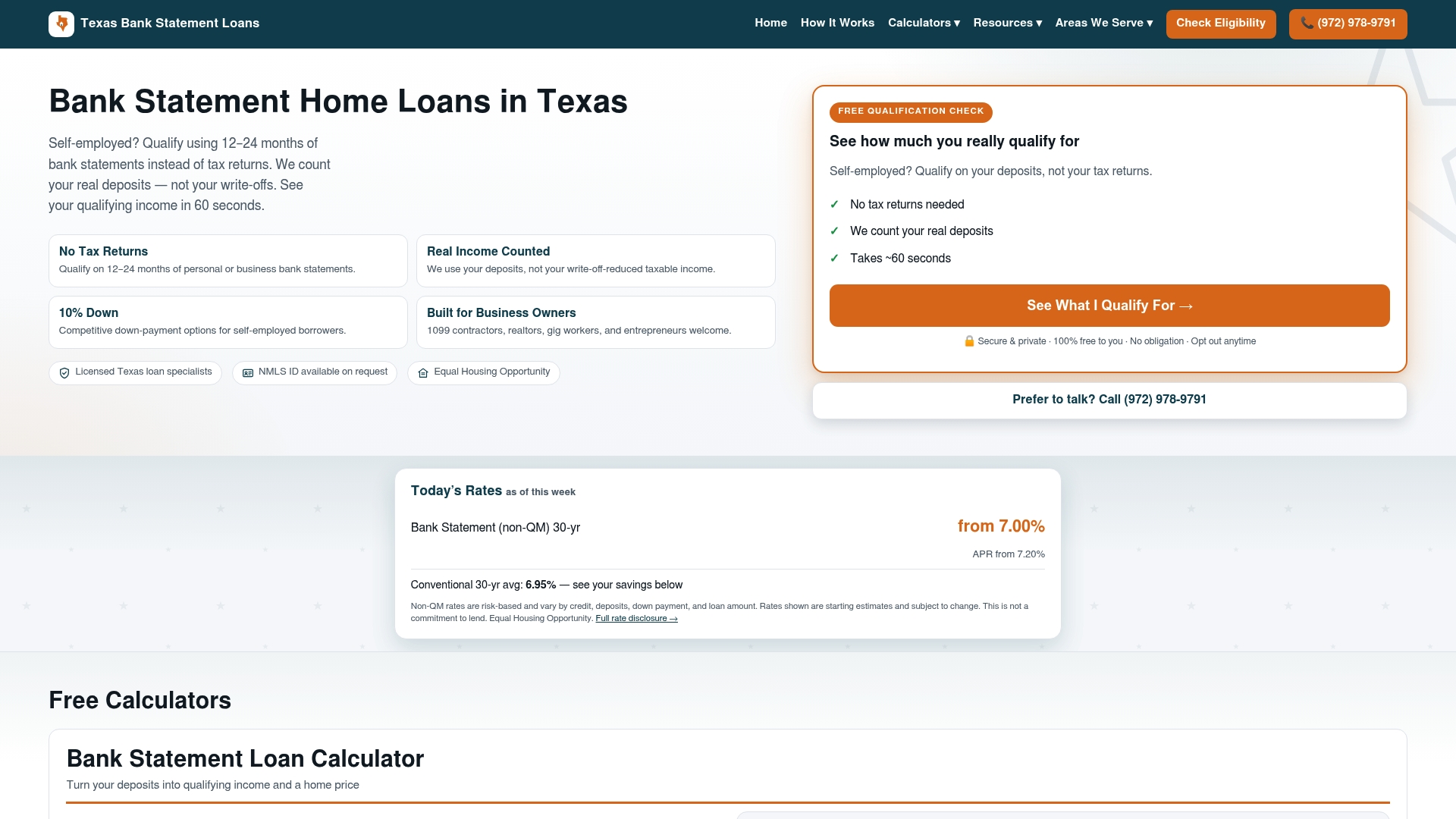
Texasbankstatementloans evaluates 12-24 months of personal or business bank deposits to calculate your qualifying income, with down payment options starting at 10%. The process works for business owners, 1099 contractors, and gig workers who show real income in their bank accounts but not on their tax returns. You can check your qualification in 60 seconds with no obligation. If you want to see how your deposit history translates into a loan amount, the self-employed affordability calculator gives you a number before you speak with anyone. Texasbankstatementloans also publishes current loan rates so you can plan with accurate figures from the start.
FAQ
What is the main difference between personal and business bank statements?
Personal bank statements record individual account activity and are used to measure household income. Business bank statements record company account activity and require lenders to apply an expense factor before calculating qualifying income.
Can I use personal bank statements for a self-employed mortgage?
Yes. Self-employed borrowers who deposit income directly into a personal account can use personal statements to qualify. This approach avoids the expense factor applied to business deposits and often produces a higher qualifying income.
How many months of bank statements do lenders require?
Lenders typically require 12-24 months of statements for bank statement loans, regardless of whether you submit personal or business records.
What happens if I mix personal and business transactions in one account?
Commingled accounts force lenders to manually separate transactions, which slows underwriting and typically results in a more conservative income estimate. Keeping accounts separate prevents this problem entirely.
Do business bank statements require extra documentation?
Yes. Business statements require supporting documents including a business license, articles of incorporation, and a CPA letter. Personal statements generally require only the statements themselves plus self-employment verification.
Recommended
- Bank Statement Loan Calculator | Texas Bank Statement Loans
- Bank Statement Loans in Houston, TX | Self-Employed Mortgage
See what you qualify for in 60 seconds, free and no credit check. Use the eligibility check at the top of this page.