
Non‑QM seasoning rules are set by each individual lender rather than a federal standard, and most lenders tier them into bands based on how recently a bankruptcy, foreclosure, or short sale wrapped up. That’s the core difference from agency lending: Fannie Mae fixes waiting periods at years, while private Non‑QM lenders can approve you sooner if you accept a lower loan-to-value ratio, larger reserves, or tighter documentation. The clock almost always starts on a documented completion date, not the date the trouble began, so pinning that date down is the single highest-leverage move in the file.
TL;DR:
- Most Non‑QM lenders start seasoning periods from documented completion dates, with shorter windows often requiring higher reserves and lower loan-to-value ratios.
- Trigger dates for derogatory events like bankruptcy or foreclosure must be verified through official documents, not just credit reports, to avoid underwriting delays.
- Borrowers typically qualify for better terms after 24 months since the event, with LTVs approaching standard levels and fewer reserves required, unlike shorter windows with stricter conditions.
- Reserves and risk-based pricing adjustments are the primary lender levers used to accommodate recent credit events, with reserves being the most flexible.
- DSCR loans place less emphasis on personal credit history, focusing instead on property income, which can benefit borrowers with recent derogatory credit but strong property cash flow.
Table of Contents
- What Counts as a Significant Derogatory Event, and When Does the Clock Start?
- What Are the Standard Non‑QM Seasoning Bands?
- How Do Underwriters Verify the Completion Date?
- How Many Tradelines Do You Need to Re-Qualify?
- What Pricing Levers Do Lenders Use for Recent Credit Events?
- How Do DSCR Loans Treat Borrower Credit Events Differently?
- What LTV and Reserve Ranges Should Borrowers Actually Expect?
- What Should a Loan Officer Collect at Intake for Post-Event Borrowers?
- Why Borrowers Confuse Tax Rules With Mortgage Seasoning
- How Texas Bank Statement Home Loans Helps You Get Back In Sooner
- Where to Verify These Rules Yourself
- Sources
- FAQ
What Counts as a Significant Derogatory Event, and When Does the Clock Start?
Lenders group a handful of events under the “significant derogatory credit” umbrella, and each one has its own trigger date for starting the seasoning clock. Getting the trigger date wrong is the most common reason a file gets kicked back to underwriting for rework.
- Chapter 7 or Chapter 11 bankruptcy: the clock starts at discharge, not the filing date.
- Chapter 13 bankruptcy: most lenders start counting at discharge, though some Non‑QM programs will count from the dismissal date if the case never converted.
- Foreclosure: seasoning begins at the recorded completion of the foreclosure sale, typically the date on the trustee’s deed.
- Deed-in-lieu of foreclosure: the clock starts on the recorded transfer date, not the day the borrower first contacted the servicer.
- Short sale: seasoning starts at the settlement or closing date shown on the final settlement statement.
- Charge-off: most Non‑QM guidelines count from the charge-off date reported on the credit file, though some ask for the creditor’s own confirmation.
None of these dates show up reliably on a credit report alone. You need the discharge order, the trustee’s deed, or the settlement statement in the file before an underwriter will run the seasoning math.
What Are the Standard Non‑QM Seasoning Bands?
Non‑QM guidelines commonly split into three rough bands, and where a borrower lands changes almost every other term on the loan. Industry lending guides describe this tiering as fairly consistent across the private-capital market, even though exact cutoffs shift lender to lender.
- 0 to 12 months since completion: eligible at many Non‑QM shops, but expect meaningfully reduced leverage, mandatory larger reserves, and a rate premium.
- 12 to 24 months since completion: LTV caps loosen, reserve requirements ease, and pricing improves, though the file still gets extra underwriter scrutiny.
- Beyond 24 months since completion: many Non‑QM programs treat the borrower close to a standard file, with LTV and pricing approaching what a clean-credit borrower would see.
Compare that to Fannie Mae’s fixed schedule: the Selling Guide sets a 7-year wait after a completed foreclosure (with a 3-year exception for documented extenuating circumstances), 4 years after Chapter 7 or 11 bankruptcy, and 2 years from discharge for Chapter 13. Non‑QM exists precisely to compress those windows for borrowers who can show current financial stability, at a cost. These bands are illustrative, not universal. Every lender sets its own thresholds, so treat this as a framework for the conversation, not a quote.
How Do Underwriters Verify the Completion Date?
Verifying a completion date is mostly a documents chase, and the order you pull them in matters. Work through this sequence before you submit the file, not after an underwriter kicks it back.
- Order the recorded public document first, the trustee’s deed for a foreclosure, the recorded deed for a deed-in-lieu, or the final settlement statement for a short sale.
- Pull the bankruptcy discharge order and docket entries directly from the court, since a credit report will often show only the filing date, not the discharge.
- Cross-check the credit report against the public record. If the two dates conflict, the public document wins.
- Request a letter of explanation (LOE) any time a bankruptcy and a foreclosure appear together, so the underwriter can determine which waiting period actually applies.
- Confirm dismissal versus discharge on any bankruptcy that never converted chapters, since the two trigger very different seasoning clocks.
A credit report alone is almost never sufficient evidence of a completion date. It shows that an event happened, not exactly when it legally concluded.
Pro Tip: When a bankruptcy and a foreclosure show up on the same file, lenders often default to whichever waiting period is longer unless you can document that the foreclosure was directly tied to the bankruptcy discharge. A clean LOE plus both source documents can let the underwriter apply the shorter of the two periods instead of stacking them.
How Many Tradelines Do You Need to Re-Qualify?
Re-establishing credit after a derogatory event usually means rebuilding a track record an underwriter can actually measure, not just waiting out the calendar. Most Non‑QM guidelines look for some combination of the following before treating a borrower as “recovered” enough to unlock better pricing.
- Two to four active tradelines with at least 12 to 24 months of on-time payment history since the event.
- Rent payment reporting through services that report to the credit bureaus, which many Non‑QM underwriters now accept as a substitute tradeline.
- Authorized-user accounts, which help but usually carry less weight than accounts the borrower opened and manages directly.
- Secured credit-builder accounts, which are a common bridge for borrowers who came out of a foreclosure or bankruptcy with a thin file.
Self-employed borrowers face a particular wrinkle here: a thin tradeline file often overlaps with income that doesn’t show cleanly on tax returns. That’s exactly the gap bank statement programs were built to close, evaluating 12 to 24 months of actual deposits instead of leaning solely on a credit profile that’s still rebuilding.
What Pricing Levers Do Lenders Use for Recent Credit Events?
Every Non‑QM lender has a small toolkit of levers it pulls when a borrower is closer to the event date than the lender would prefer. Understanding which lever moves which number helps you set realistic expectations at intake instead of after an underwriter counters the deal.
- LTV reduction is the most common lever, and it’s steepest in the 0 to 12-month band, then eases as the file moves into the 12 to 24-month range.
- Reserve requirements climb for recent events, sometimes stacking several months on top of the lender’s standard minimum.
- Risk-based pricing adjustments show up as rate add-ons rather than outright denial, which is the core trade-off Non‑QM offers over waiting out an agency timeline.
- Asset depletion or documented cash flow can occasionally offset a thin post-event file, letting strong liquidity substitute for some of the seasoning penalty.
Pro Tip: Reserves are the most negotiable lever in the stack. A borrower who can show six extra months of reserves often gets more flexibility on LTV than one who simply waits three extra months for the calendar to turn.
How Do DSCR Loans Treat Borrower Credit Events Differently?
DSCR loans (debt-service coverage ratio loans) shift the underwriting focus away from the borrower’s personal history and onto the property’s own income. That single difference changes how much a recent credit event actually matters.
- The core question becomes whether rental income covers the mortgage payment, not whether the borrower had a bankruptcy two years ago.
- Strong property cash flow and healthy reserves can offset a borrower seasoning profile that would sink a standard owner-occupied file.
- Seasoning still matters. A very recent foreclosure or bankruptcy discharge typically still needs a longer runway even on a DSCR file, but the bar tends to sit lower than on owner-occupied Non‑QM.
- Documentation shifts toward the lease, market rent analysis, and the property’s own operating numbers rather than personal bank statements.
What LTV and Reserve Ranges Should Borrowers Actually Expect?
Numbers help borrowers picture the trade-off, so here’s how the bands typically translate into real terms, understanding these are illustrative ranges rather than any single lender’s published grid.
| Seasoning band | Typical LTV range | Typical reserves | What usually tightens |
|---|---|---|---|
| 0 to 12 months | about 50% | 12 to 24 months | Appraisal review, income documentation |
| 12 to 24 months | about 65% | 12 to 24 months | Pricing add-ons, reduced but present |
| 24+ months | 75% | several months | Minimal, closer to standard Non‑QM terms |
Loan size and occupancy push these numbers around further. A jumbo loan amount or an investment property in the 0 to 12-month band often pushes reserves toward the higher end of that range, while a smaller owner-occupied loan might land closer to the low end.
What Should a Loan Officer Collect at Intake for Post-Event Borrowers?
A tight intake process is what separates a file that closes on schedule from one that stalls for weeks while documents get chased down after the fact. Build the file in this order.
- Pull the discharge order, trustee’s deed, or settlement statement immediately, before quoting rate or LTV.
- Collect 12 to 24 months of bank statements, personal or business, to establish actual qualifying income for self-employed applicants.
- Document reserves with current statements, not screenshots, since underwriters will want to trace the balance history.
- Draft the LOE early, tying the narrative directly to the dates on the public documents rather than the borrower’s memory of events.
- Confirm the down payment source, since programs offering options starting at 10% down still require sourcing and seasoning of those funds.
Pro Tip: Get the completion-date documents before you run any pricing scenario. Quoting LTV off a guessed date, then having to revise it once the trustee’s deed comes back with a different date, is the single most avoidable delay in a post-event file.
Why Borrowers Confuse Tax Rules With Mortgage Seasoning

Ask enough borrowers about “the $100,000 rule” and you’ll find most of them are actually asking about IRC §7872, the tax code section governing below-market family loans, not anything related to mortgage seasoning. That statute deals with imputed interest and de minimis exceptions on family loans. It has nothing to do with how long you wait after a foreclosure. I’d separate those two questions explicitly at intake, because conflating them wastes time on both sides.
The single highest-impact step in any post-event file is nailing the completion date against a real document, not a memory or a credit-report guess. Three quick habits speed most approvals: pull the recorded document before quoting terms, draft the LOE around dates rather than narrative, and always ask reserves-versus-LTV as a trade, not a fixed requirement. Lenders will usually move one if you strengthen the other.
- Saad
How Texas Bank Statement Home Loans Helps You Get Back In Sooner
Texas Bank Statement Home Loans is built around a straightforward trade: instead of leaning on tax returns or a credit file that’s still rebuilding, it evaluates 12 to 24 months of your actual bank deposits to establish qualifying income for self-employed borrowers, 1099 contractors, gig workers, and business owners.
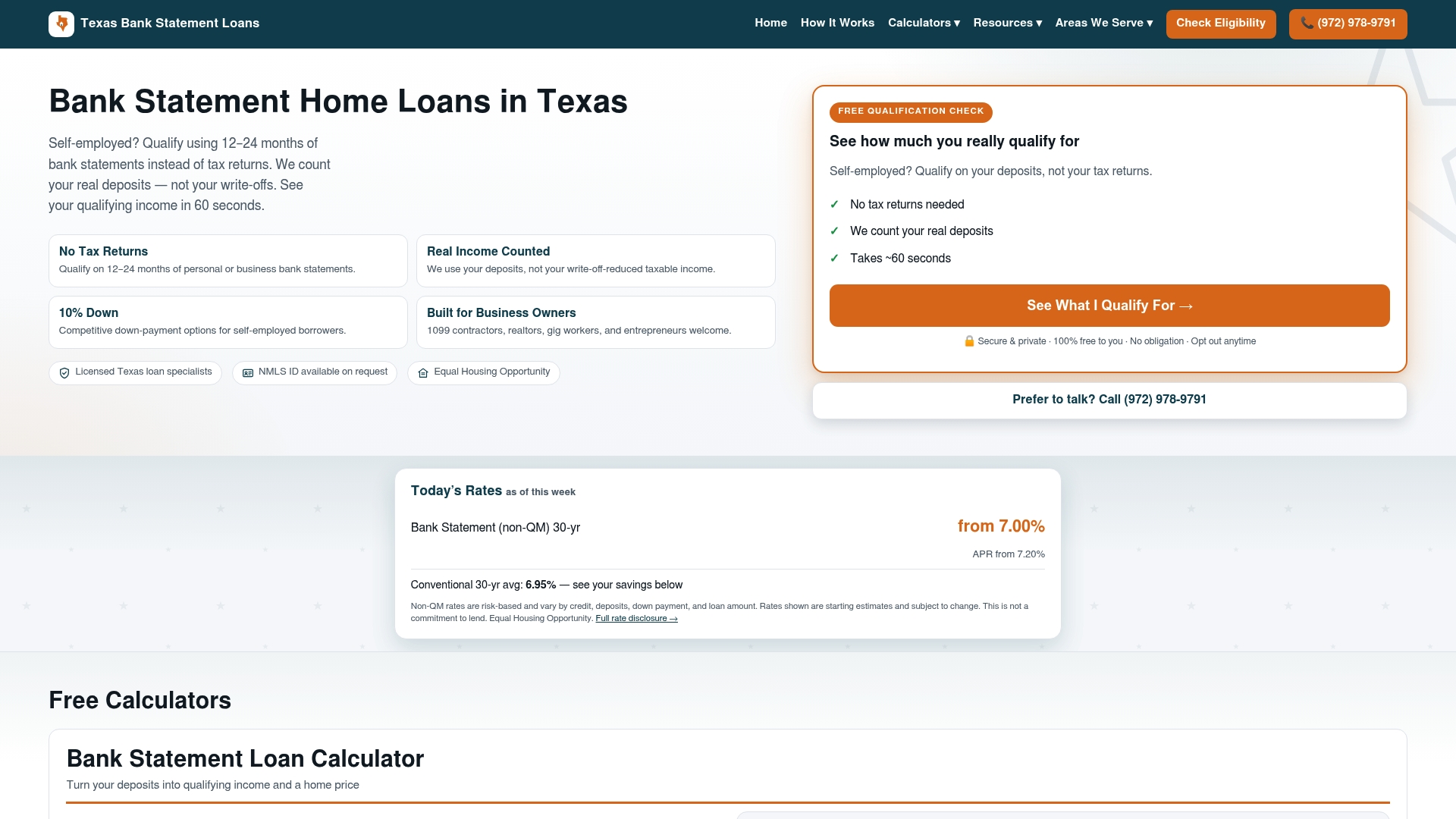
That matters most for exactly the borrowers this article covers. If you’re inside a Non‑QM seasoning band and your income doesn’t show cleanly on paper, your deposit history can carry more weight than another year of waiting. You can run a free qualification check in about 60 seconds to see where you’d likely land before you ever talk to a loan officer. From there, Texas Bank Statement Home Loans can walk you through what documentation your specific event and timeline will actually require.
Where to Verify These Rules Yourself
- Fannie Mae’s Selling Guide confirms the agency waiting periods and documented extenuating-circumstance exceptions referenced above.
- The CFPB’s Seasoned QM final rule defines the 36-month regulatory seasoning window, distinct from Non‑QM credit-event waiting periods.
- 26 U.S.C. § 7872 on Cornell’s Legal Information Institute clarifies the family-loan tax rules borrowers often confuse with mortgage seasoning.
- HUD offers regulatory guidance and consumer protection resources for verifying lender standing.
- A mortgage glossary can help if you need plain-language definitions of terms like “derogatory event” or “seasoning” while reading lender guidelines.
This article is general information, not a substitute for advice from a qualified financial advisor. Consult a qualified financial professional about your own circumstances before acting on anything here.
Sources
- Significant Derogatory Credit Events, Waiting Periods and Re-establishing Credit | Fannie Mae
- Qualified Mortgage Definition under the Truth in Lending Act (Regulation Z): Seasoned QM final rule (CFPB)
- 26 U.S. Code § 7872 - Treatment of loans with below-market interest rates | LII / Cornell Law
- HUD
FAQ
What Are the General Guidelines for Non‑QM Mortgages?
Non‑QM loans skip the strict income-documentation and debt-ratio rules that define a qualified mortgage, instead using alternative verification like bank statements, asset depletion, or DSCR calculations, with seasoning windows set by the individual lender rather than a fixed federal standard.
What Is the 60‑Day Seasoning Requirement Mortgage Applicants Ask About?
There’s no universal 60-day seasoning rule in mortgage lending. Most seasoning references to relate to derogatory credit events measured in months or years, or to fund-seasoning requirements for down payment sourcing, which typically ask for 60 days of statements showing where deposited funds came from.
Can You Give Examples of Non‑QM Loans?
Common Non‑QM examples include bank statement loans for self-employed borrowers, DSCR loans for investment properties, asset depletion loans, ITIN loans, and P&L-only programs, all of which qualify borrowers using something other than a standard W-2 and tax-return package.
What Is the $100,000 Loophole People Mention for Family Loans?
That refers to IRC §7872, a tax provision covering below-market interest on family loans, not a mortgage seasoning rule. It has no bearing on how long you must wait after a foreclosure or bankruptcy to qualify for a Non‑QM loan.
Does a Recent Credit Event Always Disqualify You From a Non‑QM Loan?
Not usually. Many Non‑QM lenders will approve borrowers within 12 months of a completed foreclosure or bankruptcy discharge, though it typically comes with a lower LTV, higher reserve requirements, and pricing adjustments compared to waiting longer.
See what you qualify for in 60 seconds, free and no credit check. Use the eligibility check at the top of this page.