
To apply for a bank-statement mortgage as a self-employed borrower, have 12 to 24 months of complete bank statements ready, along with a government ID, a recent profit and loss statement signed by you or your preparer, and clear documentation showing where your down payment and reserves came from. Round out the file with Form 4506-C and, if you have one, a CPA letter. Once those are scanned into a single folder, the fastest next move is running a quick qualification check before you submit anything.
TL;DR:
- Complete 12 to 24 months of all bank statement pages in PDF format, including personal and business accounts, to ensure smooth underwriting and avoid delays.
- Prepare a signed profit and loss statement and supporting contracts or invoices for ongoing income, especially if self-employed or gig workers without steady paychecks.
- Clearly document any large or unusual deposits with explanations and supporting paperwork, including gift funds with signed letters and donor bank statements.
- Keep personal and business funds separate, and be ready to explain any overlap or transfers that could trigger conditions during the underwriting process.
- Have your tax transcripts, formation documents, and a CPA letter available as backup, but rely primarily on bank statements and a signed P&L to verify income.
Table of Contents
- Self-Employed Documentation Checklist: What to Gather and How to Format It
- Documenting Your Down Payment, Reserves, and Large Deposits
- Business Records That Prove Your Income Is Real
- How Long It Takes and What Slows Underwriters Down
- Tax Returns and Schedule C: What Still Applies Here
- What I’ve Learned Reviewing Self-Employed Loan Files
- Get a Fast Answer on Your Bank-Statement Mortgage
- Where to Get Official Documents and Program Details
- Sources
Self-Employed Documentation Checklist: What to Gather and How to Format It
Every lender wants the same core file, even when the exact wording of the application changes. Here’s what actually needs to land in your folder before you submit, and how to format each piece so nobody kicks it back.
Bank statements: 12 or 24 months, every page. Bank-statement mortgages calculate your qualifying income by averaging deposits over 12 to 24 months instead of pulling numbers off your tax return. That means every account listed on your application needs a full statement history for the period your loan program requires, and “full” means every page, even the ones that look blank. Underwriters flag missing pages constantly, and it’s one of the easiest delays to avoid. Download PDFs directly from your bank’s portal rather than screenshotting your phone; most lenders accept clear photos or scans uploaded to a secure portal, but a proper PDF saves a round of back-and-forth.
One distinction trips up a lot of borrowers: personal deposits and business deposits aren’t treated the same. Push it through a business account, and the lender may apply an expense ratio that knocks a chunk off before it ever counts toward your qualifying income.
Identity and application basics. You’ll need a government-issued photo ID, a completed mortgage application, and a signed Form 4506-C. That last form authorizes the lender to pull your tax transcripts directly from the IRS as a verification step, even on a program that doesn’t use your tax returns to calculate income. Sign it early. It’s a small form that stalls a lot of files when borrowers leave it for later.
Income-related paperwork. A year-to-date profit and loss statement, signed by you or your preparer, belongs in every file. Add invoices or signed contracts that back up ongoing income, especially if you’re a contractor or gig worker without a steady paycheck trail. Full business tax returns usually aren’t required for this loan type, but keep two years on hand in case an underwriter asks.
Asset documentation. Pull recent statements for every checking, savings, brokerage, or retirement account you plan to use for your down payment or reserves. If you’re covering earnest money, keep the canceled check or wire confirmation. These need to match the amounts and dates on your purchase contract exactly.
Special situations. Gift funds require a signed gift letter plus the donor’s bank statement showing the withdrawal. Any deposit that looks unusual, whether it’s a bonus, a settlement, or a one-time sale, needs a paper trail explaining where it came from.
Pro Tip: Scan everything into one folder named by category (Statements, ID, P&L, Assets) before you talk to a loan officer. A borrower who shows up organized gets a faster read from underwriting than one who trickles in documents over three weeks.
Documenting Your Down Payment, Reserves, and Large Deposits
Lenders don’t just want to see money in your account. They want to see where it came from and that it’s actually yours to use. Underwriters exclude non-income deposits like account transfers, tax refunds, loan proceeds, and one-time asset sales when they calculate your qualifying income, so any large or unusual deposit needs its own explanation.

For reserves and down payment funds, recent statements from checking, savings, brokerage, or retirement accounts generally work, as long as the balances have had time to season. For gift funds specifically, you’ll need three things together: a signed gift letter stating the money doesn’t need to be repaid, the donor’s bank statement showing the withdrawal, and your own statement showing the matching deposit.
Sale proceeds, refunds, or account-to-account transfers all need contemporaneous paperwork, meaning documents dated close to the transaction, plus a transaction ID when one exists. The most common mistakes that trigger conditions are missing statement pages and transfers that don’t have a clean trail from one account to the other. Fix both before you submit, not after an underwriter asks.
Business Records That Prove Your Income Is Real
Beyond bank statements, lenders want proof that your business exists, runs, and generates the income you’re claiming. A signed year-to-date P&L is the anchor document here. Underwriters compare your reported revenue against the deposits showing up in your bank statements and check that your claimed expenses roughly line up with what’s actually leaving the account.
Formation records matter too. Articles of organization, a DBA filing, or Secretary of State registration all help establish that your business is legitimate and has been running long enough to count.
- Year-to-date P&L, signed and dated, showing revenue and expenses that roughly match your bank activity
- Business formation documents (articles of organization, DBA certificate, or state registration)
- A CPA letter, if you have one, stating your typical expense ratio
A CPA letter is optional, but it can be worth the effort. When a CPA documents your actual expense ratio, it can replace the lender’s standard expense factor applied to business account deposits, sometimes raising your qualifying income noticeably. That’s the difference between a lender assuming 50% of your deposits are expenses and a CPA showing your real number is closer to 20%.
Pro Tip: If your business account gets hit with a steep default expense ratio, ask whether routing income through a personal account, with clean documentation, would let more of it count at face value instead.
How Long It Takes and What Slows Underwriters Down
A typical bank-statement mortgage moves through preapproval, full application, underwriting, and closing. How fast you move through that middle stretch depends almost entirely on how complete your file is on day one.
The most common holdups, and the fix for each:
- Missing statement pages. Download every page directly from your bank’s portal, including ones that appear blank.
- Unexplained large deposits. Attach a short written explanation and supporting paperwork the moment you notice the deposit, not after underwriting flags it.
- Frequent overdrafts. Address a pattern of overdrafts before applying if you can; underwriters read them as a cash-flow warning sign.
- Commingled personal and business funds. Keep them separate going forward, and be ready to explain any overlap that already exists.
Assemble your digital folder before you apply, request your IRS transcripts in advance, and have your P&L and business verification ready on day one. When conditions come back from underwriting, answer within 24 to 48 hours. A complete package at application is consistently cited as the single fastest route to closing, and slow responses to conditions are the most common reason files drag out for weeks longer than they need to.
Tax Returns and Schedule C: What Still Applies Here
Bank-statement programs exist specifically because self-employed income on a tax return often understates what a business owner actually takes home. Legitimate write-offs, depreciation, and business deductions can shrink taxable income to a number that doesn’t reflect real cash flow, which is exactly why lenders built an underwriting path around deposits instead.
That doesn’t mean your tax returns disappear from the conversation. Keep the last two years of full returns, with every schedule attached, especially Schedule C if you file as a sole proprietor. Some lenders still request them as a cross-check, and having them ready avoids a scramble if an underwriter asks partway through the file. If you operate as an S-corp or partnership, keep the corresponding K-1s and business returns alongside your personal filing.
Think of your tax returns as a backup document on this loan type rather than the main event. Your bank statements and P&L carry the weight of proving income; your returns are there in case anyone wants a second angle on the same picture.

What I’ve Learned Reviewing Self-Employed Loan Files
The borrowers who struggle most aren’t the ones with complicated income. They’re the ones who assume a bank-statement loan means “no paperwork.” It doesn’t. It means different paperwork, and often more of it, front-loaded before underwriting rather than spread across the process.
Texas Bank Statement Home Loans built its process around exactly this reality: 12 to 24 months of deposits instead of tax returns, down payments starting at a moderate percentage, and a qualification check that takes about 60 seconds. Borrowers who show up with statements, P&L, and asset documentation already organized routinely get answers faster than those who don’t. That gap is almost entirely about preparation, not about how complicated anyone’s income actually is.
- Saad
Get a Fast Answer on Your Bank-Statement Mortgage
Once your documents are gathered, Texas Bank Statement Home Loans is built to move fast on exactly the file you’ve just put together. Instead of waiting weeks for a traditional lender to parse two years of tax returns, this program reads your 12 to 24 months of deposits directly, with down payments starting at a moderate percentage for qualified borrowers.
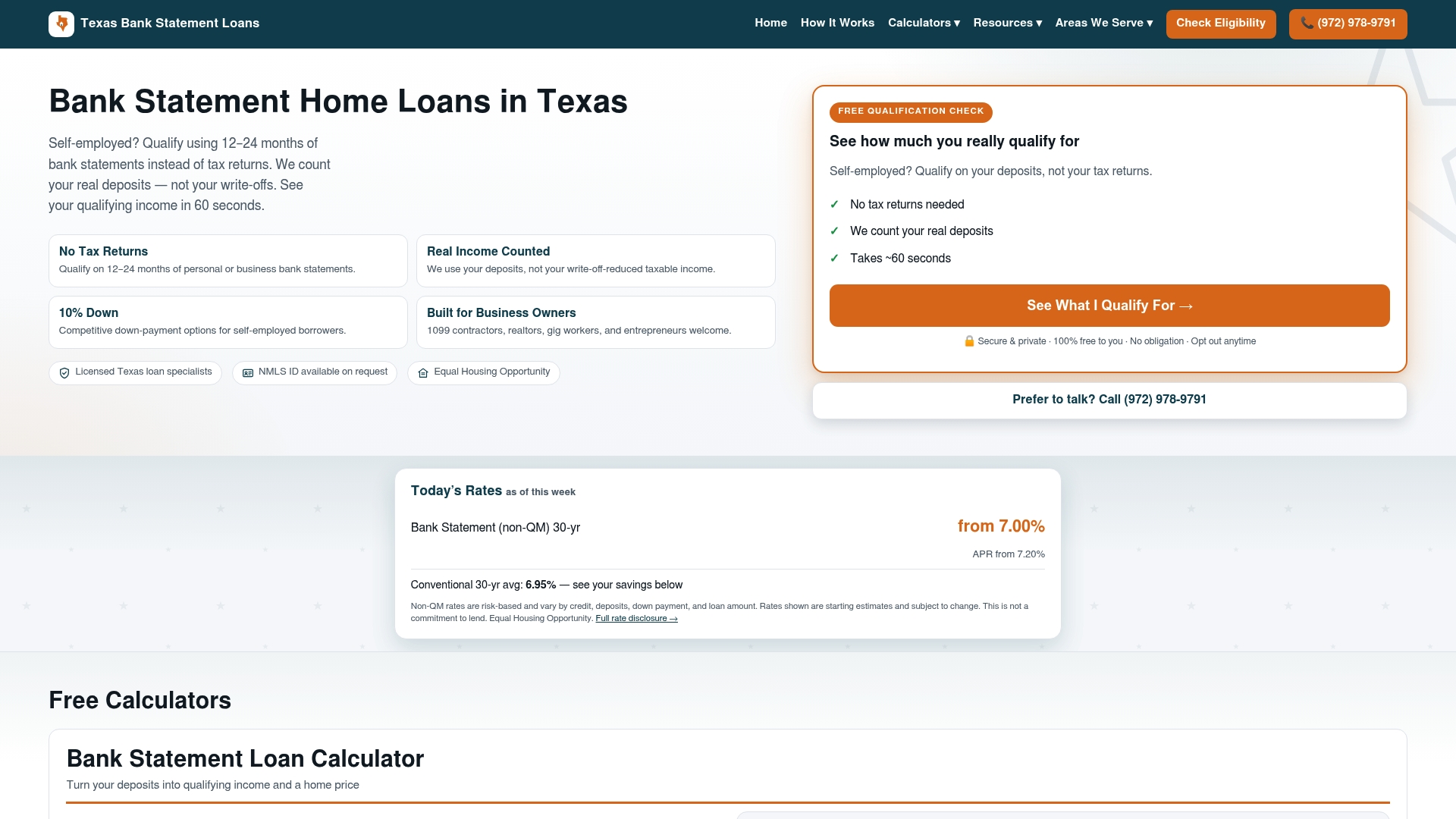
A prepared borrower gets a faster answer here because there’s nothing left to chase. Your statements are complete, your P&L is signed, and your source-of-funds paperwork is already sitting in a folder ready to upload. That’s the entire advantage: less back-and-forth, fewer conditions, and a program actually designed around how 1099 contractors, gig workers, and business owners get paid. Use the self-employed affordability calculator to see roughly where you land, then run the 60-second qualification check to find out what you can realistically afford before you talk to anyone. If you’re weighing rates against a conventional program, the current rate examples are worth a look too.
Where to Get Official Documents and Program Details
Request your tax transcripts directly through the IRS transcript request tool once your Form 4506-C is signed. For a broader look at general loan-document expectations beyond bank-statement programs, First Choice Home Loan’s self-employed mortgage guide and this homebuyer document checklist are solid references. Investors exploring income-qualifying options should also check this DSCR loan document checklist.
This article is general information, not a substitute for advice from a qualified financial advisor. Consult a qualified financial professional about your own circumstances before acting on anything here.
Sources
- What Is a Bank Statement Mortgage? Who Is It for? | SoFi
- The Bank Statement Mortgage Master Guide 2026: Self-Employed Requirements | LoanWise
- Mortgage Documents Checklist | The Lenders Network
- Bank Statement Loans: Complete Guide (2026)
See what you qualify for in 60 seconds, free and no credit check. Use the eligibility check at the top of this page.