
DSCR = Net operating income ÷ Total debt service. Divide what a property or business generates after operating costs by what it owes lenders each year, and you get one number that tells you whether income can carry the debt.
- Above 1.0 means income exceeds debt payments (a DSCR of 1.25 leaves a 25% cushion).
- Below 1.0 means income falls short of covering the loan.
- Lenders almost always calculate DSCR on an annualized basis, even when payments are monthly.
Key Takeaways
DSCR works because it reduces income and debt into one comparable number that tells a lender, in seconds, whether a deal can pay for itself.
| Point | Details |
|---|---|
| Core formula | DSCR equals net operating income divided by total annual debt service, always calculated on an annualized basis. |
| NOI definition matters | Lenders may use NOI, EBIT, or EBITDA, and each produces a different ratio from the same books. |
| Typical minimums | Most conventional lenders want 1.20 to 1.25, with volatile assets often requiring -. |
| Interest-only inflates DSCR | Removing principal from debt service temporarily raises the ratio, but amortization eventually catches up. |
| Texasbankstatementloans supports the process | Its free DSCR calculator and bank-statement underwriting help self-employed and 1099 borrowers apply this formula to real deals. |
A Practical Note On Using This Formula
After years of watching self-employed borrowers get shortchanged by income documentation that doesn’t reflect reality, my take is simple: calculate your DSCR before a lender does, using real cash flow, not the version your tax return shows. Run the numbers yourself with the DSCR calculator, then talk to a loan officer once you know where you stand.
This article is general information, not a substitute for advice from a qualified financial advisor. Consult a qualified financial professional about your own circumstances before acting on anything here.
Table of Contents
- How To Calculate Net Operating Income And Debt Service
- A Step-By-Step DSCR Calculation Example
- Why Lenders Report Different DSCR Numbers For The Same Deal
- What DSCR Values Actually Mean To A Lender
- How To Improve Your DSCR Before You Apply
- Where To Run Your Own DSCR Numbers
- Getting Pre-Qualified With A Bank Statement Loan
- Sources
How To Calculate Net Operating Income And Debt Service
Getting the DSCR formula right depends entirely on how you define its two halves. Get either one wrong and the ratio you hand a loan officer won’t match what their underwriting software spits out.
Net operating income (NOI) is revenue minus operating expenses, before debt payments, taxes, or depreciation touch the number. Some lenders substitute EBIT or EBITDA instead, particularly for operating businesses rather than income-producing real estate, since the standard formula treats NOI as interchangeable with EBIT or EBITDA depending on the asset type.
- Start with effective gross income (rental income or business revenue, minus vacancy or bad debt).
- Subtract operating expenses, property taxes, insurance, maintenance, management fees, utilities. Leave out mortgage payments, income taxes, and depreciation.
- Total debt service is annual principal plus interest across every loan tied to the asset, not just the primary mortgage. If you’re carrying a second lien or equipment financing, add it in.
Interest-only loans complicate this. Since there’s no principal component, total debt service equals annual interest paid, which usually makes DSCR look stronger than it will once amortization kicks in. Some lenders also apply a tax-effect adjustment to interest when comparing DSCR across entities with different tax structures, though this is more common in corporate lending than in real estate underwriting.
Pro Tip: Ask your loan officer upfront whether they calculate NOI using EBITDA or straight NOI, the gap between the two can shift your ratio by several tenths of a point on the same set of books.
A Step-By-Step DSCR Calculation Example
Numbers make this concrete. Say you own a small rental property generating $84,000 in annual effective gross income. Operating expenses (taxes, insurance, repairs, management) run $24,000 for the year.
- Effective gross income: $84,000
- Operating expenses: $24,000
- NOI: $60,000
Now the debt side. Your mortgage payment is $3,500 a month, which is $42,000 a year in combined principal and interest. You also carry a small equipment loan at $400 a month, or $4,800 annually.
- Total debt service: $46,800
Divide NOI by total debt service: $60,000 ÷ $46,800 = 1.28. That means your income covers your debt payments with roughly a 28% margin, comfortably above the 1.20 to 1.25 minimum most conventional lenders look for.
Now run the interest-only version. If that same $3,500 monthly payment were interest-only, at say a 6.5% rate, your annual debt service might drop since there’s no principal reduction. Swap that into the formula and your DSCR increases, reflecting the lower annual debt service. Interest-only structures inflate DSCR on paper, which is exactly why underwriters watch for them.

Why Lenders Report Different DSCR Numbers For The Same Deal
You can hand two lenders the same financial statements and get two different DSCR figures back. That’s not an error. It’s a function of which income definition and which debt assumptions each lender applies.
- NOI vs. EBIT vs. EBITDA: EBITDA adds back depreciation and amortization, which inflates the numerator and produces a higher DSCR than straight NOI on the same business.
- Add-backs and one-time items: Lenders frequently strip out non-recurring expenses, owner perks (a company car, above-market owner salary), and one-off legal or moving costs, which can meaningfully raise the effective NOI.
- Reserve requirements: Conservative underwriters set aside a reserve for capital expenditures or vacancy before finalizing NOI, which lowers the ratio.
- Stress-tested debt service: On floating-rate loans, many lenders recalculate debt service at a higher assumed interest rate to see how the ratio holds up if rates climb, and balloon payments or multiple loans on one asset get summed into that same total debt service figure.
None of these methods is “wrong.” They’re just different lenses on the same deal, which is why the DSCR you calculate at home is a starting point, not a final answer.
What DSCR Values Actually Mean To A Lender
A DSCR of exactly 1.0 means income and debt payments are dead even, no cushion either way. Most lenders want more breathing room than that, with typical minimum DSCR requirements generally starting above 1.0 depending on the type of financing.
| DSCR Range | What It Typically Signals |
|---|---|
| Below 1.0 | Income doesn’t cover debt payments; very few conventional lenders will approve |
| Above 1.0 | Break-even to thin cushion; often requires compensating factors |
| 1.20 to 1.25 | Common minimum for stabilized commercial and rental properties |
| - | Frequently required for volatile asset classes like hotels or assisted living |
| - | Conservative underwriting, often seen on lower-leverage or higher-risk-profile loans |
Loan size matters too, especially when you explore options like a commercial property loan that can offer tailored amortization schedules to optimize your DSCR. Smaller loans and specialized property types tend to carry stricter floors because revenue volatility on those assets is higher, and a lender covering that risk wants more margin baked in. DSCR is also just one input. Underwriters weigh it alongside credit history, liquidity, and loan-to-value, so a strong ratio helps your case without guaranteeing approval on its own.
How To Improve Your DSCR Before You Apply
You can move this number from either direction, income or debt, and sometimes both at once.
- Raise effective income. Push rents to market rate, cut vacancy through better tenant screening or shorter turnover windows, and add ancillary income like storage fees, parking, or laundry.
- Cut operating costs. Renegotiate insurance and service contracts, address deferred maintenance before it becomes an expensive emergency, and compare management fee structures.
- Restructure the debt. Refinancing to a lower rate, extending amortization to lower the annual principal portion, or shifting a segment to interest-only can all lower total debt service, at least temporarily.
- Strengthen the application structurally. A guarantor, additional collateral, or a larger down payment can offset a marginal DSCR when the ratio alone doesn’t quite clear a lender’s line.
Pro Tip: Run your numbers under a stress-tested rate before you apply, not after a lender does it for you. If your DSCR drops below 1.0 once rates rise a point or two, you’ll want that answer before you’re mid-application.
Where To Run Your Own DSCR Numbers
Doing this math by hand works fine for a single scenario, but it gets tedious fast once you’re testing different loan terms or comparing properties. The DSCR calculator built by Texasbankstatementloans lets you plug in income, expenses, and proposed loan terms to see your ratio instantly, and rerun it as those numbers shift.
This matters most for self-employed borrowers, 1099 contractors, and gig workers, since traditional underwriting built around tax returns often understates real cash flow. Texasbankstatementloans evaluates 12 to 24 months of actual bank deposits instead, with a quick, no-obligation qualification check and down payment options starting at 10%. That combination is especially useful for investment property purchases, where DSCR carries more weight than personal income documentation ever would.
Getting Pre-Qualified With A Bank Statement Loan
There are other ways to document income for a mortgage: tax-return underwriting, W-2 verification, asset depletion loans. Each fits a different borrower. If your tax returns understate what you actually earn, which is common for business owners and contractors who write off heavily, those routes can undersell your buying power before you even start shopping.
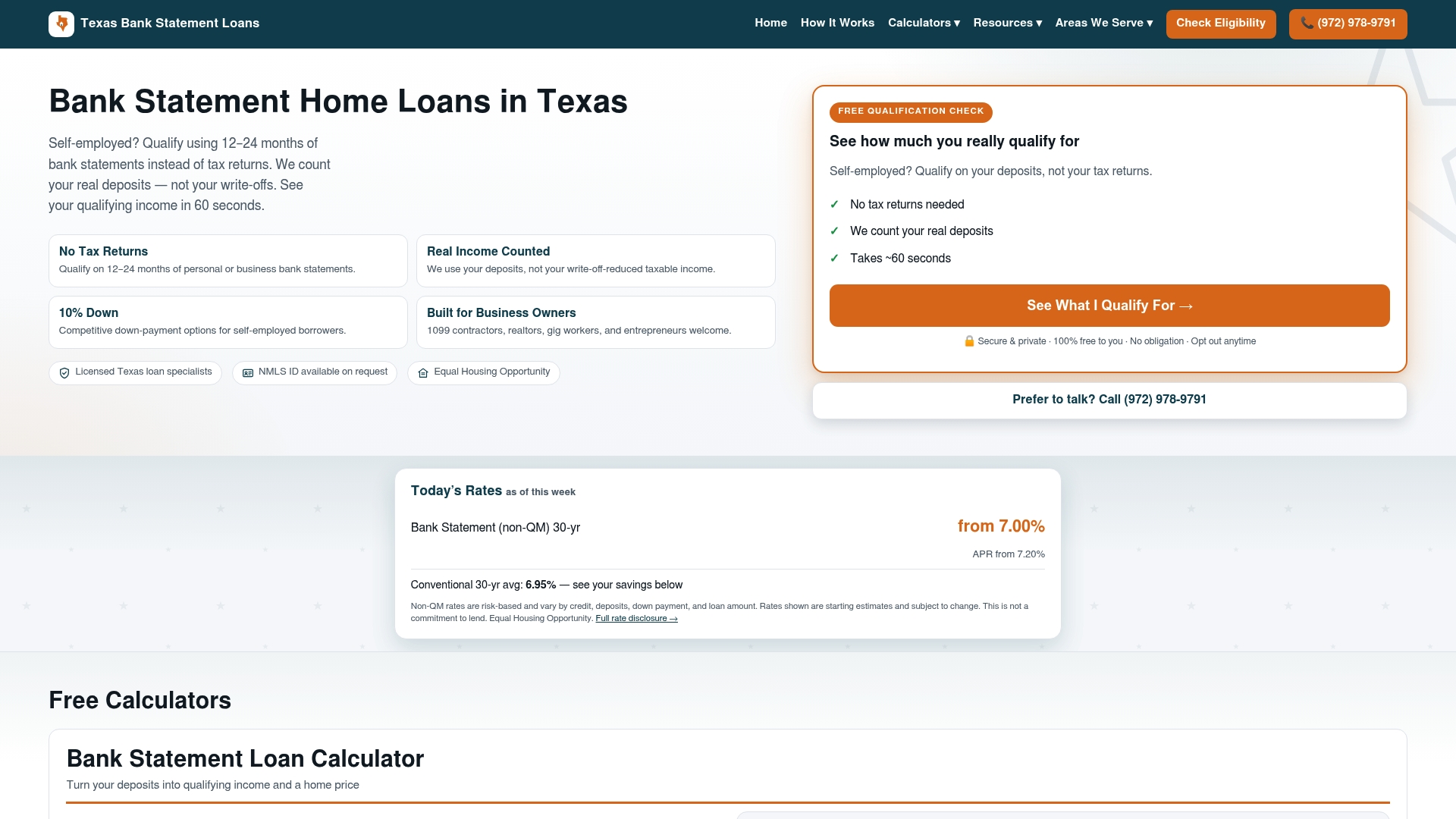
Texasbankstatementloans takes a different route: 12 to 24 months of bank deposits instead of tax returns, so your real cash flow, not your write-offs, drives the approval decision. For investment properties, that pairs directly with the DSCR calculator covered above, letting you test a deal’s coverage ratio and your qualifying income in the same sitting. Down payments start at 10%, and the 60-second qualification check gives you a realistic read on what you can afford before you talk to a loan officer. If you’re a self-employed buyer, 1099 contractor, or gig worker in Texas, start with that qualification check and see where your numbers land.
Sources
- Debt service coverage ratio (Corporate Finance Institute)
Recommended
See what you qualify for in 60 seconds, free and no credit check. Use the eligibility check at the top of this page.