
Self-employed mortgage verification is the process lenders use to confirm that a business owner earns stable, sufficient income to repay a home loan. The most reliable ways business owners prove mortgage income combine federal tax returns, bank statements, profit and loss reports, and CPA letters to give lenders a complete picture of actual earnings. Fannie Mae and Freddie Mac both require documented proof of income continuity, not just a single year’s snapshot. The challenge for business owners is that tax deductions reduce reported income on paper, even when real cash flow is strong. Understanding which documents lenders accept, and how to present them, is the difference between approval and denial.
1. What tax documents do business owners need for income verification?
Tax returns are the foundation of self-employed income verification for conventional mortgages. Lenders require two years of personal and business tax returns to establish income stability. A one-year exception exists, but only when prior income documentation shows a strong track record in a similar field.
The specific forms depend on how you file. Sole proprietors submit Form 1040 with Schedule C. Partnerships provide Form 1065 with Schedule K-1. S-Corporation owners submit Form 1120S plus K-1. C-Corporation owners file Form 1120. Each form tells a different story about how income flows from the business to you personally.

Lenders do not simply read the bottom line. Fannie Mae requires a written cash flow analysis to determine whether income is stable and likely to continue. That analysis adds back non-cash expenses like depreciation and amortization, which can meaningfully raise your qualifying income.
IRS tax transcripts serve as an independent verification tool. Lenders order them directly from the IRS using Form 4506-C to confirm that the returns you submitted match what the IRS received. Discrepancies between submitted returns and IRS records are a red flag that can stop an application cold.
- Form 1040 with Schedule C: For sole proprietors reporting business profit and loss
- Form 1065 + K-1: For partnerships, showing each partner’s share of income
- Form 1120S + K-1: For S-Corp owners, separating salary from pass-through income
- Form 1120: For C-Corp owners, with 1099-DIV showing dividends paid
- IRS transcripts: Ordered via Form 4506-C to verify return accuracy
Pro Tip: Maximize your qualifying income by asking your CPA to identify non-cash deductions like depreciation before you apply. Adding these back can increase your lender-calculated income without changing your tax liability.
2. How bank statements serve as proof of income for mortgage applications
Bank statement loans are a non-QM (non-qualified mortgage) alternative that replaces tax returns with deposit history. Lenders review 12-24 months of personal or business bank deposits to estimate average monthly income. This method directly addresses the gap between taxable income and actual cash flow.
The mechanics matter. For business bank accounts, lenders typically apply a 50% expense factor to total deposits, treating half as business costs and half as income. Personal bank accounts receive less of a haircut because deposits are assumed to be net of business expenses. Choosing which account type to use depends on your deposit patterns and how your business is structured.
The advantages are real. Business owners with strong revenue but heavy deductions often qualify for larger loans through bank statement programs than through tax return analysis. The tradeoff is that interest rates on non-QM loans tend to run higher than conventional rates.
- 12-month option: Works well for borrowers with consistent recent income growth
- 24-month option: Preferred by lenders because it smooths out seasonal fluctuations
- Personal statements: Show net deposits after business expenses are paid
- Business statements: Show gross deposits, then lender applies expense factor
- Deposit consistency: Irregular or declining deposits raise underwriter concerns
Pro Tip: Before applying, review your last 24 months of statements and remove any large non-recurring deposits, like asset sales or transfers between accounts. Lenders exclude these, and unexplained large deposits can trigger additional scrutiny.
Texasbankstatementloans evaluates bank statement income using 12 to 24 months of deposits, giving Texas business owners a direct path to qualification without relying on tax returns.
3. What role do profit and loss statements and CPA letters play?
A profit and loss statement, commonly called a P&L, shows revenue, expenses, and net income for a specific period. Year-to-date P&L statements supplement tax returns by showing current business performance, not just what happened in prior years. This matters when your business has grown significantly since your last filed return.
Lenders treat P&Ls differently depending on who prepared them. A CPA-prepared or CPA-reviewed P&L carries more weight than a self-prepared spreadsheet. Some lenders require a CPA signature on the P&L as a condition of approval, particularly for non-QM loans.
CPA letters serve a separate but equally important function. A signed letter from your accountant can confirm your ownership percentage, verify that the business has been operating for a defined period, and attest to income continuity. For newer businesses or borrowers with irregular income patterns, a CPA letter can be the document that tips a borderline application toward approval.
- Year-to-date P&L: Shows current income trajectory, not just historical averages
- CPA-prepared P&L: Carries lender credibility that self-prepared documents do not
- CPA letter: Confirms ownership stake, business longevity, and income stability
- Quarterly P&Ls: Some lenders request these to identify seasonal income patterns
- Business bank reconciliation: Often required alongside P&L to verify deposit accuracy
4. How does your business structure affect income verification?
Business structure directly determines which tax forms you file and how lenders calculate your qualifying income. The table below shows how each entity type maps to specific documentation requirements.
| Business structure | Primary tax form | Income reported to lender |
|---|---|---|
| Sole proprietorship | Schedule C (Form 1040) | Net profit after deductions |
| Partnership | Form 1065 + K-1 | Distributive share of income |
| LLC (single-member) | Schedule C or Form 1065 | Depends on tax election |
| S-Corporation | Form 1120S + K-1 | W-2 salary plus K-1 distributions |
| C-Corporation | Form 1120 + 1099-DIV | Salary plus dividends received |
The K-1 problem is one of the most misunderstood issues in self-employed mortgage applications. A K-1 may show $100,000 in allocated income, but the actual cash distributed to you could be far less. Lenders analyze distributions, not just allocations, which can significantly reduce your qualifying income.
S-Corporation owners face a specific challenge. The IRS requires S-Corp owners who work in the business to pay themselves a reasonable salary. Lenders count that W-2 salary plus any K-1 distributions actually received. Owners who minimize their salary to reduce payroll taxes often find their qualifying income is lower than expected.
Ownership percentage also matters. Lenders typically require full business tax returns when you own 25% or more of a business. Below that threshold, a K-1 alone may suffice. Knowing your ownership stake before you apply helps you anticipate exactly which documents your lender will request.
5. Key strategies to strengthen your self-employed mortgage application
Reducing discretionary write-offs in the one to two years before you apply is the single most effective way to raise your qualifying income. Higher net income on tax returns directly improves what lenders will approve. This does not mean paying more tax than required. It means being selective about which deductions you claim in the years leading up to your application.
Maintaining organized, consistent financial records prevents the delays that kill deals. Well-prepared documentation reduces underwriting delays and signals to lenders that your business is professionally managed. Disorganized records, missing statements, or inconsistent numbers between documents raise questions that slow or stop approvals.
Your credit score and debt-to-income ratio carry as much weight for self-employed borrowers as for W-2 employees. Most conventional lenders want a credit score of at least 620, and many prefer 680 or higher for self-employed applicants. Paying down business credit cards and personal loans before applying lowers your debt-to-income ratio and improves your borrowing position.
- Start 12-24 months early: Tax strategy changes take at least one filing cycle to show up in your returns
- Work with a mortgage-savvy CPA: Not all accountants understand how lenders calculate income
- Use the affordability calculator: Estimate your buying power before you start shopping
- Keep business and personal accounts separate: Commingled funds create documentation headaches
- Get a pre-qualification letter early: It reveals documentation gaps before you are under contract
Pro Tip: Talk to your loan officer before talking to your CPA about tax strategy. Loan officers know exactly how lenders calculate income from your returns. That conversation can save you from making tax decisions that hurt your mortgage application.
Key Takeaways
Self-employed borrowers who combine accurate tax returns, organized bank statements, and current P&L documentation give lenders the clearest, most complete picture of stable income.
| Point | Details |
|---|---|
| Two-year tax history is standard | Lenders require two years of returns; one-year exceptions require strong prior income evidence. |
| Bank statements bypass tax return limits | A 12-24 month deposit review reveals actual cash flow that deductions hide on returns. |
| Business structure changes your forms | Sole proprietors use Schedule C; S-Corp owners need W-2 plus K-1 distributions reviewed. |
| CPA letters add credibility | A signed CPA letter confirms ownership, business age, and income continuity for lenders. |
| Reduce write-offs before applying | Lower deductions in the prior two years raise your lender-calculated qualifying income. |
What I have learned advising self-employed mortgage applicants
The biggest mistake I see business owners make is treating their mortgage application like an afterthought. They spend years minimizing taxable income, then walk into a lender’s office surprised that their qualifying income looks thin on paper. The tax strategy that saved them money for a decade is the exact thing holding them back from buying a home.
The second most common problem is misunderstanding what lenders actually count. A K-1 showing $150,000 in allocated partnership income sounds impressive. But if only $60,000 was distributed in cash, that is the number the lender works with. Business owners who do not know this distinction go into applications with inflated expectations and come out frustrated.
My honest advice is to build a team before you start the process. A mortgage-savvy CPA and an experienced loan officer who works with self-employed borrowers regularly will catch problems before they become deal-killers. Most documentation issues are fixable with enough lead time. Almost none are fixable once you are under contract and the clock is ticking.
Self-employed buyers are eligible for every major loan program, including FHA, VA, and conventional loans. The documentation bar is higher, but the finish line is the same. Start early, keep clean records, and know your numbers before your lender does.
- Saad
Texas bank statement loans for self-employed buyers
Business owners in Texas who have strong cash flow but complex tax returns have a direct path to mortgage approval through Texasbankstatementloans.
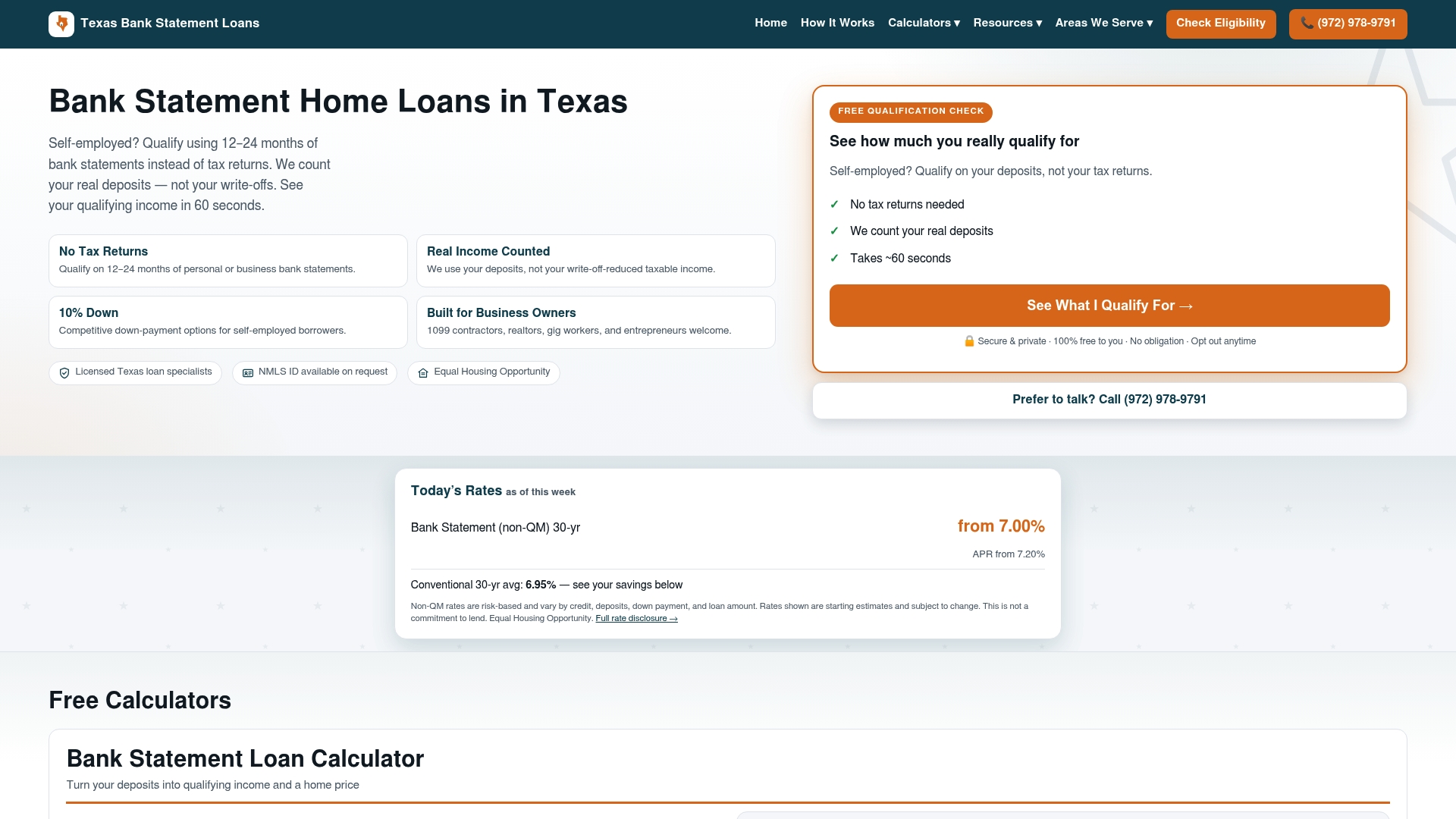
Texasbankstatementloans evaluates 12 to 24 months of bank deposits instead of tax returns, which means your actual revenue drives the qualification, not your deductions. Down payment options start at 10%, and a no-obligation qualification check takes 60 seconds. Whether you are buying in Houston, Austin, or anywhere across Texas, the program is built for the way self-employed income actually works. Visit Texasbankstatementloans to see how much you qualify for today.
FAQ
What documents do self-employed borrowers need for a mortgage?
Self-employed borrowers typically need two years of personal and business tax returns, 12-24 months of bank statements, a year-to-date profit and loss statement, and a CPA letter confirming business stability and ownership.
Can I get a mortgage without tax returns as a business owner?
Yes. Bank statement loans are a non-QM mortgage option that uses 12-24 months of deposit history instead of tax returns to verify income, making them well-suited for business owners with significant deductions.
How do lenders calculate income for self-employed borrowers?
Lenders analyze net profit from tax returns, add back non-cash expenses like depreciation, and review cash distributions. For bank statement loans, lenders apply an expense factor to total deposits to estimate qualifying income.
Does my business structure affect my mortgage application?
Yes. Sole proprietors file Schedule C, partnerships use Form 1065 and K-1, and S-Corp owners need both a W-2 and K-1 reviewed. Each structure produces different qualifying income calculations.
How far in advance should I prepare for a self-employed mortgage?
Start preparing 12 to 24 months before you plan to apply. Tax strategy changes, record organization, and credit improvements all take time to show up in the documentation lenders review.
See what you qualify for in 60 seconds, free and no credit check. Use the eligibility check at the top of this page.