
Yes, self-employed borrowers can still qualify for a mortgage through manual underwriting. It’s a documented, human review path that lenders use when automated systems can’t approve a file on their own, and it’s often the only realistic route when tax returns underreport real cash flow. Expect the underwriter to ask for two years of tax returns, a year-to-date profit and loss statement, and 12 to 24 months of bank statements, plus a written explanation for any income dips. None of this means you’ve been rejected. It means a person, not software, is about to make the call.
TL;DR:
- Manual underwriting is often necessary for self-employed borrowers when automated systems cannot confidently assess income or risk.
- Lenders require comprehensive documentation, including two years of tax returns, current profit and loss statements, and bank statements, to verify income stability.
- A decline of more than 20% in self-employment income year over year triggers a manual review, requiring additional proof of recovery and stability.
- Reserves, larger down payments, and verified additional income or residuals can help offset stricter manual underwriting criteria.
- Bank statement loans, evaluating 12 to 24 months of actual deposits, offer an alternative for borrowers with low taxable income but steady cash flow.
Table of Contents
- What Triggers Manual Underwriting for Self-Employed Applicants
- Documentation Lenders Require From Self-Employed Borrowers
- How Lenders Calculate Self-Employment Income
- The 20% Income Decline Rule and How to Handle It
- Debt-to-Income Ratios, Reserves, and Compensating Factors
- Your Preparation Checklist Before You Apply
- A Practical Alternative Worth Knowing About
- Why Most Advice on This Topic Undersells the Documentation Problem
- How Texas Bank Statement Home Loans Fits Into Your Next Step
- Sources
What Triggers Manual Underwriting for Self-Employed Applicants
Most mortgage applications today run through an automated underwriting system (AUS) like Desktop Underwriter or Loan Prospector. The system digests your income, credit, and assets, then spits out an “Approve/Eligible” or a “Refer” recommendation. A “Refer” doesn’t mean no. It means the computer couldn’t confidently model your risk, so the file drops into manual underwriting, where a human underwriter applies the actual program guidelines line by line.

Self-employed borrowers get flagged for this more often than W2 employees, mainly because business income is inherently choppier and harder for an algorithm to average cleanly. Bankrate’s overview of manual underwriting notes that this path takes longer and requires more paperwork, but it exists specifically to give a fair shot to borrowers who don’t fit a standardized profile. That includes plenty of profitable business owners whose Schedule C simply doesn’t tell the whole story.
Common triggers that push a self-employed file into manual review include:
- An AUS “Refer” result instead of “Approve”
- A greater than 20% decline in effective self-employment income year over year
- A recent bankruptcy, foreclosure, or short sale within the lookback window
- Disputed or unresolved derogatory credit accounts
- Thin credit history or too few active trade lines for the AUS to score confidently
None of these triggers are automatic denials. They’re a signal that the loan needs a closer look, and lenders can approve manually underwritten loans that would never clear an algorithm’s threshold. The tradeoff is documentation. Where an automated file might close on a handful of forms, a manual file often needs a stack of them.
Documentation Lenders Require From Self-Employed Borrowers
Underwriters build their income picture from paper, not from your bank balance on the day you apply. Fannie Mae’s Selling Guide generally requires lenders to pull a two-year history of self-employment earnings and produce a written evaluation of both personal and business income before they’ll call it stable. Here’s what that evaluation usually draws from.
- Two years of signed personal and business tax returns. This includes Schedule C for sole proprietors, K-1s for partnerships and S-corps, and full corporate returns (1120 or 1120S) where applicable. Underwriters specifically hunt for deductions that lower your taxable income but don’t actually leave your pocket, since those get added back later.
- Year-to-date profit and loss statement and balance sheet. If your most recent tax return is more than a few months old, or your business has changed shape (new partner, new location, pandemic-era pivot), the lender needs a current snapshot to confirm the business is still operating the way your tax returns suggest.
- 12 to 24 months of business and personal bank statements. This is where actual cash flow shows up. Underwriters cross-reference deposits against your reported income to see if the numbers line up.
- 1099s, signed contracts, and invoices. Especially for gig workers and contractors, these documents corroborate that the income on your bank statements is recurring and not a one-time windfall.
- Business license or registration. Proof the business is legitimate and has been operating for the length of time you claim.
- Letters of explanation. Any dip in income, gap in deposits, or unusual transaction needs a short written explanation, ideally backed by something concrete like a client contract or an accountant’s note.
Pro Tip: Ask your CPA to write a one-page letter confirming your business’s continuity and current health before you apply. Underwriters weigh third-party corroboration from an accountant far more heavily than a borrower’s own explanation, and it can shave days off the review.
How Lenders Calculate Self-Employment Income
The default method is straightforward, but the details matter. Lenders typically average your gross self-employment income over two years, then use whichever figure is lower between the one-year and two-year average if the trend is declining. A business trending upward generally gets averaged; a business trending downward gets the more conservative number.
Add-backs change the math in your favor. Certain non-cash expenses that lower your taxable income on paper, without actually costing you money, can be added back to boost your qualifying income. Common add-backs include:
- Depreciation
- Depletion
- Amortization
- A portion of home-office expenses when properly documented
Industry guidance on FHA self-employed income rules confirms underwriters commonly accept these add-backs precisely because they don’t represent recurring cash outflows. If you deducted $8,000 in depreciation last year, that $8,000 can often be added straight back into your qualifying income, which matters enormously for borrowers whose accountants have spent years minimizing taxable profit.
There’s also a one-year exception. If you’ve been self-employed for only 12 to 23 months, a lender may still qualify you using just one year of self-employment income, provided you have a documented two-year history in a related field before you went independent. A graphic designer who freelanced for 14 months after five years on staff at an agency is a textbook case.
Here’s a simplified worked example. Say your Schedule C shows net profit of $62,000 in the earlier year and $74,000 in the most recent year, with $5,000 in annual depreciation each year.
Average adjusted income: $73,000 per year, or roughly $6,083 per month in qualifying income. That monthly figure is what the underwriter plugs into your debt-to-income calculation, not your gross revenue and not what you actually took home after taxes.

The 20% Income Decline Rule and How to Handle It
If your self-employment income dropped more than 20% from one year to the next, HUD/FHA guidance requires the lender to downgrade the file to manual underwriting and document whether your business income has since stabilized, according to HUD’s Handbook 4000.1. In practice, this means the underwriter must use your lower, more recent income figure unless you can produce convincing evidence that the dip was temporary and the business has recovered.
That evidence matters more than most borrowers realize. A downturn during a slow season, a single lost client, or a documented disruption like a regional economic slowdown can all be explained, but the explanation needs backup, not just a narrative.
Evidence that tends to move the needle:
- A current, signed year-to-date P&L showing revenue back at or above prior levels
- New or renewed contracts proving the client relationships that dipped have resumed
- A letter from your accountant contextualizing the decline (a one-time equipment purchase, a temporary staffing gap, a delayed invoice)
- Third-party industry data showing the dip was sector-wide rather than specific to your business
If the underwriter isn’t convinced the income has recovered, they’ll qualify you using the lower figure, and they may also ask for additional reserves or other compensating factors to offset the perceived risk. Borrowers who came into 2020 and 2021 with pandemic-driven revenue swings saw this rule applied constantly, and many lenders developed specific documentation protocols for pandemic-related declines that are still referenced in underwriter training today.
Debt-to-Income Ratios, Reserves, and Compensating Factors
Manual underwriting runs on stricter math than automated approval, but it also leaves more room for a strong file to win an exception. Fannie Mae’s manual underwriting path generally caps total DTI at 36% of stable monthly income, though that ceiling can stretch up to 45% when the borrower brings solid credit and documented reserves, according to reporting on manual underwriting standards. FHA and VA set their own thresholds and expect lenders to follow program credit policy directly rather than lean on AUS output.
Reserves become more important the moment a file goes manual, especially after an income-decline downgrade. FHA can require additional months of PITI (principal, interest, taxes, and insurance) reserves specifically when a borrower’s income has been downgraded for a decline, on top of whatever baseline reserve requirement applies to the loan type.
Compensating factors that regularly tip a marginal file into approval:
- Verified cash reserves beyond the minimum requirement
- A larger down payment than the program minimum
- Documented residual income after all monthly obligations
- A second, stable income source unrelated to the self-employment business
Your Preparation Checklist Before You Apply
Getting ahead of the paperwork is the single biggest lever you control in this process. Assemble the file in this order and you’ll cut weeks off the timeline.
- Pull two years of signed personal and business tax returns, including every schedule (C, K-1, or corporate returns as applicable).
- Prepare a current, signed year-to-date profit and loss statement and balance sheet, especially if your last return is more than a few months old.
- Gather 12 to 24 months of business and personal bank statements, and label large deposits so the underwriter can immediately tell business revenue from personal transfers or owner draws.
- Collect 1099s, your most recent contracts, and any invoices that show recurring client relationships.
- Draft short, specific letters of explanation for any income dip, account gap, or large deposit that doesn’t obviously explain itself.
- Ask your CPA or bookkeeper for a brief cover letter confirming business continuity and current financial health.
- Confirm your reserves are documentable in a bank or investment account, not sitting in cash or mixed with business funds.
Pro Tip: Separate business and personal banking well before you apply if you haven’t already. Underwriters spend a disproportionate amount of time untangling commingled accounts, and a clean separation alone can shorten a manual review by days.
A Practical Alternative Worth Knowing About
Manual underwriting exists because tax returns are a poor proxy for how much money a business owner actually makes. Every self-employed borrower who has spent years working with a CPA to legally minimize taxable income already knows this. The system rewards you for that strategy at tax time and then penalizes you for it at the mortgage desk, which is one of the more frustrating contradictions in personal finance.
That’s the gap Texas Bank Statement Home Loans is built to close. Instead of relying on Schedule C net profit, the program evaluates 12 to 24 months of actual bank deposits, personal or business, to establish qualifying income closer to what a borrower really earns. For a contractor or gig worker whose tax returns show a fraction of their real cash flow, that distinction can be the difference between qualifying and not.
Worth saying plainly: this isn’t a shortcut around underwriting standards. Lender overlays, reserve requirements, and program rules still apply, and a bank-statement loan won’t fit every borrower’s situation. Someone with unusually inconsistent deposits or a very short operating history may still be better served by traditional agency underwriting. The self-employed affordability calculator is a fast way to see which category you’re likely to fall into before you commit to either path.
Why Most Advice on This Topic Undersells the Documentation Problem
Most articles on manual underwriting treat it like a formality, a slightly slower version of the automated process. That framing undersells how much the outcome depends on the quality of your paperwork rather than the strength of your business. I’ve seen the pattern repeat in every account of this process: two borrowers with nearly identical income and credit profiles can get very different results, and the difference almost always traces back to whether one of them showed up with a clean, corroborated file and the other showed up with raw tax returns and an explanation typed the night before closing.
Borrowers assume a good explanation is enough. It isn’t. HUD’s own guidance puts the burden on the borrower to prove stability, not just explain the dip, and underwriters are trained to be skeptical of narrative without documentation. A signed year-to-date P&L backed by real contracts does more work than a paragraph of context ever will.
The bigger miscalculation is timing. Self-employed borrowers often start gathering documents after they’ve found a house, which is exactly backward. The accountant letter, the separated bank accounts, the clean YTD P&L, all of that should exist before you’re under contract with a closing deadline bearing down. Manual underwriting rewards preparation more than it rewards a strong story, and the borrowers who understand that distinction close faster, with fewer conditions, and far less stress.
- Saad
How Texas Bank Statement Home Loans Fits Into Your Next Step
If your tax returns don’t reflect what you actually bring in, and manual underwriting feels like it’s fighting your own accounting against you, a bank-statement loan through Texas Bank Statement Home Loans is worth checking before you go further down the traditional path. The program qualifies borrowers using 12 to 24 months of actual bank deposits rather than net profit after deductions.
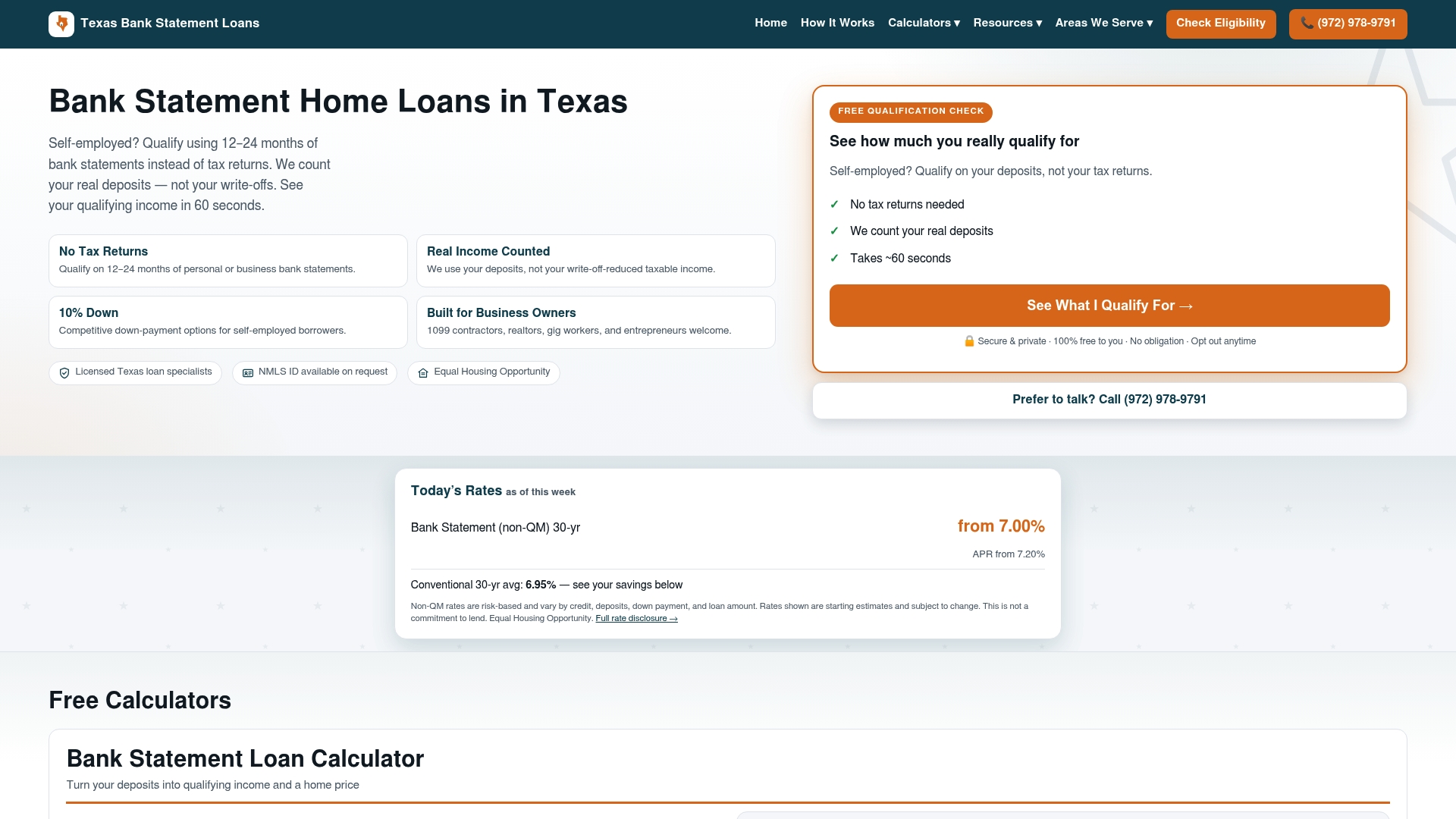
Before you start, have your last two years of bank statements handy, whether personal or business, along with a rough sense of your monthly deposits. That’s essentially all the affordability calculator needs to give you a realistic qualifying estimate in about 60 seconds. It’s not a replacement for agency underwriting in every case. Some files, particularly those with very short operating histories or highly irregular deposits, still fit traditional manual underwriting better. But if your business is healthy and your tax strategy has simply kept your reported income low, this route often gets you further, faster. Check today’s rates and run the numbers before you commit to either path.
This article is general information, not a substitute for advice from a qualified financial advisor. Consult a qualified financial professional about your own circumstances before acting on anything here.
Sources
- Underwriting factors and documentation for a self-employed borrower, Fannie Mae Selling Guide
- HUD/FHA guidance: handling self-employed income and declining income rules (HUD 4000.1)
- Manual underwriting: why lenders do it and what changes, Bankrate
See what you qualify for in 60 seconds, free and no credit check. Use the eligibility check at the top of this page.