
Yes, S-corp owners can qualify for a mortgage. Lenders count your W-2 wages plus your proportionate share of K-1 business income, adjusted for add-backs like depreciation, as qualifying income.
TL;DR:
- Owners with at least 25% voting interest are subject to a full business cash-flow review, which requires current balance sheets and liquidity evidence.
- Depreciation, depletion, and amortization are added back to the K-1 income to reflect actual cash flow supporting qualifying income.
- Typically, two years of tax returns and business filings are reviewed, with a preference for stable or improving income patterns.
- Bank-statement loans are suitable if your deposits consistently exceed your taxable income and you want to avoid restructuring payroll or tax filings.
- Proper documentation, including a clear ownership percentage and a detailed cover memo, speeds up underwriting and reduces approval delays.
Table of Contents
- How Lenders Calculate Qualifying Income for S Corp Owners
- What Documents Do Lenders Require for S Corp Income?
- Which Add-Backs and Deductions Change Your Qualifying Income?
- When Does the 25% Ownership Rule Trigger Extra Scrutiny?
- Conventional, FHA/VA, or Bank-Statement: Which Loan Fits You?
- What Should S Corp Owners Do Before Applying?
- Is a Bank-Statement Loan Right for Your S Corp Income?
- Three Priorities Every S Corp Owner Should Focus On First
- Get Started With a Bank-Statement Qualification Check
- Where to Verify This Information
- Sources
How Lenders Calculate Qualifying Income for S Corp Owners
Every S corp owner mortgage application runs through the same basic formula, whether the loan officer says it out loud or not. Underwriters take your W-2 wages and add your share of adjusted net business income divided by twelve months. Written out, it looks like this:
Monthly qualifying income = W-2 wages + [(adjusted net business income × ownership %) ÷ 12]
The “adjusted net business income” piece is where most of the confusion lives. This isn’t your gross revenue or even your K-1 line 1 ordinary business income as filed. Underwriters start with the Schedule K-1 figure, then apply your ownership percentage, then run it through a list of adjustments that either raise or lower the final number.
Fannie Mae’s guidance on analyzing S corporation returns treats these returns differently than a sole proprietor’s Schedule C or a partnership’s Form 1065, mainly because S corp owners already split their income between wages and distributions. That split matters. A shareholder who pays themselves a modest salary and takes large distributions doesn’t automatically get denied. But the lender does need to verify that both pieces are real, recurring, and available.
Common adjustments underwriters apply to the K-1 figure include:
- Adding back depreciation, depletion, and amortization, since these are non-cash deductions that reduce taxable income without reducing cash flow.
- Subtracting nonrecurring gains, like a one-time asset sale that inflated a single year’s profit.
- Subtracting obligations due within twelve months that reduce the business’s ability to distribute cash.
- Adjusting for any income not evidenced as continuing, such as a client contract that ended.
Two years of returns are the baseline unless the business shows a strong pattern of stability. Lenders generally average the two years together, though a documented downward trend can trigger a closer look or a lower qualifying figure. If your S corp posted a strong year followed by a stronger one, that trend works in your favor. If it went the other direction, be ready to explain why.
What Documents Do Lenders Require for S Corp Income?
Getting a full picture of your income accepted by an underwriter comes down to paperwork, and S corp owners need more of it than a typical W-2 employee. The list is fairly standard across most lenders, but the order in which you provide it can speed up or slow down your file.
Here’s the typical documentation sequence, roughly in the order underwriters ask for it:
- Two years of signed personal Form 1040s, including all Schedule K-1s and any W-2s issued by your own corporation.
- Two years of business Form 1120-S returns, required in most cases unless you meet a specific waiver based on time in business or income stability, per Fannie Mae’s self-employment documentation standards.
- Year-to-date profit and loss statement and balance sheet, prepared by you or your accountant, covering the months since your last filed return.
- Business bank statements, typically the most recent two to three months, showing that distributions match what’s reported on your K-1.
- A CPA letter or accountant verification, when income is inconsistent or the underwriter needs clarification on business structure or cash flow.
That fourth item deserves attention because it’s where a lot of S corp files stall. Underwriters don’t just take your K-1’s bottom line on faith. They look at your business bank statements and try to match actual distributions against what the K-1 reports. Fannie Mae’s underwriting standards specifically call for confirming that K-1 income is accessible and distributable, not just taxed on paper. If your company shows $150,000 in K-1 income but your business account never carried more than $20,000, expect questions.
A CPA letter helps most when your income swings year to year or when a loan officer needs a plain-English explanation of why a deduction happened. Ask your accountant to confirm your ownership percentage, explain any nonrecurring items, and state whether the business’s cash position supports continued distributions at the same level.
Pro Tip: Request your CPA letter before you’re mid-underwriting, not after a loan officer asks for it. A letter written under deadline pressure reads differently than one drafted with time to think through the numbers.

Which Add-Backs and Deductions Change Your Qualifying Income?
Depreciation is the single biggest lever in S corp income analysis, and most owners have no idea how much it moves the number until they see the math side by side.
Here’s why it matters: depreciation reduces your taxable income without taking a dollar out of your pocket. You bought the equipment years ago, you’re writing it off on schedule, but the cash never left the business this year. Underwriters know this, which is why Fannie Mae’s guidance explicitly permits adding back depreciation, depletion, and amortization when calculating qualifying income for an S corp owner.
Items commonly added back to raise qualifying income:
- Depreciation on equipment, vehicles, and property.
- Depletion, relevant mainly to owners in extraction or natural-resource businesses.
- Amortization of intangible assets like goodwill or capitalized loan costs.
Items commonly subtracted to lower qualifying income:
- One-time gains from selling a business asset or property.
- Obligations coming due within the next twelve months that reduce available cash.
- Income tied to a contract or client relationship that has since ended.
Here’s a simplified before-and-after. Say your K-1 shows $80,000 in ordinary business income, and you own 60% of the company. Your unadjusted share is $48,000. Now suppose the business claimed $25,000 in depreciation that year. The underwriter adds back your ownership share of that depreciation, roughly $15,000, bringing your adjusted business income to $63,000. Divide by twelve, and your monthly qualifying figure from the business side moves from $4,000 to $5,250 before your W-2 wages are even added.
That’s a meaningful swing, and it’s one reason S corp owners sometimes qualify for more than their tax return alone suggests. The difference between reported taxable income and actual cash flow is exactly what these add-backs are designed to capture, and understanding it before you apply saves you from underestimating your own buying power.
When Does the 25% Ownership Rule Trigger Extra Scrutiny?
Own a quarter or more of your S corp, and the underwriting file gets thicker. Fannie Mae requires lenders to treat anyone with 25% or greater ownership as self-employed for underwriting purposes, which means a full business cash-flow analysis instead of just a personal income review.
The point of this analysis is simple: confirm the business can afford to keep distributing income to you without damaging its own operations. A company that’s profitable on paper but drowning in short-term debt isn’t a reliable income source, even if the K-1 looks great.
To run this analysis, lenders typically request:
- A current business balance sheet showing assets, liabilities, and retained earnings.
- Evidence of liquidity, meaning enough cash or accessible credit to support continued distributions.
- A basic current-ratio check, calculated as current assets divided by current liabilities, where a ratio above 1.0 generally signals the business can cover its near-term obligations.
- A distribution history showing the pattern of payments to you over the past one to two years.
If your business bank balance stays lean but consistent, that’s actually a better signal than a large balance that spikes once a year. Underwriters read patterns, not snapshots. A revolving line of credit that’s rarely drawn on also helps, since it shows a cushion exists even if it’s not needed month to month.
The practical takeaway: if you’re a majority or near-majority owner, don’t wait for the underwriter to ask for your balance sheet. Have it ready, current, and reconciled before you apply.
Conventional, FHA/VA, or Bank-Statement: Which Loan Fits You?
The loan program you choose depends less on your credit score and more on how cleanly your tax returns reflect your actual cash flow.
Conventional financing usually offers the best pricing, but it demands the most complete paperwork. You’ll need two years of consistent returns, clear evidence that K-1 income is distributable, and a business that passes the accessibility tests described above. If your S corp has a clean, stable history and you’ve kept your books tidy, this is the path with the lowest long-term cost.
FHA and VA loans can help if your credit history has bumps or you want a lower down payment, but don’t assume they skip the self-employment documentation. The CFPB notes that self-employed borrowers face additional documentation requirements regardless of loan type, and government-backed programs still expect two years of returns and a similar income calculation. What changes is flexibility on credit and down payment, not the underwriting math itself.
Bank-statement and non-QM programs work differently entirely. Instead of running your K-1 through the standard formula, these programs look at 12 to 24 months of actual bank deposits, personal or business, to establish an income figure. This matters enormously for S corp owners who pay themselves a low salary, retain earnings inside the business for tax reasons, or run a company where the tax return simply doesn’t reflect what’s landing in the account.

The tradeoff is real: bank-statement loans typically carry higher rates and may require a larger down payment than a fully documented conventional loan. But for owners who can’t make the tax-return math work, or who don’t want to restructure their payroll just to qualify, it’s often the faster, more honest path to approval.
What Should S Corp Owners Do Before Applying?
Preparation separates a smooth underwriting process from a three-month back-and-forth. Start these steps as early as you can, ideally three to six months before you plan to apply.
- Set defensible payroll now. If your W-2 salary looks unusually low relative to your business income, expect underwriters to ask why. A salary that’s reasonable for your role and industry, and consistent year over year, strengthens your file.
- Document distributions on a schedule. Ad hoc withdrawals whenever cash is available look messier to an underwriter than monthly or quarterly distributions tracked in your books.
- Separate business and personal accounts completely. Mixing the two is one of the fastest ways to slow down a file, since underwriters can’t cleanly match deposits to K-1 income when everything runs through one account.
- Produce clean, current financials. A year-to-date P&L, a reconciled balance sheet, and both years of tax returns should all tell a consistent story.
- Write a short cover memo for your loan officer. Summarize your ownership percentage, your K-1 totals for each year, the add-backs that apply, and your distribution history. Practitioners who work with self-employed borrowers regularly recommend this exact step because it gives underwriters the context they need up front instead of piecing it together from raw documents.
- Loop in your CPA early. If your income fluctuated, if you took a one-time gain, or if your ownership percentage changed, a short letter from your accountant explaining the context can prevent a stall.
One habit worth building regardless of your mortgage timeline: keep any loans between you and your business formally documented with a written promissory note. Informal shareholder loans without paperwork create tax classification risks and raise flags during underwriting, since a lender reviewing your balance sheet has no clean way to tell a loan from a distribution.
Pro Tip: If you changed your ownership percentage in the last two years, say so upfront in your cover memo. A jump from 40% to 60% ownership changes your qualifying income calculation, and burying that change in the paperwork only invites a longer review.
Is a Bank-Statement Loan Right for Your S Corp Income?
Some S corp owners have strong cash flow and weak-looking tax returns, and that gap is exactly what bank-statement underwriting is built to solve. If your business collects steady deposits but your K-1 and W-2 combination looks thin after deductions and reasonable payroll, a bank-statement loan lets you qualify on what’s actually moving through your accounts instead of what survived after write-offs.
Signs this path fits you:
- Your business bank statements show consistent, healthy deposits that don’t match your taxable income.
- Your tax preparer has taken aggressive but legal deductions that shrink your paper income.
- Your ownership structure or a recent business change makes two full years of clean returns hard to produce.
- You’d rather not restructure your payroll or wait a full tax cycle just to hit conventional income thresholds.
Bank-statement loan programs evaluate 12 to 24 months of personal or business bank deposits to establish real qualifying income, rather than relying on the adjusted net income figure a conventional underwriter would calculate from your returns.
The tradeoff is worth knowing upfront. Bank-statement programs generally carry higher rates than conventional financing, and you’ll still need organized statements covering the full review period, not just a summary. What you gain is a faster path to approval when your tax returns don’t tell the full story, and one less reason to restructure your business finances just to satisfy a lender’s formula.
Three Priorities Every S Corp Owner Should Focus On First
If you’re an S corp owner staring down a mortgage application, three things matter more than everything else: keep your salary defensible, keep your distributions documented, and keep your business and personal accounts separate. Everything else in underwriting flows from those three habits.
For a 30-day checklist, start here: pull two years of returns and K-1s, request a current balance sheet from your bookkeeper, separate any commingled accounts you still have, and draft a one-page memo explaining your ownership percentage and income pattern. If your income looks inconsistent on paper, get your CPA’s take before a lender’s underwriter forms their own opinion of it.
Owners who treat this like a business decision, not just paperwork, tend to move through underwriting faster.
- Saad
Get Started With a Bank-Statement Qualification Check
Texas Bank Statement Home Loans is built for S corp owners whose tax returns don’t reflect what actually lands in the bank. Instead of running your K-1 through a conventional formula full of add-backs and ownership-percentage math, this program looks directly at your deposit history and lets your real cash flow speak for itself.
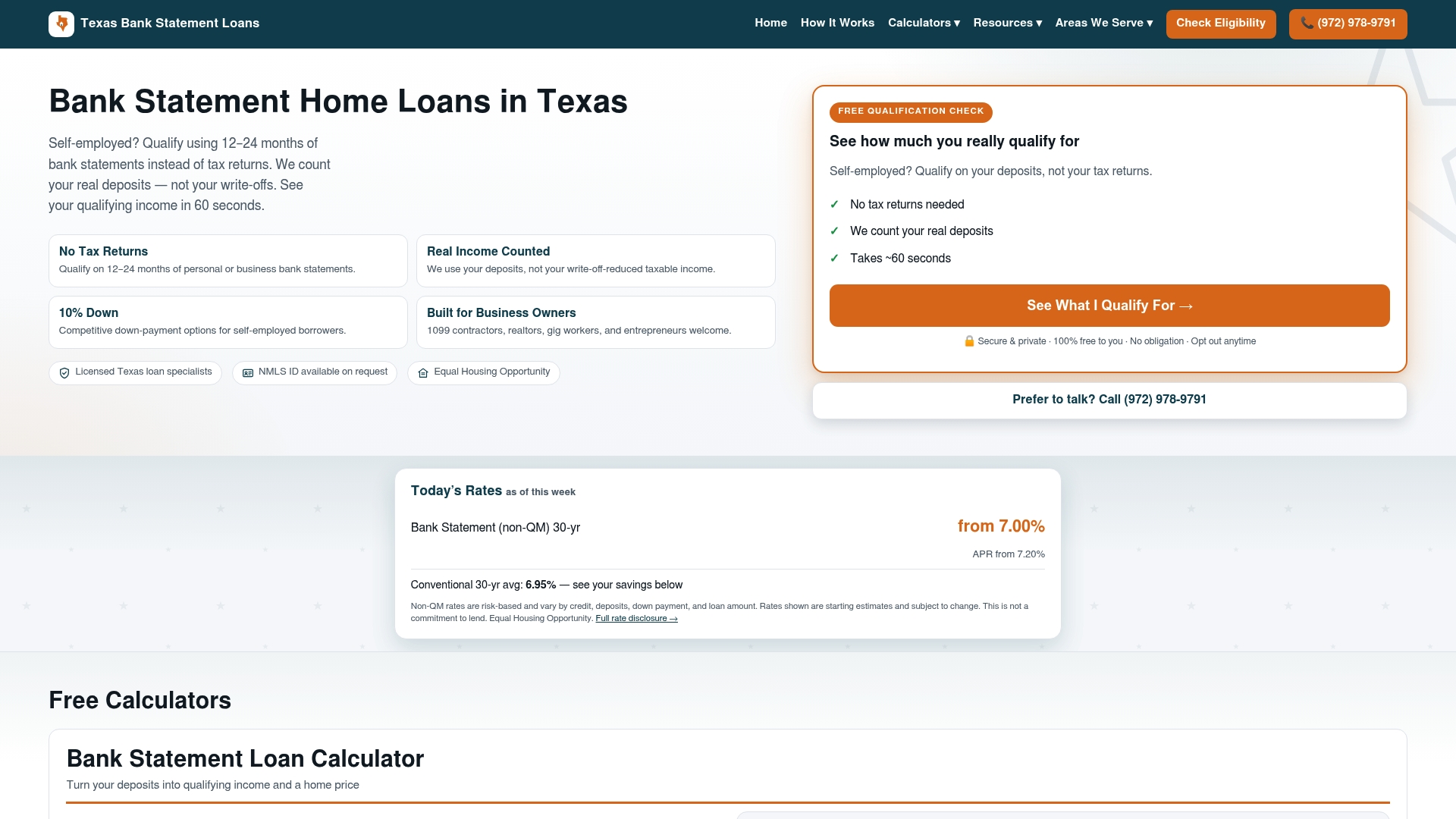
Getting started takes about 60 seconds through a qualification check that shows what you can realistically afford before you commit to a full application. From there, the process moves toward document review and rate discussion rather than a drawn-out tax-return breakdown.
If you want to see numbers before you talk to anyone, run your figures through the bank statement loan calculator or start your qualification check today to see where you stand.
Where to Verify This Information
The underwriting rules covered here come directly from agency guidance and consumer protection resources, not secondhand summaries. Fannie Mae’s selling guide on analyzing S corporation returns and its rules on Schedule K-1 income and ownership thresholds are the primary sources for how qualifying income gets calculated.
For general self-employment mortgage guidance, the CFPB’s blog on getting a mortgage while self-employed is a solid consumer resource. You can also verify any lender or loan originator through NMLS Consumer Access before signing paperwork.
This article is general information, not a substitute for advice from a qualified financial advisor. Consult a qualified financial professional about your own circumstances before acting on anything here.
Recommended
- Bank Statement Loans in Corpus Christi, TX | Self-Employed Mortgage
- Bank Statement Loans in Travis County, TX | Self-Employed
- Bank Statement Loans in San Patricio County, TX | Self-Employed
- Bank Statement Loans in Johnson County, TX | Self-Employed
See what you qualify for in 60 seconds, free and no credit check. Use the eligibility check at the top of this page.